 Joyrise
SEO for Beginners: AI, Answer Engines & Your First 90 Days
 By Alexi · · Updated · 11 min read

On this page
- What SEO for beginners means today
- How search engines (and answer engines) work in 2026
- The 3 pillars every beginner must understand
- Your first 90 days of SEO: a day-by-day framework
- Tools and tech: from free essentials to AI automation
- SEO myths that beginners still believe
- Next steps: learning resources and when to get help
- Key Takeaways
SEO for beginners in 2026 is no longer about memorizing 200 ranking factors or outsmarting an algorithm with arcane tweaks. The modern starting point sits at the intersection of three forces: AI-generated answers redefining what "a search result" even means, content automation that lets a solo operator publish like a team, and a search landscape where earning visibility in an AI snapshot can matter more than a blue link click. This guide moves past the tired "SEO basics" checklist and gives you a concrete, first-90-days action plan you can run without hiring an agency.
What SEO for beginners means today
What is SEO?
SEO—search engine optimization—is the practice of improving a website's visibility in organic (unpaid) search results. That definition, while still true, is incomplete in 2026. Today you optimize not just for Google’s traditional results but also for the AI-generated summaries and chatbot responses that are replacing click-throughs. The fundamentals of what is SEO haven't vanished, but the surface area you need to cover has expanded: you're now optimizing for answer engines, not just search engines.
The shift from blue links to answer engines
A growing share of queries never result in a click. People ask a question aloud or type it into a browser, and an AI model returns a complete answer drawn from multiple sources. As a November 8, 2026 Vocal article on answer engine optimization notes, "a few years ago, the goal of online writing was simple: get your article onto the first page of Google. Today, a growing share of people never click a single link." For a beginner, this means your SEO work must serve two audiences: the ranking algorithm and the AI model that might summarize your content into a direct answer. This shift isn’t optional—it’s the environment you’re walking into.
How search engines (and answer engines) work in 2026
Crawling, indexing, and ranking—still the foundation
Google and other search engines send bots (crawlers) to discover pages. They store copies in a massive index and then apply ranking algorithms to decide which pages appear for a query. This process remains the backbone of how to do SEO, and understanding it helps you avoid basic technical mistakes—like blocking crawlers or forgetting to submit an XML sitemap. The SEO basic principles from the Digital Experience Studio at MSU still hold: serve crawlable HTML, structure content with semantic headings, and use descriptive URLs.
AI summaries, featured snippets, and the rise of AEO
The new layer is the AI summary—often called a featured snippet or, increasingly, a conversational answer generated by models like Google’s SGE or ChatGPT. These summaries pull from top-ranking pages and cite them. The practice of answer engine optimization (AEO) aims explicitly to get your content surfaced inside these AI-generated answers. It goes beyond keyword-focused optimization and instead prioritizes answering a question directly, concisely, and authoritatively, often with structured data that helps an AI understand your content’s role.
How does Google Search work?
Google Search still works in three broad phases: crawling, indexing, and serving. Crawling discovers new and updated pages; indexing processes the page’s content, structure, and signals; serving uses over 200 ranking factors to deliver the most relevant results. In 2026, the serving step frequently includes AI summaries that synthesize content from multiple indexed pages. For you, the takeaway is: if your page can’t be crawled and indexed, it can’t rank in any form, including inside an AI answer.
What is answer engine optimization?
Answer engine optimization is the discipline of structuring and framing your content so AI models—whether inside search engines, chatbots, or voice assistants—select it as a primary source for direct answers. It differs from traditional SEO in a few concrete ways: you optimize for the question the user asks, not just the keyword they type; you format answers in a way that’s easy for an AI to lift verbatim or paraphrase; you apply schema markup like FAQ or HowTo to give the model a machine-readable version of your information. AEO is what the Vocal article from about 17 hours ago describes as a shift for bloggers and writers: you no longer need to be a technical expert, but you do need to write for machines that are reading on behalf of humans.
The 3 pillars every beginner must understand
Content that deserves to rank
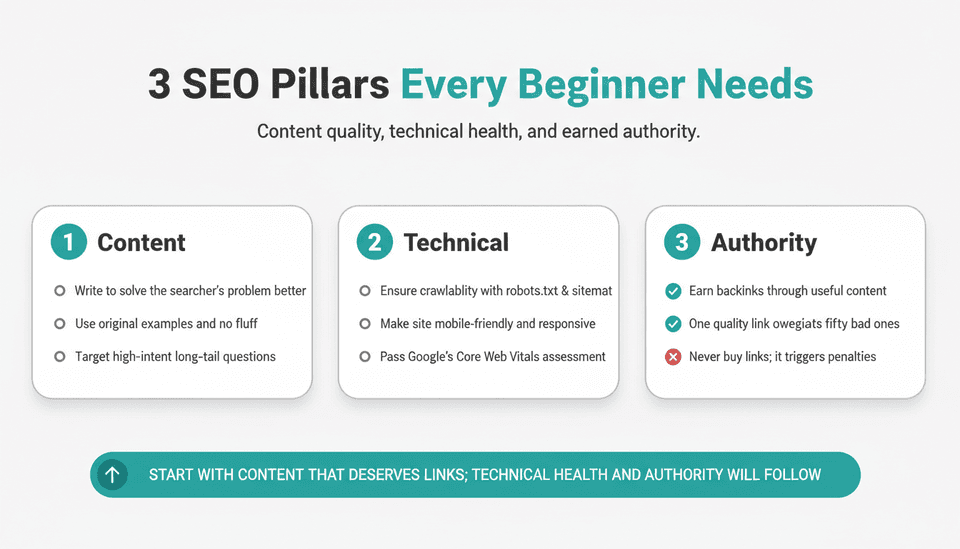
No beginner SEO guide can skip this, but here’s the compressed version: if your page doesn’t solve the searcher’s problem better than the other results, no tactic will save it. That means original information, firsthand examples, clear structure, and no fluff. For small business owners, the fastest path is often creating pages that answer high-intent, long-tail questions no competitor has addressed thoroughly—a practice at the heart of the SEO 80/20 rule.
Technical SEO without the jargon
You don’t need to be a developer, but you need three things to be right: your site must be crawlable (check your robots.txt and sitemap), mobile-friendly (responsive design), and fast enough that users don’t bounce (Google’s Core Web Vitals are a good proxy). A one-time setup in Google Search Console and your CMS gets you 90% of the way. That’s the technical foundation of search engine optimization for beginners—skip the anxiety about perfect page speed scores until you’ve published at least 30 pages.
What is a backlink?
A backlink is a link from another website to yours. Search engines treat links as editorial endorsements: when a credible site links to your page, it signals that your content is trustworthy and worth ranking. The quality of the linking site matters far more than quantity.
Should you do link building?
Sources disagree. Google’s official guidance warns against active link building, fearing it leads to spammy tactics. Many SEO resources, however, teach methods like guest posting and resource page outreach. My stance: backlinks remain crucial, but beginners should first earn them through content so useful that others cite it naturally. When you’re ready to be more proactive, use white-hat methods like writing for a reputable industry publication or fixing broken links with your relevant asset—never buy links, which can trigger manual penalties. If you’re in your first 90 days, your energy belongs on content, not outreach.
Your first 90 days of SEO: a day-by-day framework
How long until I see impact in search results?
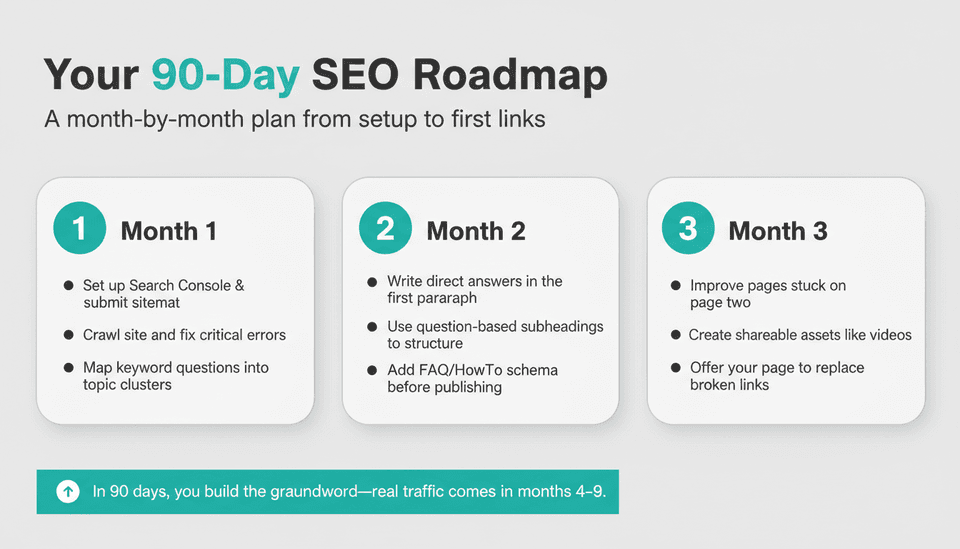
Real talk: you might see movement in 3 to 6 months, but for a new site with low domain authority, the first 90 days are about building a foundation that pays off in months 4 through 9, not about getting to page one overnight. The bulk of your early impact will be long-tail traffic from deeply specific content, not head terms. Expect gradual, compounding progress.
Month 1: Foundation and keyword research
Days 1–30 are about setup and listening.
- Day 1–3: Install Google Search Console and connect Google Analytics. Submit your sitemap. Confirm all pages are indexed.
- Day 4–10: Run a crawler audit (Screaming Frog’s free tier works) to catch status codes, broken links, and missing title tags. Fix the critical errors.
- Day 11–20: Keyword research—not a scatterplot of “search volume.” List the questions your ideal customer asks. Use free tools like Google’s “People also ask” box, AnswerThePublic, or the low-cost keyword planners. Group queries into topic clusters: one core page and several supporting pages that cover specific angles. For a deeper breakdown of keyword types, consult a types of SEO keywords guide.
- Day 21–30: Draft a 12-week SEO content strategy prioritizing the questions that have reasonable search volume (don’t obsess over the number) and low competition. Aim for a mix of short, answer-focused pieces and one pillar piece per cluster.
Month 2: Creating pages that answer high-value questions
This is where most beginners stall, because writing takes time—but you can now lean on automation. As a bonus, here are three SEO tips to keep your production on track: always write the direct answer first, use natural subheadings as mini-promises, and add schema before hitting publish. If you’re doing it manually, follow this pattern for every page:
- H1 = the primary question or topic.
- First paragraph = direct answer, in 1–2 sentences, because that’s what an AI summary might lift.
- Subheadings = related subtopics, written as natural questions when possible.
- Body = concrete examples, not generalities. If you say “SEO for small business is different,” show how: mention local landing pages, Google Business Profile optimization, and review generation.
- Schema = add FAQ or HowTo markup where applicable to strengthen your answer engine visibility.
For a faster route, an automated platform like Joyrise can scan your Webflow site, learn your brand voice, and generate illustrated, SEO-structured articles that publish directly to your blog—handling research, headings, internal links, and AEO-friendly formatting in one workflow.
Month 3: Measuring, refining, and earning your first links
- Week 1: In Search Console, identify queries where you’re on page two (positions 11–20). Improve those pages by adding a better answer, an original image, or a section addressing a closely related “people also ask” question.
- Week 2: Convert your highest-potential article into a short video, infographic, or social thread and distribute it where your audience hangs out—this becomes a natural link magnet.
- Week 3: Find 5–10 sites that link to outdated resources in your niche. Offer your page as a replacement; this isn’t a spam tactic when you genuinely have a better resource.
- Week 4: Assess growth not by total clicks but by impressions for your target topic cluster. If impressions are rising but clicks lag, your meta descriptions may need sharper hooks.
Below is a condensed 90-day checklist you can pin to your desktop.
| Timeframe | Core focus | Concrete task |
|---|---|---|
| Month 1, Days 1–3 | Technical setup | Install Search Console, Analytics, submit sitemap |
| Month 1, Days 4–10 | Health audit | Crawl site, fix errors, ensure indexability |
| Month 1, Days 11–20 | Keyword discovery | Build a question-driven keyword cluster map |
| Month 1, Days 21–30 | SEO content strategy | Prioritize low-competition, high-intent queries |
| Month 2, Daily | Production | Write or automate pages that directly answer questions, include schema |
| Month 3, Week 1 | Refinement | Improve page-two positions with better content |
| Month 3, Week 2 | Linkable assets | Turn articles into shareable formats |
| Month 3, Week 3 | White-hat outreach | Offer replacements for broken/outdated links |
| Month 3, Week 4 | Measurement | Evaluate cluster-level impression growth |
Tools and tech: from free essentials to AI automation
Do I need SEO tools?
You need a few, but not a dozen. The minimal free stack is: Google Search Console (indexing and click data), Google Analytics (traffic and behavior), and your CMS’s built-in SEO settings (like Webflow’s or WordPress’s Yoast). That’s enough for the first 30 days. For free SEO tools that go deeper, Google’s Keyword Planner, PageSpeed Insights, and Schema.org’s validator cover keywords, speed, and structured data without a credit card.
The one-time setup: Google Search Console, Analytics, and your CMS
Spend one afternoon getting these three right. Connect them, verify ownership, and set up event tracking for key actions (newsletter sign-up, demo request). After that, check Search Console weekly for new clicks and any technical warnings—that 15-minute habit will catch problems before they tank your progress.
When to consider AI writing platforms
Once you’ve validated demand for a topic and need to scale without hiring, AI SEO tools become practical. Joyrise, for example, runs deep site scans to mirror your brand voice, plans keyword clusters from competitor gaps, generates researched articles with original images, and publishes them on schedule to Webflow—consolidating research, writing, and optimization that would otherwise require three separate tools. It’s not a replacement for strategic thinking, but it collapses the production bottleneck that keeps beginners stuck in month two. If you’re evaluating full-stack platforms, a best AI for SEO writing comparison can help you weigh options.
SEO myths that beginners still believe
“SEO is dead” and other AI panic
Every time search changes, someone declares SEO dead. It evolved through featured snippets, voice search, and now AI answers. The flywheel is the same: create content that satisfies a query, make it technically discoverable, and signal its credibility. The mechanism for “ranking” inside an AI answer is just a new layer on that foundation. The Coursera SEO jobs article from November 2, 2026, shows that SEO specialist roles—including technical, local, and strategist positions—remain in demand, evidence that organizations see SEO as a growing, not shrinking, field.
“I need thousands of backlinks to rank”
Quantity is a vanity metric from a decade ago. Today, a single link from a trusted source in your niche can move rankings more than 50 low-quality directory listings. For a new site, obsessing over link count guarantees you’ll waste time on tactics that don’t move the needle. Earn the first few links by being the best answer; then, and only then, supplement with guest posting.
“Once I publish, traffic will come”
Traffic requires distribution. If you publish a new page and no one knows it exists, search engines may take weeks to crawl and index it—and even then, without any backlink signals or internal linking attention, it may languish on page five. Share each piece via your own channels, send it to relevant newsletters, and ensure it’s linked from your homepage or a key hub page. Publishing is step one; promotion is step two.
Is SEO dead?
No. What’s changing is the user interface of search—from a list of blue links to a blend of AI answers, maps, and text. Underneath that interface, search engines still need a way to determine which pages hold the right information. That system remains built on relevance, quality, and authority signals. SEO basics are more relevant than ever; they’ve just expanded to include AEO.
Next steps: learning resources and when to get help
How can I learn SEO?
Start with structured free resources that don’t overwhelm you. The SEMrush SEO basics guide covers the full stack in priority order, while LearningSEO.io provides a roadmap of reliable guides and tools. If you prefer a course-style progression, the Coursera article on learning SEO outlines a step-by-step path for 2026. For specific workflows like using ChatGPT for SEO, a ChatGPT SEO workflows guide can give you repeatable prompts.
Can I do SEO on my own?
Yes, especially if your site is a manageable size (under 100 pages) and you’re in a niche where many competitors aren’t investing in SEO. The first 90-day framework above is built for a solo operator. Where it gets hard: mid-funnel content that requires deep research, scaling beyond one post per week, or optimizing for a competitive B2B space. When your own time becomes the bottleneck, automation platforms or a specialist can accelerate the flywheel.
Key Takeaways
- Begin SEO by setting up Search Console, fixing crawl errors, and mapping customer questions into topic clusters—not by chasing link counts or chasing algorithm updates.
- Answer engine optimization is the single biggest shift for beginners in 2026: write pages that directly answer questions and use structured data so AI models can cite you.
- The 90-day framework works because it front-loads technical health and keyword discovery, then turns content creation into a production rhythm—whether done manually or automated.
- Tools are only necessary when manual effort can’t keep up; the free Google stack is sufficient for the first month, but AI writing platforms can remove the content bottleneck if you need daily publishing.
- Link building matters, but earning links through exceptional content is the beginner’s only sustainable path; white-hat outreach can follow once you have something worth linking to.
Start building your site’s organic flywheel by getting your first automated, SEO-optimized article published today through Joyrise’s daily content publishing platform.