 Joyrise
ChatGPT SEO Workflows: The Complete 2026 Guide
 By Alexi · · Updated · 15 min read

On this page
- Executive Summary: What Are ChatGPT SEO Workflows and Why Now?
- Core Concepts and Commonly Confused Terms
- The Anatomy of an Effective ChatGPT SEO Workflow
- Options, Approaches, and Tradeoffs
- Practical Implementation Framework: Your 30‑Day Rollout
- Mistakes, Myths, and Limitations
- The Future of ChatGPT SEO Workflows: Agents, Automation, and Beyond
- What exactly is a ChatGPT SEO workflow and how does it differ from simple prompt use?
- Can Google detect and penalize AI‑generated content?
- Is my company data safe when using ChatGPT for SEO?
- What is generative engine optimization and why does it matter now?
- How can I automate my entire SEO content workflow without losing quality?
- What are the real costs and tradeoffs of manual vs. automated vs. agency approaches?
- How do I maintain a consistent brand voice when scaling AI content?
- Conclusion and Next Steps
- Key Takeaways
Most people think of ChatGPT as a prompt-response tool for SEO. But a genuine approach to Chatgpt seo workflows is something else entirely: an end‑to‑end system that automates research, writing, internal linking, visuals, and publishing – so you can scale organic growth without scaling manual effort. This guide shows how to build that system in 2026, no matter your tool stack or budget.
Executive Summary: What Are ChatGPT SEO Workflows and Why Now?
A ChatGPT SEO workflow is a repeatable sequence of steps that uses large language models and supporting tools to plan, create, optimize, and publish SEO content at scale. It goes far beyond pasting a keyword into a chat window. It integrates site data, competitor intelligence, brand guidelines, automated QA, and publishing APIs – often with AI‑generated header images and infographics – to produce dozens or hundreds of articles per month without adding headcount.
Why now? Two forces make this urgent. First, generative engine optimization (GEO) is reshaping where traffic comes from: AI‑powered search like ChatGPT Search, Perplexity, and Google’s AI Overviews already answer queries directly, rewarding sites that structure content for large‑language‑model consumption. Second, manual content production simply can’t keep pace. A 2026 benchmark by Hackernoon showed an 8‑hour manual SEO workflow compressed to 15 minutes with AI, freeing strategists to work on what moves the needle. The business logic is clear: build a system once, then scale output without multiplying cost.
This guide is for operators who want that system. You’ll learn how an AI SEO workflow enables AI content generation through ChatGPT prompts for SEO, unlocking scalable SEO. We’ll define terms, walk through a 6‑step anatomy, compare manual, tool‑based, and fully automated approaches, give you a 30‑day rollout, and answer the hard questions about penalties, data safety, and brand voice.
Core Concepts and Commonly Confused Terms
ChatGPT, LLMs, and Generative AI – What’s the Difference?
- ChatGPT is a specific application (by OpenAI) built on top of an LLM. It’s the interface most people use.
- Large language models (LLMs) are the underlying neural networks that predict text. GPT‑4o, Claude, Gemini, and open‑source models are all LLMs. Your workflow should be LLM‑agnostic – different models excel at different tasks, and the best systems route the right model to the right step.
- Generative AI is the broad category that includes text, image, code, and audio generation. In SEO, it means you can produce not just articles but also branded images, infographics, and even video scripts.
When we say “ChatGPT SEO workflows,” we mean workflows orchestrated around an LLM (often ChatGPT because of its ecosystem) – but any frontier model can fill the role.
SEO Workflows vs. AI Prompts: Moving from Tactics to Systems
A single ChatGPT prompt is a tactic. An SEO content workflow is a system of interconnected steps where outputs feed into the next stage automatically. Example: a keyword gap analysis script outputs a CSV; a briefing agent reads that CSV and builds content briefs; a drafting agent writes the article; a QA agent checks for cannibalization and fact flags; a publishing API pushes it live. The leap from prompt to workflow is the difference between doing SEO and engineering growth.
Understanding Generative Engine Optimization (GEO)
GEO is the practice of making your content visible and citable in AI‑powered answer engines. It’s not a replacement for traditional SEO; it’s an additional layer. Key tactics include structuring content with clear declarative statements, using schema markup that LLMs can parse, and building topically dense resource pages. (For a deeper breakdown, see Types of SEO: AEO, GEO, and Traditional Search Explained and our ChatGPT GEO: A Practical Guide to AI Answer Visibility.) In an automated workflow, GEO rules can be baked into the drafting and optimization steps – for example, requiring each article to answer a direct question in the first 100 characters.
The Anatomy of an Effective ChatGPT SEO Workflow
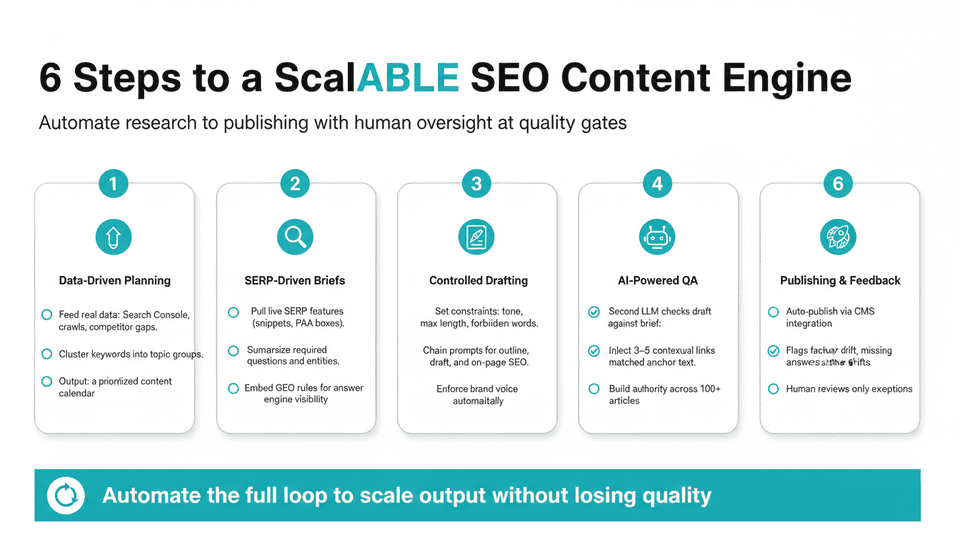
An end‑to‑end system covers six stages. At each stage, the human operator sets constraints and reviews exceptions, not every line of output.
Step 1: Data-Driven Keyword and Topic Planning
Don’t ask ChatGPT to brainstorm keywords in a vacuum. Feed it real data: your site’s Search Console queries, a crawl of your existing content, and competitor gap exports from Ahrefs or Semrush. The model’s job is to cluster thousands of keywords into topic groups and identify patterns you’d miss – like rising long‑tail queries around a product launch. A benchmark study found AI keyword clustering cut topic mapping from hours to minutes. The output is a prioritized content calendar tied to business goals, not an ad‑hoc list.
Step 2: Content Briefing with Real SERP Intelligence
A brief generated only by ChatGPT will mirror generic patterns. Instead, pull live SERP data – featured snippets, People Also Ask boxes, and page structures of top‑ranked pages – into a briefing template. The AI should then summarize what to cover, what questions to answer, and which semantically related entities to include. This is where you embed your GEO rules: “Include a direct answer box under the H2,” or “Use a three‑bullet table summarizing the main tradeoffs.” The brief becomes a quality contract that the drafting stage must fulfill.
Step 3: Drafting and Optimization with Controlled Outputs
Drafting happens via an LLM call, but you need constraints: maximum word count, required H2s, a tone-of-voice snippet from your brand guide, and a “forbidden words” list. Use a system prompt that includes those constraints and a few exemplary paragraphs from your best-performing articles. You can further chain prompts: first produce a detailed outline, then a full draft, then an on‑page optimizer that suggests meta descriptions, title tags, and internal link anchors. This is where you enforce on‑page SEO without an editor manually checking every header.
Step 4: Internal Linking and Site Structure Alignment
Internal linking automation is the most undervalued part of an SEO content workflow. After drafting, run the text against a map of your existing site content (or against a list of target page URLs and their primary keywords). The AI should inject 3–5 contextual internal links using anchor text that matches the target page’s main topic. Scale this across 100 articles, and you’ve built a lattice of topical relevance that would take a human weeks.
Step 5: Editorial QA and Quality Judgment
This step is where many workflows collapse. Publishing raw AI output is a reputation risk. A quality gate must exist, and it can itself be AI‑powered. Use a second LLM or a specialized QA agent to check the draft against the brief: Does it answer every required question? Are facts consistent with the cited sources? Are there any hallucinations about your product? The QA agent flags issues; a human reviews only the exceptions. Some platforms run this second-pass rewrite automatically, catching factual drift and tone inconsistencies.
Step 6: Publishing, Monitoring, and Iteration
Publishing should not mean copying text into a CMS. Your workflow should connect to your CMS (Webflow, WordPress, Contentful) via API or built‑in integration. For systems that support it, AI‑generated header images and infographics get attached automatically before the post goes live. Once published, track performance – clicks, impressions, average position – through Search Console. Feed that data back to the planning step: pages that rank on page 2 get a “refresh” brief automatically, closing the loop.
Options, Approaches, and Tradeoffs
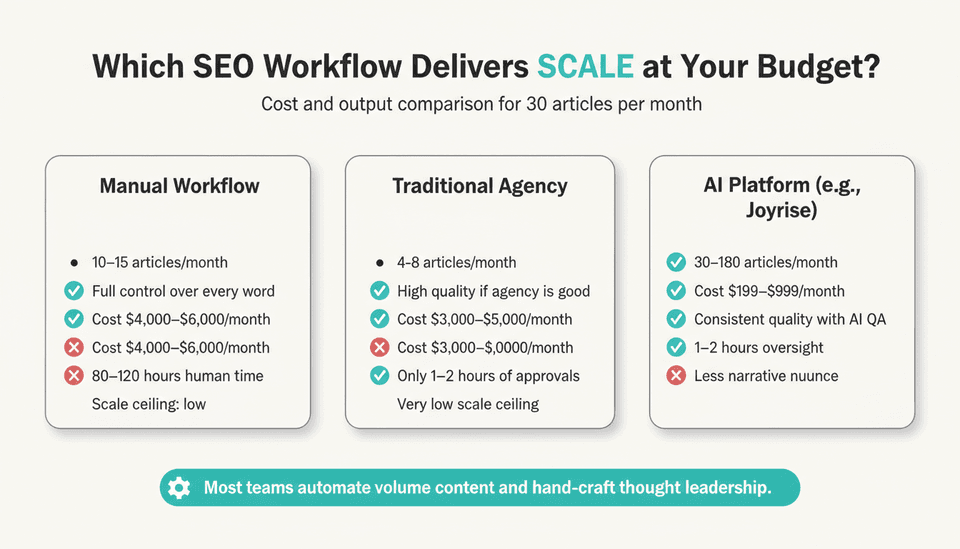
Manual ChatGPT Workflows (The Hands‑On Approach)
You open ChatGPT, paste a prompt, get a draft, then manually edit, fact‑check, add internal links, source images, and publish through your CMS.
Pros: low tool cost, full control over every word.
Cons: does not scale beyond ~8–10 articles/month per person without burnout; quality drifts as repetition sets in; no automated interlinking or performance feedback loop.
AI‑Powered Content Platforms (The Full‑Automation Approach)
Platforms like Joyrise replace the manual pipeline entirely: they scan your site to learn brand voice, plan keywords from your Search Console data, generate long‑form articles with original branded header images and infographics, inject internal links, and publish directly to Webflow – all on a schedule. A second AI stage judges quality, and an integrated dashboard tracks clicks and impressions.
Pros: 30–180 articles per month with near‑zero human touch; brand voice applied across every piece; built‑in GEO‑oriented formatting.
Cons: less granular control over individual paragraphs; recurring subscription cost; only compatible with certain CMSs (Joyrise is Webflow‑native).
Hybrid Models and When to Use Them
Many teams run a hybrid: use an automation platform for pillar content and daily blog posts, but handle high‑stakes thought leadership manually. That’s where the manual approach shines – original data studies, customer stories, or content requiring deep domain nuance. The 80/20 rule applies: automate the volume that drives long‑tail traffic, and invest human effort on the 20% of pages that build authority and convert. For more on that split, read What Is the 80/20 Rule in SEO?.
Cost Comparison: Agencies, Tools, and In‑House
A realistic, apples‑to‑apples cost‑and‑time comparison – using 2026 pricing and assuming a target of 30 publishable articles per month.
| Approach | Monthly Output | Typical Monthly Cost | Time Investment (Human) | Quality Consistency | Scale Ceiling |
|---|---|---|---|---|---|
| In‑house manual (ChatGPT + editor) | 10–15 articles | $4,000–$6,000 (salary portion + tools) | 80–120 hours | Variable; depends on editor fatigue | Low; adding more people multiplies cost linearly |
| Freelance writer + AI assist | 20–30 articles | $3,000–$5,000 | 20–30 hours (editing/coordination) | Moderate | Medium |
| Traditional SEO agency | 4–8 articles | $3,000–$5,000 | 1–2 hours (approvals) | High (if agency is good) | Very low; agencies typically cap at 8–12 articles per month for mid‑tier retainers |
| All‑in‑one AI platform (e.g., Joyrise) | 30–180 articles | $199–$999/month | 1–2 hours (spot‑checking, strategy) | High; second‑AI QA pass + brand voice model | Very high; 10 articles/day is standard on Pro/Max tiers |
| Manual hookup of 5+ SEO tools + API calls | 20–40 articles | $500–$1,200 (tool costs + compute) | 15–25 hours (writing integrations, debugging) | Moderate | High, but fragile; one API change breaks the pipeline |
The takeaway: If you need more than 10 articles a month with quality guardrails, a purpose‑built platform removes the integration overhead and drives down cost per article dramatically. Agencies still win on strategy, but not on volume execution.
Practical Implementation Framework: Your 30‑Day Rollout
This is the playbook to go from zero to a live, automated ChatGPT SEO workflow without breaking trust.
Week 1: Audit and Foundation
- Download your full Search Console query data (last 12 months) and a crawl of your site’s URLs and internal links.
- Identify 10 articles your audience actually reads – these will be your voice and structure exemplars.
- Define your “brand guide” for AI: tone adjectives, 3 forbidden phrases, sentence length preference, and an example of a perfect article.
- Choose your workflow approach (manual, hybrid, or platform). If using a platform, connect your CMS and set up the site scan.
Week 2: Pilot with Guardrails
- Select a cluster of 5–10 low‑difficulty, high‑intent keywords that are adjacent to your existing top content.
- Generate briefs and drafts with your chosen workflow. For every article, require that a human approve the final version before publish – no automatic publishing yet.
- Run the QA step: check for factual accuracy, off‑brand tone, missing internal links, and GEO compliance (did the article answer the primary question in the first paragraph?).
- Document the three most common failures. Add those as explicit rules in your prompt/system configuration.
Week 3: Scale and Integrate
- Expand to 20–30 articles. If using a manual workflow, this is where you’ll feel the ceiling – consider switching to a hybrid or platform model.
- Implement automated internal linking: map every new article to 3–5 relevant existing pages and validate the links.
- Turn on automatic publishing for articles that pass the QA gate (if your platform supports a confidence threshold, use it). Keep human review for articles targeting your top‑10 money keywords.
- Add AI‑generated header images or infographics to posts. Google’s Search Generative Experience and ChatGPT Search increasingly surface visual elements; pages with original imagery see better engagement, and AI image generation now makes this cost‑free.
Week 4: Monitor, Learn, and Optimize
- Set up a weekly Search Console dashboard – impressions, clicks, and AI‑assistant referrals (these show up in your incoming traffic logs).
- Identify the top 5% and bottom 10% of published articles by impressions after 21 days. Use an LLM to summarize common shortcomings in the bottom group and feed those insights back into the briefing template.
- Run a crawl of your site to ensure no broken internal links and no orphan pages created by automation. Adjust your workflow accordingly.
Mistakes, Myths, and Limitations
Myth: AI Content Gets Penalized by Google
Google has stated repeatedly (most recently in their March 2024 core update guidance and subsequent Search Central posts) that they don’t penalize content merely for being AI‑generated; they penalize low‑quality, unhelpful content created at scale to manipulate rankings. If your workflow produces pages that satisfy user intent with original value, you’re within guidelines. Many top‑ranking articles now use AI in their production. The risk isn’t the tool; it’s skipping human editorial oversight.
Mistake: Skipping the Human Quality Gate
Even the best LLM drafts can contain statistical falsehoods, off‑brand phrasing, or outdated claims. The single most damaging move is publishing articles without a human review step, even if brief. For volume content (30+ articles/month), the review can be a 30‑second scan of the QA report and a spot‑check of the first paragraph and any data claims. Without this gate, expect factual errors that erode trust – and yes, Google notices.
Limitation: ChatGPT’s Knowledge Cutoff and Factual Reliability
The free and standard versions of ChatGPT still have a knowledge cutoff (most models as of late 2025 know events only up to early 2025). If your niche involves fast‑changing regulations or recent events, you must inject fresh data from APIs or a search‑augmented retrieval step. Some platforms pull in news‑driven context automatically, but manual workflows need a web‑search plugin and a fact‑checking layer.
The Data Privacy Question: Is Your Company Data Safe?
When you paste proprietary data into ChatGPT’s web interface without opting out of training, assume it can be used to improve the model. For sensitive company information – product roadmap details, customer data, internal metrics – use API access with zero‑data‑retention policies (where the provider doesn’t store requests), or work through a platform that processes your data in a privacy‑compliant manner. Never feed raw customer PII into a public chat interface.
The Future of ChatGPT SEO Workflows: Agents, Automation, and Beyond
From Prompts to AI Agents: What’s Next?
The next phase is autonomous AI SEO agents that monitor your Search Console daily, detect a ranking drop, generate a new content brief, write and publish an updated article, and run A/B tests on metadata – all without a human trigger. Early implementations exist (the 2026 SEO automation tools landscape lists several agent‑style platforms). The workflow you build today should be designed for that upgrade: modular steps connected by APIs, so you can swap in smarter models or agents later.
The Role of AI Images and Visual Content
Visuals are no longer optional. ChatGPT Search and Google’s AI overviews often display images alongside text answers, and image thumbnails in search results increase click‑through rates. An automated workflow that generates unique branded header images (and simple infographics) for every article provides a double advantage: a better user experience and stronger visual signal in AI‑powered search results. This is something a standalone ChatGPT text prompt cannot do, but that end‑to‑end platforms now handle natively.
What exactly is a ChatGPT SEO workflow and how does it differ from simple prompt use?
A ChatGPT SEO workflow is a connected series of steps where a language model – used as one engine among many – automates the entire SEO content production chain. Simple prompt use, in contrast, is a one‑off interaction where a human types a request, gets an output, and then manually does all the rest: research, fact‑checking, formatting, linking, image sourcing, and publishing. The workflow’s defining trait is that it removes repetitive human decisions and manual handoffs, so one person can oversee 30+ articles a month instead of 5.
Can Google detect and penalize AI‑generated content?
Google can detect patterns associated with machine‑generated text, but detection doesn’t trigger a penalty. Their public guidance focuses on the content’s helpfulness and originality. AI‑generated content that is fact‑checked, tailored to a specific audience, and part of a site that otherwise shows expertise performs just as well as human‑written content in ranking studies. What gets penalized is mass‑produced fluff with no added value. As long as your workflow includes a quality gate and aligns with E‑E‑A‑T principles, you are safe.
Is my company data safe when using ChatGPT for SEO?
It depends entirely on how you use it. Never paste customer data, financial figures, or product secrets into a consumer chat interface that retains training data. Use API integrations with zero‑data‑retention (OpenAI’s API offers this), or adopt a platform that processes your content privately and doesn’t feed it back into public models. The risk is real: a 2023 incident saw Samsung employees inadvertently leak proprietary source code via ChatGPT. Treat your SEO content data with the same caution as any other business IP.
What is generative engine optimization and why does it matter now?
Generative engine optimization (GEO) is the set of practices that make your content easily understood and cited by AI‑powered answer engines like ChatGPT Search and Google’s AI Overviews. It matters now because these engines are already driving a measurable share of organic traffic – and early adopters who structure content for LLM consumption are getting cited in answers that used to lead to traditional blue links. For a deeper tactical dive, see our SEO for ChatGPT Search: The 2026 Definitive Guide. An automated workflow can bake GEO rules into every article by mandate: direct answers early, question‑based H2s, and factual snippets that an LLM can extract cleanly.
How can I automate my entire SEO content workflow without losing quality?
Automation without quality loss requires three pillars: a clear brief that the AI must satisfy, a second AI pass for quality judgment, and a human exception‑review loop. For example: an LLM drafts the article; a different LLM (or a fine‑tuned quality model) checks it against the brief and flags issues; a human reviews only the flagged articles and a random sample of 10%. This “AI‑QA‑human” sandwich prevents fatigue errors at scale. Add automated internal linking that cross‑references your site map, and schedule periodic crawls to catch breakage. Most quality loss happens when teams skip the QA pass and publish raw output.
What are the real costs and tradeoffs of manual vs. automated vs. agency approaches?
The table in the Options section above lays out concrete numbers for a 30‑article‑per‑month target. In summary: manual approaches cost $4k–$6k and top out quickly; agencies deliver few articles for the same cost; automated platforms cost $200–$1,000/month and produce volume with consistent quality but less narrative flair. The tradeoff is creative artistry vs. predictable output. For most businesses, a hybrid works best: automate the “answer” content (how‑to, glossary, comparison) and hand‑craft the thought leadership.
How do I maintain a consistent brand voice when scaling AI content?
Consistency comes from encoding your voice as a structured configuration, not a vague instruction. Take 3–5 articles your team considers perfect. Extract stylistic patterns: average sentence length, use of first‑person vs. third‑person, rhetorical question frequency, typical intro structure. Feed these into a “voice profile” – a set of explicit constraints like “Use contractions,” “Never use ‘leverage’ as a verb,” “Address the reader as ‘you’.” In an automated workflow, every draft passes through the voice profile as a system prompt or post‑processing filter. No human writer will hit it perfectly 100 times, but a configured model will.
Conclusion and Next Steps
ChatGPT SEO workflows are no longer experimental. They’re the operating system for content teams that need to move fast, cover topical gaps, and appear in both traditional search and AI‑driven answer engines. The difference between a scattershot prompt habit and a disciplined workflow is the difference between 5 articles a month and 50, with quality that holds.
Start by auditing what’s already working on your site, define your voice, and choose the workflow option that matches your volume and budget. Then run a 4‑week rollout with human gates until you trust the system. The organizations winning organic traffic in 2026 aren’t writing more – they’re engineering smarter production loops.
Key Takeaways
- A true ChatGPT SEO workflow automates the full loop – research, briefing, drafting, QA, internal linking, images, and publishing – not just text generation.
- Human oversight is non‑negotiable; a second AI quality pass catches most errors, but a human must still review flagged content.
- Automated internal linking and AI‑generated images are the two most overlooked levers for scaling SEO without manual effort.
- Cost per quality article collapses when you move from manual or agency models to an integrated platform, but at the tradeoff of narrative nuance for consistency.
- GEO readiness – structuring content for AI answer engines – must be baked into your workflow’s briefing and formatting rules from day one.
Ready to see an automated content marketing workflow in action? Try Joyrise and read your first daily illustrated article before you pay.