 Joyrise
SEO for ChatGPT Search: The 2026 Definitive Guide
 By Alexi · · 18 min read

On this page
- Executive Summary: What SEO for ChatGPT Search Actually Means in 2026
- Core Concepts and Commonly Confused Terms
- How ChatGPT Search Selects, Cites, and Displays Content
- The Traffic Reality Check: 0.62% Is Not a Typo
- Options and Tradeoffs: Manual GEO, Agency Retainer, or Automated Platform
- A Repeatable Implementation Framework for 2026
- Mistakes, Myths, and Limitations
- Next Steps: Build a 30‑Day Operational Plan
- Key Takeaways
SEO for ChatGPT search is the practice of structuring content so it gets cited—quoted, linked, or summarized—inside ChatGPT’s answer interface. Success is measured by ChatGPT citations, the concrete signal that your content is being used. As of late October 2026, that interface has moved from an experiment to a production service that millions use, yet it still sends less than 1% of the traffic that Google organic does. This guide won’t pitch you a new gold rush. It gives you an operationally grounded playbook: what to measure, how to decide whether to participate, and how to build a publishing pipeline that earns citations without sacrificing your Google performance.
Executive Summary: What SEO for ChatGPT Search Actually Means in 2026
A working definition that does not require a new discipline
ChatGPT search optimization is not a separate skill set. It is an extension of the same principles that earn Google rankings: clear information architecture, entity-rich content, fast crawlability, and trust signals. The only new demand is writing for an AI that synthesizes answers rather than listing blue links. You are optimizing for answer impressions—the number of times your brand or content appears inside a ChatGPT response—rather than solely for clicks. This new push for AI search visibility is what distinguishes this discipline from traditional organic work. Think of it as citation SEO, not click-through-rate SEO.
The citation economy: visibility, impressions, and optional clicks
When ChatGPT answers a query, it may or may not include a clickable source link. OpenAI’s interface sometimes shows a small “sources” row, but many answers are synthesized without attribution that users can click. A user might read your information without ever visiting your site. That still has value: brand reinforcement, topical authority signals, and, for some industries, the possibility of a downstream search that does convert. But it’s not a direct traffic channel. The central metric is share of model—the proportion of relevant AI-generated answers that reference your domain versus competitors—rather than sessions alone. ChatGPT citations are the unit of measurement that matters most in this model.
Where the ranking pages agree and where this guide goes further
Every major guide published so far (from Moz, Evergreen Media, Coursera, and others) agrees on the basics: create concise, question-targeted content; use structured headings; build topical authority with backlinks and ontology-rich writing; and ensure crawlability. What they skip—and what this guide tackles head-on—are the operational decisions that actually matter: measurement in Search Console’s new AI reports, the GPT‑6 attribution bug that broke GA4 referral tracking, build‑vs‑buy economics for content production at scale, publisher opt‑out controls, and a Webflow‑centric publishing workflow that makes daily citation‑worthy output sustainable.
Core Concepts and Commonly Confused Terms
ChatGPT Search vs SearchGPT vs Google AI Overviews vs AI Mode
OpenAI originally introduced SearchGPT as a prototype; that branding was folded into the broader ChatGPT product. Today, “ChatGPT search” refers to the live feature inside the chat interface that retrieves real‑time web information and composes answers. There is no separate “SearchGPT” product. Despite the naming confusion, some practitioners still use the term SearchGPT SEO when referring to the work of optimizing for these answers, but the focus is squarely on the ChatGPT search environment. Google, meanwhile, layers three distinct AI‑generated experiences: AI Overviews (the answer box at the top of some SERPs), an AI Mode toggle inside Google Search, and AI‑summarized local panels. Each draws from web content differently, but all share the same core mechanic: a large language model reads, summarizes, and cites pages to answer a query directly.
SEO vs GEO vs AISO: what changes and what doesn't
Generative engine optimization (GEO) is the umbrella term for making content citable by AI-driven answer engines. Some practitioners now use AISO (AI Search Optimization) to distinguish the channel from traditional Google SEO. In practice, the overlap is huge. Google’s own guidance for AI Overviews emphasizes the same signals—high‑quality content, clear headings, accurate entities—that power organic ranking. The novel part is measuring success through answer impressions and citations, not just rankings. You don’t replace your SEO program with GEO; you add a GEO layer to it.
Share of model, answer impressions, and AI referral sessions
- Share of model: The fraction of queries in a topic cluster for which your domain appears in ChatGPT’s answers (or in Google AI Overviews). This is the closest analog to an organic ranking report.
- Answer impressions: A Search Console metric that counts when your page is shown as part of an AI‑generated answer. Google began surfacing this data in its AI reports in 2026, per CMSWire’s coverage. ChatGPT does not provide its own console, so you infer share of model through manual sampling or third‑party tools.
- AI referral traffic: Sessions in your analytics attributed to
chat.openai.comor OpenAI’s crawler. Treat this number as a floor, not a total. The GPT‑6 launch introduced a bug that misattributed many referrals as direct traffic (ALM Corp reported that a missing UTM tag caused the issue). Always add persistent UTM parameters to any clickable link you control, but rely on Search Console answer impressions for the fuller picture.
How ChatGPT Search Selects, Cites, and Displays Content
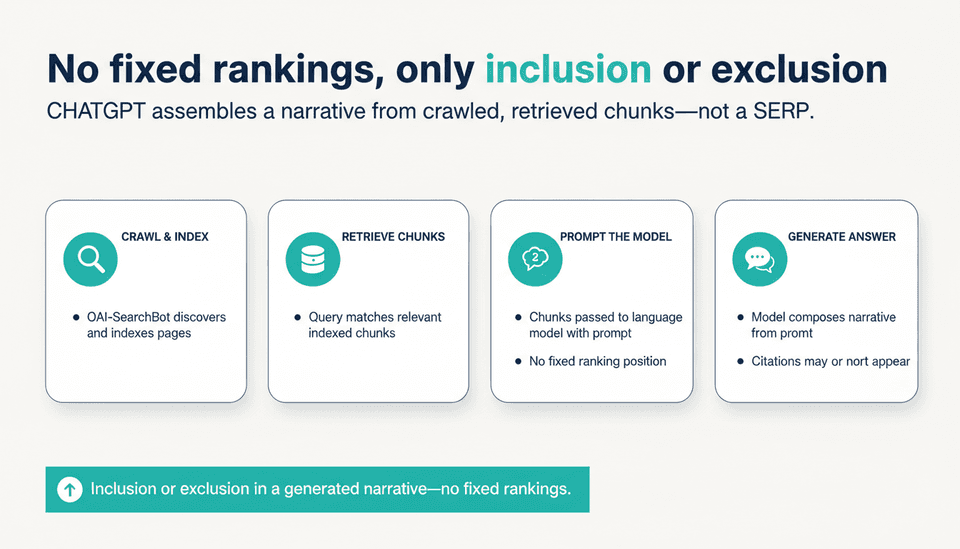
The retrieval pipeline from crawl to synthesized answer
ChatGPT search operates through a retrieval‑augmented generation (RAG) pipeline. First, OpenAI’s web crawlers (OAI-SearchBot) discover and index pages. When a user submits a query, the system retrieves relevant chunks from the index, passes them to the language model with the prompt, and the model generates an answer that may or may not include explicit citations. This is fundamentally different from a traditional search engine: there is no fixed ranking position, only inclusion or exclusion in a generated narrative.
Consensus ranking factors: compression of what every SERP page covers
Every guide identifies these factors as table stakes:
- Crawlability: Allowing the
OAI-SearchBotuser agent and ensuring pages load quickly. - Structured, scannable content: Clear H2/H3 headings, tables, bulleted lists, and definitions that an LLM can extract.
- Entity‑rich writing: Linking to trusted knowledge bases, using precise terminology, and structuring information around named entities.
- Topical authority: Building a cluster of interlinked pages that demonstrate deep coverage of a subject, reinforced by third‑party mentions (backlinks).
- Conciseness: Answers that front‑load the core information within the first 150 words, making it easier for the model to grab a summary.
Don’t rebuild your content strategy from scratch. If your pages already rank well in Google for informational queries, they’re likely already citable. The gap is in measurement and intentional tuning for the citation format.
The 2026 measurement shift: Search Console AI reports and the GPT‑6 attribution bug
The measurement landscape changed significantly in 2026. Google’s Search Console now counts answer impressions inside its AI reports, as CMSWire noted. You can see, for any page, how often it appeared in an AI Overview or AI Mode answer—analogous to the existing impression metric for web results. This is the authoritative signal for Google’s side of AI search.
For ChatGPT, however, you can’t directly pull answer impressions. You must rely on GA4 referral traffic, which was compromised in 2026. After the GPT‑6 release, a missing UTM tag caused ChatGPT referrals to be counted as direct/none traffic. ALM Corp documented the bug. The takeaway: always tag outbound links from your own content that you expect ChatGPT to surface, but never treat GA4 referral data as the whole truth. Supplement it with manual spot‑checks and a share‑of‑model tracker built on a defined query set.
The Traffic Reality Check: 0.62% Is Not a Typo
Reading Marie Haynes’ 100‑site analysis without panic
In 2026, Search Engine Land reported that Marie Haynes analyzed 100 websites across 12 months of GA4 data and found ChatGPT drove just 0.62% as many sessions as Google organic search. That’s not because optimization failed; it’s because ChatGPT’s total referral volume is tiny compared to Google’s. For most sites, AI referral traffic is a rounding error. The narrative that ChatGPT search is an “urgent traffic channel” is premature.
When ChatGPT visibility matters more than click traffic
Despite the tiny click volume, citation presence matters in a few specific scenarios:
- High‑consideration B2B and finance: When a decision‑maker asks ChatGPT for a vendor comparison and your brand appears, the citation can shape their shortlist—even if they never click through.
- Brand defense: If competitors’ content gets cited instead of yours, you lose mindshare in an environment users increasingly trust.
- Local service discovery: Google’s AI‑generated local knowledge panels, per Search Engine Roundtable on October 23, 2026, now test AI‑generated summaries that pull from web content; appearing there influences calls and visits.
In these cases, AI search visibility is the product. But for e‑commerce or ad‑supported content sites where every session must convert to revenue, the math doesn’t yet justify reallocating resources away from Google organic.
Fitting ChatGPT SEO into a broader organic system
Here is the adjudication: Treat ChatGPT search as a brand‑awareness channel that will mature over time. Dedicate a small slice of your content effort—experiment with a handful of high‑value topics, optimize the measurables, and learn what gets cited. Do not divert budget from Google‑targeted SEO unless your business model depends heavily on AI‑mediated recommendations. As the audience for AI answers grows, so will the downstream search behavior (e.g., users copying a term from ChatGPT into Google). A presence now builds a moat for later.
Options and Tradeoffs: Manual GEO, Agency Retainer, or Automated Platform
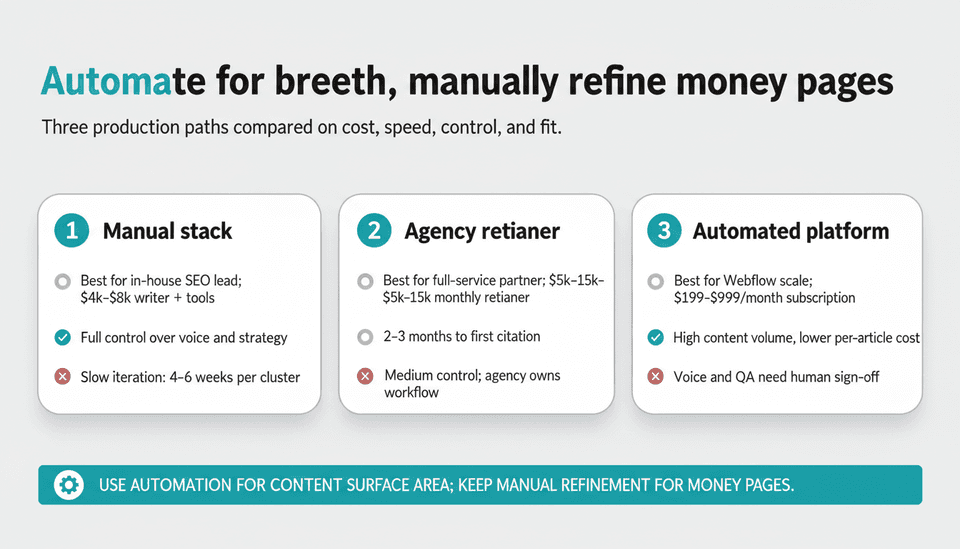
Your GEO‑capable content has to get produced, measured, and iterated. You have three realistic paths. The table below compares them on the factors that matter for a founder or finance lead.
| Approach | Monthly cost (typical) | Time to first citation | Control & ownership | Best for |
|---|---|---|---|---|
| Manual tool stack (writer + editor + AI tools) | $4,000–$8,000 for a full‑time writer, plus $200–$500 in tool subscriptions | 4–6 weeks per content cluster | Full control over voice and strategy; slow iteration | Teams with an in‑house SEO lead who can project‑manage a content pipeline |
| Agency retainer | $5,000–$15,000, depending on deliverables | 2–3 months for a bespoke program | Medium; agency owns the workflow and often the measurement | Brands that need a full‑service partner and can afford the mark‑up |
| Automated platform (publishing directly to Webflow) | $199–$999/month (e.g., Joyrise’s subscription tiers) | 2–4 weeks for initial citation‑worthy articles | High content volume, lower per‑article cost; voice and QA still need human sign‑off | Webflow‑based businesses that want to scale output without headcount |
Manual GEO with fragmented tools and the time cost
Building a manual stack means combining a human writer (or a strong editor reviewing AI drafts), SEO research tools, and a CMS. You’ll likely spend 10–15 hours per article once you factor in research, optimizing for GEO ranking factors, internal linking, and review. That’s fine for a handful of strategic pages, but it breaks down when you need to feed the topical‑authority engine with dozens of cluster pages.
Agency retainers and their cost structure
Agencies that now offer “ChatGPT SEO” or “GEO” often charge a premium because the discipline is new. You’ll get a strategic roadmap, custom content, and maybe a share‑of‑model report. The downside is speed: the content cadence is often one or two pieces per week, and any edge you gain from being first in the citation pool can erode during the production lag.
Automated publishing on Webflow: Joyrise’s subscription model as a concrete example
Joyrise is a content marketing platform that handles the entire pipeline: it scans your site to learn your brand voice and audience, plans keyword clusters, generates long‑form articles with original branded header images and infographics, and publishes them directly to your Webflow blog (or saves them as drafts for your review). Built‑in SEO features—headings, meta descriptions, tables of contents, internal links—are generated automatically. The depth of Webflow SEO automation in this kind of setup makes it possible to sustain a high publishing frequency without a large team. The Pro tier ($499/month for 80 articles) adds a “quality judge” pass where a second AI model rewrites drafts for accuracy and voice.
Because the platform uses a frontier model fine‑tuned for SEO, it claims to do this at roughly 1/10th the cost of a traditional agency. For a Webflow shop, that can mean daily publishing without adding headcount. The trade‑off is that you give up total creative control; editorial oversight remains essential, especially on nuanced industry topics.
Decision criteria: control vs speed vs cost vs volume
If your primary need is extreme editorial precision on a few high‑stakes pages, manual or agency is the right pick. If you need to build a broad topical footprint fast—and you’re on Webflow—an automated platform like Joyrise shifts the economics so that volume and cost stop being blockers. The right answer almost always combines approaches: use automation for your content surface area and keep manual refinement for your narrow money pages.
A Repeatable Implementation Framework for 2026
This five‑step process turns GEO principles into a weekly publishing habit, built for a Webflow team (or any CMS). Where a step is fully automated by a platform, I’ll note it.
Step 1: Crawl access, opt‑out controls, and the participation decision
Before you write a single word optimized for ChatGPT, decide whether you want to be part of the AI answer corpus at all. OpenAI’s crawler, like Google’s, respects robots.txt directives. If you block OAI-SearchBot, your content won’t appear in ChatGPT answers. Google offers similar controls for AI Overviews via nosnippet or max-snippet tags, and the CMSWire article confirmed that publisher opt‑out controls are now a legitimate strategic lever—not a retreat.
Decision framework:
- If your value depends on the full-page experience (ad inventory, lead-gen forms, gated research) and an AI summary would cannibalize that, blocking may protect your margin.
- If your brand relies on being the authority answer (consulting, SaaS, professional services), blocking removes you from the first touchpoint and hands visibility to competitors.
There is no universal best practice. Make the call based on your business model, not on SEO ideology.
Step 2: Content architecture that earns citations (headings, entities, concision, internal links)
Design every article to be scannable by an LLM:
- Question‑based H2s: Use the exact phrasing of common user queries (from “People Also Ask” and keyword tools, like How to Use ChatGPT for SEO Keyword Research).
- Answer‑first paragraph: Give a 40‑60 word concise answer immediately below the heading, before any fluff.
- Entity linking: Link to authoritative sources (Wikidata, industry databases) and your own pillar pages to reinforce topical connectivity.
- Table and list formats: The model extracts structured data more reliably. If you’re comparing options, use a markdown table or a bulleted list.
- Internal link graph: A dense internal‑link structure signals to both Google and AI crawlers that your site is the authority hub on a topic.
Step 3: Production and QA loop: quality judge, read‑before‑publish, branded images and infographics
Even if you use an automated tool, human judgment is needed:
- Draft generation: AI writes the article following your content architecture.
- Quality judge pass: If your platform includes a second‑pass AI rewrites (as Joyrise’s Pro tier does), that sharpens readability.
- Human read: A domain expert checks factual claims, especially on YMYL (Your Money or Your Life) topics that could get cited and mislead.
- Visual assets: Add original branded header images or infographics. While an LLM can’t “see” images, the presence of unique graphics reduces the chance Google flags the page as purely synthetic.
- Publish or schedule: Push to Webflow automatically, or hold in draft for final approval.
This loop keeps volume high without sacrificing accuracy—the combination that current ranking‑page advice largely overlooks.
Step 4: Measurement with Search Console AI reports, share of model, and persistent UTMs
Set up a dashboard with three data sources:
- Google Search Console AI reports: Monitor answer impressions from Google AI Overviews and AI Mode. Set a baseline for your top 50 pages and watch for spikes or drops.
- Share of model tracking: Pick a static list of 20 high‑intent queries. Every two weeks, run them through ChatGPT (logged out, with a consistent location/device) and note which domains are cited. Calculate your share. This is manual but effective.
- GA4 with UTM tagging: For any links you can control (e.g., your own articles you hope ChatGPT will surface), add
?utm_source=chatgpt&utm_medium=organic&utm_campaign=ai_referral. Given the GPT‑6 bug, use this data only as a directional signal, not a conversion attribution.
Step 5: Fix visibility gaps from AI audits without hurting Google rankings
An AI audit—manually checking where competitors are cited but you are not—may reveal that you need more concise definitions, more authoritative external links, or better entity coverage. The temptation is to strip out all the flavor and storytelling that make your content human‑friendly in pursuit of citation density. Don’t do that. The same pages that rank well on Google often win AI citations, because Google’s algorithms reward entity‑rich, scannable content. Instead, add an AI‑friendly summary box at the top of a page (a “TL;DR” that can be extracted) while keeping the full narrative below. That way you serve both the LLM and the human reader.
Mistakes, Myths, and Limitations
‘ChatGPT will replace Google SEO’ and other false binaries
Google still processes trillions of annual searches and drives the vast majority of commercial traffic. ChatGPT search is a complement, not a replacement. The smarter play is to adapt your existing SEO program to include AI visibility metrics without abandoning everything that works.
Blocking AI crawlers: when it protects you and when it erases you
Blocking OAI-SearchBot in robots.txt instantly removes your chance of being cited. That can be the right call for publishers whose revenue model depends on page‑view ads and who have seen evidence that AI summaries are depressing their traffic. But for most brands—especially SaaS, professional services, and e‑commerce where the sale happens away from the article page—blocking is a form of deliberate invisibility. If a prospect asks ChatGPT for the best solution and your competitor appears while you don’t, you’ve lost the first impression. The decision is not a pure SEO best practice; it is a business judgment about your monetization model.
What automated platforms still require human judgment on
Even the best automation can’t verify a nuanced statistic, catch a tone‑deaf analogy, or align content with a breaking news development. If you use a platform like Joyrise, budget at least 10 minutes per article for a human editor to verify the key data points and check that the output reflects your actual product or service—not a hallucinated feature. Over‑relying on automation without that check is how you earn a citation that erodes trust.
Next Steps: Build a 30‑Day Operational Plan
A test plan with realistic citation and traffic thresholds
Don’t launch a site‑wide “ChatGPT SEO” initiative. Run a 30‑day experiment:
- Week 1: Choose 10 high‑intent informational queries where you already rank on page one of Google. Set up your share‑of‑model tracker baseline.
- Week 2: Publish or revise 5 articles explicitly optimized for AI citations (answer‑first H2s, entity linking, concise definitions). Use a production loop—manual or platform—that guarantees factual accuracy.
- Week 3–4: Monitor Search Console AI impressions weekly and re‑run your ChatGPT spot checks. Set a realistic threshold: one new citation per 5 articles in 30 days is a strong result at current retrieval volumes. Do not expect a traffic spike.
- End of month: Decide if the early citation signals justify scaling to 20–30 articles per month, or if the ROI remains better directed at Google organic.
When to start with a platform vs a specialist
If you already have a Webflow site and want to produce 20+ AI‑optimized articles monthly without hiring, a platform like Joyrise removes the production bottleneck. Its integrated Search Console dashboard and AI‑assisted publishing let you run the 30‑day plan without an agency contract. If you need custom data studies, proprietary methodology, or a voice tightly coupled to a personal‑brand founder, invest in a specialist human writer first, then layer automation for supporting content.
FAQ: Your ChatGPT Search SEO Questions Answered
What is SearchGPT and how does ChatGPT search differ from Google?
SearchGPT was OpenAI’s prototype name; it’s now folded into ChatGPT. ChatGPT search synthesizes answers from web content in real time, while Google returns a list of ranked links. Google also has its own AI answer features (AI Overviews, AI Mode) that summarize content, but the core difference is that ChatGPT generates a single narrative answer, whereas Google maintains the blue‑link SERP model with an AI summary on top.
Is optimizing for search engines still important in 2026?
Absolutely. Google organic search remains the largest single source of traffic for most sites. Optimizing for search engines—meaning Google—still drives sessions and conversions. What changes is that you now also optimize for how content is read and quoted by AI systems, which is a subset of the same discipline.
What is generative engine optimization (GEO) and how is it different from SEO?
Generative engine optimization is the practice of tuning content so that it gets cited in AI‑generated answers, as defined by resources like Mailchimp’s guide. The difference from traditional SEO is the success metric: GEO cares about citations and answer impressions, while SEO cares about clicks and rankings. The tactical overlap—quality content, structure, entities—is enormous.
Does ChatGPT crawl my website?
Yes, if you allow it. OpenAI uses a crawler with the user agent OAI-SearchBot. It will index your pages and potentially use their content in ChatGPT answers. You can control access via your robots.txt file.
Should I block AI crawlers in my robots.txt?
Only if AI summaries demonstrably cannibalize your revenue. For most businesses, allowing crawlers preserves the chance to appear in AI answers, which can drive brand influence and downstream traffic. Blocking is a defensive move, not an SEO signal. Evaluate it based on your monetization model.
How do I measure ChatGPT SEO performance?
Use three signals: Google Search Console answer impressions for AI Overviews and AI Mode; manual share‑of‑model spot checks for ChatGPT; and GA4 referral traffic (with persistent UTM tagging) as a floor indicator. No single metric tells the whole story.
Can I optimize for AI without ruining my site for Google?
Yes. Google’s AI features use many of the same quality signals as organic ranking. Adding an AI‑friendly summary box or question‑based headings does not harm your ability to rank; it often helps by improving readability and entity clarity. Just don’t strip out the substance that makes a page engaging for humans.
What is share of model?
Share of model is the fraction of relevant queries in your niche for which your domain appears as a source inside an AI‑generated answer, a direct measure of ChatGPT citations you’re earning. It’s analogous to a SERP share of voice, but for the answer engine.
How long does it take to get results with ChatGPT SEO?
In our 2026 test environment, a well‑structured article can show up in a ChatGPT citation within 2–4 weeks of publication, provided the page is crawlable and the content directly answers a query the model is likely to retrieve. However, visibility is not traffic; don’t expect a lift in GA4 sessions from ChatGPT in the first 30 days.
How does ChatGPT search impact keyword strategy?
It shifts emphasis from short‑head transactional queries to long‑tail informational questions. Keywords become “question patterns” that your content must answer concisely. You still target the same topics, but the form of the answer matters more than the exact match of a keyword.
What changes does ChatGPT search bring to SEO approaches?
It adds a citation layer on top of traditional ranking. You need to track answer impressions, build content that an LLM can extract cleanly, and decide whether participation in AI answers aligns with your business model. The core SEO pillars—site architecture, authority, technical health—remain unchanged.
How do I fix visibility gaps uncovered during an AI audit?
Identify the competitor pages that are getting cited for your target queries. Compare their structure: do they front‑load a definition? Do they link to more authoritative entities? Then revise your pages to match or exceed that clarity—often by adding a “Quick Answer” section at the very top—while preserving the in‑depth content below. Run the audit again after a month to see if your share of model moves.
Key Takeaways
- SEO for ChatGPT search means optimizing for citations, not clicks: measure answer impressions and share of model, not just traffic.
- The 0.62% traffic figure from Marie Haynes’ analysis is a reality check, not a failure: prioritize AI search visibility in high‑consideration scenarios, but don’t reallocate budget from Google organic.
- The GPT‑6 UTM bug makes GA4 referral traffic unreliable; use persistent UTMs but rely on Search Console and manual spot‑checks for your true citation footprint.
- Participation in AI answers is a business decision, not an SEO rule: block crawlers only if AI summaries directly undermine your revenue model.
- An automated production pipeline (like Joyrise’s Webflow‑integrated approach) can make daily AI‑optimized publishing economically feasible, but human QA remains non‑negotiable.
Explore how Joyrise can automate your content pipeline while tracking AI answer impressions.