 Joyrise
What Is the 80/20 Rule in SEO?
 By Alexi · · 10 min read

On this page
What is the 80/20 rule in SEO? It is the observation that roughly 80% of measurable organic search results—traffic, leads, revenue—come from about 20% of your pages. It’s a pattern, not a law. A handful of assets do the heavy lifting while most pages contribute modestly or not at all. For founders and finance leads, the rule forces a simple question: are you spending time and budget on what actually moves the needle?
What Exactly Is the 80/20 Rule in SEO?
The Pareto Principle in plain terms
The Pareto principle states that a small number of inputs produce a disproportionate share of outputs. In a business, 20% of customers often generate 80% of revenue. In SEO, it’s common to see 20% of landing pages bring 80% of organic conversions. This is the Pareto principle SEO pattern that gets cited constantly—and for good reason. It’s visible in every Analytics or Search Console account you open.
Is the 80/20 rule real in SEO, or just a saying?
It’s real, but it’s a measurement outcome, not a mystical force. Multiple analyses of large site portfolios confirm the pattern. An article by Metasense Marketing describes a client where 22% of pages drove 78% of organic traffic and 88% of goal completions. Another by SmartSites reports similar ratios across ecommerce and SaaS. These aren’t cherry-picked outliers; they’re the default you’ll find when you audit your own data. The rule is descriptive, not prescriptive—it tells you what already happened, so you can decide where to aim.
Does the 80/20 Rule Apply to Link Building?
Absolutely. A small fraction of backlinks typically drives most of the domain’s authority and referral traffic. One well-placed link from a high-authority, topically relevant page can outweigh dozens of generic directory links. The same pattern appears in technical SEO: a handful of crawl budget fixes (like canonicalization, index bloat, or slow page speed on key pages) often remove 80% of the noise in Search Console. The rule applies wherever impact is uneven. Spend your effort where the lift is greatest.
Is it always 80/20, or can it be 90/10?
The real distribution varies. A content-heavy news site might see 10% of articles drive 90% of ad revenue. A small SaaS site with five core product pages might have 60/40 or even 50/50. The point is not the exact numbers—it’s that a minority of pages dominate outcomes. Call it 90/10, 70/30, or something in between; the structure holds. Once you accept that, you stop treating every page as equal.
How Do I Know Which 20% of My Pages Actually Matter?
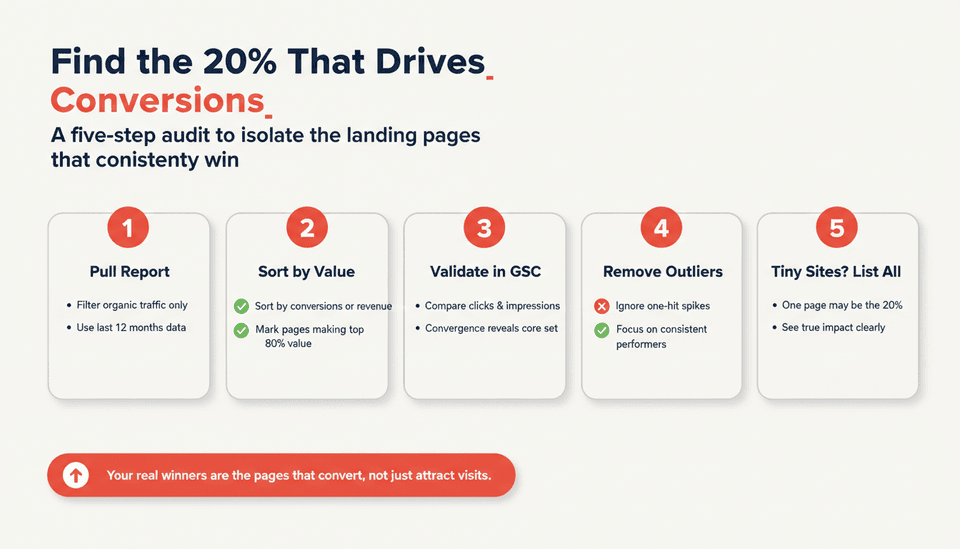
Metrics that matter more than traffic: conversions, revenue, and engagement
Most people grab a traffic report and stop there. That’s a mistake. A blog post can pull 10,000 visits a month but convert zero. Another page with 400 visits might drive 30 demo requests. Identify the 20% SEO pages that produce revenue, not just eyeballs. Use these metrics:
- Revenue (or pipeline) attributed to organic landing pages (from CRM or analytics goals)
- Conversion rate (setup goal completions in GA4 or a comparable tool)
- Assisted conversions (pages that appear early in the user journey)
- Engagement signal strength (scroll depth, time on page, return frequency) for content that influences purchase decisions, even if it doesn’t transact
Step-by-step audit: isolating the pages that consistently win
- Pull a landing page report from your analytics platform for the last 12 months. Filter organic search traffic only.
- Sort by total conversions or revenue. Mark pages that account for the top 80% of cumulative value—this is your rough 20%.
- Validate with Search Console. Do the same exercise for clicks and impressions. The convergence between clicks and conversions usually reveals the core set.
- Exclude outliers. One viral post that spiked six months ago but hasn’t converted since is noise, not signal.
- For small sites, list every page. You’ll often find a single product page, the homepage, and one pillar article doing all the work. That’s your 20%—or your 100% that matters.
What if your site has only 10 pages? The rule still works
When your inventory is tiny, the “20%” can be just one or two pages. The rule doesn’t break; it sharpens. If your homepage and a case study generate all leads, every other page existed for your internal reasons, not for SEO ROI. Use the audit to see that clearly, then decide whether those other pages justify their cost.
Applying the 80/20 Rule to Content Strategy
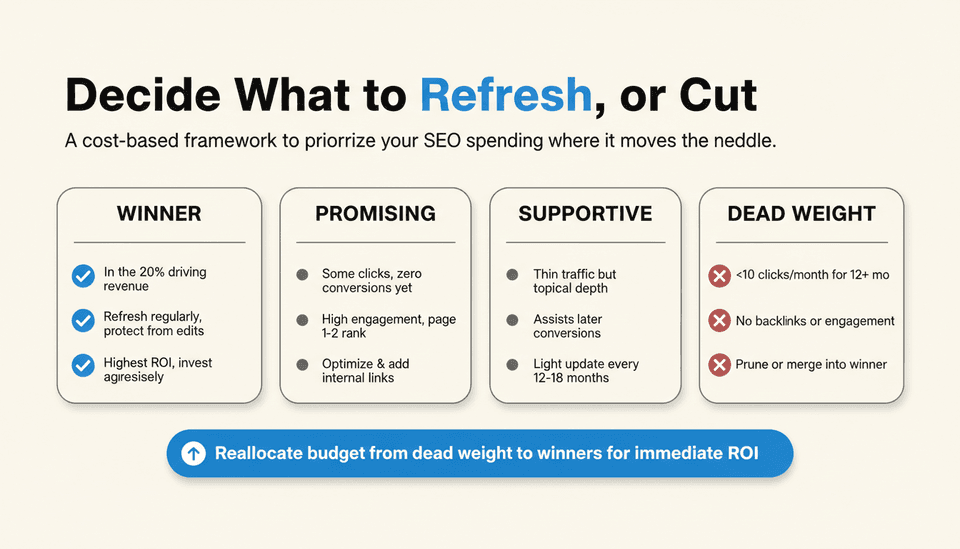
Financial decision: prune, refresh, or consolidate? A quick ROI lens
Not every low-traffic page should be deleted. Some support topical authority, answer buyer questions, or serve legal requirements. But many pages simply drain resources. This forces you to prioritize high-impact SEO tasks that directly affect outcomes. Use this framework to decide, based on cost-per-page value.
| Page Status | Traffic & Conversion Profile | Action | Cost/Value Lens |
|---|---|---|---|
| Winner | In the 20% that drives revenue or qualified leads | Refresh regularly; protect from unintended edits | Highest ROI; invest aggressively |
| Promising | Some clicks, zero conversions yet but high engagement or ranking on page 1-2 for valuable terms | Optimize for conversions, add internal links from winners; run a 90-day test | Moderate cost, high potential |
| Supportive | Thin traffic but ranks for long-tail queries that build topical depth; assists later conversions | Keep and lightly update every 12-18 months; do not delete | Low ongoing cost, intangible authority benefit |
| Dead weight | <10 organic clicks/month for 12+ months; no backlinks, no engagement, no ranking improvement history | Prune or consolidate: redirect to the most relevant winning page, or merge content into a stronger asset | Eliminate crawling waste and maintenance hours |
Pages costing more to maintain than they return should go. If you’re paying writers to update 30 posts that collectively bring 100 visits, you’re ignoring the 80/20 reality. Reallocating that budget to the 20% that already works delivers far better SEO ROI.
The 80/20 content refresh playbook: update pages already driving 80% of results
The fastest way to gain traffic isn’t writing new posts from scratch; it’s updating what already ranks. That’s the essence of top-performing pages SEO: doubling down on proven assets. The 80/20 SEO strategy for refreshes:
- Pick the top 20% of pages by organic clicks from Search Console.
- Identify those that have slipped in rank over the last 6 months for their primary keyword. These are the highest-potential uplift candidates.
- Sequence by potential revenue impact, not traffic volume. A product page losing 10% rank monthly is more urgent than a blog post that’s flat but gets low-value views.
- Update the content with fresh data, better structure, and clear CTAs, then request re-indexing. This refresh often produces a 20-50% traffic bump within weeks, based on observed case studies from Ginger IT Solutions.
Common mistakes and misconceptions (and what the rule does not mean)
- “Delete the bottom 80% of pages.” No. Many low-traffic pages form a topical cluster that signals relevance to search engines. Deleting them indiscriminately can damage the authority of your winners.
- “Ignore everything except the 20%.” You can’t avoid technical SEO fundamentals, site speed, or basic crawl hygiene just because they don’t directly map to a single page’s conversions.
- “The 20% is static.” It shifts. Quarterly reviews reveal new winners and former stars that have faded. Treat identification as a recurring process, not a one-time project.
- “Traffic equals the 20%.” Without conversion data, you’ll optimize the wrong pages. The metric that leads to cash is always the North Star.
How Automation Locks In the 80/20 Advantage
Why manual 20% discovery breaks at scale
If you run a site with 500 pages, pulling a manual report, analyzing patterns, and reverse-engineering what made the top pages succeed takes days—and it’s stale by the time you act. For site networks or fast-growing blogs, human-driven audits can’t keep pace. Manual discovery becomes the bottleneck, and you end up guessing about what to write next.
How Joyrise’s deep site scan automatically pinpoints your winning content patterns
Joyrise, an automated content marketing platform, performs deep site scans that learn your brand voice, audience preferences, and product offering. But more importantly for the 80/20 rule, it analyzes your current organic performance and competitor gaps to identify the exact characteristics of your top-performing pages: topic clusters, content depth, structure, image usage, and CTAs. It doesn’t just tell you which pages are in the 20%; it extracts the template of success so you can replicate it repeatedly. This AI content platform SEO approach turns analysis into action automatically. This shifts SEO content automation from keyword guessing to pattern-driven creation.
Scaling your 20% with AI-generated articles modeled on proven winners
Once the winning pattern is identified, the platform can generate AI content that follows the same structural and topical rules. For example, if your top 20% consists of in-depth how-to guides with step-by-step numbered lists, original infographics, and internal links from other high-authority pages, Joyrise produces new articles that match that blueprint. You’re not starting from zero. You’re scaling what already works, which is the most direct path to improving SEO efficiency. This is how you turn the 80/20 rule from a diagnosis into a daily operating model. Instead of writing 50 posts hoping one sticks, you produce 10 articles that mimic your winners and see the distribution narrow naturally.
Turning a static audit into a continuous operating model
With Search Console dashboard monitoring and automatic publishing, you get ongoing feedback on which new articles are entering the 20% and which are slipping. Joyrise’s quality judgment pass (a second AI that rewrites drafts) ensures that every article meets the bar set by your best pages. The result: you spend zero hours on manual pattern analysis and still get the strategic benefit of the 80/20 principle. For marketing teams that have been paying agencies to produce volume without strategic targeting, this represents a bridge to genuine SEO tools for 2026 and beyond.
Frequently Asked Questions
What's the difference between the 80/20 rule in SEO and general business?
In general business, the rule might refer to product lines, customer segments, or employee performance. In SEO, it’s specifically about the relationship between organic landing pages and organic outcomes. The measurement tools (analytics, Search Console) are unique, and the actions you take—content refreshes, internal link optimization, pruning—are specific to search. The principle is the same, but the application requires SEO data fluency.
What’s NOT Working About Posts With Less Traffic?
The question itself reveals a traffic-centric view. A post with low traffic can still work if it converts well or supports the buyer’s journey. However, if a page has low traffic and zero conversions for 12 months, something is almost certainly wrong: poor keyword targeting, thin content, no internal links, or a mismatch with user intent. Traffic alone doesn’t define failure; the combination of low traffic, zero engagement, and no ranking progress does. Use the financial decision table above to diagnose, not just the traffic column.
How often should I re-evaluate my 20%?
Quarterly, with a light review monthly. SEO shifts are continuous, not quarterly, but a full conversion-path analysis is time-consuming. Each quarter, run the audit from Search Console and analytics. Monthly, glance at the top 20 pages by clicks and check for any significant position drops using a rank tracker or the integrated dashboard. That cadence catches winners before they dip out of the 20%.
Can I apply the 80/20 rule across multiple domains?
Yes. When you manage a portfolio of sites, the rule often shows up at a domain level too: 20% of domains might produce 80% of aggregate organic leads. From there, you apply the rule within each domain. The strategic question becomes: do you invest more in the winning sites, or try to lift a laggard by applying the pattern from the stars? The pattern-replication approach works cross-domain, provided the audiences and intent are similar. Be cautious about copying structure blindly; always verify intent alignment.
What’s the fastest way to start using the 80/20 rule today?
Export your last 12 months of organic landing-page data with goal completions. Sort by completions descending. Sum the total, then calculate how many pages it takes to reach 80% of completions. That’s your core set. Spend the next two weeks refreshing the content on those pages with updated information, stronger CTAs, and better internal links. Do nothing else until that’s done. That single exercise typically beats a month of random blog posting.
Key Takeaways
- The 80/20 rule in SEO is a measurement fact: a small set of pages almost always produces the majority of organic results, and the only way to act on it is to identify those pages by conversion value, not traffic alone.
- Prune or consolidate pages that cost more to maintain than they return—redirect budget to refreshing your proven winners for immediate, compounding SEO gains.
- Automation transforms the rule from a periodic audit into a continuous operating rhythm by reverse-engineering your top-performing patterns and replicating them at scale without manual guesswork.
- Even a tiny site reveals the pattern; if one page drives 90% of leads, your entire SEO effort should orbit that asset until you’ve exhausted its potential.