 Joyrise
SEO Tools: The Definitive Guide for 2026
 By Alexi · · 15 min read

On this page
- Executive Summary
- What Are SEO Tools?
- The 6 Core Functions of an SEO Stack
- The 2026 Shift: From Manual Stack to Automated Workflow
- Data Trust Crisis: What the Ahrefs Poisoning Means for Your Tool Choices
- How to Choose a Stack Around Your Biggest Bottleneck
- Implementing Your Stack: A 4-Stage Framework
- What is an SEO tool?
- How do I choose the best SEO tools for my business?
- Are Google’s free SEO tools sufficient?
- How can I build an SEO tool stack that works?
- How does AI automation affect my SEO tool selection?
- Common Mistakes, Myths, and Limitations
- Next Steps: From Tool Buyer to Traffic Engine
- Key Takeaways
Meta description: Learn to choose the best SEO tools for your business—from AI SEO tools to automated content publishing and Webflow SEO.
SEO Tools: The Definitive Guide for 2026
Building a modern search advantage today means moving beyond a jumbled folder of SEO tools you toggle between. The real shift is from a manually stitched-together tech stack to an AI-powered automated workflow that plans, writes, and publishes directly to your CMS — and the recent revelation of data poisoning in ranking data makes that shift urgent. This guide gives you the concrete framework to get there, no filler.
Executive Summary
Most “definitive” guides stop at listing tool categories and comparing features. They ignore the hidden cost of hopping between disconnected point solutions and the reality that 5–20% of the ranking data you pay for may be poisoned by Google, according to Ahrefs’ own data quality teams. This article will:
- Define the six core functions every SEO stack must cover and why most teams over‑buy in low‑impact categories.
- Show you how to structure your tool investment around your biggest content bottleneck, not a generic checklist.
- Walk through a 4‑stage framework that turns a fragmented tool collection into an automated publishing engine, with Webflow as the target.
- Explain how AI‑powered publishing platforms (not just content assistants) pre‑judge quality before drafts go live, making integrated SEO platforms a key consideration.
- Deliver a decision matrix for integrated platforms vs. best‑of‑breed tools, so you can pick what actually matches your speed and budget.
You’ll leave with a clear, repeatable method to audit your workflow, select the right tools for the right jobs, and build a verification layer that keeps your data honest.
What Are SEO Tools?
SEO tools are software that help you research keywords, audit technical health, analyze backlinks, track rankings, optimize content, and report on performance. Google’s own free offerings — Search Console, Analytics (GA4), and Keyword Planner — form the foundation, but they only show you a portion of the picture. Paid tools unlock larger datasets, competitor intelligence, and automation that free versions cannot deliver. Among these, AI SEO tools are reshaping how we approach everything from content ideation to automated content publishing.
Beyond that surface definition, the way you combine these tools defines your real capability. A stack built for a solo founder writing two posts a week looks nothing like one for a marketing team publishing 80 articles a month to Webflow. The critical insight: sort tools by the job you’re doing at that moment, not by category. That advice, published by Runway on October 19, 2026, changes how you shop. You don’t buy “a rank tracker”; you solve the job “I need to know which pages lost traffic last week so I can update them.” This framing runs through everything that follows.
The 6 Core Functions of an SEO Stack
Every effective SEO stack must handle these six jobs. You do not need a separate tool for each; a well‑chosen combination can overlap. The danger is buying tools for functions you don’t actually need to measure daily.
Keyword Research & Intent Analysis
Find what your audience searches for and identify the intent behind the query. Modern keyword research tools also surface topic clusters, question‑form queries, and AI‑overview triggers. Look for a platform that connects search volume to your actual site’s existing coverage so you don’t waste cycles on terms you already own. A solid starting point is to consult a comprehensive comparison of SEO tools for keyword research and site audits to avoid analysis paralysis.
On‑Page & Content Optimization
Assign a quality score or checklist to every page before it goes live. Traditional tools grade headings, keyword density, and meta tags. In 2026, on‑page optimization also means ensuring your content is structured for AI overviews and voice answers — clear H2/H3 hierarchy, factual claims, and internal linking that a crawler can follow instantly. Many content automation platforms embed this step directly into the publishing pipeline, eliminating manual grader checks.
Technical Auditing & Crawling
Detect broken links, orphan pages, slow core web vitals, and indexation errors. A regular crawl (often weekly for active sites) is non‑negotiable. Google Search Console catches many issues, but dedicated technical SEO tools like Screaming Frog give you the depth needed to fix problems before they ding your budget.
Link & Authority Analysis
Understand who links to you and to competitors. Link data has become less deterministic with AI‑overview rankings, but authority signals still matter for traditional blue‑link rankings. Use link analysis to identify digital PR opportunities, not to chase a vanity metric.
Rank Tracking & SERP Monitoring
Track where you rank for specific keywords across devices and locations. The critical twist in 2026: you must now verify rankings against your own GA4 click data because the raw SERP data you buy may contain poisonous entries (more on that below).
Reporting & Client Dashboards
Turn data into decisions. Dashboards should tell you which pages moved, which content clusters are gaining or losing traffic, and what the next concrete action should be. A dashboard that simply refreshes a rank number is useless unless it surfaces the outlier.
The 2026 Shift: From Manual Stack to Automated Workflow
For most teams, a “stack” means logging into Semrush for keyword data, copying‑pasting into a Google Doc, running a separate content optimizer, and then manually scheduling in their CMS. The friction is enormous. The hidden costs go well beyond subscription fees.
The Hidden Costs of Stitching Tools Together
Every handoff between systems costs you in three ways:
- Time overhead: Toggling between 5+ browser tabs, reformatting data, and updating trackers eats hours of productive writing time each week.
- Data sync gaps: Your content optimizer might use a different keyword set than your rank tracker. Your publishing CMS knows nothing about the SEO work you’ve already done. The result is duplicated work and missed opportunities.
- Error rate: Manual steps invite mistakes — a missing meta description, a wrong canonical, an image without alt text. When you publish at scale, the error rate multiplies.
Agencies have long tolerated these costs because the alternative didn’t exist. That’s changed.
When AI Becomes the Content Engine, Not Just the Assistant
There’s a big difference between an AI content assistant (you prompt, it drafts, you edit) and an AI‑powered publishing engine that handles the full chain: deep site scan to learn brand voice, keyword planning from competitor gaps, long‑form article generation with original images, built‑in on‑page SEO (headings, meta, internal links), and direct publication to Webflow. This is the essence of automated content publishing — it turns a fragmented routine into one seamless flow.
With an engine like Joyrise, the platform performs a quality judgment pass using a second AI model before the draft ever reaches your site. That second pass checks for factual consistency, brand voice alignment, and SEO structure. If it fails, it rewrites. This turns the “editor” role from line‑by‑line reviewer into high‑level strategist.
Automated publishing isn’t just faster; it eliminates the manual cost of moving content from idea to live URL. You go from a 15‑step process requiring 4 different tool logins to one workflow. For those running Webflow sites, a dedicated Webflow SEO integration ensures meta tags, structured data, and internal links all arrive intact — no copy‑paste needed.
Data Trust Crisis: What the Ahrefs Poisoning Means for Your Tool Choices
In late October 2026, Ahrefs disclosed that Google is inserting abnormal results — effectively “poison” — into the SERPs served to SEO data tools. Their analysis, reported by PPC Land, found that between 5% and 20% of results can be unnatural pages designed to mislead scrapers. Ahrefs now rejects those abnormal pages and cleans old historical data to maintain integrity. Other major SEO tool providers have not publicly addressed the issue, leaving agencies wondering which rank data they can trust. This data poisoning SEO crisis is a structural trust problem.
This isn’t a small bug; if your rank tracker pulls poisoned results, your entire optimization strategy could be built on false signals. You might think you dropped for a crucial keyword and spend hours “fixing” a non‑problem, while the real decline is somewhere else.
How to Build a Data Verification Layer into Your Stack
You cannot rely on a single rank data source anymore. A verification layer adds these checks:
- Cross‑reference SERP data with first‑party analytics. If a tool says you rank #3 for a term but GA4 Search Console shows zero clicks and zero impressions for that query in the same period, flag it.
- Use at least two independent data providers for your most important 50–100 keywords. tools like Semrush maintain their own index, but even there, the underlying crawl can be affected. Diversify. A reliable resource to compare trustworthy options is the Semrush platform’s guide to SEO tools for the AI search era.
- Set anomaly thresholds. When a rank change is larger than 10 positions overnight, do not react until you’ve confirmed with a second tool and your own click data.
- Prefer platforms that build data quality safeguards directly into their pipeline. The Ahrefs case shows that aggressive cleaning matters more than ever.
In practice, a healthy 2026 stack uses combined data from Google Search Console (not scraped) for impression and click truth and cross-checks with a secondary source for ranking position trends. Automated systems can flag discrepancies for review. That’s your verification layer.
How to Choose a Stack Around Your Biggest Bottleneck
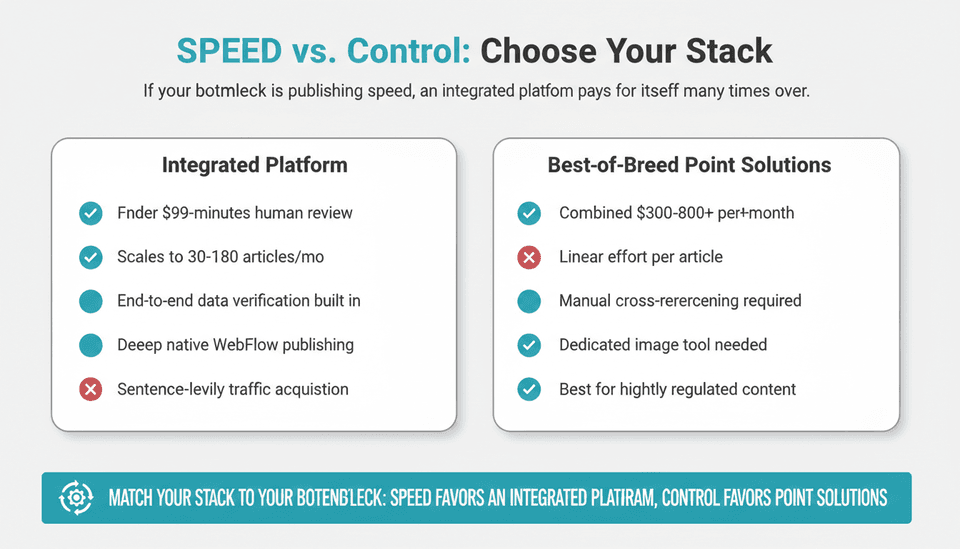
Following Runway’s framework from their October 19 2026 content tool guide , start by identifying the single step that costs you most time or causes the most missed opportunity. For many teams , that bottleneck shifted in 2026 from “writing” to “publishing and distribution”—especially when Webflow is the target.
Audit Your Current Content Workflow
Map your entire pipeline from content idea to live URL. For each step , ask: how many manual minutes do we spend? Which tools do we open? Where does the delay happen?
A simple exercise: over one week , log every time you switch context between a keyword tool , a writing environment , an image generator , an optimizer , and a CMS. The step that appears most often is your starting point.
Map Tools to Jobs (Writing, Ideation, Distribution, Reporting)
Sort tools by job , not category:
- Ideation: Find content gaps and high-opportunity keywords based on your site’s actual authority.
- Writing: Produce long-form drafts that match your brand voice and include original images.
- Distribution: Publish directly to your CMS with SEO metadata intact , no copy-paste. A true integrated SEO platform handles distribution natively.
- Reporting: Show real organic traffic movement tied to specific content , not just rank numbers.
You may need one tool per job , or one platform that covers multiple. The litmus test: if a tool doesn’t directly reduce minutes spent on your bottleneck , skip it until you’ve solved the immediate constraint.
The Integrated Platform vs Best-of-Breed Decision Matrix
Use this table to weigh options based on real world trade-off:
| Factor | Integrated Platform (e.g., Joyrise) | Best-of-Breed Point Solutions |
|---|---|---|
| Monthly cost | $199–$99 (flat) | Combine Semrush ($139+), Surfer ($59+), Screaming Frog (£199/year), CMS plugin , image generator , etc. Total often $300–$800+ |
| Time to publish one article | Under 2 minutes of human review | 45–90 minutes assembling + publishing |
| Control over every sentence | Limited to editing the final draft; editorial style is set upfront | Full control ; you write or heavily edit each piece |
| Speed of scaling | 30–180 articles/month automated | Linear: each article requires the same manual effort |
| Data integrity | Platform manages end-to-end verification | You must build cross-referencing manually |
| CMS integration depth | Deep – publishes directly to Webflow with internal links , meta , tags | Usually requires a separate publishing step or plugin |
| Customization of images | Included , generated per article | Requires a separate AI image tool + manual insertion |
| Best for | Teams that see content as a daily traffic acquisition channel and want to reduce tool overhead | Teams that need sentence-level editorial control for highly regulated or technical content |
Decision rule: If your biggest bottleneck is publishing speed and you are willing to trade a degree of sentence-level control for volume and velocity , an integrated platform pays for itself 10x over the cost of stitching tools together. If your bottleneck is editorial uniqueness and every piece must be hand-crafted , then a curated best-of-breed stack still wins.
Implementing Your Stack: A 4-Stage Framework
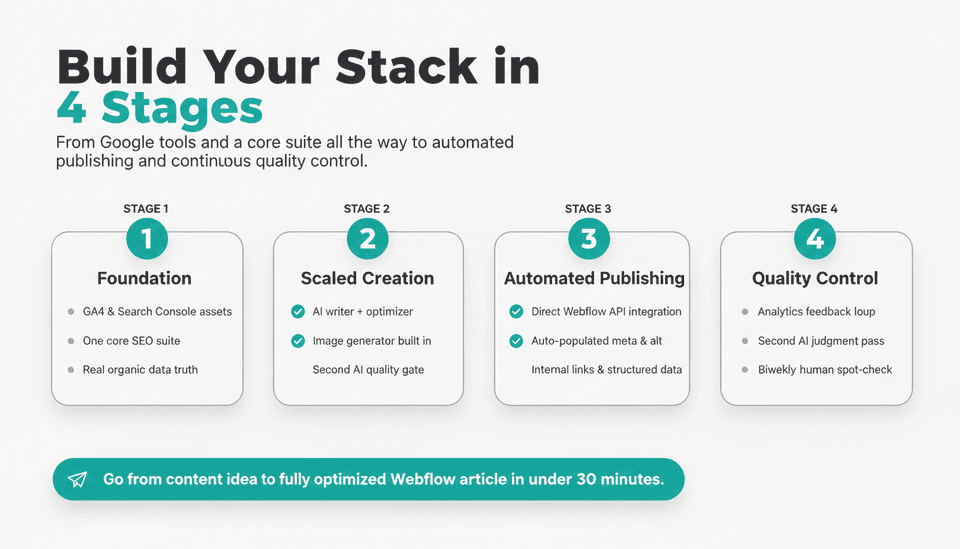
Work through these stages in order. Don’t skip the foundation for the flashy AI tool..
Stage 1 – Foundation (GA4, Search Console, and a Core SEO Suite)
Every stack needs Google Search Console and GA4 as the single source of truth for real organic performance. Add one core SEO suite – such as Semrush or Ahrefs – to handle keyword research, competitor analysis, and technical health monitoring. The core suite becomes your “source of record” for non-Google data. Set up search Console email alerts for coverage drops. This minimal foundation costs $0 to $139/month and answers 80% of your strategic questions. For an independent look at how these suites compare, see MorningScore’s personally tested ranking of the 20 best SEO tools in 2026.
Stage 2 – Scaled Content Creation (AI Writer + Optimizer + Image Generator)
With a foundation in place, you can add tools that accelerate production. The stack here depends on your approach:
- If you stay manual , use a dedicated AI writer (like Jasper) alongside Surfer for on-page grading, and Canva or Midjourney for images.
- If you move to automation , use a platform that bundles all three (e.g., Joyrise handles writing, optimization, and branded images in one pass). This eliminates the toggling between tabs.
At this stage , you must define your quality bar. For automated setups , ensure the system has a “second set of AI eyes” judging output before publication – akin to a quality gate in a software pipeline.
Stage 3 – Automated Publishing & Distribution (CMS Integration, Webflow)
The biggest leap in efficiency comes when content moves from a document into your CMS without human intervention. Integrate directly with Webflow’s API. Whether you use an automated platform or a custom Zapier connection , the goal is to eliminate the final copy-paste step that introduces formatting errors and delays.
When publishing to Webflow , verify that every article includes:
- Correct slug structure
- SEO meta title and description (auto-populated)
- Internal links to related articles
- Alt text and compressed images
- Structured data markup
A publishing engine that sends all this in one push turns a CMS into a traffic acquisition machine rather than a storage bucket.
Stage 4 – Quality Control & Iteration (Second AI Judgment, Analytics Feedback)
Once articles are live , close the loop. Use analytics to feed back into your ideation and optimization steps. Which articles are gaining traction within 30 days? Which are flat? A well-designed automated workflow will pull Search Console data directly into the platform so you can identify “sleeper hits” that need a refresh , and “overperformers” that deserve internal linking support.
The second AI judgment pass (found in platforms like Joyrise’s Pro and Max tiers) should flag not just grammar but SEO structure and brand voice drift. Then , every two weeks , run a manual spot check on a sample of published articles. This spot check becomes your ongoing quality audit.
What is an SEO tool?
An SEO tool is any software application that assists with search engine optimization tasks – from discovering what people search for to auditing your website’s technical health to tracking where you rank. In pracice , most teams use a combination of free Google tools and paid third-party applications because no single tool covers every job wel. The definition expanded in 2026 to include AI-driven tools that don’t just report on data but act on it—writing , optimizing , and publishing content directly.
How do I choose the best SEO tools for my business?
Start by identifying your biggest bottleneck (see the audit above). Then match tools to that bottleneck , ignoring the categories the market insists you need. A company that publishes 10 blog posts a week but spends 4 hours per post on images and formatting benefits more from an automated publishing platform than from a premium rank tracker. Conversely , a large enterprise with complex technical architecture might need an enterprise SEO platform (reviewed by Gartner) first. Choose the tool that fixes the job you’re paying for in labor right now , not the job you think you’ll have next year.
Are Google’s free SEO tools sufficient?
For a brand new site with litle competition , Google Search Console and GA4 + Keyword Planner can give you a workable starting point. But as your site gorws , the answer is an unequivocal no. Free tools won’t show competitor data , won’t automate on-page optimization , and won’t give you the cross-verification layer required in a data-poisoned landscape. You will blind spots that cost you traffic. The minimum viable paid addition is a core SEO suite for keyword and technical data.
How can I build an SEO tool stack that works?
Build in stages: foundation (Google tools + one core suite) , then scaled creation , then automated publishing , then quality iteration. At each stage, prefer tools that talk to each other. A stack that requires you to manually transfer data between a rank tracker , content optimizer , and CMS is a stack that slows you down. The practical criteria for “works” is: can you go from identifying a content opportunity to a live , fully optimized article in under 30 minutes with less than 3 human touches? If not , your stack still has a manual cog that needs replacing.
How does AI automation affect my SEO tool selection?
AI automation forces you to evaluate tools by their ability to complete entire workflows, not just singe tasks. Traditional tools deliver dashboards . AI-powered platforms deliver final output. This shift means you should favor tools that have embedded AI for the heavy lifting (writing , image generation , meta data creation) and can publish directly—especially if you use Webflow. However , you must baked in quality checks. A tool that generates 100 articles without a second AI judgment pass or a human spot-check is a rick. Automation doesn’t remove the need for oversight , it shifts oversight into setting the right rules and periodic audits. The 2026 AI-safe approach to SEO pairs automation with deliberate quality gates.
Common Mistakes, Myths, and Limitations
Mistake 1: Buying a tool for every function before you have a traffic problem. If you’re publishing 4 articles a month , you don’t need a Web crawler or an enterprise rank tracker. Solve your first bottleneck.
Mistake 2: Trusting rank data without a verification layer. With the Ahrefs revelation , ignoring cross-reference steps is negligence. Build that layer now.
Myth 1: AI-written content will be penalized by Google. The recent case study by Chicago SEO consultant Kyle Eggleston (covered by The National Law Review in October 2026) shows a 100% AI-written site that grew through three Google updates over five months. Google does not penalize AI content per se ; it penalizes low-quality , unhelpful content. The meta-lesson is that AI output with human judgment gates can perform as wel as human-written work.
Myth 2: You need a separate tool for every SEO function. An integrated platform can replace 4–6 tools when your primary need is content publishing speed , and it does so at a lower monthly cost and with far less context-switching.
Limitation: No tool or platform will replace strategic thinking. Tools can find keywords and generate drafts , but they cannot decide what your audience deeply needs or how to position your product. The operator’s judgment remains the system’s brain.
Next Steps: From Tool Buyer to Traffic Engine
You stop being a passive buyer of SEO utilities when you stop collecting features and start building a content production line that converts organic attention into business outcomes. The next step is straightforward: audit your current publishing workflow today. Find the step that waits on a human to move data from one system to another. Replace that step with an automated alternative that pushes directly to Webflow.
When you do that , you aren’t just using SEO tools; you’re running a traffic engine.
Key Takeaways
- Sort tools by the job they solve right now , not by category—the Runway framework from October 2026 eliminates waste.
- 5–20% of ranking data may be poisoned; cross-check all SERP data against first-party Search Console and GA4 click metrics.
- An automated publishing workflow integrating directly with Webflow cuts the content publishing cycle from hours to minutes and removes manual handoffs.
- Use a 4-stage implementation framework—foundation , scaled creation , automated publishing , quality iteration—to build a stack that grows with you without runaway cost.
- AI automation does not replace quality control ; it shifts it to a second AI judgment pass and periodic human spot-checking, as proven by a site growing through three updates on 100% AI content.
- The decision between an integrated platform and point solutions comes down to speed versus control: if your bottleneck is publishing velocity, a unified platform typically pays off.
Ready to turn your blog into a daily traffic engine without the manual stack? Try Joyrise’s automated publishing to Webflow and read your first article before you pay.