 Joyrise
Which AI Tool Is Best for SEO? 2026 FAQ & Answers
 By Alexi · · 18 min read

On this page
- Direct answer: Which AI tool is best for SEO?
- What are AI SEO Tools?
- AI SEO tool categories worth knowing in 2026
- Questions grouped by buying decision
- Questions grouped by SEO task
- Troubleshooting AI SEO workflows
- Where Joyrise fits—and where it doesn’t
- So, What’s the Best AI SEO Tool for You?
- Sources, evidence gaps, and review cadence
- Key Takeaways
Direct answer: Which AI tool is best for SEO?
Which AI tool is best for SEO? This FAQ cuts through the noise. The short answer: match the tool to the job, not the feature list
There is no single best AI SEO tool. The answer depends entirely on which part of your workflow consumes the most time and budget. For a team publishing 80 long-form articles every month on a Webflow blog, the best tool is the one that removes all manual steps between research and live post — an automated content operations platform. For a backlink analyst or technical SEO, a traditional suite like Ahrefs or Semrush still runs laps around any AI-only tool. The right question is not “which tool is best?” but “which tool best replaces the manual work I’m doing today?”
If your job is daily Webflow publishing with minimal manual overhead, Joyrise is the closest fit
If your primary goal is to scale a Webflow blog with original, illustrated articles that rank, and you do not want to spend time on copy-pasting, scheduling, internal links, or image sourcing, an AI content marketing platform built for Webflow solves a problem no general AI writer or SEO suite does. Joyrise scans your site for brand voice, identifies keyword gaps, writes illustrated long-form posts, adds internal links and meta tags, and publishes them directly to your Webflow blog on a schedule you control.
If your job is backlink research or technical site audits, you may still need a traditional suite
AI tools — writers, content optimizers, and publishing platforms — do not replace deep backlink crawlers or site auditing features. If your day-to-day involves link intersect analysis, log file checks, or Core Web Vitals diagnostics, a platform like Semrush or Ahrefs remains essential. This article adjudicates that you need a traditional suite for those jobs unless your AI platform explicitly covers them, which most do not.
A three-question framework: research, writing, publishing, tracking
Before comparing tools, answer three questions about your own workflow:
- Who finds the keywords and judges opportunity — you, an agency, or an AI that scans your site?
- Who creates the draft — a human writer, a general-purpose AI like ChatGPT, or an AI article generator for SEO that generates articles with images, structure, and internal links?
- Who publishes and tracks the article — you manually, a freelancer, or an automated SEO publishing pipeline that also shows you clicks and impressions in one dashboard?
The tool that best answers those three questions for your team is the best AI tool for your SEO.
What are AI SEO Tools?
The three working categories: AI writers, all-in-one SEO suites, and automated publishing platforms
AI SEO software falls into three categories in 2026, and most confusion comes from treating them as interchangeable. For a broader AI SEO tool comparison of tested options, see the independently verified lists like The 20 best SEO tools in 2026? I personally tested all tools and 12 AI SEO Tools That Actually Work in 2026 (Tested) - Darkroom.
- AI writers and content optimizers generate or refine article text. Examples: Jasper, Writesonic, Frase, SurferSEO, Neuronwriter. They focus on the draft, not the research or the act of publishing.
- All-in-one SEO suites bundle keyword research, rank tracking, site audits, and competitive analysis. Semrush, Ahrefs, and similar platforms belong here. Some now bolt on AI writing assistants, but their core is research and monitoring.
- Automated content publishing platforms handle the end-to-end pipeline: keyword discovery, brand-voice drafting, image creation, internal linking, and direct publishing to a CMS. They measure success through integrated tracking. Joyrise (for Webflow) is an example in this third category, built as an AI content marketing platform and an SEO agency alternative, and there are very few that publish natively to a specific CMS rather than producing generic text output. For more on why brands are adopting such platforms, contentmarketing.ai provides further context on AI content marketing.
What AI SEO tools can automate today, and what still needs human judgment
AI tools can reliably automate:
- Keyword gap analysis based on your site and competitor data
- Drafting of complete articles that follow SEO structure (headings, meta, table of contents)
- Internal link insertion between related posts
- Auto‑generated header images and infographics
- Scheduled publishing with post‑publish tracking
They cannot yet automate:
- Backlink acquisition or link‑building strategy
- Technical infrastructure decisions (site architecture, page speed, crawl budget)
- Brand‑voice nuance that requires a human’s final taste
- Fact‑checking claims that carry legal or reputation risk
The best tools reduce the review burden to a quality‑judgment pass, not a full rewrite. The Pro tier of Joyrise, for instance, runs every draft through a second AI that rewrites until it passes a quality check — but a human still needs to verify what gets published. Applying brand voice AI content consistently at scale is a key advantage of automated platforms like Joyrise.
Why Do You Need One?
The main driver in 2026 is cost per article and publishing volume. An agency routinely charges $500 to $1,200 for a single researched article with images and internal links. An AI content platform can produce the same article for $5 to $7, depending on plan volume. When you need 30, 80, or 180 articles a month to stay competitive, that cost gap funds other growth activities.
A second reason is AI‑search visibility. ChatGPT, Gemini, and Google AI Overviews now cite sources and recommend products (a marketing lead asked ChatGPT which accounting software suits a 30‑person startup on October 30, and it named four products with explanations and links, according to Technology Org). Owning the content that AI models choose to cite requires a volume of well‑structured, authoritative content that most teams cannot produce manually. This is where AI search optimization becomes critical.
AI SEO tool categories worth knowing in 2026
AI writers and content optimizers: what they do and when to pick them
Pick an AI writer (Jasper, Writesonic) or a content optimizer (SurferSEO, Neuronwriter, Frase) when you already have a strong research process and a human editor who will shape every article. These tools speed up drafting and tune content against SERP competitors. They do not plan your keyword strategy or push the article live to your CMS. If you have a dedicated content team, these tools are accelerators. If you lack that team, you will still end up doing most of the workflow yourself.
Research and rank-tracking suites: what they do and when to pick them
Semrush and Ahrefs remain the heavyweights for backlink analysis, technical site audits, and rank tracking. Semrush’s recent release of free tools (including Keyword Magic Tool and Position Tracking, detailed in a Semrush blog post on October 27, 2026) proves that even the suites are lowering barriers to entry. Pick one of these when your SEO program depends heavily on link building, competitor research, and granular technical fixes. AI‑assisted writing inside these platforms is supplementary — it will not publish to Webflow on its own or replace daily content operations.
Automated content platforms that publish directly to Webflow: what they do and when to pick them
This category exists specifically for marketing teams that use Webflow as their main site and want to scale organic content without hiring a content agency. Joyrise scans your live site to learn what you sell, what your audience reads, and how you write. It then plans keywords, drafts long‑form posts with on‑brand images, adds internal links and structured data, and publishes directly to your Webflow blog — either automatically or as reviewed drafts. Because publishing is native, there is no copy‑paste, no Zapier step, no CSV export. When your daily volume is high (5‑10 articles a day), the automation of the “last mile” — pushing content live — becomes the deciding factor. This kind of Webflow SEO automation reduces the manual overhead dramatically.
Questions grouped by buying decision
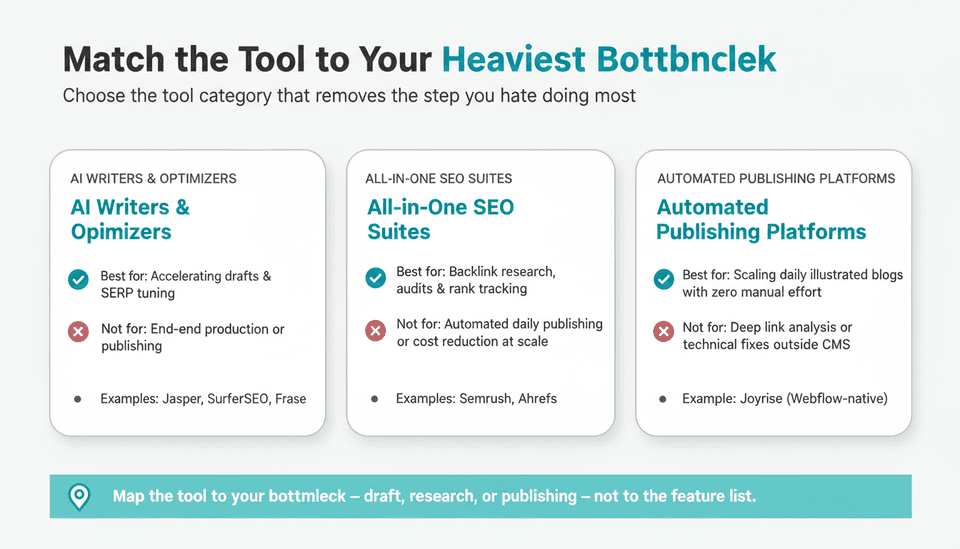
How do I choose between an AI writer, an all-in-one suite, and an automated publishing platform?
Map the tool to the heaviest bottleneck in your process. Choose the tool that removes the step you personally hate doing most.
- If you hate writing first drafts but love keyword research and technical SEO, an AI writer or optimizer is enough.
- If you need link data, keyword difficulty, and audit reports to sell SEO internally, get a traditional suite.
- If you hate the entire process of planning, drafting, formatting, image sourcing, linking, and publishing, and you want to see real traffic from daily publishing, an automated SEO publishing platform that publishes to Webflow eliminates those steps. That is the automated content operations model, and only a few platforms (Joyrise included) are built for that end‑to‑end job.
This decision is why assessing your job‑to‑be‑done matters more than comparing feature lists. The The 11 Best SEO Tools in 2026 guide from Zapier illustrates how matching the tool to the specific job yields the best results.
What Are the Best AI SEO Tools Right Now?
This table groups tools by the job they are best at, not by popularity score. For a deeper, hands-on comparison, see The 20 best SEO tools in 2026? I personally tested all tools.
| Category | Best for | Example tools | Not for |
|---|---|---|---|
| AI writers and optimizers | Accelerating draft creation and tuning content to SERP benchmarks | Jasper, Writesonic, SurferSEO, Neuronwriter, Frase | End‑to‑end production; publishing automation |
| All‑in‑one SEO suites | Backlink research, site audits, rank tracking, competitive intelligence | Semrush, Ahrefs | Automated daily publishing; per‑article cost reduction at scale |
| Automated publishing platforms (Webflow‑native) | Scaling daily, illustrated blog content with zero manual publishing effort | Joyrise | Deep link analysis; technical site health fixes outside the CMS |
Rank‑tracking tools and free utilities can supplement any category. As Semrush noted on October 27, 2026, free SEO tools now cover core visibility checks, keyword ideas, and site audits — making the paid decision about which heavyweight jobs you need to automate.
What is the best AI SEO tool in the market?
There is no single answer because no tool dominates every SEO task. The best AI SEO tool in the market is the one that aligns with your primary job — content production at scale, technical audits, or research. Joyrise is a top choice for Webflow-first teams wanting automated daily publishing; Semrush or Ahrefs remain best for link analysis. The AI SEO tool comparison above clarifies which tool fits specific roles. For those looking for the best AI SEO tools 2026 specifically for hands-off publishing, the automated platform category stands out.
Do I still need traditional SEO software if I’m using AI tools?
Yes, with a clear boundary. If your AI tool handles research, drafting, internal linking, and publishing, it does not replace the need for a backlink crawler, a rank tracker for non‑brand terms, or a full technical site audit. Backlinko’s head‑to‑head comparison of Semrush and Ahrefs on October 25, 2026, emphasizes that both platforms remain unrivaled for link analysis and technical depth. Use a traditional suite for link gaps and technical health — use an AI platform to run your content engine.
Many teams combine a traditional suite for quarterly audits and backlink monitoring with an automated publishing platform for daily content ops. That split often costs less than an agency retainer alone.
How much should an AI-generated article cost in 2026?
The market range for a fully produced, illustrated, published article from an AI‑native platform is $5 to $20 per article, depending on volume and included quality checks. Here is how that breaks down using Joyrise’s published pricing as of October 31, 2026:
| Plan | Monthly cost | Articles/month | Cost per article |
|---|---|---|---|
| Basic | $199 | 30 | ~$6.63 |
| Pro (recommended) | $499 | 80 | ~$6.24 |
| Max | $999 | 180 | ~$5.55 |
At these volumes, the per‑article cost is roughly 1/10th of what an agency charges for a comparable article (typically $500–$1,200 each). The cost model makes sense when you need consistent daily publishing, not occasional hero pieces. If you only need four articles a month, an agency or a freelancer plus a point AI writer may cost less overall. This cost structure positions automated platforms as a viable SEO agency alternative for high‑volume sites.
Can an AI tool learn my brand voice from a site scan?
Some can, but the approach varies. Joyrise runs a deep site scan that ingests existing blog posts, product pages, and tone cues, then builds a custom brand voice AI content profile. The platform uses that profile when drafting every article, and on Pro and Max tiers a second AI “quality judge” rewrites drafts that drift off‑brand. Other tools require you to manually upload style guides, example articles, or train a model with prompt‑engineering — which works but requires more setup time. A fully automated site scan shortens the time to first useful article, but you should still audit the first few drafts to confirm the voice matches.
How can I test an AI SEO tool before paying?
Look for one of two methods: a free tier that gives you real output, or a “read before you pay” model. Joyrise offers the latter: you sign up, the platform generates your first article using your site scan and keyword plan, and you review the full draft (including images and links) in your dashboard before you enter payment details. This lets you judge whether the output meets your brand threshold without financial risk. Additionally, check for a satisfaction guarantee or a cancellation policy that lets you leave without questions. Many AI writers provide limited free credits; traditional suites often give free 7‑day trials with restricted features. A read‑before‑pay model is more practical for publishing platforms because you see exactly what would go live.
Questions grouped by SEO task
Can AI tools help me optimise for AI search results?
Yes, in two ways: they can produce the kind of content AI models cite, and they can measure whether you are being cited. On October 30, 2026, Technology Org reported a real‑world example: a marketing lead asked ChatGPT which accounting software suits a 30‑person startup, and the answer named four products, explained why each fit, and linked two. Content that directly answers such buyer questions — and is structured so that AI models can parse it — is more likely to be cited. Automated publishing platforms that build topical depth over time with interconnected articles create that citation surface area. This is the essence of AI search optimization.
Tracking AI referrals requires a different setup. Joyrise includes a Search Console dashboard that surfaces clicks and impressions from AI assistant referrals, giving you line‑of‑sight into whether your content is appearing in AI Overviews and other AI‑driven results. For broader AI visibility tracking beyond Google, external tools are emerging, but as SF Weekly noted on October 28, 2026, AI visibility has become a distinct battlefield in 2026. We agree with Semrush’s assessment (October 27) that the content and technical foundation is shared between classic and AI visibility, but the measurement and attribution tasks are separate — you need to track AI citations specifically.
For a deeper guide, see ChatGPT GEO: A Practical Guide to AI Answer Visibility.
Are any of these tools useful for local SEO?
AI content tools can help you produce local‑area pages at scale — “best plumber in [city]” articles, neighborhood guides, and service descriptions. However, local SEO success still depends overwhelmingly on Google Business Profile optimization, review volume, and local link building, which AI tools cannot automate. Use AI for the content layer of local landing pages; do not expect it to move the needle in the map pack on its own.
Can I rely on AI SEO tools to follow SEO best practices automatically?
No. AI tools can automate many best practices — proper heading hierarchy, meta descriptions, table of contents, internal linking, image alt text — but they can also produce content that is factually thin, repetitious, or misaligned with search intent. Automation handles structure; human judgment catches relevance. The quality‑judgment pass in Joyrise Pro (a second AI rewrite) reduces generic output, but it is not a human editor. Always review at least your first few articles, and spot‑check later ones, especially for YMYL topics or claims that carry regulatory weight.
Are AI tools useful for building long-term SEO strategies?
They support strategy execution, not strategic thinking. Publishing 80 quality articles a month that build topical authority is a long‑term play — AI enables that cadence. However, the strategic decisions — which topic clusters to attack, how to distribute internal link equity, when to refresh old content versus create new — still need a human (or a very experienced consultant) to make. AI tools can surface keyword gaps and suggest clusters, but they do not understand your business’s shifting priorities or market conditions. Use them to execute the volume your strategy demands, not to write the strategy.
Troubleshooting AI SEO workflows
Symptom: AI articles publish but don’t rank—what to check
- Indexing. Check Google Search Console for “Crawled – currently not indexed” or errors. Resubmit the sitemap and request indexing for new URLs.
- Content quality. If the article is generic and adds nothing beyond top‑ranking pages, it will sit. Compare it to the top three SERP results. If your draft is shorter, less specific, or misses the primary answer, the tool may need better source material or a quality‑judgment rewrite.
- Keyword competition. AI tools can pick keywords that look good in a gap analysis but are far above your site’s authority. Target long‑tail queries first.
- Internal links. Ensure the platform correctly inserted contextual links from older, high‑authority pages. A missing internal link pass starves new posts of equity.
- Technical issues. If the platform publishes as drafts but they don’t go live, check your CMS permissions. On Webflow, verify that the API token has write access to the blog collection and that the collection’s “Publish” settings are not blocking automated pushes.
Symptom: Drafts sound generic or off‑brand—how to fix
If you are using a platform with a brand‑voice site scan, re‑run the scan with more representative content — include product pages, About pages, and your top‑performing blog posts. If the tool allows it, upload a style guide with phrases to avoid and sentence‑length preferences. In Joyrise, the quality‑judge pass on Pro and Max tiers acts as a second layer: it flags deviations and rewrites before the draft reaches you. If you are using a general AI writer, feed it explicit examples of your voice and instruct it to mimic those patterns in the prompt; generic prompts produce generic output.
Symptom: Webflow publishing skips or stalls—permissions, draft mode, and image generation
This is a platform‑specific issue most common with direct Webflow integration. Check:
- API token permissions: read and write access to the CMS, with the correct site selected.
- Blog collection settings: if the collection uses a “Draft” status by default, articles may go live as drafts but never auto‑publish. Confirm that the platform is set to publish or that you intentionally keep drafts for review.
- Image generation limits: if the platform creates AI images for headers, a generation failure can stall the whole article. Look for fallback settings that use a default image or stock photo.
- Rate limits: some platforms throttle daily article publishing to avoid overwhelming the CMS. If you skip a scheduled publish, check the queue.
Symptom: AI assistant referrals don’t show traffic—where to look in Search Console
In Google Search Console, look under the performance report and filter by “Search Appearance” > “AI Overview” or “AI Assistant results” (Google’s exact label may vary by account). Joyrise’s built‑in Search Console dashboard surfaces these directly. If you see zero AI referral traffic, it does not necessarily mean you are not being cited; many AI search tools (ChatGPT, Gemini) do not pass referral data through your analytics yet. Use an external AI visibility tool, or manually query the AI models with your target questions to see if your content appears. As SF Weekly reported on October 28, tracking AI visibility is a new measurement task that often requires a mix of platform dashboards and third‑party monitors.
Where Joyrise fits—and where it doesn’t
What Joyrise automates: site scan, keyword planning, drafting, internal links, publishing, and tracking
Joyrise is an AI content marketing platform built for Webflow. It does a deep site scan to learn your products, audience, and brand voice; it plans keywords around your site’s gaps; it writes long‑form articles with original header images and infographics; it inserts internal links and meta tags; it publishes directly to your Webflow blog (on a schedule or as drafts); and it shows you clicks, impressions, and AI assistant referrals through an integrated Search Console dashboard. This Webflow SEO automation lets you operate an organic content engine without manual intervention.
What Joyrise expects you to own: backlink strategy, technical site health, and final brand judgment
You are still responsible for link building, site performance, and the final call on what gets published. Joyrise does not crawl your backlink profile, fix Core Web Vitals, or replace a human when content could carry legal weight.
Joyrise pricing at a glance and the ‘read before you pay’ trial model
- Basic: $199/month (30 articles/month, AI images, Search Console check‑ins)
- Pro: $499/month (80 articles, deep research, quality judge, news‑driven articles, custom voice)
- Max: $999/month (180 articles, priority support)
Every tier includes the “read your first article before you pay” evaluation — you get a full draft with images and links, based on your actual site, and can judge quality before entering payment details. Cancellation is no‑questions‑asked.
When not to choose Joyrise
Do not choose Joyrise if:
- You are not on Webflow. The publishing integration is Webflow‑specific.
- Your SEO priority is backlink analysis, technical audit depth, or large‑scale link disavowal — this is not that tool.
- You need fewer than 30 articles a month. The value is in scaling daily, not in producing a few hero pieces.
- You want complete human editorial control over every article. While drafts can be reviewed, the platform is designed for flow, not one‑off perfection.
So, What’s the Best AI SEO Tool for You?
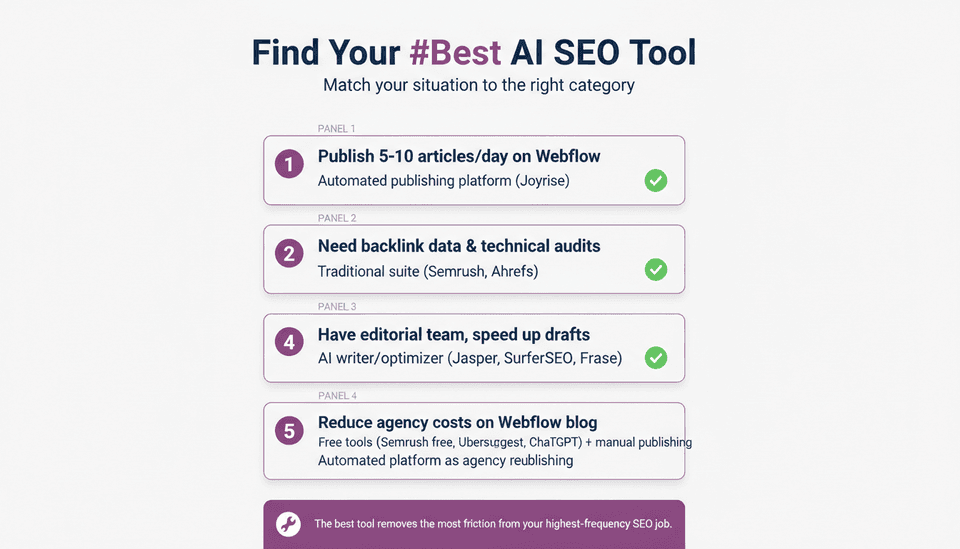
Use this decision table to map your situation to the right tool category. For additional AI marketing tool ideas, the 30 best AI marketing tools I'm using to get ahead in 2026 list offers a broader set of options.
| Your situation | Best choice |
|---|---|
| I need to publish 5‑10 articles a day on my Webflow blog, hands‑off | Automated publishing platform (Joyrise) |
| I need backlink data and technical audits more than content volume | Traditional suite (Semrush, Ahrefs) |
| I have an editorial team and just need to speed up first drafts | AI writer or content optimizer (Jasper, SurferSEO, Frase) |
| I’m on a tight budget and just starting with content | Free tools (Semrush free, Ubersuggest, ChatGPT) plus manual publishing |
| I want to reduce agency costs while growing a Webflow blog | Automated platform as a direct agency replacement |
The best AI SEO tool is the one that removes the most manual friction from your highest‑frequency SEO job. For many Webflow operators in 2026, that job is daily publishing — and the category of tools built for that exact workflow is not a writer, not a suite, but an automated content platform.
Sources, evidence gaps, and review cadence
What this FAQ is based on, and what it is not: no independent lab tests or fabricated outcomes
This FAQ draws on publicly available documentation, recent industry reporting, and product‑listed capabilities (as of October 31, 2026). No independent lab tests or firsthand trials are claimed. The cost‑per‑article figures for Joyrise come from the platform’s own pricing page, not performance testing. Where opinions are given, they are reasoned from the stated capabilities and known market limitations, not from fabricated data.
Links to deeper resources: Joyrise pricing, Webflow publishing help, Google Search Console support, Semrush free tools, and Backlinko's suite comparison
- SEO Tools: The Definitive Guide for 2026 for a broader tool landscape
- How to Use ChatGPT for SEO Keyword Research for AI‑assisted keyword planning
- ChatGPT GEO: A Practical Guide to AI Answer Visibility for tracking AI referrals
- Semrush’s free tools breakdown (October 27, 2026): 7 free SEO tools to boost visibility & traffic
- Backlinko’s Ahrefs vs Semrush comparison (October 25, 2026): Ahrefs vs Semrush: Which SEO Tool Should You Use in 2026?
- The 20 best SEO tools in 2026? I personally tested all tools
- 12 AI SEO Tools That Actually Work in 2026 (Tested) - Darkroom
- The 11 Best SEO Tools in 2026
- ai for content marketing | contentmarketing.ai | Fueled by Brafton
- 30 best AI marketing tools I'm using to get ahead in 2026
Review cadence: owner assigned, next quarterly review after October 31, 2026
This page is owned by the Joyrise content team. It will be reviewed and updated by January 31, 2027, to reflect any product changes, pricing adjustments, or shifts in the AI SEO tool landscape.
Key Takeaways
- The best AI SEO tool is defined by your highest‑frequency job: drafting, research, or end‑to‑end publishing.
- Traditional SEO suites (Semrush, Ahrefs) still handle backlink analysis and technical audits — no AI content platform replaces them.
- AI content publishing platforms that plug directly into Webflow (like Joyrise) reduce per‑article cost to roughly $5–$7 at scale, compared to $500+ from agencies.
- Tracking AI‑search visibility (ChatGPT, AI Overviews) requires separate measurement, often through a Search Console dashboard or third‑party tools.
- Always test with real output first; a “read before you pay” model gives you concrete brand‑voice and quality checks before you commit.
When you’re ready to see what automated daily publishing looks like for your Webflow blog, sign up for your first article at Joyrise and read it before you pay.