 Joyrise
ChatGPT GEO: A Practical Guide to AI Answer Visibility
 By Alexi · · 16 min read

On this page
- Executive Summary: ChatGPT GEO Is a Decision, Not a Checklist
- Core Concepts: GEO, AEO, SEO, and Why the Labels Matter
- How does ChatGPT work for SEO?
- Is ChatGPT GEO Worth It? The 2026 Data Conflict
- A Question-First GEO Playbook
- Production Options: Manual, Agency, or Automated Content Operations
- Fixing Visibility Gaps After an AI Audit
- Mistakes, Myths, Limitations, and Next Steps
- Key Takeaways
In 2026, ChatGPT SEO requires a decision framework that measures whether AI search referrals matter enough to justify the effort—and, if they do, building content shaped by the questions your buyers actually ask. ChatGPT GEO (ChatGPT search optimization) isn’t about sprinkling schema or stuffing answer boxes. This guide maps query types to citation patterns, builds a GA4 measurement model to calculate the value of an AI referral, and walks through production models—manual, agency, or Webflow-native automation—so you can choose the path that matches your lead economics.
Executive Summary: ChatGPT GEO Is a Decision, Not a Checklist
Plain-language definition and scope
ChatGPT GEO (ChatGPT Generative Engine Optimization, also called ChatGPT search optimization) means tailoring your pages to be cited or summarized by ChatGPT when it answers a question. It’s a subset of generative engine optimization that focuses on the conversational AI market, not just Google. You do it because appearing as a source can drive qualified visitors, even if click volumes are small, and because those sources increasingly influence purchasing and research workflows.
What this guide will and will not cover
This guide covers:
- How ChatGPT selects sources in 2026, including the roles of OAI-SearchBot, GPTBot, and search grounding.
- A query-type-first methodology—fact, comparison, recommendation, numeric, local—that replaces generic checklists.
- A measurement framework for AI search referrals using GA4, UTM tagging, and server logs so you can calculate your own ROI threshold.
- Operational trade-offs: manual vs. agency vs. automated publishing on Webflow (via platforms like Joyrise).
- A working audit-to-fix process for visibility gaps.
It will not cover: prompt engineering for users, building product bots, or paid ad placements. The focus is solely on organic visibility in ChatGPT’s answers.
Core Concepts: GEO, AEO, SEO, and Why the Labels Matter
Generative Engine Optimization vs. traditional SEO
GEO extends classic SEO into generative AI environments. Traditional SEO optimizes for search engine rankings and SERP features; generative engine optimization structures content so language models can parse, trust, and recall it when synthesizing answers. Good GEO relies on the same fundament: clear headings, authoritative sources, fast rendering, and E-E-A-T signals. But it adds a layer: source formats that LLMs prefer (direct answers, statistics, structured comparisons) and an understanding of how different AI platforms retrieve information.
Answer Engine Optimization and the acronym stack
Answer Engine Optimization (AEO) focuses on being the source for instant answers—think featured snippets or voice assistants. GEO folds AEO into a broader practice that also includes multi-turn citations and model-specific behavior. In practice, the terms are converging; agencies now package “AEO and GEO services” together (JH SEO Agency’s October 2026 expansion offers both across ChatGPT, Google AI Overviews, and other AI platforms). For clarity, this guide treats GEO as the umbrella that includes answer visibility in any generative model.
How is GEO different from traditional SEO?
They’re different in medium, not in principle. SEO strives for high rankings and click-throughs; GEO seeks to be the source a model chooses when it constructs an answer. The result is often fewer clicks but higher intent: someone who clicks through from a ChatGPT citation has read a summary and chosen to investigate further. If you’re measuring ROI, a GEO visitor is more like a pre-qualified lead than a top-of-funnel search click. This distinction matters when you allocate budget: spending $1,000 on GEO content might bring 20 visitors who convert at 10%, while the same spend on classic SEO might bring 500 visitors who convert at 1%. You need to know your numbers, not just industry averages.
ChatGPT vs. Perplexity vs. Google AI Overviews
- ChatGPT uses web browsing (via GPTBot and OAI-SearchBot) and, in some modes, a search grounding layer that pulls from Bing index. Citations appear as numbered footnotes or in-line links.
- Perplexity is a search-first engine that retrieves real-time web pages and summarizes them, always showing sources prominently. Its citation behavior is more reliable than ChatGPT’s browsing mode, but it’s vulnerable to similar content quality signals.
- Google AI Overviews (previously SGE) generate summaries for certain queries atop search results. They rely on Google’s index and the same ranking signals as classic organic results. Optimizing for them closely mirrors traditional SEO, as detailed in Google's Guide to Optimizing for Generative AI Features.
What is GEO in AI-driven search engines?
GEO is the practice of making pages more likely to be cited or summarized by generative engines such as ChatGPT. It overlaps heavily with traditional SEO fundamentals: clear headings, E-E-A-T, credible sources, and fast, renderable pages. But it also requires understanding how each model retrieves, processes, and cites information—and, critically, that the question drives the citation pattern, as the Muck Rack and Generative Pulse report published October 28, 2026 (via Axios) demonstrated across multiple platforms.
How does ChatGPT work for SEO?
The retrieval path: crawler-based browsing, search grounding, and model knowledge
ChatGPT’s ability to cite a page depends on which mode it uses. In browsing mode, it can send GPTBot or OAI-SearchBot to your site in real time; in search-grounded mode, it can query Bing’s index and pull pages similar to a search engine. Some answers draw from the model’s pretraining data (with a knowledge cutoff). Understanding this distinction helps you see why a page might be cited one day and not the next: visibility requires being accessible to the crawlers and ranking well in the underlying search index when search grounding is active.
Why the question matters more than the answer
The Axios report on Muck Rack and Generative Pulse’s findings (October 28, 2026) makes explicit what practitioners suspected: what an AI cites depends heavily on the question and the platform. A “what is X” query might surface a definition page from an institutional site, while a “best X for Y” query might pull a comparison table from a niche blog. There is no universal set of ranking factors for ChatGPT. Instead, you need to map the queries you care about to the content formats those queries naturally summon.
Citation signals that hold up in 2026
From multiple tests and platform documentation, these signals consistently influence whether ChatGPT cites a page:
- The page directly answers the implicit question in the first 100 words.
- It includes recent, specific data (e.g., “as of October 2026”) or original research.
- It uses structured subheadings, bulleted lists, and tables that the model can extract.
- It is accessible to OAI-SearchBot and GPTBot (200 status, fast response, and not blocked by robots.txt or meta tags).
- It demonstrates clear source attribution itself, building credibility for the model’s own citation.
Does ChatGPT crawl my website?
Yes, if you allow it. OAI-SearchBot and GPTBot are the two OpenAI user agents. OAI-SearchBot is used for search-grounded responses and respects robots.txt directives. GPTBot crawls for web browsing and model training. To appear in ChatGPT’s browsing or search-grounded answers, you must allow at least OAI-SearchBot in your robots.txt. If you block both, ChatGPT can still cite your page if it appears in Bing’s index (for search-grounded mode) but only if Bing can crawl you. For full control, explicitly whitelist OAI-SearchBot and GPTBot for the URLs you want cited.
Why user search behavior GEO important?
The phrase the user types into ChatGPT—or any LLM—determines the retrieval pathway and citation pattern. Unlike Google, where a keyword can trigger a standard SERP, ChatGPT’s answer synthesis depends on the conversational framing. A user who asks “ChatGPT, what’s the best CRM for a 5-person sales team?” triggers a recommendation-oriented retrieval that prioritizes comparison content and review roundups. Someone who asks “Tell me the average cost of HubSpot per seat” triggers a numeric query that demands precise, current data. If you publish content without first mapping the search behaviors your audience uses inside ChatGPT, you’ll produce pages for the wrong “questions.” This is the core idea behind the question-first playbook later in this guide.
Is ChatGPT GEO Worth It? The 2026 Data Conflict
The 0.62% number: GA4 reality across 100 sites
Marie Haynes analyzed 12 months of GA4 data from 100 websites and reported in Search Engine Journal (October 23, 2026) that ChatGPT sends just 0.62% of Google’s organic traffic. That’s not a typo. Even allowing for under-counting (many AI referrals appear as direct traffic because they lack UTM tags), the raw volume is tiny. Haynes argues that GEO is a distraction and that the real opportunity lies in agentic search—where AI agents act on behalf of users, booking flights or adding items to carts. On the other hand, vendors like JH SEO Agency and Mutant Media are expanding GEO services, citing high intent and early-adopter advantage. Which side is right?
Lead quality vs. click volume: a measurement framework
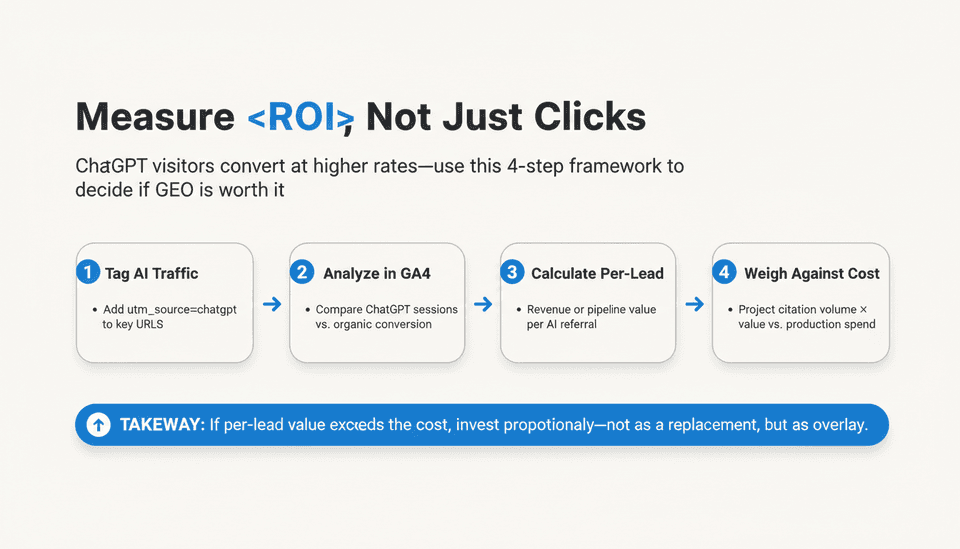
The conflict resolves when you stop counting clicks and start measuring lead quality. ChatGPT visitors often arrive with deep context: the AI has already summarized your offering, so the click is more akin to a bottom-of-funnel action. If your average ChatGPT referral converts at 5% and your average Google organic visitor converts at 0.5%, then 0.62% of traffic can still deliver a disproportionate share of leads. To decide whether ChatGPT GEO is worth it, build this simple measurement:
- Tag all AI search referrals by adding
utm_source=chatgpt(or similar) to your most important URLs when cited. (You can also derive source from user-agents in server logs.) - In GA4, create an exploration comparing sessions and key events from ChatGPT traffic vs. Google organic.
- Calculate the revenue or pipeline value per ChatGPT referral and multiply by your estimated potential citation volume (from an audit of how often you currently appear in ChatGPT for target queries).
- Compare that projected value to the cost of producing or adapting content for ChatGPT visibility.
If the numbers show a positive return, invest proportionally—not as a replacement for current SEO, but as a targeted overlay. If the numbers don’t justify it, wait and monitor monthly. This is a measured ROI decision, not a bandwagon.
Agentic search: the reason this becomes more than GEO
Agentic search changes the architecture. When an AI agent books a service or buys a product, it doesn’t just cite a page; it transacts. That requires structured data, API endpoints, and trusted brand signals far beyond content optimization. Getting cited in ChatGPT today is a precursor to being selected by agents tomorrow because agents will use the same source credibility signals to inform decisions. So even if click volume is low, building citation authority now prepares your site for a future where agentic actions depend on model trust. This is why you see agencies investing in GEO despite the low current referral share: they’re placing a bet on the agentic web.
What is ‘Share of Model’?
Share of Model refers to the proportion of times your brand or page appears in a generative model’s output for a given set of queries. It’s analogous to share of voice in traditional search, but because models can give a single answer and cite multiple sources, it’s measured by counting the number of citations across a query corpus. Tools are emerging to track this, but you can approximate it manually by querying ChatGPT for your target terms and recording which domains appear. The metric matters because it correlates with agentic trust: a model that repeatedly cites your data is more likely to surface your product when a user asks for a recommendation.
When to wait, when to invest now
- Invest now if: you sell high-consideration products or services where a single lead is worth thousands; you’ve already seen ChatGPT citations in your referral logs; your content already answers specific, complex questions well (comparisons, how-tos, data-driven guides).
- Wait and monitor if: your traffic is high-volume, low-margin; AI referrals are zero after three months of proper tagging; your primary audience is mobile-first voice search (where platforms like Perplexity are still more relevant than ChatGPT’s text interface).
A Question-First GEO Playbook
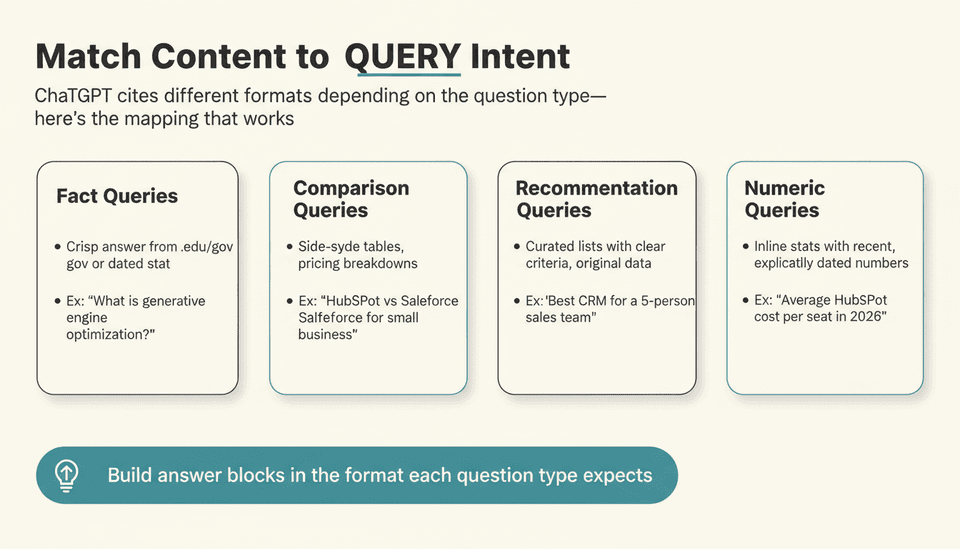 The playbook replaces static checklists with a query-type mapping framework—one of the most effective generative engine optimization strategies for 2026, as detailed in Semrush’s practical guide to GEO. Because citation behavior depends on the question, you must match content format to query intent.
Query type mapping: fact, comparison, recommendation, numeric, local
The following table distills what works for each query type, based on observed ChatGPT and Perplexity citation patterns.
| Query Type | What ChatGPT cites most often | Example | Production priority |
|---|---|---|---|
| Fact / Definition | Crisp, single-paragraph answer; reputable .edu or .gov domains; recent, dated stats | “What is generative engine optimization?” | Medium |
| Comparison | Side-by-side tables, structured lists, pricing breakdowns | “HubSpot vs Salesforce for small business” | High |
| Recommendation | Curated lists with clear criteria; review roundups; original test data | “Best CRM for a 5-person sales team” | Highest |
| Numeric / Data | Inline statistics, chart descriptions, frequently updated dates | “Average HubSpot cost per seat in 2026” | High |
| Local / Proximity | NAP (name, address, phone) consistency, Google Business Profile data (if search-grounded to Bing), local news citations | “Webflow agencies near me” | Varies |
Building answer blocks and source formats ChatGPT cites
For each high-priority query, build an “answer block” that follows the pattern:
- Open with the direct answer in one to three sentences, using the query’s words.
- Immediately support with a specific, attributed data point (“According to [Source], as of [date], …”).
- Follow with structured meat: bulleted comparisons, a table, or numbered steps.
- Close with a source list or internal links that model can use to deepen trust.
This format satisfies browsing mode and search-grounded mode because it mimics how ChatGPT itself constructs an answer.
Platform-specific differences: ChatGPT, Perplexity, Google AI Overviews
- ChatGPT: browsing and search-grounded. In browsing, the page must be crawlable and render quickly; JavaScript-heavy pages often fail. In search-grounded, you compete in Bing’s index. Use the same answer-block approach and ensure Bing indexing.
- Perplexity: more search-engine-like; it prefers pages that load instantly and contain tightly focused answers. Proximity to the query intent is even stricter. Adding a “Key Takeaway” box at the top of a page helps Perplexity extract a concise answer.
- Google AI Overviews: follows traditional ranking signals. If you rank in the top 5 for a query organically, you’re likely to be cited in AI Overviews. Structured data helps, but content quality and links still dominate.
How does Perplexity.ai optimization differ from ChatGPT?
Perplexity’s retrieval is more deterministic: it retrieves web pages in real time for every query, so technical crawlability and page speed matter even more. It also tends to show multiple sources side-by-side, meaning that being the second or third credible source on a niche topic can still win you traffic. Auditing your site’s Core Web Vitals and ensuring content is served as accessible HTML (not solely rendered via JavaScript) is more critical for Perplexity than for ChatGPT’s browsing mode.
Does video content help with GEO?
Directly, no. ChatGPT and Perplexity do not transcribe or cite video as a primary source in 2026. However, a transcript of the video published as text on the same page can be cited. If you produce video, always publish a full-text companion article with key quotes and data points. That article becomes the GEO asset; the video supports user engagement and SEO indirectly.
Is voice search optimization the same as GEO?
Not exactly, but they overlap. Voice search (via Alexa, Siri, Google Assistant) often pulls from featured snippets or top search results, which aligns with answer-style content. GEO, however, targets text-based AI interfaces where the answer may be synthesized from multiple sources. Voice search optimization is a subset: if your content is optimized for Google’s featured snippets, it’s likely to do well in voice answers, but that doesn’t guarantee ChatGPT visibility. Treat voice optimization as a complement to GEO, not a substitute.
Production Options: Manual, Agency, or Automated Content Operations
The cost of producing GEO-optimized content at scale determines whether the ROI math works. You have three paths.
Manual workflows and their ceilings
Manual GEO means a content team (writer + editor + SEO specialist) creating answer-block pages. This works well for 10–20 high-priority queries: the team can research, write, and publish each page with precise formatting. But when you want to cover hundreds of comparison or numeric queries, manual production hits a ceiling—costs climb, turnaround slows, and consistency falters. For most growth-stage companies, manual is excellent for a focused pilot, but it won’t scale.
Agency retainers and the cost-per-citation problem
Agencies now offer GEO-specific retainers, often bundling it with traditional SEO. JH SEO Agency’s expansion (October 23, 2026) and Mutant Media’s new GEO service (launched October 28, 2026 for UAE businesses) illustrate the vendor push. A typical retainer might range from $3,000 to $10,000 per month. If you’re only getting 0.62% of organic traffic from ChatGPT, the cost-per-citation can be astronomical unless each citation drives a high-value lead. Before signing an agency contract, you must do the measurement framework above and project how many additional citations you could realistically earn. If you’re starting from zero, ask the agency for a 30-day pilot with a clear citation-count target.
Automated publishing on Webflow (Joyrise) as an operating model
For businesses on Webflow, automated content platforms collapse the cost of content production. Joyrise, for example, plans SEO-optimized articles, writes illustrated long-form posts, and publishes daily directly to a Webflow blog. It costs between $199 and $999 per month for up to 180 articles, making it possible to address hundreds of query types without a team of writers. This model excels for question-first GEO because you can programmatically target query clusters: “best X for Y,” “how to Z,” “comparison A vs B.” The output still needs a human review for sensitive claims, but the operational overhead is a fraction of agency or manual work. For companies that have validated the ROI of ChatGPT GEO on a small set of queries, automated publishing is the scaling lever.
Choosing the right production model for your stage
- Pre-revenue or bootstrapped: manual pilot for 10 queries; use GA4 and referral logs to measure.
- Growing with a content team: supplement manual with a platform like Joyrise to cover mid-funnel query types at speed, while reserving agency expertise for high-stakes pages.
- Enterprise with an agency on retainer: ask the agency to incorporate automated production for long-tail query coverage; negotiate a hybrid model where agency oversight ensures quality and the platform handles volume.
Fixing Visibility Gaps After an AI Audit
How do I fix visibility gaps uncovered during an AI audit?
An AI audit reveals which of your target queries produce no ChatGPT citations for your domain, or where competitors are cited instead. Fixing those gaps requires a triage process.
- Conduct a crawl and citation audit. Use bots like Screaming Frog to ensure OAI-SearchBot and GPTBot can access high-value pages. Then query ChatGPT (browsing mode and regular mode) for your priority terms and record which domains appear. Cross-reference with your GA4 AI referral data (or server logs with user-agent filtering) to see which pages actually get clicks.
- Triage by query type. Fact queries that you miss likely need more authoritative stats or clearer sourcing. Comparison gaps usually mean you lack a structured comparison table. Recommendation gaps often arise because your content is too promotional; neutral, criteria-based content works better. For numeric queries, check that the data is recent (<12 months) and explicitly dated.
- Fix and monitor. For each gap, either add an answer block to an existing page or create a new dedicated page. Submit the URL to Bing Webmaster Tools (since ChatGPT search grounding often uses Bing) and request indexing. Then, in Google Search Console, look for impressions under “Search results” for your target queries to see if Google’s AI Overviews start picking you up. In GA4, monitor the chatgpt source/medium segment for upticks.
Tracking remediation in Search Console and AI referral logs
Set up a custom dimension in GA4 to capture full referrer URLs. ChatGPT referrals often appear as https://chatgpt.com/... but can be stripped; using a server-side approach to parse the HTTP referer header ensures you don’t lose them to direct traffic. Over the 30 days following fixes, you should see incremental growth in AI-sourced sessions for the fixed queries. If not, re-check crawl access and test the pages in Perplexity (which offers more transparent citation logs) to diagnose.
Mistakes, Myths, Limitations, and Next Steps
Should I block AI crawlers in my robots.txt?
No. Blocking OAI-SearchBot or GPTBot eliminates your chance of appearing in ChatGPT’s browsing and search-grounded modes. Some sites block them to protest AI training, but that’s a brand decision, not a traffic decision. If you want visibility, explicitly allow:
User-agent: OAI-SearchBot
Allow: /
User-agent: GPTBot
Allow: /
Restrict only the pages you truly don’t want cited (e.g., staging, login pages). Blocking everything is the fastest way to zero citations.
Can I optimize for AI without ruining my site for Google?
Yes. The core techniques—clear structure, factual data, fast pages—benefit both. The only risk is over-optimizing for one query type at the expense of overall user experience. Don’t turn every page into a robotic answer block; keep narrative depth where users expect it. For Google, you should still maintain internal linking, topic clusters, and backlink profiles; those don’t conflict with GEO. In fact, types of SEO you need often overlap, and a solid foundation in on-page and technical SEO remains essential.
Limitations of current measurement
AI referral measurement is still immature. Many referrals arrive as direct/none traffic in GA4, UTM parameters are not always passed by platforms, and server logs require maintenance. Tools that claim to track Share of Model are nascent and vary in accuracy. Your internal data will always be an underestimate, so build a conservative model and then apply a judgment multiplier (e.g., “assume actual is 2x measured”) based on your log analysis.
A 30-day test, not a total transformation
Don’t overhaul your entire site. Pick 10 high-priority queries, create/optimize the answer-block pages, ensure crawl access, and monitor for 30 days. Use the measurement framework to decide if expanding is justified. This approach keeps your risk low while you gather real data specific to your audience and market.
Key Takeaways
- ChatGPT GEO is a measured ROI play, not a traffic replacement: focus on lead quality over raw click volume.
- Map every piece of GEO content to a query type (fact, comparison, recommendation, numeric, local); the question determines the citation, not a universal checklist.
- Allow OAI-SearchBot and GPTBot in robots.txt, serve content as fast, crawlable HTML, and structure answer blocks with current, attributed data.
- Choose a production model that fits your economics: manual for pilot, automated (e.g., Joyrise on Webflow) for scaling, agency only when the per-lead value justifies the retainer.
- Connect your GEO work to agentic search readiness: the trust signals you build for ChatGPT today will likely influence AI agent decisions tomorrow.
If you’re ready to turn question-first GEO into daily published content without the overhead, sign up to Joyrise and get your first article published automatically.