 Joyrise
Types of SEO: Choosing What Your Business Really Needs
 By Alexi · · 15 min read

On this page
- Executive Summary
- What Are the Types of SEO?
- The Core SEO Types: Non-Negotiables for Any Site
- Specialized SEO Types: When and Why They Matter
- Ethical Dimensions: White-Hat vs. Black-Hat vs. Gray-Hat SEO
- Settling the Taxonomy Debate: Which Types Are True Standalones?
- A Framework to Prioritize SEO Types by Business Stage
- The Automation Advantage: When AI Combines On-Page, Content, and Technical SEO
- Common Mistakes and Myths About SEO Types
- 2026 Reality Check: What Fresh Ecommerce Data Says About Page Priorities
- Next Steps: Turn SEO Types into a Real Strategy
- Quick Answers: Common SEO Type Questions
- Key Takeaways
Every business owner eventually asks, “What types of SEO do I actually need?” The answer depends on your business stage, not a checklist of tactics. This article moves beyond the standard definitions to give you a prioritization framework, show how AI automation now combines on-page, content, and technical SEO, and explain why fresh 2026 ecommerce data should shift your page focus.
Executive Summary
Most lists of SEO types read like a dictionary—accurate but useless for decision-making. The real competitive advantage comes from sequencing: knowing when to invest in technical SEO versus local SEO, when international SEO pays off, and how automation can collapse three separate workstreams into one. In this guide, you’ll get:
- A plain-language definition of each SEO type, stripped of filler.
- A business-stage framework to prioritize your resources.
- An honest look at how AI tools are blurring the lines between on-page, content, and technical SEO.
- The 2026 ecommerce data that challenges the old “product pages above all” rule.
- The most common mistakes founders make when treating SEO types as standalone silos.
If you want a checklist, there are a thousand. If you want a strategy for your specific situation, keep reading.
What Are the Types of SEO?
SEO isn’t one activity; it’s a collection of disciplines. How you group them determines how you budget, hire, and measure success. At the highest level, the industry agrees on four core types—on-page, off-page, technical, and local—and a growing list of specialized focuses like ecommerce, international, content, and multimedia SEO. Some practitioners also split by ethical approach: white-hat (search-engine approved), black-hat (spam), and gray-hat (the risky middle).
The problem with many taxonomies is they treat specialization as separation. In practice, a single article involves on-page (keyword placement), content (quality, depth), and technical (schema, load speed) simultaneously. This guide treats specializations as lenses you apply on top of the core types, not mutually exclusive boxes.
According to a simplified classification by StudioHawk, the three most commonly cited core types—on-page, off-page, technical—form the backbone of any program. But for local businesses, local SEO is practically a fourth core pillar, not an afterthought.
There are also specialized types: ecommerce SEO for product-driven sites, international SEO for multi-language or multi-region strategies, content SEO as a strategic function, mobile SEO due to mobile-first indexing, and multimedia SEO for video, images, and voice search. Their value lies in unique success metrics, not in entirely unique techniques.
The Core SEO Types: Non-Negotiables for Any Site
These four form the minimum viable SEO effort. Skip any one, and your results will hit a ceiling.
On-Page SEO
On-page SEO is everything you do on the webpage itself to signal relevance to search engines and users: title tags, meta descriptions, headings, URL structure, internal linking, and strategic placement of keywords within high-quality content. It is the most controllable layer, and for many early-stage sites, it delivers the quickest feedback loop.
If you have an hour to spend on SEO today, spend it on improving the on-page elements of your 3 most valuable pages.
Modern on-page SEO isn’t keyword stuffing; it’s about satisfying search intent. Google’s algorithms now evaluate whether your content comprehensively answers the question behind the query, using related entities and topical depth.
Off-Page SEO
Off-page SEO primarily means link building—getting other reputable sites to link to yours—but also encompasses brand mentions, social signals (as an indirect factor), and influencer collaborations. It’s the hardest type to control directly, the one most prone to shortcuts, and the one that still moves the needle significantly for competitive keywords.
The key shift over the last two years: Google has gotten better at ignoring manipulative links, meaning the “spray and pray” guest posting strategy is largely dead. Off-page efforts now look more like digital PR: earning links through original data, expert commentary, and real partnerships.
Technical SEO
Technical SEO ensures search engines can crawl, index, and render your site without friction: site architecture, page speed, mobile-friendliness, structured data (schema), XML sitemaps, canonical tags, and security (HTTPS). Technical problems can silently tank rankings—a misconfigured robots.txt or a slow server response time can keep you invisible regardless of content quality.
Because many site builders now handle basics like sitemaps and SSL automatically, a common mistake is assuming technical SEO is “done.” It requires regular audits, especially after plugins, CMS updates, or traffic growth.
Local SEO
For any business with a physical location or a service area, local SEO is a distinct skillset: optimizing your Google Business Profile, building local citations (consistent NAP: name, address, phone), earning reviews, and creating locally relevant content. Local search operates on a proximity-and-prominence model, making tactics like review velocity and category selection as important as traditional on-page factors.
Google’s local pack can drive more calls and foot traffic than the organic blue links for many industries. If you serve customers in a specific geography, local SEO is not optional.
Specialized SEO Types: When and Why They Matter
Specialized types aren’t fundamentally different in mechanics; they’re adaptations of the core four for specific contexts. Labeling them ensures your strategy accounts for unique user behavior and platform dynamics.
E-Commerce SEO
Ecommerce SEO applies on-page, technical, and off-page tactics to product and category pages, cart flows, and transactional queries. It must balance conversion optimization with rankings, handle faceted navigation (which can create duplicate content), and manage seasonal cycles. A rankings drop for a core product category directly cuts revenue.
Recent data (see the 2026 Reality Check) shows that category pages often outperform product pages for certain high-volume terms, making intelligence-driven prioritization essential.
International SEO
Multinational or multilingual sites face challenges like hreflang tags, ccTLDs vs. subdirectories, cultural keyword differences, and local link-building in each market. A single mistake—like pointing the wrong language page to a search engine—can cause bounce or duplicate content issues.
If less than 15% of your traffic comes from outside your primary country, international SEO is usually a distraction. Verify product-market fit in the target region before investing.
Content SEO
Content SEO elevates content creation from a marketing tactic to a search-driven discipline: topic clusters, keyword-driven editorial calendars, content refreshes, and measuring performance by organic traffic and conversions, not just pageviews. While all on-page SEO involves content, “content SEO” refers to a strategic function that plans, produces, and optimizes at scale.
This type is most relevant for media sites, SaaS blogs, and businesses where education is the primary acquisition channel.
Mobile SEO
With Google’s mobile-first indexing, mobile optimization is inherently part of technical and on-page SEO. However, the specialization remains because mobile user behavior differs: shorter queries, more voice search, higher bounce tolerance for slow pages. Core Web Vitals like Largest Contentful Paint (LCP) make mobile performance a direct ranking factor.
Multimedia SEO (Video, Image, Voice)
YouTube SEO is often called its own type because YouTube’s algorithm weights watch time, engagement, and metadata differently. Image SEO (alt text, file compression, structured data) impacts Google Images traffic. Voice SEO focuses on natural language, featured snippets, and question-based queries for assistants.
These are best treated as channels within your broader SEO strategy, each with specific optimization rules, but all pull from the same core principles of relevance and accessibility.
Ethical Dimensions: White-Hat vs. Black-Hat vs. Gray-Hat SEO
The ethical dimension cuts across all types. White-hat practices adhere to search engine guidelines and focus on long-term value. Black-hat techniques (keyword cloaking, link farms, comment spam) aim to cheat the algorithm and work—until they don’t, often resulting in manual actions or algorithmic suppression that can take months to reverse. Gray-hat sits in the ambiguity, like buying expired domains for a private blog network or using AI to generate borderline-spam content at scale.
For any business with a real brand to protect, white-hat is the only durable path. The occasional gray-hat tactic may offer a short-term boost, but the risk-reward ratio has worsened as Google’s SpamBrain gets increasingly sophisticated.
Settling the Taxonomy Debate: Which Types Are True Standalones?
You’ll find sources listing 14 types of SEO or more, including Content SEO, Mobile SEO, YouTube SEO, and even Negative SEO. The debate: are these distinct types or merely applications of core types?
Our explicit adjudication: Content, Mobile, and YouTube SEO are specialized focuses. They require dedicated playbooks and performance indicators, but their mechanics are combinations of on-page, technical, and off-page principles. The reason to treat them as separate in planning is organizational: a content team may need a standalone content SEO function, a product team a dedicated mobile performance lead. They are operationally distinct enough to warrant their own goals and KPIs, but they are not theoretically separate.
Negative SEO (someone maliciously pointing spammy links to your site) appears on some lists. We exclude it from any practical taxonomy—it’s a threat to mitigate, not a strategy you pursue. It belongs in a risk management plan, not a capabilities map.
The practical takeaway: don’t get hung up on taxonomy. Ask, “Does my business model create a specific context that demands a non-standard focus?” If yes, give that focus a name and allocate resources to it.
A Framework to Prioritize SEO Types by Business Stage
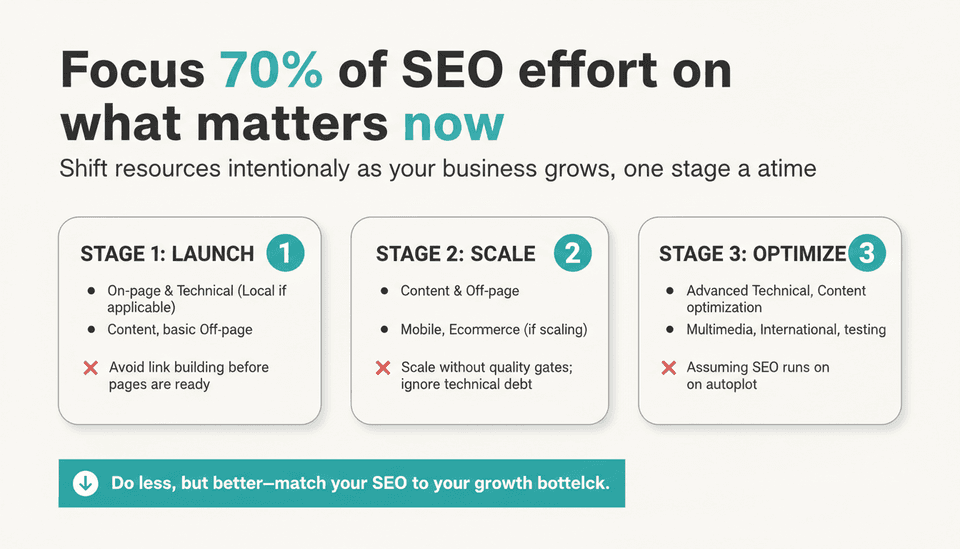
This is the section most guides skip. Here is a practical, stage-dependent framework for allocating your limited time, budget, and attention. Identify your current stage, then focus 70% of your SEO effort on the primary types, 20% on the secondary, and 10% on maintenance of the rest.
Stage 1: Launch & Authority Building
Typical situation: New website, low domain authority, little organic traffic, small team.
Primary focus: On-page SEO and technical SEO. Without solid on-page foundations (well-optimized pages, clear architecture, fast loads), any links you earn later will be wasted. Technical SEO ensures crawlability and indexing. If you’re a local business, local SEO joins the primary set from day one.
Secondary focus: Content SEO (create cornerstone content matching your core offerings), off-page SEO (basic directory profiles only; avoid aggressive outreach until your pages are worth linking to).
Common mistake: Investing in link building before you have pages that deserve links. You’ll burn cash and attract low-quality links.
Stage 2: Scaling & Audience Expansion
Typical situation: Established site, steady organic traffic (perhaps 10k–50k visits/month), growing content inventory, starting to rank for non-brand terms.
Primary focus: Content SEO and off-page SEO. Scale content around topic clusters, earn editorial links through outreach, original research, and partnerships. Technical SEO shifts to maintenance and advanced optimizations (JavaScript rendering checks, structured data expansion). On-page becomes a systematic process for all new content.
Secondary focus: Specialized types based on signals. If mobile traffic exceeds 60%, invest in dedicated mobile performance. If your product catalog is growing, formalize ecommerce SEO. International SEO enters only if data shows demand from other countries.
Common mistake: Scaling content quantity without quality gates, leading to thin content that hurts overall authority. Also, neglecting technical debt during a site migration.
Stage 3: Optimization & Sustaining Growth
Typical situation: High authority, ranking for thousands of keywords, large content library, significant organic revenue.
Primary focus: Advanced technical SEO (log file analysis, edge SEO), conversion-oriented content SEO (refreshing old content, improving internal linking to boost page-2 rankings), maintaining link velocity through ongoing PR. Multimedia SEO becomes important: optimizing videos, images, and voice search schemas.
Secondary focus: International SEO if global expansion is active; A/B testing on-page elements for CTR; experimenting with schema types (FAQ, HowTo) for rich results.
Common mistake: Assuming “we’re doing well, so SEO is on autopilot.” At this stage, competitors target your keywords; sustaining growth requires active defense.
SEO Prioritization by Business Stage: A Summary Table
| Business Stage | Primary SEO Types | Secondary SEO Types | Key Resource | Top Pitfall |
|---|---|---|---|---|
| Launch & Authority Building | On-page, Technical (Local if applicable) | Content, basic Off-page | In-house + free tools | Link building before pages are ready |
| Scaling & Audience Expansion | Content, Off-page | Mobile, ecommerce, potential International | SEO manager or agency, automation | Scaling without quality; ignoring technical debt |
| Optimization & Sustaining Growth | Advanced Technical, Content optimization | Multimedia, International, testing | In-house team + specialists | Assuming SEO runs on autopilot |
This framework is not rigid; overlap is expected. The point is intentional allocation—doing less but doing it better at each stage.
The Automation Advantage: When AI Combines On-Page, Content, and Technical SEO
Historically, on-page SEO, content creation, and technical audits required three skill sets, three tools, and three people. AI-driven platforms now collapse these into a single workflow.
For example, an automated content marketing platform like Joyrise scans your site for technical and content gaps, generates an SEO-optimized article complete with internal links and schema markup, and publishes it directly to your Webflow blog—all in one sequence. This means that for a growing business, the distinction between content SEO and technical SEO becomes operationally invisible: the output is a page that is well-written, keyword-informed, technically clean, and published consistently.
On the site-builder side, tools like Hostinger’s AI website builder (reviewed by Cybernews on October 21, 2026) can automatically generate mobile-friendly pages with proper headings and meta tags—tackling basic on-page and technical SEO out of the box. However, these tools don’t build backlinks, write deep content, or manage local listings. The pattern is clear: AI can now handle the execution-heavy parts of on-page, content, and technical SEO, but off-page and local still require human relationship-building.
What does this mean for your prioritization? You can automate the types that are rules-based and repetitive, freeing your team to focus on the types that require creativity and trust-building.
If you’re evaluating your stack, the SEO tools landscape in 2026 has shifted heavily toward integrated AI. The key is to assess whether your tools reduce the number of manual steps between planning and publishing. For an honest look at what generative AI can and can’t do, see this FAQ on ChatGPT and SEO—the short answer is that it needs an orchestration layer to connect on-page, technical, and publishing workflows.
Automation doesn’t eliminate the need to understand types of SEO; it changes the required depth. You still need to know what good on-page looks like to set rules, but you don’t need to manually adjust every hreflang tag.
Common Mistakes and Myths About SEO Types
Treating types as sequential phases. Many founders think: “We’ll do on-page first, then off-page after 6 months.” In reality, they overlap. A great page earns links naturally; a good link profile makes on-page work more effective. Run them in parallel with correct resource weighting.
Equating “content SEO” with “blogging.” Content SEO encompasses service pages, product descriptions, guides, and landing pages. A blog is just one format.
Assuming technical SEO is a one-time project. Search engines change how they crawl; your CMS gets updated. Technical SEO is ongoing hygiene.
Thinking ecommerce SEO is just product descriptions. The biggest wins often come from category page optimization, faceted navigation management, and internal linking—elements overlooked by many site owners, as highlighted by the Search Engine Land analysis.
Believing that local SEO doesn’t apply because “we sell online.” If you have a physical office tied to any service, or want to rank for “near me” queries, local SEO matters.
Confusing “automated SEO” with “set-and-forget.” Automation handles execution; it still requires strategy inputs, performance reviews, and periodic rule adjustments. Without human oversight, an automated system will compound errors at speed.
2026 Reality Check: What Fresh Ecommerce Data Says About Page Priorities
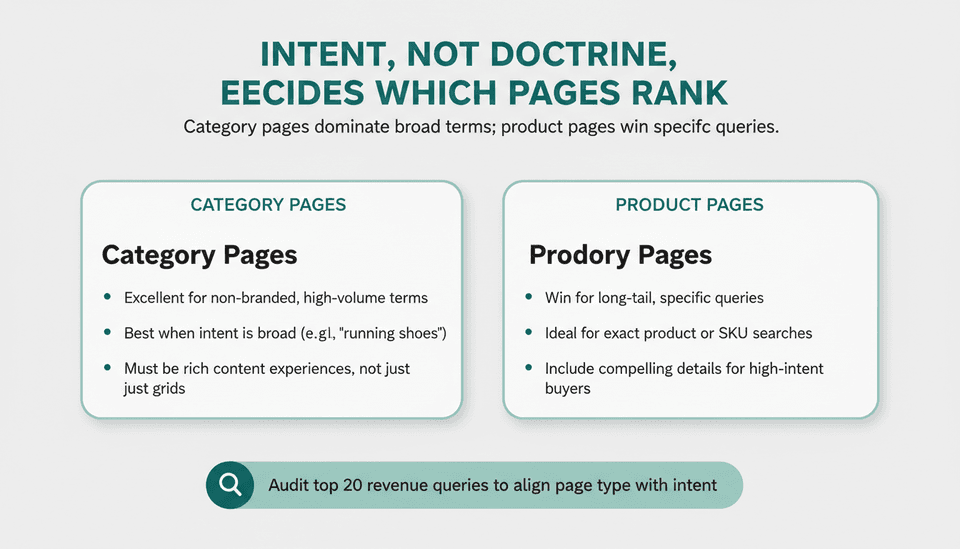
For years, ecommerce SEO dogma held that product pages are the most valuable and that you should build your architecture to channel authority to them. New data, published by Search Engine Land on October 24, 2026, analyzing 100 ecommerce sites, challenges that assumption.
The research found that category pages often outperform product pages for non-branded, high-volume terms, while product pages tend to win for long-tail, specific queries. Google’s interpretation of search intent—not a blanket rule—decides which page type ranks. For “running shoes,” a well-optimized category page may be more relevant than any single product page. For “Nike Air Zoom Pegasus 38 size 10,” the specific product page wins.
Your ecommerce SEO priority must be data-driven, not doctrine-driven. Audit your top 20 revenue-driving search queries. Note whether Google currently ranks your category or product pages for each. Optimize (or create) the page type that aligns with the intent of that query. Do not assume that adding text to product pages will leapfrog a category page that better matches broad intent.
This insight also affects internal linking: if a category page is your best contender for a head term, link to it from related blog content, not just from product pages. Treat category pages as rich content experiences, not just grids of products.
Next Steps: Turn SEO Types into a Real Strategy
Audit your current state. Identify which core types (on-page, off-page, technical, local) are solid and which are weak. Use Google Search Console for basics, and consider a professional technical audit if you’ve never done one.
Determine your business stage. Use the framework table above. If you have fewer than 1,000 organic visits a month, you’re likely still in Stage 1 regardless of how long your site’s been live.
Allocate 70/20/10 resources. Shift your primary focus to the types that match your current bottleneck. If you’re a local bakery, local and on-page are primary; international is off the table.
Select automation for repetitive types. On-page and content SEO at scale are prime candidates. Evaluate whether a platform can collapse your content production and technical checks into one workflow, freeing you for off-page and strategy.
Set 90-day measurable goals for each type. Instead of “improve SEO,” define:
- On-page: increase indexed pages by 20%.
- Technical: achieve a Core Web Vitals “good” score for mobile.
- Content: publish 12 optimized target-topic articles.
- Off-page: earn 5 new links from domains with DR > 40.
Review and rebalance. After 90 days, reassess. If technical SEO is clean, shift effort toward content or off-page. Stagnation means you’re over-investing in a type that has reached its marginal return for your current stage.
Quick Answers: Common SEO Type Questions
What are the main types of SEO?
The main types are on-page (content and HTML elements), off-page (backlinks and authority signals), technical (crawlability and site health), and local (visibility in geographic searches). Specialized types like ecommerce, international, content, mobile, and multimedia SEO adapt these core types to specific channels or contexts.
Why is on-page SEO important?
On-page SEO is the most directly controllable layer and the first place search engines look to understand relevance. Without optimized title tags, headings, and content that matches search intent, even a site with strong backlinks and perfect technical health will fail to rank for its target terms. It’s the foundation that makes all other SEO effort worthwhile.
Is it possible to do SEO on my own?
Yes, especially in early stages. For a simple website, you can handle on-page SEO, basic technical audits, and foundational content creation with free tools like Google Search Console. As you scale, off-page and advanced technical work often require specialist help, but many founders successfully run their own SEO for the first year—provided they avoid quick-fix temptations.
How do I choose which SEO types to focus on?
Use the business-stage framework in this guide. If you’re launching, prioritize on-page and technical. If scaling, emphasize content and off-page. Let data—not assumptions—tell you when to add specialized types like international or multimedia. Focus 70% of your resources on the types that match your current growth bottleneck.
How does automation change the way I do SEO?
Automation, especially AI-driven platforms, combines on-page, content, and technical tasks into single workflows, cutting the manual effort for routine publishing and audits. It allows small teams to produce high-quality, SEO-optimized content at scale and maintain technical cleanliness without dedicated specialists for each type. However, off-page and local SEO still require human judgment, and all automation needs strategic oversight.
Key Takeaways
- The four core SEO types—on-page, off-page, technical, and local—are non-negotiable, but the weight you give each must shift with your business maturity.
- Prioritize by business stage, not by a static checklist: launch with on-page and technical; scale with content and off-page; optimize with advanced technical and multimedia.
- AI automation now collapses on-page, content, and technical SEO into a single workflow, making it possible to operate lean while scaling output—but it doesn’t replace off-page relationship building.
- New 2026 ecommerce data shows category pages often outrank product pages for high-volume terms, so let search intent data drive your page optimization priorities, not outdated rules.
- Treat specialized SEO types (ecommerce, international, multimedia) as operational focuses on top of core types, not entirely separate disciplines, and only invest when your business context demands it.
To see how an automated platform can execute your on-page, content, and technical SEO in one integrated workflow, sign up for Joyrise and get your first AI-optimized article free.