 Joyrise
Can ChatGPT Do SEO? An Honest FAQ for Founders
 By Alexi · · 10 min read

On this page
- What does “Can ChatGPT do SEO?” actually mean?
- Using ChatGPT to do SEO tasks: What’s realistic?
- What is ChatGPT SEO (optimizing for ChatGPT)?
- ChatGPT vs. specialized AI SEO tools: Which should you use?
- Recent developments that change the ChatGPT SEO landscape
- Frequently asked questions about ChatGPT and SEO
- Key Takeaways
If you’re asking “Can ChatGPT do SEO?”, you are probably trying to figure out whether the tool you keep hearing about can replace a content writer, an agency, or at least save you a dozen hours a week. The short answer is yes, but not in the way most founders hope. It will not run your entire organic growth engine by itself, but it can accelerate specific tasks—if you know where it breaks. This FAQ addresses both meanings of the question: using ChatGPT as an assistant to do SEO work, and optimizing your site so ChatGPT surfaces it as a traffic source.
What does “Can ChatGPT do SEO?” actually mean?
The phrase splits into two distinct problems founders need to solve right now.
The first is using ChatGPT to do SEO tasks: keyword research, outlining, drafting, title tag ideas, schema markup snippets, and even regex for redirects. This treats ChatGPT as a low-cast assistant.
The second is optimizing for ChatGPT as a search engine—what practitioners now call generative engine optimization 2026. Here, your goal is to get your brand cited when users ask ChatGPT a question, which sends referral traffic your way. Both matter, and both have hit turbulence in October 2026 that makes an honest FAQ necessary.
Using ChatGPT to do SEO tasks: What’s realistic?
What SEO tasks can ChatGPT help with?
ChatGPT is genuinely useful for ideation and first-draft content frameworks. Give it a cluster topic and your best-performing page, and it will return related subtopics faster than any manual brain dump. It can write meta descriptions at scale, generate schema markup when you feed it the field list, and convert messy bullet points into coherent H2/H outlines.
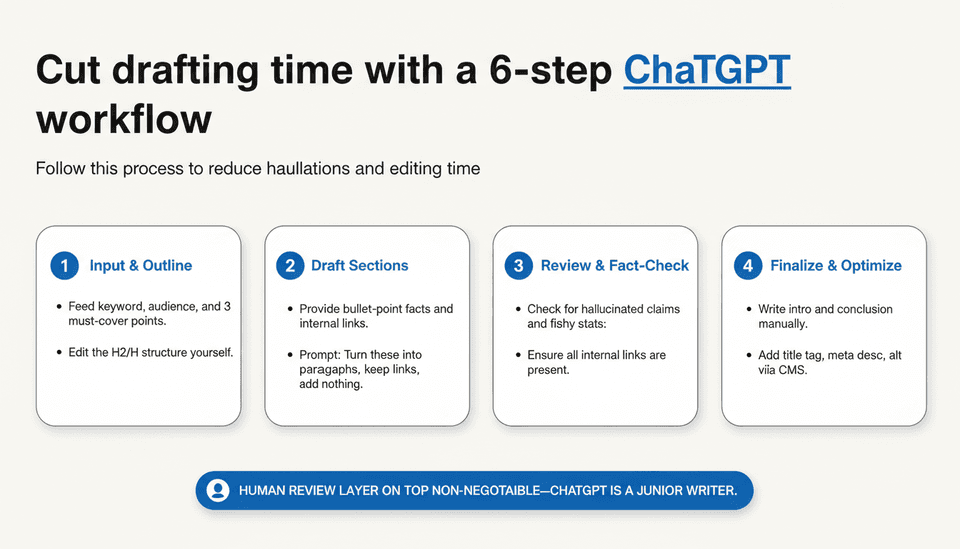
For content production, it works best when you treat it like a junior writer with no brand knowledge. You provide the specific claims, the data, the quotes, and the internal links; ChatGPT structures them into readable paragraphs. SEOs who run structured workflows with it report cutting outline-to-draft time by roughly half, but always with a human review layer on top.
A practical checklist for using raw ChatGPT on one article:
- Feed it your target keyword, audience, and the three points you must cover.
- Ask for an H2/H outline. Edit the structure yourself—do not outsource information hierarchy.
- For each section, give it your bullet-point facts and links. Prompt: “Turn these bullets into two paragraphs. Keep the links. Do not add information not listed.”
- Review the output for hallucinated claims, fishy statistics, and missing internal links.
- Write or rewrite the introduction and conclusion yourself. ChatGPT can frame, but you own the hook and the ask.
- Add all technical SEO elements (title tag, meta description, alt text) manually or via your CMS.
Using ChatGPT for keyword research
When using ChatGPT for keyword research, it can suggest semantically related terms and classify search intent, but it cannot provide search volume, keyword difficulty, or click-through rate data. Using it for final keyword decisions means guessing on the numbers that deretmine ROI. Treat its keyword ideas as prompts for validation inside Ahrefs, Semrush, or Google Search Console—never as the source of truth.
The second risk is workflow fragmentation. Copy-pasting between ChatGPT, your SEO tool, Google Docs, and your CMS adds friction that causes mistakes. Missed internal links, duplicate H1s, and publication delays multiply when there is no single system connecting research to the live page.
What is ChatGPT SEO (optimizing for ChatGPT)?
Why should you do SEO for ChatGPT?
Because ChatGPT is now a meaningful traffic source for brands whose content gets cited in its responses. When a user asks “best project management tool for small teams” and ChatGPT names three products, the ones with brand citations get the click. As Search Engine Land reported on October 21, 2026, generative engine optimization has matured into a distinct discipline, complete with strategies for getting surfaced inside ChatGPT, Google AI Overviews, Gemini, and Perplexity. Generative engine optimization 2026 is no longer an experiment—it is a requirement for brands that want to show up where their audience now asks questions.
The mechanics differ from traditional SEO. ChatGPT does not crawl the web live for every query—it relies on training data and, in some cases, browsing integration. Your content still needs to be authoritative, structured, and well-cited across the web. Brand mentions on high-authority domains, clear schema markup, and original research all increase the odds that ChatGPT pulls your business into a response.
How to measure ChatGPT SEO performance
Measuring ChatGPT referral traffic got harder four days ago. On October 20, 2026, DesignRush reported that ChatGPT was stripping UTM tags from links, causing those visits to appear as direct traffic in analytics rather than properly attributed referrals. This is not a setting you can fix on your end—it is a platform-level bug that makes accurate attribution impossible right now.
For the moment, your best measurement strategy is to:
- Monitor your Search Console dashboard for any AI-assistant referral data Google surfaces.
- Watch for spikes in direct traffic to pages you suspect are being cited by ChatGPT, then cross-reference with brand monitoring tools that track LLM citations.
- Use third-party LLM visibility tools that query ChatGPT directly and report whether your brand appears.
Assume your ChatGPT traffic is undercounted until OpenAI resolves the UTM issue. Founders evaluating AI SEO investment should budget time and tooling specifically for this attribution gap.
ChatGPT vs. specialized AI SEO tools: Which should you use?
This is the decision that an honest AI SEO tool comparison needs to clarify: when is a general-purpose chatbot enough, and when do you need a platform built for search?
When is raw ChatGPT enough?
Raw ChatGPT works when you are producing fewer than four pieces of content per month, each under 1,500 words, and you or your team can hand-edit every draft before publication. It also works for one-off technical SEO snippets—generating an .htaccess redirect rule or a robots.txt directive—where you can test the output immediately.
The cost is just the subscription fee ($20/month for Plus), but the real cost is editing time. Practitioners who run ChatGPT for SEO tasks consistently report spending 30–60 minutes per article correcting hallucinated facts, rewriting generic intros, and manually adding internal links. For a founder producing eight articles a month, that is four to eight hours of editing—half a workday that could go toward strategy or product.
When to upgrade to an AI content publishing platform
Specialized platforms like Joyrise function as an AI content publishing platform, compressing the research-write-publish pipeline into a single workflow. Rather than prompting ChatGPT for an outline, then keywords, then a draft, then heading structure, you start with a site scan that learns your brand voice, audience, and content gaps. The output includes long-form articles with original branded images, meta descriptions, internal links, and table-of-contents formatting—all delivered directly to a Webflow blog as published posts or drafts. For teams that need automated SEO articles Webflow publishing, this eliminates the manual transfer that causes delays and errors.
The functional difference is that a second AI model performs a quality judgment pass on every article (available on Pro and Max tiers), catching the generic filler prose and unsupported claims that raw ChatGPT routinely introduces. This addresses the core editing burden without requiring a human to read every first draft.
ChatGPT vs SEO agency cost
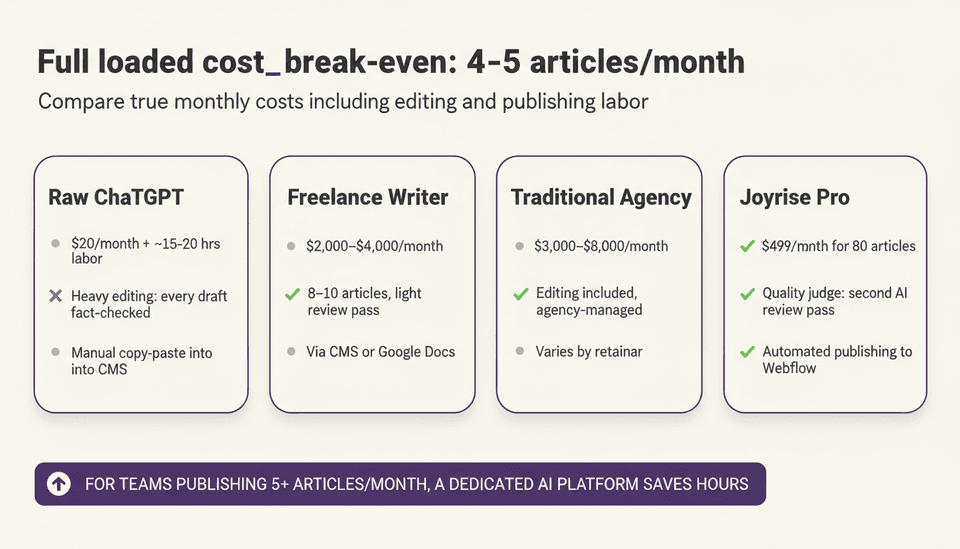
The cost difference is straightforward. When comparing ChatGPT vs SEO agency cost, you must account for the hidden labor of editing and publishing raw AI output:
| Approach | Monthly cost (approx.) | Articles/month | Editing required | Publishing workflow |
|---|---|---|---|---|
| Raw ChatGPT + manual workflow | $20 + ~15-20 hrs labor | 8–10 | Heavy: every draft needs fact-checking and formatting | Manual copy-paste into CMS |
| Freelance SEO writer | $2,000–$4,000 | 8–10 | Light: one review pass | Via CMS or Google Docs |
| Traditional SEO agency | $3,000–$8,000 | Varies | Included in retainer | Agency-managed |
| Joyrise (Pro tier) | $499 | 80 | Light: strategic review of published posts | Automated to Webflow |
| Joyrise (Basic tier) | $199 | 30 | Moderate: no quality judge pass | Automated to Webflow |
Founders scaling beyond a handful of posts per month should compare the full loaded cost of DIY ChatGPT (subscription plus editing labor) against a subscription that automates the publishing step entirely. The break-even is usually around four to five articles per month, assuming your editing time is worth at least $50/hour.
Recent developments that change the ChatGPT SEO landscape
October 20, 2026: ChatGPT traffic data errors
The DesignRush SEO Roundup from October 20 confirmed what many operators already suspected: ChatGPT traffic attribution is broken. Links surfaced in ChatGPT responses are losing their UTM parameters, dumping that traffic into the direct channel bucket in Google Analytics. If you are evaluating the ROI of generative engine optimization, your current data is almost certainly undercounting ChatGPT referrals. No fix is available from the user side as of this writing; monitoring the issue through analytics community channels is the only near-term action.
Generative engine optimization gains traction
On October 21, Search Engine Land published a definitive guide to generative engine optimization, signaling that GEO has moved from experimental tactic to established practice. The guide covers content structure, entity optimization, and the citation patterns that LLMs favor when constructing responses. For any founder asking “Can ChatGPT do SEO?”, the answer now includes the fact that you must also do SEO for ChatGPT—and the playbook for that is being written in real time.
Frequently asked questions about ChatGPT and SEO
Why should you do SEO for ChatGPT?
Because your prospects are asking ChatGPT questions about your product category right now, and the brands that appear in those answers capture traffic that never touches Google. This is not theoretical—referral data from AI assistants is showing up in analytics, even if the October 2026 UTM bug makes current numbers unreliable. Ignoring ChatGPT as a traffic source means ceding your category to competitors who invest in the structured, authoritative content that LLMs favor.
Can AI replace SEO experts?
No, not for strategy and decision-making. ChatGPT can execute defined tasks—write a meta description from a keyword, generate headline variants, suggest content clusters—but it cannot audit a site, diagnose a traffic drop, or decide which pages to consolidate. The adjudication here is clear: resources that claim ChatGPT is a reliable research assistant are overstating; those that dismiss it entirely miss its real utility. The balanced position: ChatGPT is a useful tactical assistant for ideation and frameworks, but data-critical decisions (keyword targeting, technical fixes, content investment) require a human who can validate outputs and understand the business context. So when you ask, “can AI replace SEO experts,” the operational truth is that it augments them—but it cannot replicate the strategic judgment that turns data into revenue.
What are the risks of letting ChatGPT write your SEO content?
The primary risk is publishing plausible but factually wrong claims that erode trust and potentially violate Google's helpful content guidelines. ChatGPT hallucinates statistics, attributes quotes to the wrong people, and defaults to generic, unsupported advice when it lacks specific information. A secondary risk is duplicate or near-duplicate content; if multiple sites in your space prompt ChatGPT similarly, the output converges on the same phrasing. Human review—not just proofreading but fact-verification—is non-negotiable before any AI-written content goes live.
How do I fix traffic attribution when ChatGPT drops UTM tags?
You cannot fix this on your own in October 2026. The UTM-stripping behavior reported by DesignRush on October 20 is a platform-side issue. Your immediate steps: (1) annotate your analytics to flag the direct traffic spike period as potentially including ChatGPT referrals, (2) cross-reference ChatGPT citation data from LLM monitoring tools if you use them, and (3) watch for an OpenAI fix or acknowledgment. When attribution is restored, ensure your ChatGPT-optimized content includes tracking-ready URLs with campaign parameters.
What is generative engine optimization?
Search Engine Land's October 21 guide defines it as the discipline of optimizing content to appear in AI-generated search responses—across ChatGPT, Google AI Overviews, Gemini, Perplexity, and similar systems. It differs from traditional SEO in prioritizing entity recognition, citation authority, and content structure that LLMs can parse cleanly. Tactics include publishing original data, securing brand mentions on high-authority domains, and using clear schema markup that helps models understand your content's purpose and relationships.
Is there a cost-effective alternative to using ChatGPT for bulk SEO content?
Yes—platforms designed for automated SEO articles Webflow publishing fill the gap between expensive agencies and time-heavy DIY ChatGPT workflows. Joyrise, for example, handles the full pipeline from keyword research through publishing at a per-article cost that undercuts both agency retainers and the loaded labor cost of editing raw ChatGPT output. The economic trade-off: you trade a few minutes of prompt control for hours of editing time saved, with quality guardrails built into the generation process rather than bolted on afterward. For teams publishing more than a handful of posts per month, this is typically the most cost-effective path.
A final note on the broader landscape: the recurring debate over whether AI can replace SEO experts misses the operational reality most founders face. You do not need to replace an expert entirely. You need to publish accurate, optimized content consistently without spending all week on it. The tools that handle the pipeline—not just the drafting—are the ones that actually change your weekly calendar. For a step-by-step approach to building that pipeline, see this guide to doing SEO in 2026.
Key Takeaways
- ChatGPT is useful for SEO ideation and frameworks, not final data decisions—validate every keyword claim, statistic, and competitor reference it generates against a real data source.
- The October 2026 UTM-stripping bug means ChatGPT referral traffic is currently undercounted, so do not make investment decisions based solely on GA4 attribution until the issue is resolved.
- Generative engine optimization is now a distinct discipline requiring entity authority, citation building, and content structure that traditional SEO alone does not cover.
- Cost comparison matters: raw ChatGPT costs $20/month but demands heavy editing time; specialized platforms cost more in subscription but eliminate the manual publishing and quality-review steps that eat founder hours.
- AI content must still pass the helpful content standard—publishing ChatGPT output without fact-checking creates trust and ranking risk that no workflow shortcut justifies.
Get your first AI-optimized article published t Webflow before you commit a cent—try Joyrise and read your first article before you pay.