 Joyrise
How to Do SEO in 2026: An AI-Safe, Step-by-Step Guide
 By Alexi · · 17 min read

On this page
- What You’ll Get from This Guide
- The 2026 SEO Reality Check: AI Is Now Inevitable, But Risk Is Real
- Before You Start: Tools, Access, and Safety Nets
- Step 1: Diagnose Your Site’s Current Health with an AI Audit
- Step 2: Plan a Content Strategy That Builds Authority
- Step 3: Create AI-Assisted Content That Survives Scrutiny
- Step 4: Optimize On-Page Elements for Readers and Robots
- Step 5: Publish, Submit, and Monitor
- Worked Example: Launching a B2B SaaS Blog from Scratch
- Success Criteria: How to Know Your SEO Is Working
- When Things Go Wrong: Troubleshooting Common SEO Issues
- How does Google Search work? (brief overview)
- How long until I see impact in search results?
- Why prioritize content creation over off-page SEO?
- How can I use AI for SEO safely?
- What is Generative Engine Optimization (GEO)?
- Key Takeaways
description: Learn how to do SEO in 2026 safely with AI. Step-by-step guide covering technical audit, content creation, on-page SEO, and GEO to avoid AI penalties.
How to Do SEO in 2026: An AI-Safe, Step-by-Step Guide
Learning how to do SEO today requires a new playbook. It’s no longer enough to chase keywords. You must create content that ranks in traditional search results and gets cited by AI assistants like ChatGPT, Claude, and Gemini. This guide shows you exactly how to do that—without triggering AI content penalties. It’s built for founders, marketing leads, and content teams who want a repeatable, measurable system that balances AI speed with the authority signals engines now reward. This how to do SEO 2026 guide covers everything you need.
What You’ll Get from This Guide
The outcome: A fully optimized, AI-enhanced SEO strategy using the latest ai seo tools
By following the steps below, you’ll have a content operation that produces high-authority pages, passes all major technical health checks, and surfaces your brand in both search results and generative engine responses. You’ll know how to use AI tools safely, not as a shortcut, but as an accelerator that multiplies your team’s expertise.
Who this is for: Marketing leads, founders, and content teams
This guide suits anyone responsible for growing organic traffic on a business site—especially if you’re on Webflow, but the principles apply universally. If you’re tired of generic SEO advice and want a concrete workflow that accounts for 2026’s generative-search reality, start here.
Time, cost, and risk
| Phase | Estimated time | Cost | Risk if skipped |
|---|---|---|---|
| AI audit & diagnosis | 2–4 hours | Free (GSC) to $139/mo (Semrush) | Missed technical blockers; indexing failures |
| Content strategy & planning | 5–10 hours | Tooling optional | Aimless content; no authority buildup |
| AI-assisted content creation | 2–5 hours per page | Platform fees (e.g., Joyrise at $199–$999/mo) or manual effort | Low-value pages; potential spam flags |
| On-page optimization & publishing | 1–3 hours per page | CMS cost | Poor rankings even with good content |
| Monitoring & troubleshooting | Ongoing, 1–2 hours/week | GSC free; dashboards vary | Months of stagnation unnoticed |
Risk management note: The largest risk in 2026 is getting a manual action or algorithmic demotion for scaled AI content. The workflow in Step 3 eliminates that risk by mandating a second AI or human quality judgment pass before anything goes live.
The 2026 SEO Reality Check: AI Is Now Inevitable, But Risk Is Real
Why most 'how to do SEO' guides are outdated
Most guides were written before AI-generated content flooded the web and before generative engines became a meaningful traffic source. They still treat content creation as fully manual, ignore LLM citations, and haven’t updated their on-page advice for the machine-reader layer. You can’t afford to follow a 2024 recipe in late 2026.
The GEO shift: How generative engines are rewriting the rules
On October 21, 2026, Search Engine Land published a comprehensive introduction to Generative Engine Optimization (GEO), defining it as “strategy, structure, and metrics for AI-driven search discovery.” In practice, this means your content must be visible and citable by AI models that answer queries directly. If ChatGPT or Claude serves your product comparison to a user without a click, you still win—but only if your pages are structured and authoritative enough to be the source. As also noted in 8 top SEO trends I'm seeing in 2026, generative engine citations are transforming organic reach.
The AI content warning—and how to do it right
On October 20, 2026, Practical Ecommerce warned that creating content at scale with ChatGPT, Claude, and similar tools is “increasingly dubious for SEO.” That’s a fair caution: raw, mass-produced AI output with no human oversight routinely triggers spam signals. Yet Backlinko’s updated on-page SEO guide (October 15, 2026) and Search Engine Land both show how AI can be used for research, drafting, and optimization. The conflict is real, but it’s also resolvable.
The position we take: Unedited, scaled AI content is a liability. A human-AI collaboration where a domain expert shapes the draft and a second AI or human reviewer verifies uniqueness, accuracy, and value is both effective and safe. That quality judgment pass is the line between spam and scale. Skip it, and you’re gambling.
Our guiding principle: Use AI as an accelerator, not a replacement for expertise
Everything in this guide operates on that principle. AI writes fast; you provide the strategy, the unique insights, and the final judgment call. For a broader look at the forces reshaping organic discovery, see our SEO in 2026: Definitive Guide for Founders and Operators.
Before You Start: Tools, Access, and Safety Nets
Essential tools
You’ll need:
- Google Search Console (free) – for indexing, performance monitoring, and troubleshooting.
- Semrush (paid, with Site Audit and MCP server support) – for technical audits and competitor gap analysis. The MCP server connects to Claude for AI-driven audit interpretation (more in Step 1).
- Claude (or an equivalent LLM with API/MCP capability) – for analyzing audit data, generating research briefs, and performing quality reviews.
- A content automation platform – optional but transformative. If you’re running a Webflow blog, a platform like Joyrise handles everything from keyword planning to AI-generated articles with original images and auto-publishing. You can replicate the steps manually, but the time savings are significant when scaling beyond a handful of pages per month.
Permissions and backups
Ensure you have:
- Admin access to Google Search Console for your domain property.
- Publishing rights to your CMS (e.g., Webflow Editor or Admin).
- A backup workflow: before any bulk publishing or site-wide SEO changes, export your existing pages or create a restore point. Joyrise’s draft mode (if used) can serve as a safety net, letting you review each article before it goes live.
Step 1: Diagnose Your Site’s Current Health with an AI Audit
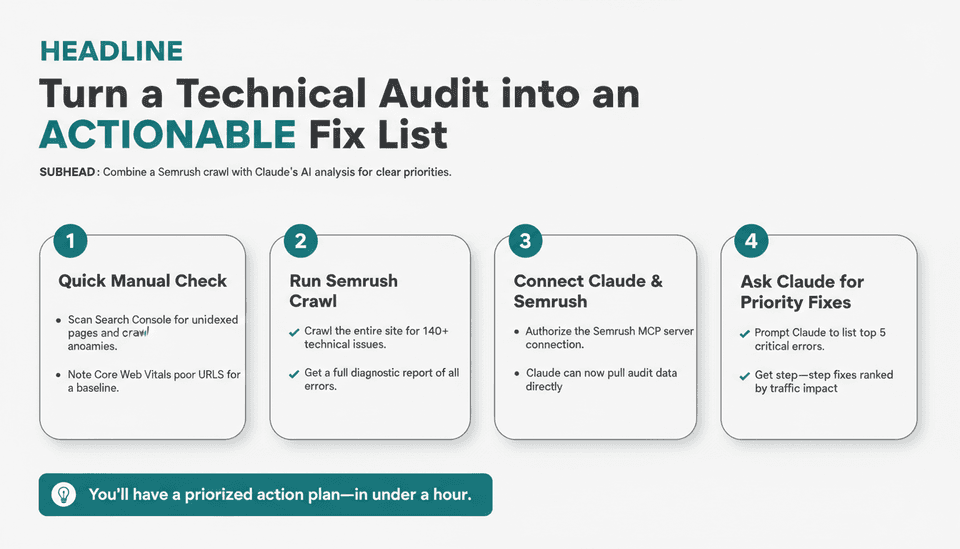
This technical SEO audit AI method combines Semrush’s crawl with Claude’s analysis.
Quick manual check using Google Search Console
Start by scanning Search Console’s Pages report. Filter by unindexed pages, crawl anomalies, or pages blocked by robots.txt. Note any spike in exclusions. Then check Core Web Vitals for poor URLs. These give you a baseline for critical fixes.
How to run an AI-enhanced audit with Claude + Semrush MCP
On October 15, 2026, Semrush published a detailed guide on running an SEO audit with Claude using its Model Context Protocol (MCP) server. Here’s the updated workflow:
- Crawl your site with Semrush Site Audit. Let it scan for 140+ technical issues.
- Connect Claude to Semrush’s MCP server. Follow Semrush’s docs to authorize the connection. Once linked, Claude can pull Site Audit data directly.
- Ask Claude to analyze the top 10 issues and recommend priority fixes. Use a prompt like: “Using the Semrush MCP, pull my site’s audit data and list the 5 most critical errors, why they matter, and a step-by-step fix for each. Prioritize by potential traffic impact.”
- Review Claude’s output. It should produce a prioritized list with specific URLs, error types (e.g., missing meta robots tag, slow LCP), and actionable steps—like “add a self-referencing canonical to product pages under /shop/.”
This approach turns a raw audit report into a plain-English action plan in minutes.
Checkpoint: You have a list of prioritized fixes
Before moving to content, you’ve resolved or scheduled fixes for the top technical blockers. At minimum, you’ve ensured that search engines can crawl, index, and render your site without critical errors.
Step 2: Plan a Content Strategy That Builds Authority
Deep site analysis and competitor gap analysis
Use Semrush’s Domain Overview to compare your site against competitors. Look at:
- Organic traffic trend (compare last 6 months).
- Keywords you rank for vs. competitors’ keywords you don’t.
- Top pages and their primary topics.
Identify topic clusters where competitors have deep coverage and you have none. These gaps will form your editorial foundation.
Answering 'Why prioritize content creation over off-page SEO?'
In 2026, content creation SEO is the engine that earns citations from AI assistants and can drive qualified traffic even before it ranks #1. Generative engines like ChatGPT’s browsing mode pull from authoritative sources regardless of raw backlink counts. A well-researched, clearly structured pillar page can get cited by an AI answer engine in weeks, while chasing links might take months with diminishing returns. Off-page signals still matter, but they follow content quality, not the reverse. Start with the content, and the links—and AI citations—will come.
Mapping content to user intent and business goals
For every topic, define:
- Primary intent: Informational, commercial, transactional, or navigational.
- The business outcome: Trial signup, demo request, or brand credibility.
- The AI-citation target: How would an LLM summarize this page in 2–3 sentences? Write with that summary in mind.
Then plot a 3-month editorial calendar. Each week, target one pillar page and one supporting cluster post. Tools like Semrush’s Keyword Magic Tool help find long-tail variants, but if you’re using a content automation platform like Joyrise, the entire keyword planning and scheduling can happen automatically based on your site’s data and competitor gaps.
Checkpoint: You have a 3-month editorial calendar
At the end of this step, you’ve documented:
- 6–10 pillar topics with target keywords.
- 2–4 supporting posts per pillar.
- Publication dates and responsible writers/reviewers.
Step 3: Create AI-Assisted Content That Survives Scrutiny
Research with depth: Going beyond AI summaries
AI drafting tools are great for structure, not facts. Before you prompt, do primary research:
- Interview subject-matter experts or your own team.
- Mine product usage data or customer support logs for unique insights.
- Pull proprietary stats or case studies (even small ones).
- Check recent industry reports and academic papers.
Feed these into your AI tool as source material, not as a crutch.
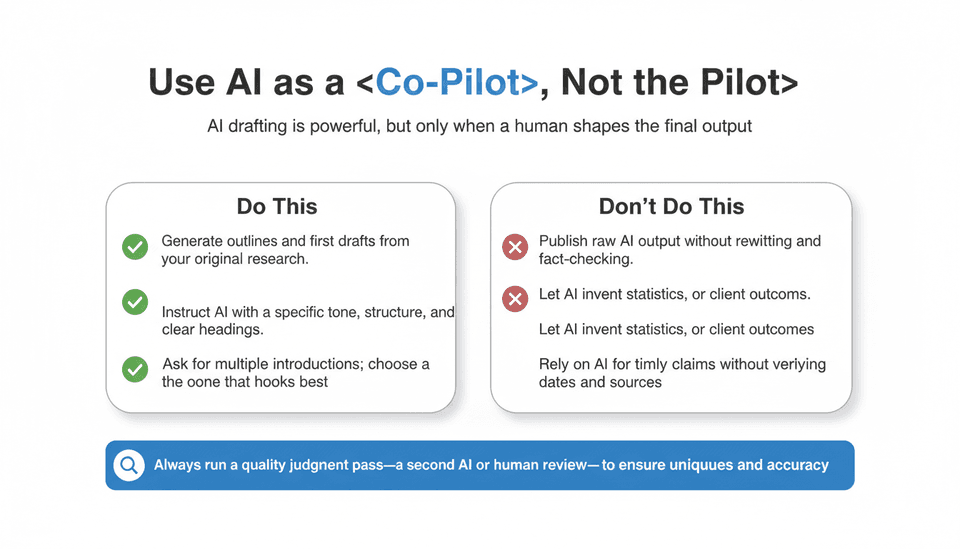
Drafting with AI: The do’s and don’ts
Do:
- Use AI to generate outlines and first drafts based on your research notes.
- Instruct it to write in a specific tone and structure with clear section headings.
- Ask for multiple introductions and choose the one that hooks.
Don’t:
- Publish the raw output without rewriting.
- Let it invent statistics, quotes, or client outcomes.
- Rely on it for timely, industry-specific claims without verifying dates and sources (even today’s date is October 22, 2026—and you should check any dates it mentions).
The Practical Ecommerce warning (October 20, 2026) is exactly about this habit: “creating content at scale with ChatGPT, Claude, and others is increasingly dubious for search engine optimization.” The way to avoid that classification is to treat AI as a drafting assistant, never an author.
The quality judgment pass: Why a second AI review matters
After a human rewrites the AI draft, run it through a second, independent AI review. This “judgment pass” checks:
- Factual consistency with your original research.
- Uniqueness compared to top 10 competitors.
- Readability and clarity for both humans and summary-generating models.
In a platform like Joyrise’s Pro tier, this step is automated: a second AI model rewrites the draft for originality and depth. Even if you do it manually, the principle stands. A second pass is your insurance policy against accidental duplication, thin content, and the AI content penalties that Google now applies. Skip it, and you’re gambling.
Adding original images and infographics
Search engines and LLMs increasingly reference visual content. Include:
- Branded header images that reflect the article’s angle.
- Original infographics that summarize data (you can have AI generate these, but verify).
- Charts or screenshots from your product or dashboards.
Every image should have descriptive alt text optimized for the keyword context, not stuffed.
Checkpoint: Your draft has passed a uniqueness and value test
Before publishing, confirm:
- The page says something a competitor’s page doesn’t.
- It passes a plagiarism checker (Copyscape or similar).
- It contains at least one original piece of data, expert quote, or visual.
- The quality judgment pass (human or AI) flagged no major factual errors.
Step 4: Optimize On-Page Elements for Readers and Robots
Backlinko’s updated on-page SEO guide (October 15, 2026) emphasizes that you’re optimizing for two audiences: humans and LLMs. For on page SEO 2026, apply these rules:
- Title tag: Front-load the primary keyword, keep under 60 characters, and make it compelling. Example: “How to Do SEO in 2026: A Step-by-Step AI-Safe Guide.”
- Meta description: Write a 150–160 character summary that an LLM could quote. Include a benefit and a call to action.
- URL: Short, keyword-rich, and readable (e.g.,
/how-to-do-seo-2026). Avoid dates so the URL stays evergreen.
According to the SEO Best Practices in 2026 guide, dual optimization for humans and LLMs is non-negotiable.
Headings, internal links, and structured data
Use one H1, then H2s for main sections, H3s for subsections. This hierarchy helps both readers and AI parses.
Internal links: Link to 3–5 relevant existing pages using descriptive anchor text. For example, link to your pillar page on SEO fundamentals from new supporting posts. This distributes authority and helps search engines understand topic clusters.
Add applicable structured data: Article, FAQ, HowTo, or Product schema. It increases the chance of rich results and feeds structured information to AI assistants.
Mobile and page experience signals
Check that every page passes Core Web Vitals (LCP under 2.5s, FID under 100ms, CLS under 0.1). Use Google’s PageSpeed Insights. If you’re on Webflow, most pages are fast by default, but large uncompressed images or heavy custom code can drag you down.
Checkpoint: Your page scores 90+ on Core Web Vitals and readability
Run a final check: PageSpeed Insights score over 90, no mobile usability errors in Search Console, and a readability grade of 8th–10th grade using Hemingway or similar.
Step 5: Publish, Submit, and Monitor
Automatic publishing vs. manual review
If you use an automation platform like Joyrise, articles can be published directly to Webflow on a schedule. Even then, I recommend at least a weekly manual spot-check: pick one post, read it in full, ensure images render, links work, and meta data matches. For high-stakes pillar pages, force draft mode and review before publishing.
Submitting to Search Console and tracking indexing
Immediately after publishing, go to Google Search Console and paste the new URL into the URL Inspection tool. Request indexing. This speeds up discovery. Over the next 24–48 hours, monitor the Coverage report for “Submitted and indexed” status.
Using an integrated dashboard for clicks and impressions
Search Console’s Performance tab shows clicks, impressions, CTR, and average position. For a more integrated view, a platform like Joyrise offers a built-in dashboard that pulls Search Console data and also shows AI assistant referral traffic—crucial as generative engines become a separate channel. Track:
- Clicks from search vs. clicks from AI assistants (if broken out).
- Impressions growth week-over-week.
- Pages that get zero clicks after 30 days (need updating or merging).
Worked Example: Launching a B2B SaaS Blog from Scratch
Let’s walk through a concrete scenario using the tools and steps above. This is SEO for SaaS in action.
Company: A B2B SaaS providing inventory management for mid-sized retailers. No blog yet, just a static Webflow site.
Baseline audit and strategy setup
- AI audit: Run Semrush Site Audit on the site, connect Claude via MCP. Claude reports: missing meta descriptions on all pages, slow mobile LCP on the product page (3.8s), and no sitemap. Fixes scheduled: add descriptions, compress product images, generate sitemap via Webflow settings.
- Strategy: Competitor analysis reveals that “inventory forecasting methods” and “retail stockout prevention” are high-volume, low-competition topics. Three pillar topics identified: Inventory Forecasting, Demand Planning, Warehouse Automation. Each gets a pillar page and two supporting posts. Calendar: 1 per week for 12 weeks.
- Tool choice: The team uses Joyrise to handle content creation and publishing because it integrates with Webflow and includes a quality judge pass. (You could substitute manual writing or another stack; the principles remain.)
Creating the first pillar page with AI assistance
- Research: The founder spends 2 hours gathering internal data on forecasting accuracy improvements from their beta customers. They also pull two industry reports from 2026. These become the source material.
- Drafting: Using Joyrise’s deep research feature, the platform generates a first draft that includes a comparison of statistical vs. machine learning forecasting, with original charts created from the internal data. The draft uses proper headings, internal links to the product page, and FAQ schema.
- Quality judgment pass: Joyrise’s second AI model rewrites sections for clarity and checks for duplication against the top 10 SERPs. One paragraph flagged for too-close similarity to a competitor’s How-to; rewritten manually.
- On-page optimization: The team sets the title to “Inventory Forecasting Methods That Cut Stockouts by 30% [2026]” with a meta description that reads like an AI-ready summary: “Learn how mid-sized retailers use statistical and ML forecasting to reduce stockouts. Real data from beta users, plus trend analysis.”
- Publishing: After a 30-minute review, the team approves the draft and it publishes automatically to the /blog/inventory-forecasting-methods/ URL. They request indexing.
Expected outcomes after 4 weeks
- Indexing within 2 days.
- First impressions appear for “inventory forecasting methods” and long-tail variants by week 2.
- By week 4, the page ranks position 12–18 for the main keyword and drives 80–120 organic impressions per week. No AI citation traffic yet, but the structured FAQ schema increases the chance of appearing in LLM responses.
- Zero manual actions or spam flags because every piece was human-reviewed.
Success Criteria: How to Know Your SEO Is Working
Ranking improvements and traffic growth
Expect a gradual climb, not overnight. Most B2B blogs see meaningful traffic increases after 3–6 months of consistent publishing. Measure:
- Keyword position changes for target terms (GSC average position).
- Organic click growth month-over-month.
- AI assistant referral clicks if tracked (check GSC’s “Other” or platform-specific metrics).
Conversion and engagement metrics
Traffic that doesn’t convert is noise. Track:
- Newsletter signups or demo form fills from organic landing pages.
- Time on page over 2 minutes, indicating engagement.
- Scroll depth greater than 70% for pillar content.
If rankings improve but conversions don’t, your content isn’t aligned with business goals. Revisit your content-to-intent mapping.
When Things Go Wrong: Troubleshooting Common SEO Issues
Issue: Pages not indexed
Symptoms: URL remains “Discovered – not indexed” for weeks.
Likely causes: Low-quality content, crawl budget limits, or technical blocks.
Fix:
- Check robots.txt and meta robots tag (noindex must not be set).
- Improve the page’s quality—add more unique insights, internal links, and structured data.
- Request indexing again after updating.
- If still not indexed, use the URL Inspection tool to see any manual action notices.
Issue: AI content flagged as spam
Symptoms: Manual action in GSC for “Unnatural content” or sudden traffic drop.
Fix:
- Pause all automated publishing. Revert to human-only drafts.
- Identify the offending pages—usually those with lowest engagement and highest duplication.
- Rewrite them entirely with original research and clear authorship.
- Submit a reconsideration request explaining your new process that includes human review and AI disclaimers.
- Don’t scale AI again without a quality judgment pass—that’s the exact cause of the penalty.
Issue: Rankings dropped after an update
Symptoms: Steady positions decline after a core update.
Diagnosis: Check if the drop correlates with a known update (search “Google update October 2026”).
Fix:
- Analyze which pages lost traffic using GSC’s compare feature.
- Review those pages against Backlinko’s on-page criteria: are they serving dual audiences? Add clearer structure, more internal links, and expert quotes.
- Update content to reflect current year (2026).
- If the drop is severe and you suspect a site-wide quality issue, roll back recent bulk changes to a version from a known good date (if you have backups). Then re-apply improvements one at a time.
Rollback steps for critical changes
If you’ve damaged traffic with a broad change (e.g., mass meta description rewrite):
- Restore the previous version of all affected pages from your CMS backup.
- Re-submit sitemap in Search Console.
- Wait for recrawl (3–5 days).
- Monitor recovery before attempting any new optimization.
How does Google Search work? (brief overview)
Google’s automated crawlers discover pages, index their content and meaning, and then algorithms rank them against user queries. In 2026, ranking considers relevance, quality, E-E-A-T (experience, expertise, authoritativeness, trustworthiness), and technical performance. Increasingly, Google also surfaces content from its index to power AI-generated overviews in search, so the line between ranking and citation is blurring.
How long until I see impact in search results?
With a new site, you might see first impressions within a week after indexed pages. Noticeable traffic growth typically takes 3–6 months of consistent, high-quality publishing. Competitive niches require longer. If you’re optimizing for generative engine citations, you may see referral traffic from AI assistants sooner—sometimes weeks after a thorough pillar page goes live.
Why prioritize content creation over off-page SEO?
Because content is the primary asset that both search engines and generative models use to evaluate and cite you. Off-page signals like backlinks are still a ranking factor, but they are a byproduct of having content worth linking to. In a world where users ask ChatGPT for a “best inventory forecasting tool,” the model picks from content it trusts, not from the page with the most links. Start with content depth and authority, and the off-page signals will accumulate naturally—and often faster than you could build them manually.
How can I use AI for SEO safely?
Use AI as a co-pilot, not an author. Steps:
- Feed it original research, not just generated text.
- Have a domain expert shape the draft and validate facts.
- Run a quality judgment pass—a second AI or a human reviewer checks for uniqueness, accuracy, and value.
- Never publish raw, scaled AI output without this final gate.
This workflow aligns with Practical Ecommerce’s warning while leveraging the speed that tools like Semrush’s MCP audit or Joyrise’s automated drafting provide.
What is Generative Engine Optimization (GEO)?
As defined by Search Engine Land on October 21, 2026, GEO is the practice of optimizing content so that it is discovered, understood, and cited by generative AI engines like ChatGPT, Gemini, and Siri. It moves beyond traditional rankings to encompass:
- Structure: Clear headings, lists, and schema so AI can extract summaries.
- Strategy: Targeting queries where AI overviews appear and answering them concisely.
- Metrics: Tracking referrals from AI sources (e.g., “ChatGPT” appears in your analytics).
It’s a response to a world where more than 25% of informational searches may never result in a click to a website—but your brand can still win if your content is the source.
Key Takeaways
- The only safe way to scale content with AI is through a human-in-the-loop workflow that includes a quality judgment pass—skip it and risk spam penalties.
- Content creation now outweighs off-page SEO because generative engines cite authoritative pages regardless of backlink count; you build links by building value.
- An AI-powered technical audit (Semrush + Claude via MCP) turns a tedious 140-issue check into a clear 5-priority fix list in under an hour.
- On-page optimization in 2026 serves two masters: human readers and LLM summarizers—structure your pages so they can be easily cited.
- Start monitoring AI assistant referrals now; this traffic channel is already measurable and growing, and GEO will only become more important.
Ready to implement an AI-safe SEO system that scales? Try Joyrise’s automated content platform and see your first article published before you commit.