 Joyrise
SEO in 2026: Definitive Guide for Founders and Operators
 By Alexi · · 19 min read

On this page
- Executive summary
- What SEO actually is
- The baseline every ranking page covers
- Core concepts and commonly confused terms
- How the ranking system works
- The levers and types of SEO you will use
- 2026 pressure points older guides do not cover
- AI‑generated content and SEO: separating automation from risk
- Options and tradeoffs: DIY, agencies, plugins, and automation
- Practical implementation framework
- Mistakes, myths, limitations, and next steps
- Key Takeaways
Executive summary
SEO is still one of the highest-leverage growth motions a business can own, but the playbook that worked in 2023 will get you pummeled in 2026. This guide covers what remains durable—crawl, index, rank, user-focused content, technical hygiene—and layers on the parts most ranking pages miss: supply‑chain security after the Rank Math PRO hijack, a working standard for AI‑assisted content that dodges Google’s penalties, and a clear‑eyed look at where organic search fits now that social commerce and AI‑home surfaces are eating its lunch.
What still holds in 2026 — and what most guides miss
The core mechanics of search haven’t changed. Google still crawls your pages, indexes what it deems valuable, and ranks results based on relevance, quality, and usability. On‑page fundamentals—titles, structured content, internal links—remain non‑negotiable. The difference is risk. In October 2026, a trusted SEO plugin delivered a self‑restoring backdoor. At the same time, a major publisher saw social‑commerce revenue edge past SEO for the first time. And Apple shipped a kitchen‑first display that could carve away recipe traffic once taken for granted. Most guides stop at the basic checklist; this one starts there and covers what the checklist cannot: toolchain risk, traffic‑mix shifts, and how to separate AI‑assisted content that builds authority from content that triggers algorithmic suppression.
Who this guide is for
Founders, finance leads, and marketing operators who need to make budget and headcount decisions about organic search. You are not trying to become an SEO technician. You need enough working knowledge to evaluate tradeoffs, spot hype, and set realistic timelines and resourcing.
How to use this guide
Read the sections on pressure points and AI‑content risk first—those are the 2026‑specific calls you cannot delegate. The baseline and core‑concept sections are your quick‑reference for conversations with team members. The implementation framework and checklist are ready to hand to an operator. Any claims in this guide rest on publicly available information and the stated capabilities of platforms mentioned; no proprietary performance data or firsthand tests are offered.
What SEO actually is
What is SEO and how does SEO work?
SEO—search engine optimization—is the practice of making a website more visible in organic, non‑paid search results. When someone types a query into Google, the engine sifts through billions of pages and returns a set of results it believes best match the intent. SEO work increases the likelihood that your pages appear in those results, attract clicks, and convert visitors. The work spans content creation, technical site structure, and signals from other sites that Google interprets as trust (What Is SEO - Search Engine Optimization?).
What does optimization mean?
Optimization is not a one‑time fix. It’s the ongoing discipline of bringing a page or a whole site closer to what the search engine’s ranking systems reward. That means writing content that satisfies the searcher’s need (not just stuffing keywords), keeping the site fast and crawlable, and building a reputation that makes Google confident enough to surface you above competitors. On any given day, optimization can be as small as tightening a title tag or as large as restructuring an entire site architecture.
Why is SEO important?
Organic search traffic still sends the majority of trackable traffic to most content‑based businesses. It’s a compounding channel: content that ranks today can generate clicks months or years into the future without incremental ad spend. But importance doesn’t mean invulnerability. As recent data from The Independent shows—social commerce revenue edged past SEO‑based commerce revenue in September 2026, per Digiday’s report on October 16—the traffic mix is shifting. SEO remains important precisely because it is not a standalone, and you need to understand its role in a broader acquisition portfolio.
What SEO is not
SEO is not a guarantee. Google’s algorithms change, competitors enter, and a page that ranks today can drop tomorrow. It’s not one‑time work; rankings decay without maintenance. It’s not a substitute for a product or a brand people want to talk about. And it’s not a channel you control—you can influence it, but you don’t own it.
The baseline every ranking page covers
Crawl, index, rank in a paragraph
Google discovers pages through links and sitemaps (crawl), stores and evaluates them (index), and orders them for a given query (rank). A site that Googlebot cannot reach, or that loads too slowly, or that returns thin content, will not index, much less rank.
The consensus checklist
Any competent guide will tell you:
- Produce content that answers genuine user questions with depth and clarity.
- Use descriptive, keyword‑aware titles and headings.
- Write meta descriptions that encourage clicks, even though they aren’t a direct ranking factor.
- Structure the site with clean internal links, no orphan pages, and a logical hierarchy.
- Optimize images for speed and include alt text.
- Secure the site with HTTPS and make it mobile‑friendly.
You already know this. The guidance is correct. But if you stop here, you are reading a guide written before October 2026.
Why most guides stop there
The checklist is the easy part. It doesn’t tell a founder what to do when their entire SEO plugin stack can be weaponized, or when a content‑generation tool triggers an algorithmic demotion. The real leverage comes from handling those under‑covered risks.
Core concepts and commonly confused terms
Organic vs paid vs social vs referral traffic
- Organic traffic: visitors who click a non‑ad link on a search engine results page. Cost is in time and resources, not per click.
- Paid traffic: visitors from search ads (PPC) or display ads. Stops when budget stops.
- Social traffic: visitors from social platforms, increasingly blending with commerce features.
- Referral traffic: visitors from links on other sites.
Finance leads often mistake organic for free. It is not free—it consumes staff hours, tool subscriptions, and opportunity cost—but it is not metered per visitor the way ads are.
On‑page, technical, off‑page, and local SEO
These are the types of SEO commonly referenced, though they overlap heavily.
- On‑page SEO: everything you control directly on a page—content, headings, internal links, images, structured data.
- Technical SEO: site‑level infrastructure—crawlability, indexability, page speed, mobile rendering, site architecture, secure HTTPS.
- Off‑page SEO: signals from outside your site, primarily links from other domains, but also brand mentions and social signals.
- Local SEO: optimizing for queries with a geographic intent, including Google Business Profile management and local citations.
Keywords vs topics; rankings vs traffic vs revenue
A keyword is the string someone types; a topic is the cluster of intent around it. Ranking #1 for a keyword with zero traffic is worthless. Traffic that doesn’t convert into sign‑ups, leads, or revenue is a vanity metric. Always measure what matters downstream.
Authority, trust, and relevance without jargon
Google’s systems evaluate pages for relevance (does this page match what the user wants?), quality (is the information trustworthy and well‑presented?), and usability (does it load fast on a mobile phone? is it readable?). There’s no single “Authority Score” that Google shows; tools like Moz and SEMrush estimate it based on link profiles, but the real thing is a complex signal. When you hear “E‑E‑A‑T,” that’s just a framework: experience, expertise, authoritativeness, trustworthiness (What is SEO? A Guide to Site Optimization).
How the ranking system works
How does Google Search work?
Google Search works in three broad phases. First, crawling: automated bots follow links across the web to discover URLs and page content. Second, indexing: Google processes and stores that content, analyzing text, images, video, and structured data to understand the page. Third, ranking: when a query is entered, Google’s algorithms search the index for matching pages and order them using hundreds of signals—relevance, quality, authority, context (device, location), and more. The exact ranking formula is proprietary and constantly updated (What is SEO? A complete guide to search engine ...).
What factors into SEO rankings?
The primary SEO ranking factors fall into four areas you can influence directly:
- Relevance: does your content match the searcher’s intent? Use topic‑focused pages, not keyword‑stuffed keyword‑lists.
- Quality: original research, clear writing, proper sourcing, and a site free of thin or duplicate content.
- Usability: fast load times (especially Core Web Vitals), mobile‑friendly design, secure connection.
- Context: location, search history, and device affect results; local SEO targets the first.
The measurement loop
You need a loop: Search Console shows impressions and clicks for queries, and alerts you to index coverage issues. Pair it with analytics (conversions, goal completions) to see which pages produce business outcomes. Don’t stop at rankings—measure what happens after the click.
How can you keep a page out of Google's search results?
You can keep a page out of Google’s search results entirely with a <meta name="robots" content="noindex"> tag or an HTTP X‑Robots‑Tag. You can also use a robots.txt disallow to prevent crawling (though the page might still be indexed if linked). For duplicate or similar pages, use a canonical link element to tell Google which version is the primary one. These are standard controls every SEO operator should know.
The levers and types of SEO you will use
What are the types of SEO?
We covered the main buckets—on‑page, technical, off‑page, local—above. For most founders, the daily work lives in on‑page and technical, with off‑page building over time. You do not need to memorize taxonomy; you need to know which levers pull best for your business.
Search intent and content formats
Every query has an intent: informational (learn something), commercial (compare options), transactional (buy), or navigational (find a specific site). Match your content format to that intent. An informational query about “seo in 2026” deserves a long‑form guide, not a product page. A commercial query like “best SEO agency for startups” deserves a comparison table and clear value props. Get intent wrong and nothing else matters.
Technical and site‑structure essentials
Your site must be crawlable, with a clean URL structure, no broken links, and a sitemap submitted to Search Console. Page speed is a ranking factor, but more importantly, slow sites lose visitors. Use a content delivery network (CDN), compress images, and minimize render‑blocking scripts.
Internal links and external signals
Internal links are under your control and tell Google which pages are most important and how they relate. External links (backlinks) from reputable sites remain a strong quality signal, but building them takes time and is easy to do poorly. Prioritize creating content worth linking to; treat link‑building as a byproduct, not a standalone tactic.
Image, video, and local search
Image alt text and descriptive file names help with image search. Video content—properly transcribed and embedded—can rank in both web search and YouTube. For local businesses, claiming and optimizing your Google Business Profile, getting legitimate reviews, and maintaining consistent NAP (name, address, phone) across the web are table stakes.
2026 pressure points older guides do not cover
Plugin and tool supply‑chain attacks: the Rank Math PRO hijack
Most ranking pages treat SEO plugins as neutral infrastructure. They cannot after October 2026. According to The Hacker News (October 19, 2026), copies of the popular Rank Math PRO WordPress plugin downloaded or updated between 20:02 UTC on October 15 and 07:12 UTC on October 16 contained malware that creates a self‑restoring backdoor. Installing the clean version 3.0.124 does not remove the files, administrator accounts, or scheduled tasks the malware planted. Any site that installed and activated one of those copies should be treated as compromised.
This is not a story about a single plugin. It is a story about attack surface. The SEO stack—the plugins, the performance tools, the content automation platforms—has access to your database, your content, and often your user accounts. A security lapse in any one of them can turn your whole SEO investment into a liability.
The adjudication here is not to abandon all tools. That’s unrealistic. The lesson is to harden the stack:
- Audit what has write access to your site. If you run WordPress, restrict plugin file editing and install only what you need.
- Use a staging environment for plugin updates and monitor change logs.
- Prefer static‑site architectures (like Webflow) where the content platform publishes API‑based, with no server‑side plugin execution that can be hijacked at scale.
- Review your toolchain every quarter. The question is no longer just “Does this tool help with SEO?” but “What happens if this tool is compromised?”
Social commerce edging past SEO at some publishers
On October 16, 2026, Digiday reported that The Independent’s social‑commerce revenue edged past its SEO‑based commerce revenue for the first time in September. CEO Christian Broughton described the gap as narrow but directional. This isn’t a mass exodus from search—most sites still live and die by organic traffic—but it signals a real shift. If your revenue model depends on search‑led affiliate or commerce income, you need a multi‑platform attribution model that can handle a world where social platforms siphon purchase intent.
For any business, the takeaway is not to panic but to budget accordingly. SEO remains high‑ROI, but it’s no longer the only long‑tail commerce engine. If a competitor builds a social‑commerce channel while you double down on SEO alone, you may cede a growing piece of the pie.
Apple HomeView and the rise of AI/home search surfaces
Apple HomeView, launched and marketed heavily for kitchen use, shows a screen‑first, voice‑triggered interface that can display recipes, timers, and instructions. Six Colors, on October 18, 2026, highlighted the implication: recipe blogs that rely on SEO traffic and long‑form storytelling to capture ad revenue or affiliate sales may find that users no longer land on the blog at all. The HomeView (and similar assistants from Google and Amazon) extracts the answer—the step‑by‑step—and displays it without a click.
This matters for any content type where the answer can be fully satisfied in a single, concise result. Recipes, definitions, how‑to steps, lyrics, and certain B2B reference data. The standard defense is to build a brand strong enough that users want more than the snippet—but for utilitarian content, you may need to accept that some queries will never click.
What changes — and what does not — for a business that relies on organic search
What hasn’t changed: relevance, quality, and usability remain the foundation. What has changed: the toolchain now carries security risk, the user’s attention is fragmented across social‑commerce and AI‑home surfaces, and the algorithmic environment is punishing undifferentiated content. Your SEO strategy must account for all three, not just the on‑page checklist.
AI‑generated content and SEO: separating automation from risk
What ‘Beware of AI content for SEO’ is actually warning about
A day ago, Practical Ecommerce published a piece titled “Beware of AI Content for SEO,” reporting that creating content at scale with ChatGPT, Claude, Gemini, and similar tools is increasingly dubious for search engine optimization. The warning is about mass, undifferentiated generation—hundreds of generic articles pumped out with no research, no editorial review, and no distinct brand voice. Google’s systems have gotten good at detecting and demoting such content.
The line between assisted, reviewed, branded content and mass auto‑generation
The industry tension is real. Moz frames AI‑powered insights as a central SEO advantage. Practical Ecommerce warns against it. The resolution is not contradictory: the problem is not AI. The problem is using AI as a content factory that eliminates human judgment.
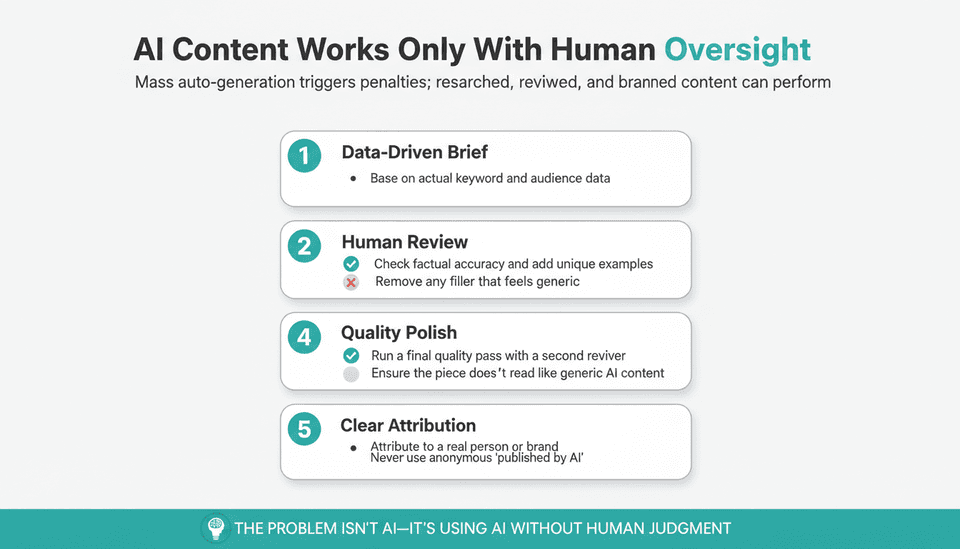
A reasonable working line: if a draft is produced by a language model and then researched, fact‑checked, rewritten with original insight, and published under an accountable human or brand, that’s AI‑assisted content—and it can perform. If the pipeline is prompt → publish, with no quality gate, that’s the dangerous territory.
A working standard: research, originality, human review, accountability
If you’re going to use AI content for SEO, you need at minimum:
- A topic brief informed by actual keyword and audience data, not just a prompt.
- AI drafting with specific instructions based on your brand voice and existing site content.
- A human review step that checks for factual accuracy, adds unique examples or data, and removes generic filler.
- A final quality pass—ideally with a second tool or human—to ensure the article doesn’t read like every other AI‑generated piece on the web.
- Attribution and editorial accountability, not anonymous “published by AI.”
Where automated platforms fit when they include a quality‑judgment pass
Some SEO automation platforms bake in that quality‑judgment step. For example, a platform like Joyrise performs deep site scans to learn brand voice, generates researched articles with original branded images, and—on its Pro and Max plans—runs a second AI quality judge to rewrite drafts before publishing. The technical capability is there. The risk is still editorial: you must decide whether the second‑pass quality is good enough for your brand, and you remain accountable for what goes live. No tool removes the need for a human to occasionally audit output.
Options and tradeoffs: DIY, agencies, plugins, and automation
Can you do SEO by yourself?
Yes—and for a solo founder or a very small site, it’s often the right starting point. You can learn to write content, configure Search Console, and handle basic on‑page work. The ceiling, however, is low because your time is finite and the web is competitive. DIY SEO works best when paired with a strong product that attracts organic links naturally.
Is SEO free or paid?
SEO is never free when you account for the cost of time, tools, or talent. A founder doing SEO “for free” is spending hours that could have gone to product or sales. A paid tool or agency has a clear invoice. The real question is whether the return—organic traffic and conversions—exceeds the full cost.
DIY SEO: cost, time, and ceiling
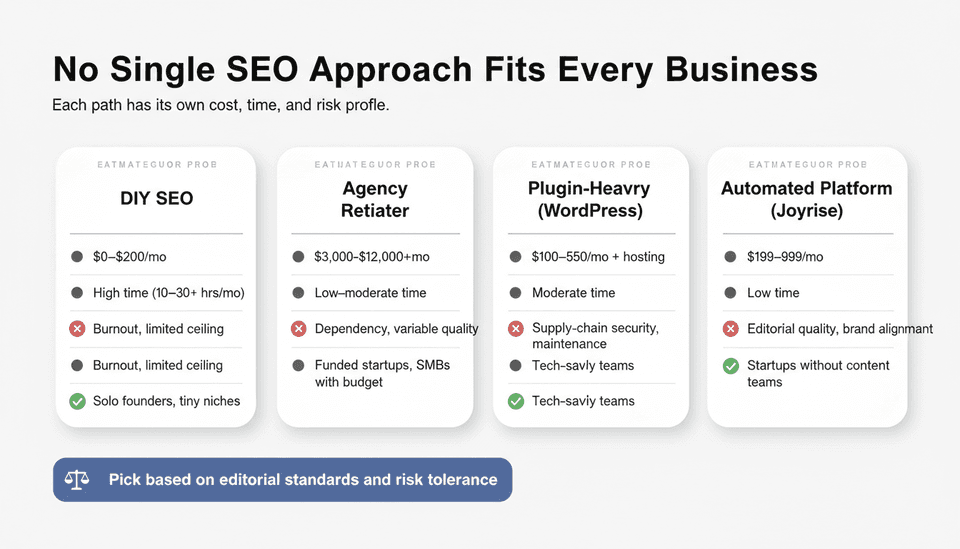
Cost: typically just your time and maybe a few hundred dollars per year for a keyword research tool. Time: ongoing, 10–30 hours per month minimum to make a dent. Ceiling: limited mostly by your ability to produce content, build links, and keep up with technical changes. Suitable for pre‑revenue or very niche businesses.
Agency retainers
Agencies bring strategy, execution, and cross‑functional skills (content, tech, outreach). Retainers can range from a few thousand dollars per month to over $10,000, depending on scope. They save time but introduce risk: you depend on the agency’s talent, their understanding of your business, and their security practices. Contract terms should include clarity on deliverables and a kill switch if the partnership stalls.
Plugins and point tools
WordPress SEO plugins like Rank Math or Yoast give you in‑editor feedback and technical controls. They’re useful, but as the Rank Math incident of October 2026 showed, they also expand your attack surface. Plugins require continual security monitoring and a willingness to patch and audit. For non‑WordPress environments like Webflow, the attack surface shifts to the platform itself and any API integrations.
Automated content platforms: volume vs editorial control and risk
Platforms that use AI to plan, write, and publish SEO‑optimized content (Joyrise is one example on Webflow) trade human editorial control for speed and volume. The promise: daily publishing without hiring a team. The tradeoff: the output is only as good as the platform’s quality‑judgment pass and your ability to steer it. For a startup with no content team, a platform can jumpstart organic traffic; for a brand with a strong editorial voice, automated content may feel generic unless you invest heavily in custom voice training and review.
The real free vs paid cost picture
| Approach | Monthly Cash Outlay | Time Investment | Key Risk | Best For |
|---|---|---|---|---|
| DIY SEO | $0–$200 (tools) | High (10–30+ hrs/mo) | Burnout, ceiling | Solo founders, tiny niches |
| Agency retainer | $3,000–$12,000+ | Low‑moderate | Dependency, variable quality | Funded startups, SMBs with budget |
| Plugin‑heavy (e.g., WordPress) | $100–$500 + hosting | Moderate | Supply‑chain security, maintenance | Tech‑savvy teams |
| Automated content platform (e.g., Joyrise) | $199–$999/mo | Low | Editorial quality, brand alignment | Startups without content teams |
Joyrise’s plans range from $199 to $999/month, claiming 1/10th the cost of a traditional agency. No independent audit of that cost claim is publicly available, so treat it as a vendor’s positioning. The real decision is whether the platform output matches your editorial bar and whether you are comfortable with AI‑generated content on your domain.
Practical implementation framework
Week 1: site audit, keyword map, and baseline metrics
Start with a crawl (Screaming Frog, Sitebulb, or similar) to find broken links, missing titles, duplicate content, and indexing issues. Build a keyword map from Search Console data, competitor analysis, and tool research, grouped by intent. Record baseline data: total indexed pages, organic clicks, top‑10 queries, and conversions.
First 90 days: publishing cadence, interlinking, Search Console review
Publish consistently—one high‑quality article per day is a real pace if you have an automated system; two per week is realistic for a small human team. Every piece should link to relevant existing content and be linked from a pillar or category page. Weekly: check Search Console for new queries and sudden index drops. Monthly: review Core Web Vitals in PageSpeed Insights and adjust.
What is an example of SEO?
An example of SEO: take a business selling sustainable office supplies. You identify through keyword research that “bulk recycled printer paper for offices” has decent search volume and commercial intent. You create a page that explains paper sustainability standards, compares bulk pricing, includes an FAQ, and links to your product catalog. The page is structured with clear headings, meta description, alt‑tagged product images, and fast load time. You internally link from your blog posts about office greening. Over time, the page attracts organic traffic from procurement managers, and you track the click‑to‑purchase conversion rate in analytics. That’s SEO in action.
A more automated version: Joyrise might scan your existing site, detect that topic gap, generate a researched article with original infographics, and publish it to your Webflow blog on a set schedule. The workflow demonstrates how SEO automation can replicate parts of that manual process—though editorial review remains your responsibility.
Measurement that matters
Ignore vanity rankings. Track:
- Organic clicks (Search Console)
- Indexed pages vs total pages
- Click‑through rate for important queries
- Conversions from organic landing pages (analytics)
- Revenue or sign‑ups attributed to organic search.
Set a quarterly target, not a weekly panic.
Who can affect SEO?
SEO is affected by more roles than just the marketing lead. Content writers drive on‑page execution. Developers control crawl, speed, and site architecture. Product managers influence site structure and features that affect indexing. Finance sets budgets and approves tools. A founder or CEO who dismisses SEO as “just content” will under‑resource it. The people who can affect SEO are essentially everyone who touches the website, the product, or the content pipeline. That’s why governance matters—clear ownership of technical SEO, content strategy, and tool vetting.
Mistakes, myths, limitations, and next steps
Myths that waste budget
- “Ranking is the goal.” No. Conversions are the goal. Ranking is a means.
- “More pages always better.” Thin or duplicate pages dilute quality and can hurt overall site performance.
- “AI volume is a shortcut.” Post‑2026, undifferentiated AI content is more likely to sink you than lift you. Volume without quality is a liability.
Limitations and risks
Algorithm shifts can wipe out traffic overnight, often with no clear warning. Attribution is messy—did that sale come from SEO, or did the user see a social ad, search the brand, and then buy? Tool dependence creates a single point of failure if that tool’s security is compromised. The Rank Math PRO incident is not an isolated problem; it’s a category risk for any maintained codebase with write access.
How long until I see impact in search results?
Meaningful impact rarely shows in fewer than 3–6 months. Some tactical fixes (fixing a noindex tag, submitting a sitemap) can produce a lift in weeks. New content typically takes 3–6 months to mature, and competitive queries can take a year or more. If an agency guarantees first‑page rankings in 30 days, run. The search landscape doesn’t work that way in 2026.
A 30‑60 day checklist
Here’s a practical checklist for the first two months, suitable for a founder or operator:
- Week 1: Set up Google Search Console and verify ownership.
- Week 1: Run a site crawl, fix critical errors (broken links, 404s, noindex blocking important pages).
- Week 1: Build a keyword map with 10–20 seed topics and intent tags.
- Week 2: Optimize existing high‑traffic pages for meta data, headings, and internal links.
- Week 3: Write and publish your first new piece following the intent‑first format.
- Week 4: Review index coverage report; request indexing for new URLs.
- Week 4: Audit your SEO toolchain—any plugins or integrations with write access? Document and review security update processes.
- Week 5‑6: Publish two more pieces and cross‑link them.
- Week 6: Review Core Web Vitals; fix any “poor” URLs.
- Week 7‑8: Set up analytics goal for a key conversion event from organic traffic.
- Week 8: Evaluate content quality: any AI‑generated pieces that look generic? Flag for human rewrite.
- End of Month 2: Check organic click and impression trends; adjust keyword map.
Key Takeaways
- SEO fundamentals remain, but the risk profile has changed: toolchain security, AI‑content quality, and platform diversion are now board‑level concerns.
- AI‑assisted content works only when it’s researched, reviewed, and branded; mass auto‑generation will damage your rankings.
- Organic traffic is not free—budget for time, tools, or outsourcing, and weigh it against the rising importance of social‑commerce and AI‑home surfaces.
- Rankings are not your metric; organic clicks that convert are the signal that matters.
- Audit your entire SEO stack quarterly, not just for performance but for security—a compromised plugin can undo years of work.
Try Joyrise if you want to see what daily, automated SEO content looks like without building an in‑house team from scratch. Sign up to read your first article before you pay.