 Joyrise
Is SEO Dead or Evolving in 2026? A Working FAQ
 By Alexi · · 17 min read

On this page
- The short answer
- How has SEO changed with the rise of AI search?
- What is Generative Engine Optimization (GEO), and how does it differ from SEO?
- Decision questions: invest, shift, or automate?
- Which SEO practices no longer work in 2026?
- What types of content still rank well in 2026?
- Do backlinks still matter for SEO and GEO in 2026?
- How often should I update existing content to stay competitive in 2026?
- Operational questions the strategy posts skip
- How do I know if my content is being cited in AI Overviews or generative AI responses?
- Symptom-by-symptom troubleshooting
- Where to go deeper
- How this FAQ stays current
- Key Takeaways
If you’re asking whether SEO is dead or evolving in 2026, the short answer is straightforward: SEO isn’t dead—it’s being rewired around AI-assembled answers, zero-click surfaces, and generative engines. But the strategic debate stops before founders and SEO leads get the answers they actually need. How do you plan, produce, and review daily content on Webflow when you’re not a large team? How do you spot when an AI Overview cites your content, and what do you do when it doesn’t? Where does the cost actually land at 30, 80, or 180 articles a month? This FAQ answers the production-level questions that most ranking pages skip, while grounding every answer in what’s observable today—October 23, 2026.
The short answer
Is SEO dead in 2026?
No. Organic search still drives measurable traffic, conversions, and brand authority for businesses that adapt. What died are the purely mechanical tactics: thin content, keyword stuffing, exact-match anchor text, and volume-for-volume’s-sake publishing. The modern game asks for topical depth, clear answers, credible entity signals, and content that generative engines want to cite. As Stacker noted in March 2026, the fundamentals haven’t vanished; they’ve been reframed into seven strategies that work in an AI-dominant SERP. [^stacker]
SEO is evolving, not disappearing. If you treat it as a single “blue link” channel, you’ll miss the expanding citation and visibility opportunity that Google’s AI Overviews, Bing Chat, and other generative engines now offer. Meanwhile, Search Engine Land’s October 2026 analysis confirms that AI-assisted search referrals are becoming a measurable traffic source in their own right, not just a footnote. [^searchengineland]
Why do some businesses think SEO no longer works?
The perception comes from observable, painful shifts. A well-ranking page can suddenly see impressions rise while clicks plummet—because the AI Overview answered the query directly on the results page. A domain can hold position 2 for years and never appear as a source in a generative answer. When reporting only on traditional clicks and rankings, SEO results look like they’re evaporating. That gap is real. What’s missing isn’t the traffic; it’s the measurement framework that can track zero-click SEO and AI-assisted referrals alongside traditional organic performance.
How has SEO changed with the rise of AI search?
From 10 blue links to AI-assembled answers
By late 2026, a Google search for a complex informational query often presents a generative AI overview above the fold, sometimes accompanied by a carousel of cited sources, followed by traditional web results. Bing Copilot and other assistants have extended this pattern further. The user gets an assembled answer—a synthesis drawn from multiple pages—without always needing to click through.
This shift doesn’t mean you stop writing content. It means your content must be the source the AI picks. That’s a different goal from simply ranking first. AI search optimization now demands you structure information in a way that’s both crawlable and citable: clean headings, clear definitions, well-sourced data, and direct answers to specific questions.
Why rank tracking alone undercounts performance
Traditional rank tracking reports position for keywords. That number ignores the instances when your page is cited inside an AI Overview, shown as a reference in a generative snippet, or surfaced in a voice assistant answer. Google Search Console has added reporting for AI-assisted search referrals, but many teams haven’t wired that data into their weekly tracking. If you’re only watching blue-link positions, you’ll undercount the real visibility your content generates—and you’ll misinterpret a drop in clicks as a content failure when it might be a format shift.
What is Generative Engine Optimization (GEO), and how does it differ from SEO?
What Generative Engine Optimization (GEO) is and how it layers on top of SEO
Generative Engine Optimization (GEO) is the practice of optimizing content so that generative AI models—like those powering Google’s AI Overviews or Copilot—cite your content as a source. While SEO aims for the traditional clickable link, GEO targets the citation and the brand mention inside an AI-assembled answer. The ongoing GEO vs SEO framing often misses the point: GEO doesn’t replace SEO; it layers on top. SEMrush’s practical guide describes GEO as a discipline that adds techniques like source-worthy formatting, entity clarity, and citation-focused link building on top of existing SEO fundamentals. [^semrush]
Crucially, GEO doesn’t replace SEO; it layers on top. Generative engines still rely on a crawlable, authoritative, well-structured web. Without an SEO baseline—sound indexing, clear topic architecture, credible backlinks—your content won’t be found or trusted enough to be cited. The two disciplines share the same foundation; they differ in the surface they optimize for.
Decision questions: invest, shift, or automate?
Should businesses invest in SEO or shift to GEO instead?
Some pages frame this as an either-or choice. The more accurate answer: shifting entirely to GEO is premature. GEO depends on an SEO base. If your content isn’t indexed, crawlable, and on-topic, no amount of citation formatting will get it into an AI Overview.
Treat GEO as a layer on top of SEO, not a replacement. Invest in strong SEO fundamentals—clear site architecture, topical authority, reliable technical hygiene. Then overlay GEO tactics: write in scannable question-answer formats, include citable data points, build entity associations, and optimize for the “source carousel” beneath AI Overviews. This layered approach protects you regardless of how the SERP surface evolves.
When to keep SEO in-house, bring in an agency, or use an automated publishing platform
The right model depends on your publishing volume, internal capacity, and the need for speed. For those aiming to scale without overhead, an automated content publishing platform can transform your SEO production workflow.
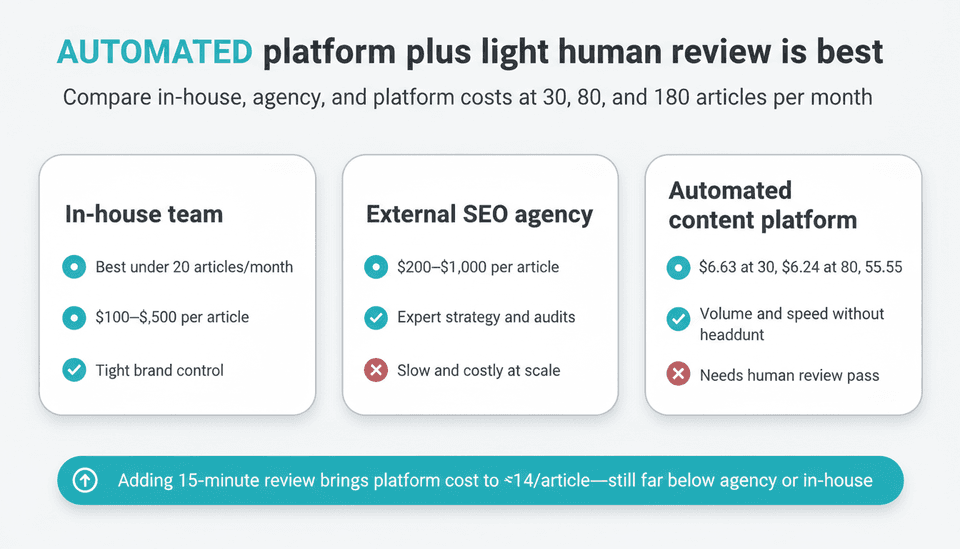
- In-house team: Makes sense when you publish fewer than 20 articles per month, have a dedicated writer and editor, and need tight control over brand narrative. Per-article costs with salary, benefits, SEO tools, and overhead often run $100–$500 or more.
- External SEO agency: Useful when you need strategy, technical SEO auditing, and high-touch content creation. Agencies commonly charge retainers of $2,000–$10,000/month for a handful of articles. That can translate to per-article costs of $200–$1,000. The benefit is expertise and strategic counsel; the trade-off is speed and cost at scale.
- Automated content platform: When you need consistent daily publishing—especially on Webflow—without growing headcount, a platform handles keyword research, drafting, image creation, and publishing. Joyrise, for instance, plans, writes, and publishes illustrated articles directly to Webflow blogs, with built-in quality-saving passes and Search Console monitoring, effectively offering Webflow SEO automation. The cost is subscription-based, not per-article.
The table below compares illustrative per-article costs at three common publishing volumes, using Joyrise’s actual subscription prices and conservative estimates for internal and agency models.
| Publishing volume | In-house team (est.) | Agency retainer (est.) | Joyrise platform |
|---|---|---|---|
| 30 articles/month | $100–$500/article | $200–$1,000/article | $6.63/article (Basic plan, $199/mo) |
| 80 articles/month | $100–$400/article (scale efficiencies possible) | $150–$600/article | $6.24/article (Pro plan, $499/mo) |
| 180 articles/month | $100–$300/article | Varies widely | $5.55/article (Max plan, $999/mo) |
These platform figures don’t include the cost of a human review pass. At a $30/hour editorial rate, adding a 15-minute review per article brings Joyrise’s effective cost to roughly $14 per article—still far below agency or in-house models. The tradeoff: the automated platform gives you volume and speed; you must invest effort in a quality review cadence (covered below) to ensure consistency.
For a Webflow blog, combining an automated platform with a light-touch human review is the closest thing to a production line without building a content team from scratch.
Which businesses are least disrupted by AI Overviews and which are most exposed?
Businesses that rely on simple informational queries—“how do I do X,” “what is Y”—are most exposed. When the AI Overview can assemble a complete answer from a few sources, the click often disappears. The most exposure occurs where the user’s intent is fully satisfied by a paragraph or a bullet list.
Least disrupted are businesses that serve transactional and deep-investigatory intent: e-commerce product searches, complex comparison queries, legal or medical advice requiring specific disclaimers, and queries where the user must interact (e.g., “buy,” “sign up,” “configure”). Local services with strong Google Business Profiles also hold clicks because the AI Overview still pushes the map pack. If your content offers a unique dataset, a simulation, a tool, or a perspective that an AI summary can’t fully replicate, you create a reason to click.
Which SEO practices no longer work in 2026?
Which SEO practices no longer work in 2026?
- Thin, mass-produced pages written solely to capture long-tail variants. If the page says nothing uniquely useful, it won’t get cited, and it likely won’t last in the index.
- Exact-match anchor text building. Over-optimized anchor signals are more likely to attract algorithmic suppression than help.
- Keyword stuffing in headings and body copy—this hasn’t worked for years, and generative models actively penalize unnatural repetition.
- Purely volume-based publishing without topical connection or quality review. Publishing 200 articles a month doesn’t compound if none of them earn citations or trust.
- Automated AI drafts with zero human or second-AI quality pass. Raw AI content that hasn’t been fact-checked, trimmed, and aligned with brand voice performs poorly as a citation source; generative engines increasingly weigh editorial signals.
What types of content still rank well in 2026?
What types of content still rank well in 2026?
Formats that do well in 2026 share a pattern: they answer a question definitively, are easy to scan, and provide something an AI summary alone cannot fully replicate.
- Structured Q&A hubs with clear headings that match natural language queries.
- Step-by-step guides with original photos or diagrams; the visual makes the page worth a click.
- Original research and data summaries—charts, proprietary survey results, original industry benchmarks—that AI models want to cite.
- Comparison pages that use tables and decision logic; the interactive element drives clicks.
- News-driven content with timely, source-linked reporting. Google’s AI optimization guide explicitly notes that fresh, authoritative information helps content appear in generative features. [^google]
Content with original branded header images, infographics, and internal linking to deeper resources also tends to accumulate more engagement, making it a stronger citation candidate over time.
Do backlinks still matter for SEO and GEO in 2026?
Do backlinks still matter for SEO and GEO in 2026?
Yes, but they’re no longer the only citation signal. Backlinks still matter for crawlability, authority, and indexing speed. Pages with high-quality referring domains get discovered faster and earn initial trust. However, AI-generated answers increasingly look for entity citations and brand mentions across the web, not just links. A mention of your brand in a trusted news outlet without a hyperlink can still reinforce your entity’s authority. The practical takeaway: build links from credible, topically relevant sources—and also pursue unlinked brand mentions, contributor citations, and appearances in data roundups that generative engines might scrape.
SERP opinion is split: older SEO advice treats backlinks as the central scorecard; newer AI-search guidance emphasizes citations and brand signals. The working position here is to optimize for both. Backlinks remain a necessary foundation; citations and brand mentions are the newer layer that determines whether you appear inside an AI-assembled answer.
How often should I update existing content to stay competitive in 2026?
How often should I update existing content to stay competitive in 2026?
The cadence depends on the topic’s volatility. For AI-related content, a quarterly review is prudent—Google’s features change frequently. Evergreen how-to guides around stable topics can withstand a 12-month cycle. For finance, legal, or regulatory content, update whenever rules change. The practical rule: schedule a six-month rolling review for your top 100 pages. During each review, check:
- Has the query now triggered an AI Overview, and are you cited?
- Have any statistics or dates in the article become outdated?
- Could you add a citable data point, a new header, or a clearer definition to improve citation odds? If you have a platform that surfaces AI-assisted referral data (such as Joyrise’s Search Console dashboard), you can prioritize updates based on pages that recently lost AI citations or saw a jump in impressions but no clicks.
Operational questions the strategy posts skip
Strategy pages tell you to “create high-quality content” and “optimize for AI.” They don’t show the daily workflow. Here’s what actually happens.
How do I plan, write, and publish daily SEO articles on Webflow without a large team?
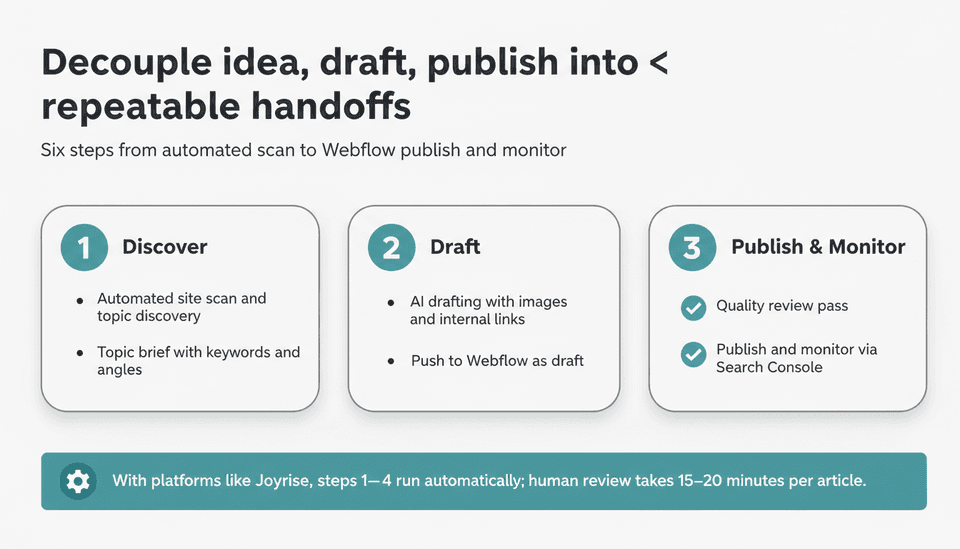
The key is to decouple idea generation, drafting, and publishing into a repeatable process with clear handoffs. A workflow that works in 2026:
- Automated site scan and topic discovery. A tool (or a set of tools) crawls your existing site, learns your brand voice, identifies content gaps, and finds competitor keywords with realistic ranking opportunities.
- Topic brief generation. The system produces a list of target keywords and article angles—not just “write about X,” but “write a guide that compares X and Y with a table.”
- AI drafting with images and internal links. The draft includes a structured H2/H3 outline, keyword-informed headers, internal links to related pages, a meta description, and branded illustration images.
- Push to Webflow as draft. The article lands in your Webflow CMS as a draft, with all images and links already attached.
- Quality review pass. A human editor (or a second AI quality judge) reviews the draft against a short checklist before hitting publish.
- Publish and monitor. After going live, the article is tracked via Search Console for impressions, clicks, and AI-assisted search referrals.
If you’re using a platform like Joyrise, steps 1–4 happen automatically at the interval you set. What remains is the editorial step—a daily or batch review of the day’s drafts. That can take 15–20 minutes per article for an experienced editor. With 5 articles per day, that’s roughly a 90-minute daily block. Without such a platform, you’d need to coordinate a writer, an illustrator, an SEO analyst, and a Webflow publisher—which gets expensive and slow.
How do I review AI-generated drafts before they go live?
A reliable quality review doesn’t require line-by-line editing. Use a structured checklist:
- Fact-check the two or three most novel claims. If the draft states a statistic or quotes an authority, verify it against a primary source.
- Scan for hallucinated products or names. AI can occasionally invent product features or attribute quotes incorrectly. Check any proper nouns.
- Confirm brand voice and tone. Does it sound like your company? If the tone is too generic, tweak the opening paragraph and the conclusion.
- Validate infographic accuracy. Even a well-designed AI-generated chart can have a mislabeled axis or a logical error.
- Check internal links. Ensure linked pages exist and match the anchor text.
- Review the meta description and title tag. Are they compelling and do they include the primary topic?
A second AI quality pass—what Joyrise’s Pro and Max tiers call a “quality judge”—can flag ambiguities, overly long sentences, and factual inconsistencies before a human ever looks at the draft. This turns the human review from a slog into a quick approval or tweak. Without that second pass, you’ll burn hours checking basic coherence.
How do I know if my content is being cited in AI Overviews or generative AI responses?
How do I know if my content is being cited in AI Overviews or generative AI responses?
Google Search Console has evolved to include a dedicated reporting section for AI Overviews and other generative search features. Look for the “Generative AI” tab (or the equivalent as of late 2026) under the Performance report. There you’ll see:
- Impressions from AI Overviews.
- Clicks from links in AI Overviews.
- Which pages and queries triggered citations.
The data isn’t perfect; you won’t see every unlinked brand mention. But it’s the most direct signal you have. Some third-party tools and platforms, including Joyrise’s integrated Search Console dashboard, surface AI-assisted search referrals alongside traditional clicks and impressions, helping you spot pages that gained visibility without gaining clicks—and vice versa.
Actionable interpretation: If a page racks up AI Overview impressions but no clicks, it’s being used as a source but not driving traffic. That’s a zero-click visibility win—but if you want clicks, you may need to add a compelling reason to leave the AI summary (a tool, a downloadable template, a unique calculator). If the page never appears in AI Overviews at all, its structure likely needs more direct question-answer formatting and clearer entity signals.
What does a reliable review cadence look like for automated SEO content?
For a platform that publishes drafts to Webflow, you have two cadence options: pre-publication review or post-publication review.
Pre-publication review: All drafts are saved as unpublished. A designated editor (often the content lead or a freelance editor) reviews the batch each morning or afternoon, then publishes approved pieces. This ensures nothing goes live unchecked, but it introduces a delay. If you publish 5 articles a day, the editor’s daily load is roughly 60–90 minutes.
Post-publication review: Articles go live automatically on a schedule, and the editor reviews them within 24 hours. Corrections are made live. This keeps the publishing pace fast, but you must trust your draft quality—which is where a second AI quality pass becomes critical.
Assign an owner explicitly: one person (or a named agency contact) accountable for the daily review. Without a named owner, reviews drift. For FAQ-style, time-sensitive SEO content that can go stale after algorithm or UI changes, set a calendar reminder to re-review top-performing articles monthly. Joyrise’s Pro and Max plans include news-driven article creation; those pieces should be published same-day and reviewed within a few hours, given their time sensitivity.
How do I calculate the true per-article cost of automated publishing?
The subscription price is only part of the picture. Include editorial labor. Use this simple formula:
Cost per article = (Monthly platform cost / Number of articles) + (Hourly editor rate × Review hours per article)
Example with Joyrise Pro ($499/month, 80 articles) and a freelance editor at $30/hour spending 15 minutes (0.25 hours) per article:
- Platform cost per article: $499 / 80 = $6.24
- Editorial cost per article: $30 × 0.25 = $7.50
- Total: $13.74 per article
Now compare that to an internal writer earning $60,000/year, producing 4 long-form articles per week (~16/month). Fully loaded cost with benefits and tools might be $80,000/year, or $6,666/month. That’s ~$416 per article. Even with scale, the difference is stark. The caveat: the internal writer brings unmatched brand nuance. The platform brings volume. The sweet spot for many teams is blending the two—an automated platform handling 80% of volume, and a human editor (or in-house writer) polishing the top 20% and writing high-stakes pages.
Symptom-by-symptom troubleshooting
Impressions rise but clicks fall after an AI Overview change
Diagnosis: Your page is showing up as a source in the AI Overview, but users get their answer without leaving the results page.
Action: First, confirm that your URL is being cited. Check Search Console’s generative AI report. If you’re cited but not clicked, consider adding a “for more detail” link bait—a downloadable checklist, a calculator, or a step the AI can’t fully summarize. Increase the unique value proposition of the click. You may also restructure the page so that the most complete answer is partly hidden behind a single expand or requires one more step, giving users a reason to visit. But don’t artificially gate basic info; that can reduce citation-worthiness.
Rankings hold, but AI Overviews answer the query without citing me
Diagnosis: The AI model considers other pages a better match for the question, even if you rank well for the traditional blue link.
Action: Evaluate how your content is structured for citation readiness. Does the page contain a crisp, self-contained answer in the first 100 words? Is the information formatted with clear headers that match the query exactly? Add entity schema, prefix definitions with “Definition:”, and use bulleted or numbered lists when possible. Update your heading hierarchy to mirror the question’s natural language. Test by searching the query yourself to see which sources the AI Overview currently cites, then study how they present the answer.
Content is indexed but never appears in AI-assisted referrals
Diagnosis: Indexing isn’t enough. The content hasn’t gained the authority and citation context to be pulled into a generative answer.
Action: Build contextual citations. Get your domain mentioned in news articles, industry roundups, and Wikipedia (where appropriate). Encourage editorial citations from other high-trust sites without requiring a linked backlink. For your own pages, increase internal linking from authoritative, frequently cited pages on your site. Over time, this lifts entity strength. Also, check that your page is serving a clear, factual answer that an AI would want to cite; opinion pieces or purely narrative content get cited less often than data-rich, structured answers.
Publishing volume is high, but quality reviews are inconsistent
Diagnosis: The volume outpaces your review capacity. The editor skips deep checks to keep up, and uneven quality appears.
Action: First, slow the publishing pace to match review capacity. It’s better to publish 30 high-quality pieces a month that pass review than 80 that don’t. Then, implement a second AI quality pass before human review to catch obvious issues. Use a simple scoring rubric: fact accuracy, tone, link validity, image relevance. Assign a single owner. If the owner can’t handle the volume, consider splitting the load with a freelance editor, or reduce volume and invest more in each piece’s uniqueness. Joyrise users can toggle the quality judge pass (Pro and Max) to surface problems early, cutting human review time significantly.
Where to go deeper
For a step-by-step playbook on implementing modern SEO that accounts for AI surfaces, see Joyrise’s How to Do SEO in 2026: An AI-Safe, Step-by-Step Guide. If you want a broader strategy overview covering GEO, zero-click tracking, and team structures, the SEO in 2026: Definitive Guide for Founders and Operators fills in the gaps this FAQ couldn’t.
For external deep dives, SEMrush’s Generative Engine Optimization (GEO): A Practical Guide grounds the GEO concept with tactical steps, and Google’s own AI optimization guide gives the official lens on what matters for appearing in generative features.
How this FAQ stays current
This page is owned by the content team at Joyrise. It is reviewed for accuracy every quarter, with faster updates triggered by major Google algorithm or AI Overview changes. The last review was October 23, 2026. If you spot an answer that has gone stale or can think of a production-level question that deserves its own spot, let us know.
Key Takeaways
- SEO is not dead—it is evolving into a discipline that must serve both traditional blue links and AI-assembled answers, making GEO a necessary layer, not a replacement.
- Measure what matters now: track AI-assisted impressions and clicks in Google Search Console alongside organic rankings; a rise in impressions with a fall in clicks can signal zero-click visibility, not failure.
- Build for citation: structure content with clear answers, scannable headers, and citable data; backlinks still help authority, but entity mentions and contextual citations increasingly drive AI inclusion.
- Operationalize quality at scale: use a second AI quality pass and a named human reviewer with a clear checklist; without that, volume publishing will degrade trust and citation performance.
- Calculate true per-article cost: include editorial review time; automated publishing can deliver SEO articles at under $15 per piece when paired with a light-touch review, far below agency or in-house models.
If you’re ready to see automated publishing at work on your own Webflow blog, start with a free first article at Joyrise—no credit card, no commitment.
[^stacker]: Stacker, “Is SEO dead in 2026? 7 strategies to thrive in the age of AI,” via Yahoo Sports, March 30, 2026, https://sports.yahoo.com/articles/seo-dead-2026-7-strategies-153022970.html?fr=sycsrp_catchall. [^semrush]: SEMrush, “Generative Engine Optimization (GEO): A Practical Guide,” accessed October 2026, https://www.semrush.com/blog/generative-engine-optimization/. [^google]: Google, “Google’s Guide to Optimizing for Generative AI Features on Google Search,” accessed October 2026, https://developers.google.com/search/docs/fundamentals/ai-optimization-guide. [^searchengineland]: Search Engine Land, “The State of SEO in 2026: AI Overviews, GEO, and Beyond,” October 5, 2026, https://searchengineland.com/state-of-seo-2026-ai-overviews-geo-451223.