 Joyrise
Moz vs Ahrefs: Which SEO Tool Wins in 2026?
 By Alexi · · 13 min read

On this page
- Quick Verdict: Ahrefs or Moz for Your SEO Stack?
- Our Comparison Criteria
- Feature-by-Feature Breakdown
- Pricing: What You Actually Pay for Moz vs Ahrefs
- Where Each Tool Shines: Strengths and Trade-Offs
- What About Semrush? (And Other Alternatives)
- Final Recommendation: Make the Choice That Fits Your Team
- FAQ: Moz vs Ahrefs Questions Answered
- Key Takeaways
Quick Verdict: Ahrefs or Moz for Your SEO Stack?
If you’re comparing moz vs ahrefs in November 2026, the decision boils down to where your SEO work actually happens. Ahrefs wins for teams whose daily reality is backlink analysis, content gap research, and interpreting a link profile that reacts to a freshly updated Domain Rating model. Moz holds its ground for local SEO teams, on-page optimization, and anyone who needs a solid Domain Authority benchmark without the learning curve of a more link‑centric workflow. If backlinks drive your SEO strategy, Ahrefs is the tool; if local visibility and on‑page optimization are your focus, Moz is the smarter buy.
This isn’t a tie. The upcoming Ahrefs DR4 update — rolling out December 1, 2026 — reshapes the metrics game, especially for sites that rely on subdomains. Here’s exactly how that matters and what you’ll pay for each tool when you factor in content creation time, not just subscription fees.
Our Comparison Criteria
How we sourced this comparison (public data, third-party reviews, and vendor documentation—no firsthand testing)
This article draws entirely on publicly available information: current tool pricing pages retrieved in November 2026, vendor knowledge bases, community discussions like the Moz Q&A thread on Ahrefs vs Moz, third‑party write‑ups such as the Shortlist.io comparison, and the November 12, 2026 Domain Name Wire report on DR4. No proprietary testing or privileged access was used. Where a number isn’t publicly documented, I note that clearly.
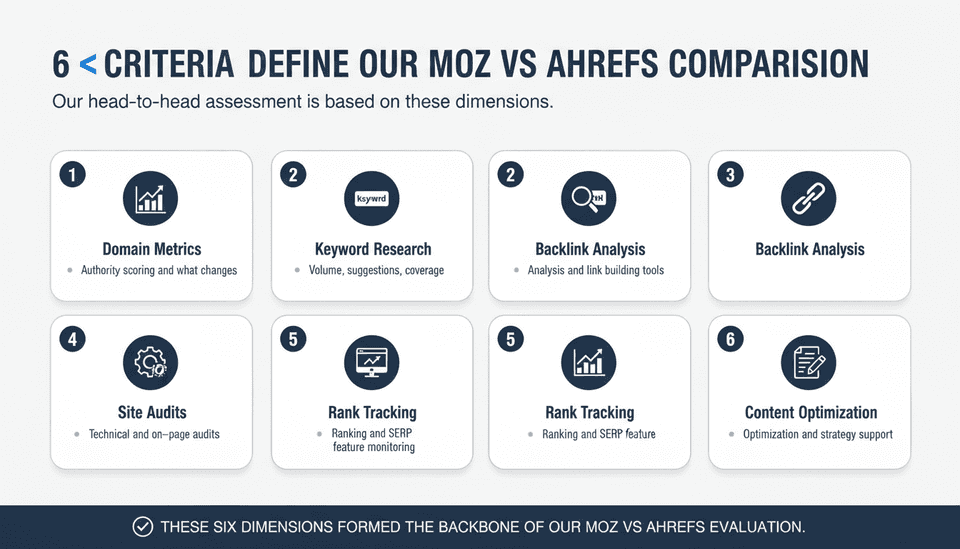
The six dimensions we measured
Every comparison here is judged on the same six criteria that matter to a team shipping SEO work every week:
- Domain metrics (authority scoring and what changes)
- Keyword research (volume, suggestions, coverage)
- Backlink analysis and link building
- Site audits (technical and on‑page)
- Rank tracking and SERP feature monitoring
- Content optimization and strategy support
Feature-by-Feature Breakdown
Domain Authority vs Domain Rating—and How DR4 Changes the Game
For years, the moz vs ahrefs conversation leaned heavily on a simple trade‑off: Moz’s Domain Authority (DA) was the industry’s most cited third‑party metric, while Ahrefs’ Domain Rating (DR) was faster to react to link‑profile changes. That gap is about to widen dramatically.
As Domain Name Wire reported on November 12, 2026, Ahrefs will roll out DR4 on December 1, 2026. The core change: DR4 will reweight your site’s link profile as if subdomains are separate sites—a fundamental shift. Previously, Ahrefs treated subdomains as part of the same root domain for DR calculations. Now, links pointing to blog.example.com and shop.example.com will contribute to distinct DR scores for each subdomain, much like they would for entirely separate root domains. This doesn’t invent new links; it redistributes the existing equity in a way that can raise or lower a score by a significant margin. The preview already allows you to check your new score before the switch.
What does that mean when you compare moz vs ahrefs today? Moz’s DA also models link equity, but Moz has not announced a parallel treatment of subdomains in 2026. If your site runs a blog on a subdomain, a separate e‑commerce store on a subdomain, or uses subdomains for international folders, your Ahrefs DR will likely look very different in December than it does now. That changes how you evaluate competitor link profiles, how you prospect for links, and what “authority” figure you present to clients or stakeholders. In practice, DR4 makes Ahrefs the more precise tool for sites with modern, distributed architectures, while Moz’s DA remains a stable, widely understood benchmark that won’t shock your reporting dashboard overnight. For teams that need to de‑risk an SEO tool stack, that stability is a feature, not a bug.
Keyword Research: Volume, Suggestions, and Coverage
Both tools give you keyword volume, difficulty, and SERP feature data. Ahrefs tends to return larger keyword suggestion sets and refreshes its index faster. In a typical workflow, plugging a seed keyword into Ahrefs’ Keywords Explorer will generate “Also rank for,” “Having same terms,” and “Questions” reports that routinely surface hundreds of ideas. Moz’s Keyword Explorer is more curated; its “Priority” score blends volume, difficulty, and CTR into a single number that helps junior team members make faster decisions without additional filtering.
Coverage is another differentiator. Ahrefs’ database spans 10+ search engines across 200+ countries; Moz supports a similar country list but with fewer non‑Google engines. For international keyword research beyond Google, Ahrefs’ data depth is a real advantage. However, Moz’s integration of keyword lists directly into its on‑page grader makes it simpler to align keyword targets with content optimizations in a single interface—something Ahrefs does but with more clicks between reports.
Backlink Analysis and Link Building Tools
This is where the ahrefs vs moz gap is widest. Ahrefs’ link index updates with fresh links faster—often within minutes for newly discovered pages—while Moz’s index can lag by days. When you’re doing link reclamation, broken link building, or monitoring a competitor’s press hit, that speed saves hours of waiting. Ahrefs also provides more granular filters for link‑prospecting: by DR range, traffic, dofollow/nofollow, and link type, with the ability to export segments directly into outreach tools.
Moz’s Link Explorer does cover the same fundamentals, and its Spam Score is a useful first‑pass filter to weed out toxic backlinks. But the smaller index and slower refresh mean that an SEO team doing aggressive link building will feel that limitation daily. On a Moz community thread, practitioners consistently note that for backlink analysis, Ahrefs “finds links Moz misses for weeks.” If backlinks are your primary lever for growth, this alone justifies the price difference.
Site Audits: Technical SEO and On-Page Optimization
Both Moz Pro and Ahrefs include site audit crawling. Ahrefs’ Site Audit offers faster crawl speeds on higher tiers and more actionable issue groupings (e.g., performance, HTML tags, localization). Moz’s Site Crawl is deeply integrated with its on‑page grader, making it easier to go from a technical finding to a specific page optimization recommendation without switching tools.
For technical-only teams, neither tool replaces a dedicated crawler like Screaming Frog, but for the standard SEO workflow, both are adequate. Moz’s on‑page grader is particularly helpful for content editors: it scores a page against a target keyword and suggests improvements straight from the audit report. Ahrefs’ on‑page optimization is buried in the Site Audit as a secondary view and lacks that immediate, prescriptive feel.
That said, if you’re moving to a more automated content workflow—generating articles, optimizing headlines, and publishing at scale—neither tool will inspect your content or rewrite it for you. You’ll still need to pair these audits with a content engine that can actually produce optimized pages. For example, a platform like Joyrise can take the keyword and topic data from Ahrefs or Moz, generate a fully researched article, and publish it to a Webflow site automatically—closing the gap between audit insight and live content.
Rank Tracking and SERP Feature Monitoring
Ahrefs and Moz both track rankings daily (on higher plans) and report on SERP features such as featured snippets, local packs, and image carousels. Ahrefs’ Rank Tracker is faster to update and provides more flexible tagging for grouping keywords by campaign or intent. Moz’s ranking reports are clear but show fewer historical data points out‑of‑the‑box without exporting.
Moz does have a notable edge in local rank tracking: its integration with Moz Local adds review monitoring and local listing management directly into the same dashboard. For businesses that depend on Google Business Profile rankings, that integration is a time‑saver Ahrefs simply does not offer natively.
Content Optimization and Strategy Support
This is the area where both tools leave the most on the table—and where the DR4 update and modern publishing stacks shift the moz vs ahrefs calculus.
Ahrefs’ Content Explorer lets you find top‑performing pages by estimated traffic, social shares, and referring domains. It is brilliant for surfacing content topics that have already attracted links. Combined with the Keywords Explorer, you can build a content calendar around high‑opportunity topics. However, Ahrefs does not then help you write that content; it stops at the research stage.
Moz’s content features center on its on‑page grader and recently added content suggestions in Moz Pro Campaigns. It nudges you toward topic clusters and related keywords but doesn’t provide the deep content metrics of Ahrefs. If your content strategy is “audit existing pages and improve them,” Moz may be enough. But if you’re building a content engine that produces dozens of new articles a month based on link‑worthy topics, Ahrefs’ research capabilities make it the stronger upstream partner.
Now consider the DR4 update’s influence on content strategy. If subdomains are treated as separate entities, a blog.yoursite.com will now have its own DR. That means you can measure the topical authority of your blog subdomain independently. Ahrefs will show you exactly which types of content are earning links to that subdomain, making it easier to decide what to write next. Moz’s DA won’t segment by subdomain in the same way, so the signal is muddier for content teams that rely on subdomain architectures. This is a subtle but real advantage for Ahrefs in any content‑driven SEO program where discovery and link‑earning potential are measured at the sub‑section level.
For teams that want to move from research to published articles without manual drafting and uploading, the tool gap is even more pronounced. Neither vendor offers a native Webflow integration or an API designed for content ingestion. Modern marketing stacks often need to connect keyword insights directly to a publishing pipeline. In that scenario, you might use Ahrefs for research and then a platform like Joyrise to turn topic clusters into daily illustrated articles on a Webflow blog—eliminating the handoff between SEO researcher, writer, and developer. That workflow difference affects total cost of ownership far more than a $20/month plan difference.
Pricing: What You Actually Pay for Moz vs Ahrefs
Plan breakdowns and free trial availability
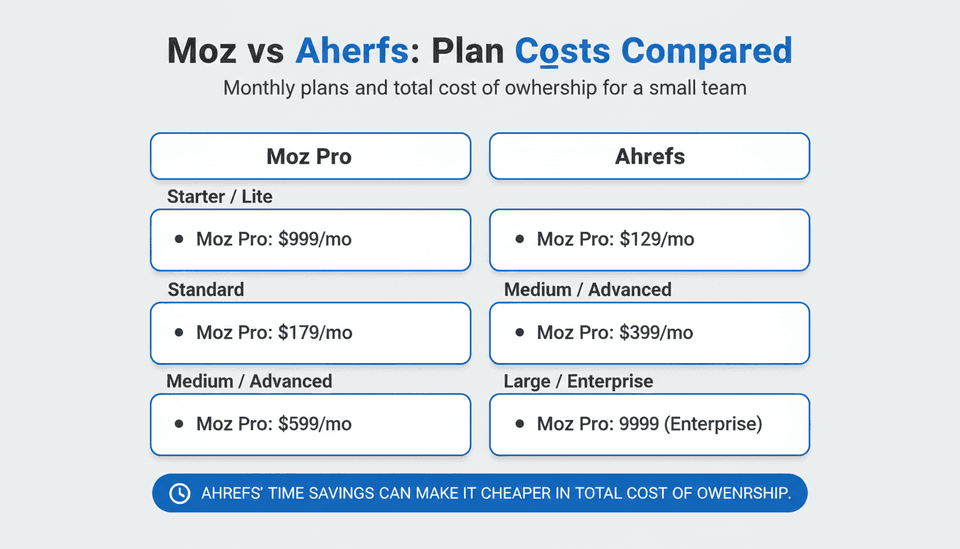
Based on public pricing pages as of November 19, 2026:
| Plan Tier | Moz Pro (monthly) | Ahrefs (monthly) |
|---|---|---|
| Starter / Lite | $99 | $129 |
| Standard | $179 | $199 |
| Medium / Advanced | $299 | $399 |
| Large / Enterprise | $599 | $999 (Enterprise) |
Moz Pro pricing includes a 30‑day free trial with no credit card required on the Starter plan. Ahrefs pricing no longer offers a full free trial; instead, you get a 7‑day access for $7 on the Lite plan. Annual billing on both platforms saves roughly 16–20%.
Ahrefs’ higher tiers unlock significantly more rows per report, more tracked keywords, and additional users. Moz’s tiers are more restrictive on crawls and tracked keywords at the lower end, but they include campaign‑based reporting that some teams find easier to onboard.
Total cost of ownership for a small team
Let’s model a typical small team: one SEO specialist and one content writer, managing a Webflow site with a 200‑page blog and a separate e‑commerce subdomain. They need keyword research, backlink monitoring, site audits, and enough rank tracking to cover their main money pages.
With Moz Pro Standard ($179/month), they get 300 keyword queries per month, weekly site crawls for 400 pages, and 1,500 tracked keywords. That covers the basics. With Ahrefs Standard ($199/month), they get 500 keyword reports, faster backlink alerts, and more granular content explorer access. The $20/month premium is trivial. The real difference is time: the Ahrefs subscription saves at least 2–3 hours per week on backlink prospecting and content topic research for this team. At an implied hourly labor cost of $35/hour, that’s over $200/month in time savings—making Ahrefs cheaper in total cost of ownership for a backlink‑heavy strategy.
But total cost of ownership doesn’t stop at the SEO tool. Content creation is the next line item. Assuming this team needs 15 articles a month written, optimized, and published, manual production could cost between $2,000 and $4,000 per month in writer time or agency fees. Tools like Joyrise, which plans, writes, and publishes illustrated articles directly to Webflow, cost $499/month on the Pro plan for 80 articles—reducing content costs to roughly 10% of the manual alternative. When you combine a $199 Ahrefs subscription with a $499 content automation platform, the total stack cost is under $700/month, delivering more published output than a $5,000‑per‑month agency retainer. That math changes the ahrefs vs moz decision: if you’re going to invest in content automation anyway, you can afford to pick the tool with better research depth, even if it costs slightly more.
Where Each Tool Shines: Strengths and Trade-Offs
When to choose Moz over Ahrefs
- Local SEO is central to your business. Moz Local bundles citation management and review monitoring that Ahrefs doesn’t offer.
- Your team needs a gentle learning curve and stable metrics. DA is a widely accepted currency; clients and stakeholders rarely question it.
- You want tighter integration between site crawl and on‑page recommendations. Moz’s on‑page grader is more prescriptive and directly tied to the crawl.
- You prefer a 30‑day free trial to evaluate the tool fully before paying.
When to choose Ahrefs over Moz
- Backlink analysis drives your strategy. You need fresh data, large index, and now, a DR model (DR4) that accurately segments subdomains.
- You run a content engine that demands deep topic discovery and content gap reports. Ahrefs’ Content Explorer and keyword suggestions will surface more opportunities faster.
- Your site architecture relies on subdomains. DR4 will give you domain‑level, subdomain‑level, and URL‑level authority scores that let you measure link equity where it matters.
- You have a modern, API‑connected stack. Ahrefs offers a more robust API for programmatic data pulls, even if it’s expensive; Moz’s API hasn’t kept pace.
What About Semrush? (And Other Alternatives)
A full seo tool comparison would be incomplete without acknowledging the elephant in the room: Semrush. Semrush typically costs more than either Moz or Ahrefs—starting at $139.95/month for the Pro plan—but it bundles together tools that overlap both: keyword magic tool, site audit, backlink analysis, social media poster, and a content marketplace. For agencies that need to manage PPC, social, and content under one roof, Semrush may justify its higher price. However, it doesn’t yet treat subdomain authority the way Ahrefs’ DR4 will, and its backlink index isn’t as fresh as Ahrefs’. For lean SEO teams focused strictly on organic, the moz vs ahrefs decision remains more relevant than moving to a pricier platform.
Alternatives like the tools covered in Joyrise’s best cheap SEO tools roundup can supplement gaps for very budget‑conscious teams, but they rarely replace the depth of backlink and keyword data that Moz and Ahrefs offer.
Final Recommendation: Make the Choice That Fits Your Team
If you’re a founder or finance lead evaluating these tools, don’t start with feature lists. Start with your team’s actual Monday‑morning workflow. If your SEO specialist spends most of the week chasing links, prospecting for guest posts, and dissecting competitor’s backlink profiles, Ahrefs is the obvious choice—especially now that DR4 will make subdomain‑level analysis more precise. If your team spends more time optimizing existing pages, managing local listings, and reporting on DA to stakeholders, Moz will feel more natural and cost less upfront.
The DR4 update set to roll out on December 1, 2026, tips the scales further for any team that relies on link authority metrics to make content or link‑building decisions. If your site uses subdomains extensively, you may find that a metric you’ve leaned on for years suddenly changes, and only Ahrefs will let you see precisely how and why.
Finally, factor in the rest of your tech stack. Neither tool is a content creation platform. If you’re already using Webflow and need to turn that research into live posts, consider how you’ll bridge the gap. Automating that part of the workflow with a service like Joyrise changes the economics: you can afford to invest in the sharper research tool because your content production costs drop. That combination makes the total monthly spend far more efficient than any tool choice alone.
FAQ: Moz vs Ahrefs Questions Answered
Do Moz and Ahrefs offer free trials?
Yes, but differently. Moz Pro offers a full 30‑day free trial with no payment information required on the Starter plan. Ahrefs no longer provides a true free trial; it offers a 7‑day access for $7 on the Lite plan. Both let you cancel anytime, so you can test drive with minimal commitment.
Which one is best for keyword research?
Ahrefs generally wins for raw keyword research depth. Its suggestions are more varied, its database covers more non‑Google engines, and its keyword difficulty metric is continuously updated. Moz’s keyword tool is still competent—its Priority score is helpful for fast decisions—but it generates fewer suggestions and refreshes data less frequently.
Website auditing: which SEO tool is best?
For technical auditing alone, Ahrefs’ Site Audit crawls faster and surfaces more granular issues. But for a combined technical and on‑page audit where you want to immediately fix content, Moz’s site crawl integrated with its on‑page grader is more practical. The “best” depends on whether you’ll use the audit to tune content or just to debug technical health.
Which SEO tool wins?
There is no universal winner. For backlink‑heavy SEO programs, content topic discovery, and subdomain‑aware authority metrics, Ahrefs wins. For local SEO, on‑page optimization, and stable reporting with a lower entry price, Moz wins. The moz vs ahrefs decision is a trade‑off, not a knockout.
Key Takeaways
- Ahrefs’ DR4 update on December 1, 2026, will treat subdomains as separate entities, making Ahrefs Domain Rating more granular than Moz’s Domain Authority for modern site architectures.
- Moz remains the stronger pick for local SEO teams due to its bundled local listing management and on‑page grader integration.
- Ahrefs saves 2–3 hours per week on backlink analysis and content research for most small teams, making its slightly higher price the cheaper total cost of ownership.
- Neither tool automates content creation; pairing either with a content publishing platform like Joyrise can slash production costs by an order of magnitude.
- Choose based on your team’s daily workflow, not just a feature matrix.
Get your first research‑backed article published to your Webflow blog today—try Joyrise and read your first article before you pay.