 Joyrise
SEO for CrossFit Gyms: The Definitive Guide
 By Alexi · · 14 min read
On this page
- Executive Summary: What This Guide Covers
- The SEO Landscape for CrossFit Gyms
- Essential SEO Building Blocks
- Local SEO: Owning Your Neighborhood
- The SEO Implementation Playbook
- DIY, Agency, or Automation: Choosing Your Path
- Common SEO Mistakes CrossFit Gyms Make
- Measuring Success: SEO Metrics That Matter for Gyms
- What’s Next? Voice Search, Video, and AI’s Growing Role
- Frequently Asked Questions
- Key Takeaways
Use SEO CrossFit tactics to get your gym found locally. This guide covers CrossFit marketing strategy, Google Business Profile for gyms. If your CrossFit box isn’t showing up when locals search for a gym, you’re invisible to the only people who matter: people ready to walk through your door. SEO CrossFit is not a luxury; it’s the mechanism that connects your coaching, your community, and your schedule to the exact person Googling “CrossFit near me” at 6 a.m. This guide is a complete, actionable playbook built specifically for the CrossFit business model — memberships, drop-ins, and local-only traffic — so you can stop guessing and start ranking.
Executive Summary: What This Guide Covers
You’ll get a plain-language breakdown of a CrossFit marketing strategy — how search engines decide which gym to show first — then a phased implementation roadmap you can follow yourself, hand off to an agency, or delegate to an AI-powered platform. We’ll cover the two search fronts every gym fights on (organic results and Google Maps), the keywords that actually fill classes, the local SEO tactics that turn your Google Business Profile into a lead engine, content that converts, and the metrics that connect a number on a dashboard to a new membership. We’ll also answer the five questions gym owners ask most about cost, DIY feasibility, and timelines. The goal is not theory; it’s a system you can start today.
The SEO Landscape for CrossFit Gyms
Organic Search vs. Google Maps: Two Fronts
When someone searches for a gym, Google often returns a blended results page: paid ads at the top, a map pack (three local businesses pinned on a map), and organic blue links below. For a CrossFit gym, the map pack is disproportionately important — it’s where the click-to-call and direction requests happen. Organic results below it matter for brand authority, answering deeper questions (“is CrossFit safe for beginners?”), and capturing traffic from fitness keyword research outside your immediate zip code. A CrossFit SEO strategy that only optimizes the website and ignores the map is like running a 5K without warming up: you might finish, but you’ll leave a lot of performance on the table.
Google’s local ranking factors weigh proximity, relevance, and prominence. Your physical address alone isn’t enough; you need a fully built-out Google Business Profile, consistent citations, and review velocity to win the map pack. Meanwhile, your website must handle on-page and technical signals to rank for broader fitness business SEO terms.
Keywords That Actually Fill Classes
Not all traffic is created equal. A CrossFit gym needs to target two buckets: transactional keywords (someone ready to sign up or drop in) and informational keywords (someone researching CrossFit). Transactional terms are the goldmine: “CrossFit gym near me,” “CrossFit drop-in [city],” “CrossFit membership cost [neighborhood].” Informational terms like “what is CrossFit” or “CrossFit vs OrangeTheory” can attract top-of-funnel traffic, but they rarely convert without a strong content-to-class pipeline.
Use a tool like Google Keyword Planner or Ahrefs to build a seed list. Then filter by local intent modifiers. A study in WellnessLiving’s functional fitness SEO guide reinforces that high-intent keywords with a location modifier convert at 2–3x the rate of generic fitness terms. Avoid chasing high-volume, low-intent terms like “exercise routine” — you’ll burn budget on visitors who will never set foot in your box.
Essential SEO Building Blocks
On-Page Optimization: Your Website’s Foundation
Each page on your site should target a single primary keyword and its variants. For your homepage, that’s typically your city + “CrossFit gym.” Dedicated pages for your schedule, coaches, and a beginner’s guide let you own long-tail informational search. These CrossFit SEO tips will help you rank a gym website for local searches. On-page elements to nail:
- Title tag: Primary keyword near the front, location included, under 60 characters.
- Meta description: Action-oriented copy that includes the keyword and a reason to click.
- H1: Clear, one per page, matched to the intent.
- Body copy: Use the keyword naturally, include semantically related phrases (functional fitness, WOD, affiliate, box).
- Internal linking: Connect your “beginner’s guide” to your “free intro class” page to funnel authority.
Make sure your CrossFit website SEO includes all the basics: your business name, physical address, and map location prominently; coach profiles with certifications and CrossFit credentials; class types, schedules, and a clear pricing or trial offer; your CrossFit affiliation badge and community messaging; and contact forms and phone numbers. These elements are not just for users; they signal local relevance to Google.
Technical SEO: Speed, Mobile, and Structured Data
Most gym websites run on WordPress or a page builder that loads unnecessary scripts. Run a PageSpeed Insights test: if your mobile score is below 50, Google will deprioritize you. Optimize images, reduce plugins, and use a CDN. Mobile-first indexing means your phone experience is what Google sees. Structured data (schema markup) helps search engines understand your business type, location, opening hours, and reviews. At a minimum, implement LocalBusiness schema, Review schema for Google to pull star ratings into the SERP, and FAQ schema for any Q&A pages to win featured snippets. For a deeper dive into structured data and technical audits, you might find the AI SEO vs Traditional SEO comparison useful, as it breaks down what modern tools can automate.
Content That Converts: Beyond the Blog
A generic blog of “5 WODs to Try” won’t cut it. Content must map to the buyer’s journey. Here’s a framework that works:
- Awareness: “What to expect at your first CrossFit class” (targets “CrossFit beginner guide [city]”)
- Consideration: “CrossFit gym pricing [city] – what you actually get”
- Decision: “Best CrossFit gym in [neighborhood]: how we compare” (with location-specific details)
- Retention: Member spotlight stories, nutrition tips, community events — these earn backlinks and social shares.
Each piece should answer a specific query and include a soft call-to-action like “Try a free class.” Use original photos of your facility, not stock images; real imagery increases trust and dwell time. For gyms without a dedicated writer, platforms like Joyrise can automatically plan and publish daily, research-backed articles that match your voice and local keyword gaps, turning content into a system rather than a sporadic chore.
Local SEO: Owning Your Neighborhood
Google Business Profile: Your Digital Front Desk
A Google Business Profile for gyms is your single most important SEO asset — it often brings more calls and direction requests than your website. Optimize it completely:
- Business name exactly as registered with CrossFit, Inc. and your LLC. Don’t stuff keywords.
- Category: “Gym” or “Fitness center” plus secondary “Personal trainer.” Don’t try to use “CrossFit gym” as a category; it’s not an option, and keyword-stuffing the name invites penalties.
- Description: Use your 750 characters to explain what makes your box different, naturally including “CrossFit gym in [city]” and a few service keywords.
- Services: Add items like “CrossFit classes,” “personal training,” “open gym,” with a brief description. This also strengthens SEO for personal trainers who operate out of your box.
- Photos: Upload weekly. Real photos of coaches, the facility, and community events. Google’s algorithm rewards fresh, authentic images.
- Q&A: Seed and answer questions such as “Do you offer a free intro class?” and “What should I bring to my first WOD?”
- Posts: Use the Posts feature to share upcoming events, testimonials, or a weekly challenge. Consistency signals activity.
The ChalkitPro local SEO guide for gyms confirms that GBP profiles with 10+ photos and weekly posts see a 200% higher rate of direction requests than stagnant profiles. This is a massive, low-effort lever.
Citations, Directories, and the Review Engine
A citation is any online mention of your gym’s name, address, and phone number. Consistency across the web is critical. Use a service like BrightLocal or Semrush to audit your listings on CrossFit-specific directories (map.crossfit.com, local box finders), Google Maps, Yelp, Facebook, and Apple Maps. Inconsistent information weakens local trust. The Wodify cheat sheet for fitness business SEO lists the top directories every gym should claim, including Mindbody and WellnessLiving if you use their software.
Reviews are the heartbeat of local SEO. Aim for a steady flow of new, detailed reviews on Google. Ask members after their first month or after a PR achievement; never incentivize with discounts. Respond to every review — yes, even the negative ones — with appreciation and professionalism. Review volume, velocity, and reply rate are all ranking signals.
The SEO Implementation Playbook
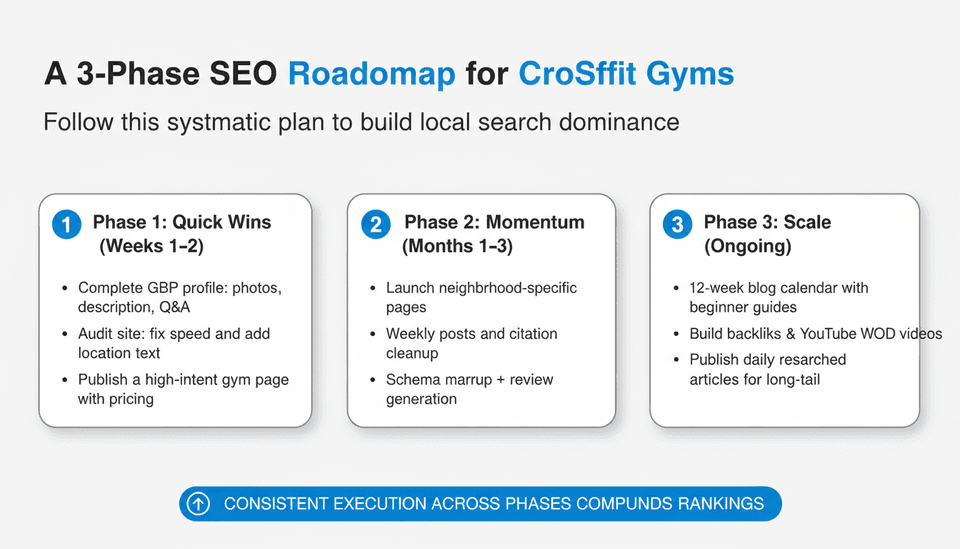
Phase 1: Quick Wins (Weeks 1–2)
- Claim and fully optimize your Google Business Profile (photos, description, services, Q&A).
- Run a simple site audit: fix broken links, compress large images, and ensure your name, address, and phone number are text (not an image) on every page.
- Install Google Search Console and submit your sitemap.
- Write one high-intent page: “CrossFit Gym in [City] – [Box Name]” with pricing info, trial offer, and a contact form.
- Build a list of 10 transactional seed keywords from Google’s “People also ask” and auto-suggest results.
Phase 2: Building Momentum (Months 1–3)
- Publish 4–6 website pages targeting location + service combinations (e.g., “[Neighborhood] personal training,” “CrossFit nutrition coaching [City]”).
- Start a weekly cadence for Google Posts and photo uploads.
- Run a citation cleanup using a tool; fix inconsistencies across at least 30 platforms.
- Implement LocalBusiness and Review schema.
- Begin a systematic review-generation process: one personal ask per day after class.
- Set up a simple tracking dashboard (Google Analytics + Search Console) to watch for branded and local keyword impressions.
Phase 3: Scaling with Content (Ongoing)
- Launch a blog or resource center with a 12-week content calendar covering member questions, local event coverage, and beginner guides.
- Create YouTube videos of WOD tips and embed them on relevant pages. Optimize titles and descriptions for search using YouTube SEO best practices.
- Build local backlinks: sponsor a 5K, host a nutrition workshop, get featured in local news.
- Use an SEO content platform to publish daily, researched articles that target long-tail informational keywords, keeping your site fresh without constant manual effort.
- Monitor rankings and adjust: retire underperforming pages, update old content with new dates and statistics.
DIY, Agency, or Automation: Choosing Your Path
The DIY Route: Tools and Time Commitment
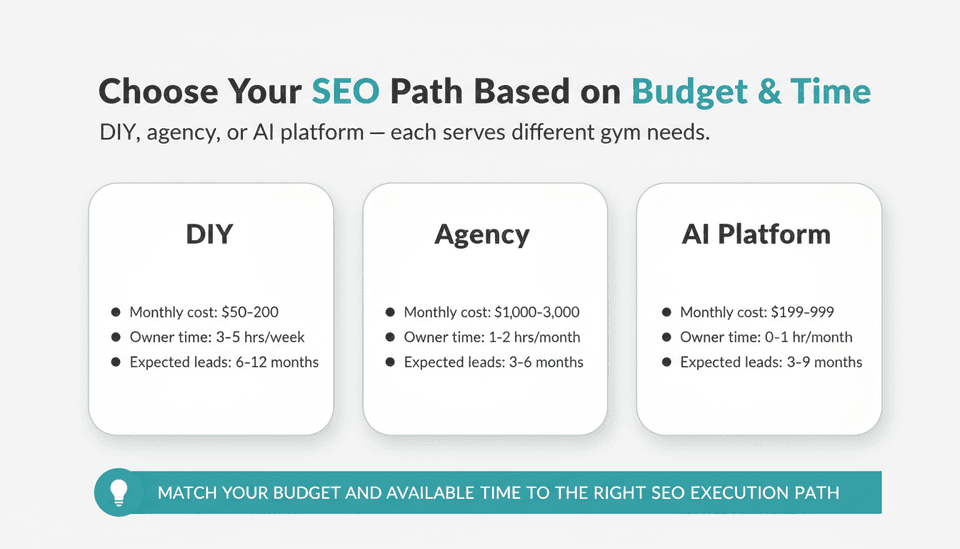
You can absolutely handle the basics yourself if you’re willing to dedicate 3–5 hours per week. The tools needed: Google Search Console (free), Google Business Profile (free), a keyword research tool like Ahrefs or Mangools ($30–$100/month), and a site audit tool like Screaming Frog (free for small sites). The biggest risk is burnout. Gym owners already wear ten hats; SEO is a slow-burn activity that feels unrewarding for months. If you’re consistent, DIY can get you to page one for local terms within 6–12 months, but it requires discipline.
When to Hire an SEO Agency
If you have a budget of $1,000–$3,000/month, a specialized fitness marketing agency can accelerate results. Look for agencies that show you a plan built on local SEO for fitness, not just generic audits. They should deliver monthly reports tying keywords to lead actions, not just traffic numbers. Trade-off: you’re paying for expertise but losing some control, and many agencies require 6-month contracts. Always ask for a list of current gym clients and check their GBP activity and organic visibility yourself before signing.
The Rise of AI-Powered SEO Platforms
The middle ground — and the fastest-growing option for gyms — is an AI-powered content marketing platform that replaces the manual effort of blogging and on-page optimization. For a flat monthly fee, platforms like Joyrise scan your site, learn your brand voice, identify keyword gaps, generate researched articles with original images, and even publish directly to your Webflow blog. This approach bridges the gap between doing nothing and paying a full-service agency: you get consistent, quality content that targets long-tail fitness keywords with near-zero owner involvement. It’s not a replacement for your Google Business Profile work or citation management, but it solves the content engine problem at roughly a tenth of agency costs. A gym owner using such a platform can run a full-scale content operation that would otherwise consume 15+ hours a week.
The table below compares the three execution paths for the average CrossFit gym.
| Approach | Monthly Cost | Owner Time | Content Quality | Typical Time to First Organic Leads | Best For |
|---|---|---|---|---|---|
| DIY | $50–200 (tools) | 3–5 hrs/week | Dependent on skill | 6–12 months | Hands-on owners with a marketing background |
| Agency | $1,000–3,000 | 1–2 hrs/month (calls) | High | 3–6 months | Gyms with budget wanting fast growth |
| AI platform | $199–999 (e.g., Joyrise) | 0–1 hr/month | High, AI-generated but human-reviewed | 3–9 months | Webflow-based gyms seeking scalable content |
Common SEO Mistakes CrossFit Gyms Make
Chasing Irrelevant Keywords
Trying to rank for “workout plans” or “best exercises” because they have high volume. These terms don’t convert for a local gym, and you’ll never outrank established fitness sites. Stick to locally-modified, high-intent keywords.
Ignoring Local Signals
A beautiful website means nothing if your Google Business Profile is incomplete or your citations are inconsistent. The map pack drives more calls than your organic listing for most local queries. If you’re not actively managing your GBP, you’re losing leads every day.
Treating SEO as a One-Off Project
SEO is not a launch-and-forget campaign. Algorithms change, competitors optimize, and your content decays. A gym that does an SEO overhaul, sees a bump, and stops posting fresh content will watch its rankings erode. Think of it like programming: you need to do regular maintenance to keep climbing.
Measuring Success: SEO Metrics That Matter for Gyms
Traffic, Leads, and Memberships: Connecting the Dots
Don’t obsess over raw traffic numbers. A gym’s success metric is new memberships, trial sign-ups, and class visits sourced from search. In Google Analytics, set up goals for form submissions, phone calls (via a forwarding number), and direction requests from your GBP. In Search Console, watch the “queries” report for local terms to see which keywords are generating impressions and clicks. If you’re scaling content, the ranked keywords guide explains how to track growth positions and interpret the data so you don’t confuse activity with progress.
At the end of each month, calculate: total organic leads / total organic sessions = conversion rate. This number should trend upward if your landing pages align with intent. If it doesn’t, your content isn’t matching what people want when they click.
What’s Next? Voice Search, Video, and AI’s Growing Role
Preparing Your Site for AI-Driven Search
By late 2026, AI overviews and conversational search are becoming primary discovery channels for many users. When someone asks their phone, “What’s the best CrossFit gym near me that has a 6 a.m. class and a kids’ area?” Google’s AI doesn’t just look at keywords; it looks at structured data, GBP completeness, review sentiment, and the depth of information on your website. To prepare:
- Implement thorough FAQ schema for your class schedule, membership options, and facility amenities. This gives AI clear, structured answers to pull from.
- Create video content that answers common local questions. A 60-second walkthrough of your gym, with a transcript, embedded on your site, can surface in video carousels and AI-generated answers. Don’t just post on social; own the content on your domain.
- Voice search queries are longer and more conversational. Use natural language in your content: think “How much does a CrossFit membership cost per month in Austin?” not just “Austin CrossFit membership.”
- Ensure your GBP is so complete that an AI can confidently recommend you. This means having recent reviews that mention “great 6 a.m. class” and “the coaches are so patient with beginners.”
The shift to AI-powered search doesn’t replace traditional SEO; it doubles down on the same fundamentals: local relevance, authentic content, and technical hygiene. A gym that’s doing everything in this guide will already be ahead.
Frequently Asked Questions
What is SEO for CrossFit?
SEO for CrossFit is the practice of optimizing a CrossFit gym’s online presence — website, Google Business Profile, and off-site listings — to appear prominently in search engine results for terms related to CrossFit classes, memberships, and personal training in a specific geographic area. It’s not about ranking for “CrossFit” globally; it’s about being the first gym a local prospect sees when they’re ready to start. It combines general fitness keyword research, local ranking signals, and content strategies that demonstrate your expertise as an affiliate.
How can I get my CrossFit gym to rank higher on Google?
Focus on three layers: a technically sound, mobile-friendly website with location-specific pages; a fully optimized Google Business Profile with regular posts, fresh photos, and a growing number of authentic reviews; and a steady stream of locally relevant content (blog posts, videos, and event pages) that answers real questions people in your city are asking. Consistent citation accuracy and earning local backlinks from community partners give you a competitive edge. This is a long game — quick spikes from a one-time fix won’t stick.
What are the best keywords for CrossFit gyms?
The best keywords combine high intent with location: “CrossFit gym near me,” “CrossFit [city],” “[neighborhood] CrossFit drop-in,” “CrossFit membership cost [city],” and “best CrossFit box in [area].” Secondary, informational terms that feed your funnel include “what to expect first CrossFit class [city]” and “CrossFit for beginners [city].” Avoid generic terms like “fitness tips” — they don’t convert for a local gym.
How much does SEO cost for a gym?
It varies widely. A DIY approach costs $50–200/month in tools plus several hours of your time each week. A specialized SEO agency typically charges $1,000–$3,000/month with a multi-month commitment. An AI-powered content platform that automates the blogging and on-page optimization can cost $199–$999/month, freeing you from manual content work while keeping costs far below agency retainers. The right path depends on your budget, available time, and growth urgency.
Can I do SEO for my gym myself?
Yes, if you’re willing to learn the fundamentals and invest consistent effort. You’ll need to master Google Business Profile management, basic on-page optimization, and content creation. Many successful gym owners start DIY, then gradually bring in tools or platforms as they scale. The key is to treat SEO like a weekly operational task, not a one-time project. If you can spare 3–5 hours per week, DIY is viable.
How long does it take to see results from SEO for a fitness business?
Expect meaningful traction — defined as a measurable increase in organic leads — between 6 and 12 months. Quick technical fixes and GBP optimization can yield small wins in weeks, such as a bump in map pack impressions. But building the domain authority and content depth needed to consistently rank for competitive local terms is a marathon. Results compound if you maintain a steady publishing cadence and never pause your local listing upkeep.
Key Takeaways
- Google Business Profile is the cornerstone of gym SEO: a complete, frequently updated profile with consistent review generation brings more calls and visits than organic rankings alone.
- Target locally modified, high-intent keywords — terms like “CrossFit gym in [city]” convert far better than broad fitness topics, so don’t waste effort on irrelevant volume.
- SEO is a system, not a project — long-term growth requires ongoing content, citation management, and technical upkeep, whether you handle it yourself, hire an agency, or use an AI-powered platform.
- Choose the execution path that matches your resources: DIY if you have time, an agency if you have budget, and an automated content platform if you want scale without the overhead.
- Prepare for AI-driven search now by implementing structured data, creating video content with transcripts, and answering conversational queries directly on your site — these actions align with how Google’s AI overviews source answers today.
Put your SEO on autopilot without sacrificing quality. Joyrise plans, writes, and publishes daily illustrated articles that help your gym rank for the right terms, starting with a free trial article before you pay a cent.