 Joyrise
YouTube SEO Title Generator: Beyond the Free Tools
 By Alexi · · 14 min read

On this page
- Executive Summary & Definition
- How YouTube Title Generators Actually Work
- What the Data Says About YouTube Title Performance
- Free vs. Paid Title Generators: Tradeoffs That Matter
- How to Evaluate a Title Generator for Your Content Workflow
- Connecting YouTube Titles to Your Full‑Stack Content Strategy
- Myths, Mistakes, and Controversies in YouTube Title Optimization
- Measuring Title Generator Impact Beyond Clicks
- The Future of AI‑Driven Video Discovery
- Can AI Title Generators Replace Human Creativity?
- Key Takeaways
Stop treating a YouTube SEO title generator as a quick fix for a single video. For founders and marketing leads who need to scale, the tool is one lever in a broader, AI‑powered content machine—one that should connect video discovery directly to blog traffic, brand authority, and measurable revenue. This guide moves past one‑off free tools and examines how to evaluate, integrate, and measure title generators as part of a unified YouTube SEO tools strategy that includes video title optimization and content strategy for YouTube.
Executive Summary & Definition
A YouTube SEO title generator is software that analyzes search data, engagement signals, and language patterns to propose video titles optimized for both YouTube’s algorithm and human click‑through. But the best operators don’t use these tools in isolation. They embed automated YouTube SEO workflows where title generation links YouTube videos to blog posts, landing pages, and email sequences—so a single keyword cluster fuels growth across every surface your brand owns.
What is a YouTube Title Generator?
It’s an AI‑powered tool that inputs a topic, target keyword, or video description and outputs title ideas built around proven frameworks. The generator pulls from historical CTR data, common emotional hooks, and real‑time search trends to increase the odds that a viewer finds and clicks your video. Unlike generic AI chatbots, these tools are trained specifically on video platform behavior: they know that a 55‑character title with a number and a curiosity gap often outperforms a 70‑character descriptive headline. If you’re looking for how to write YouTube titles that win, understanding this underlying mechanism is essential.
What can I use this AI YouTube Title Generator for?
Beyond saving 10 minutes per video, a competent YouTube title generator becomes a strategic asset. You use it to:
- Shortlist title variants for A/B testing at scale.
- Align video titles with the blog posts and product pages they complement.
- Maintain a consistent brand voice across dozens of weekly uploads.
- Generate foreign‑language title adaptations for multi‑market channels.
- Feed title ideas back into your keyword planning so blog and video teams work off the same map.
How YouTube Title Generators Actually Work
AI model training on search patterns and engagement data
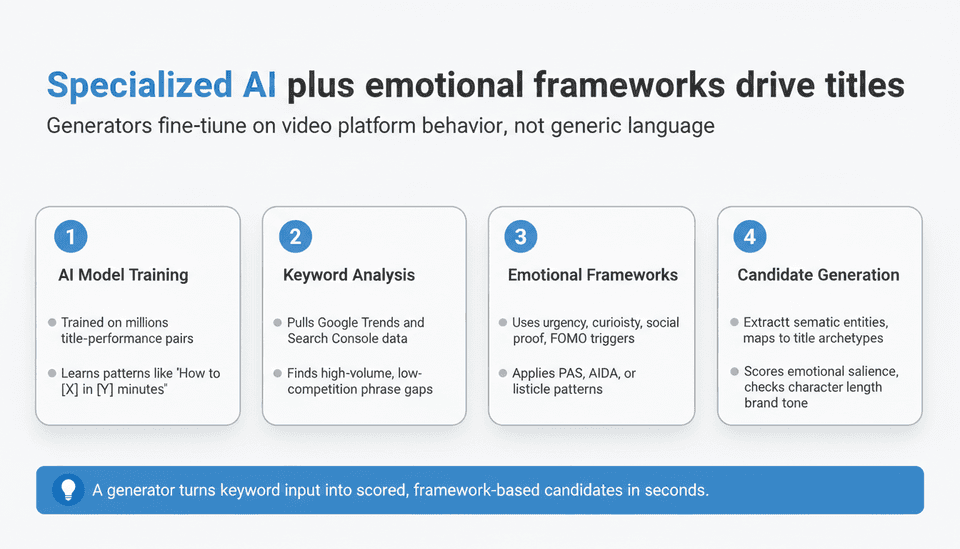
Specialized YouTube title generators are built on models fine‑tuned on millions of video-title-performance pairs. They learn that certain syntactic patterns—like “How to [X] in [Y] minutes” or “[Number] Ways [Benefit]”—correlate with higher impressions and longer watch time. The models also ingest regional YouTube search autocomplete data, trending terms, and competitor top‑performing titles, then weight freshness against evergreen relevance.
Keyword analysis and trending topic integration
A strong generator pulls live data from sources like Google Trends, YouTube Search Console data (if connected), and public video metadata. It identifies high‑volume, low‑competition phrase gaps—a query where demand outstrips supply—and proposes titles that target those gaps without sounding stuffed. For example, instead of “Best DSLR Camera 2026” it might suggest “DSLR vs Mirrorless in 2026: Which Camera Actually Wins?” because the comparison angle captures both information seekers and purchase‑intent viewers. Following some simple YouTube title tips like this can dramatically improve your results.
Emotional trigger and framework libraries
Behind every suggestion is a library of triggers: urgency, curiosity, social proof, fear of missing out. The tools apply these through frameworks like PAS (Problem‑Agitate‑Solve), AIDA (Attention‑Interest‑Desire‑Action), or simple listicle patterns. A title like “We Tested 20 Budget Mics—This $49 Option Shocked Us” uses curiosity (“shocked us”) and specificity ($49) to stand out.
How Does the AI Title Generator Work?
The generator processes your input (topic, keyword, or even a draft script) through a sequence of steps: it extracts semantic entities, maps them to high‑performing title archetypes, checks character length for truncation risk, scores the emotional salience, and then uses a transformer‑based model to craft multiple candidate titles. Some tools run a secondary “quality judge” pass—like Joyrise’s blog article pipeline—that re‑grades the title for brand tone and factual accuracy before output.
How does this YouTube Title Generator work?
From a user’s perspective, you paste a target keyword or a short description, select a content type (tutorial, review, news), and optionally set constraints like maximum character count or inclusion of a brand name. Within seconds you get 5‑20 ranked suggestions, often with a “clarity” or “virality” score. The underlying mechanism is the same AI process described above, just wrapped in a UI that hides the complexity.
What the Data Says About YouTube Title Performance
Title length, structure, and character limits
YouTube’s display truncates titles after roughly 60 characters on mobile and around 70 on desktop—but that doesn’t mean you should fill every slot. Data aggregated from multiple channel audits shows that titles between 47 and 55 characters generate the highest average CTR in most niches, because they display fully on mobile without wrapping. Front‑loading the primary keyword remains non‑negotiable, but the “power position” in the first 30 characters belongs to an emotional or benefit‑driven phrase.
The role of emotional language vs. factual clarity
Titles that pair a concrete fact with an emotional modifier consistently outperform purely dry, factual titles. “How to Reduce Churn by 22% (Without Discounting)” carries both a hard number and a pain‑point resolution. Purely emotional clickbait (“You Won’t Believe What Happened Next…”) gives a quick CTR spike but tanks average view duration—a signal YouTube now weighs heavily in recommendations. The optimal ratio depends on your channel: tutorial and B2B channels see better retention with factual clarity, while entertainment can lean heavier on emotion.
Impact of brand keywords and episode numbering
Adding your brand name at the end of a title (“… | CompanyName”) can hurt discovery if the brand is unknown, because it consumes characters that could go to broader keywords. For returning audiences, however, episode numbering (“Ep. 12”) and brand tags increase subscriber pull—existing subscribers are more likely to click when they recognize the series. Weigh brand keywords against new‑user acquisition goals; if you’re in growth mode, keep the brand tag minimal.
Why Do These Titles Outperform Generic AI?
Generic AI chatbots produce titles that are grammatically correct but lack video‑specific structural insight. A standard LLM might output “The Importance of Keyword Research for SEO” while a dedicated SEO title generator for YouTube knows the platform rewards “Keyword Research in 2026: The 3‑Step Process That Replaced Old Methods.” The difference is training data: specialized tools are conditioned on platform data, character‑limit constraints, and emotional frameworks that match video‑viewer behavior, not just search‑engine behavior.
Free vs. Paid Title Generators: Tradeoffs That Matter
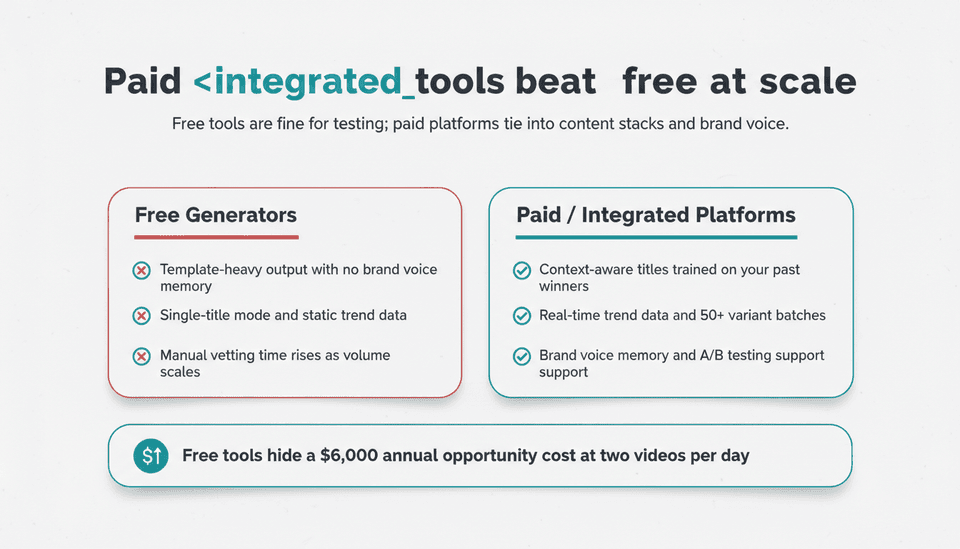
Below is a snapshot of the decision every team eventually faces—start with a free point tool or invest in a solution that connects to the rest of the content stack. While the best free YouTube title tool might be TubeRanker, FatJoe, or Opus.pro, they each come with limits.
| Factor | Free Generators (e.g., TubeRanker, FatJoe, Opus.pro) | Paid / Integrated Platforms |
|---|---|---|
| Output quality | Good for one‑off inspiration; often template‑heavy | Context‑aware titles trained on your channel’s past winners |
| Customization | Limited to keyword input; no brand voice memory | Can learn house style guides, preferred frameworks, and banned terms |
| Data freshness | Relies on static keyword lists or delayed trend data | Real‑time search console and trend API integration |
| Bulk generation | Usually single‑title mode only | Generates 50+ variants in one go; ideal for batch scripting |
| A/B testing support | None beyond manual copying | Some tools flag top‑2 candidates and integrate with title testing workflows |
| Cost at 20 videos/month | Free, but time cost for vetting rises | Starts around $10–$30/month for solo creators; $100+ for team plans with API access |
| Long‑term ROI | Hard to measure; limited to CTR uplift | Attributable to subscriber growth and cross‑platform traffic when integrated with analytics |
Output quality and customization control
Free tools give you a list of ten decent titles. But they can’t remember that your channel never uses all‑caps or that you always phrase comparisons as “X vs Y” rather than “X vs. Y.” Paid tools, especially those with API access, let you feed in data from your top‑performing video titles so every new suggestion stays on‑brand. That consistency adds up: viewers who see a familiar pattern in titles are more likely to subscribe.
Integration with other SEO and analytics tools
A standalone title generator lives in a browser tab. An integrated automated YouTube SEO tool plugs into your workflow via APIs—pulling keyword data from your rank tracker, checking your video description generator outputs, and then pushing title candidates into a scheduling platform. The real productivity unlock isn’t the title suggestion; it’s the elimination of copy‑pasting between tools.
Long‑term cost when scaling video production
The “free” tool costs you roughly 20 minutes of manual review per video. At two videos a day, that’s over 120 hours a year—roughly $6,000 in opportunity cost for a $40/hour employee. A paid generator that automatically aligns with your content calendar and filters out weak options cuts that to minutes. Factor in the revenue impact of even a 2% CTR lift across 500 videos, and the free tool’s hidden cost becomes clear.
How to Evaluate a Title Generator for Your Content Workflow
Required features: bulk generation, A/B testing, brand voice preservation
If your channel publishes more than three videos a week, bulk generation is not a luxury. You need the ability to run a single topic or keyword set and receive 20‑50 ranked title ideas, with filters for character length, emotional category, and keyword inclusion. A/B testing support doesn’t yet mean YouTube natively splits title variants (unless you test via thumbnail experiments), so look for generators that auto‑log variant performance in a dashboard so you can manually swap and track. Brand voice preservation is the hardest feature to get right: demand that the tool learns from uploaded “golden” titles and blocks specific words or patterns your audience dislikes.
APIs and automation readiness
For teams, the real power is automating the handoff: idea → keyword research → title generation → draft scheduling. An API that accepts JSON payloads of video topics and returns scored titles can plug into a content ops stack. In AI SEO Content Optimization: The Definitive Guide we cover how modern SEO teams are stitching these components together. Similarly, your YouTube title generator should talk to the same tool that builds your blog headlines and meta descriptions, so cross‑channel keyword themes stay coherent.
Pricing models and ROI estimation
Ignore sticker price; calculate cost per usable title. A tool that charges $49/month but generates 200 titles, of which you publish 40, costs $1.23 per final title. Now estimate the additional views and subscriber value those 40 titles bring. If the tool lifts your average CTR from 4% to 5.5% on a channel with 100,000 monthly impressions, that’s 1,500 more clicks per month—worth more than the tool’s fee in most niches. Ask for a trial and track before/after data on a consistent video series to make the business case.
Connecting YouTube Titles to Your Full‑Stack Content Strategy
Why isolated title optimization leaves traffic on the table
A killer YouTube title brings viewers to your video. But if that video topic isn’t also an SEO YouTube keyword target for a blog post that ranks on Google, you’re forcing viewers to choose between a video and an article they can’t find. Isolated optimization means your title wins a click, but the viewer then exits your ecosystem. A unified approach ensures that the same query triggers both a YouTube result and a Webflow‑hosted blog post, capturing the segment of your audience that prefers to read. Effective content strategy for YouTube demands this cross‑surface thinking.
Aligning video titles with blog posts, landing pages, and social copy
Adopt a “one topic, many surfaces” rule. When you plan a video like “How to Build a B2B Content Calendar in Asana,” your blog team writes an article with the angled H1 “The 2026 B2B Content Calendar Template That Saved 8 Hours/Week.” The social copy teases the workflow, and the landing page for a product tracks signups from both. A good YouTube title generator can export the raw title frameworks that your blog AI then re‑clothes for search. This is what we mean by full‑stack: titles aren’t endings; they’re the front door of a content journey.
A look at platforms that unify SEO content creation (blog, image, and video planning)
The emerging category of integrated platforms handles the blog side automatically so your video team doesn’t have to stop and write. For example, Joyrise uses AI to plan, write, and publish daily illustrated articles directly to Webflow blogs, learning your brand voice and topic gaps. When your YouTube channel covers “SaaS churn reduction,” Joyrise ensures a matching article appears on your site each week, pulling from the same keyword research—all without an agency. This cross‑surface reinforcement strengthens your domain authority and keeps viewers in your ecosystem. You can see how the Joyrise platform works for a unified content engine; the principle applies regardless of which tool you choose.
Myths, Mistakes, and Controversies in YouTube Title Optimization
Do Emojis in YouTube Titles Help or Hurt Your Views?
The evidence is split, and the answer depends on audience and niche. For tech reviews, finance, and B2B knowledge channels, emojis in titles can reduce credibility —viewers associate a clock emoji with cheap, templated content. In lifestyle, gaming, and “vlog” categories, an emoji can signal tone and increase CTR by up to 3% according to some channel managers’ self‑reported data. My position: unless you’re in a niche where casual tone is a core part of your brand, avoid emojis in titles. If you’re curious, run a side‑channel experiment, never a split test on your main series. The risk of alienating high‑intent commercial viewers outweighs a speculative bump.
Is clickbait ever a sustainable strategy?
Clickbait—titles that promise something the video doesn’t deliver—creates a trust deficit that compounds. While you may see a short‑term CTR lift, the algorithm tracks signals like early drop‑offs, dislikes, and low watch time. A June 2026 YouTube Creator Liaison update explicitly reinforced that “misleading titles” are a ranking demotion factor. Sustainable high performance comes from “accuracy + curiosity.” A title like “We Lost 40% of Our Subscribers in One Day—Here’s the Real Fix” satisfies the curiosity gap while delivering. The data shows that channels which pivot to accurate, value‑driven titles recover from clickbait damage over 6–12 months.
Keyword stuffing and the ‘robotic’ AI title problem
Feeding a generator a list of five target keywords and asking for a title that includes them all produces clunky results: “Best Cheap Fast Web Hosting 2026 Top Affordable Review.” Even a well‑trained AI can parrot this if constraints are too tight. The fix is to give the generator a primary keyword, let it choose one secondary, and then add a human‑readability filter. Always listen to the title out loud before publishing. If you can’t imagine someone saying it, neither can YouTube’s NLP models.
Measuring Title Generator Impact Beyond Clicks
Watch time, retention, and session duration as quality signals
A higher CTR from a new title means nothing if retention craters. Use YouTube Analytics to compare the average view duration and retention at 30 seconds between videos with old titles and those with generator‑optimized ones. A good title lifts click‑through without overselling; watch time should stay flat or increase. If it drops, the title is misleading—adjust the promise.
Subscriber conversion and traffic source shifts
The most overlooked metric: subscriber gain per video. A well‑targeted title attracts more viewers likely to subscribe. Track the “Subscribers” source attribution after title changes. Additionally, monitor traffic source reports: if YouTube search impressions rise but browse features or suggested views fall, the title might be over‑optimized for search at the cost of algorithm virality.
Attribution: linking title changes to downstream business goals
Ultimately, you want to connect titles to revenue. Use UTM‑coded links in descriptions (e.g., ?utm_source=youtube&utm_campaign=title_variant_A) to track sign‑ups or free‑trial starts from videos with different title strategies. For B2B channels, attribute leads using CRM tagging; for ecommerce, track affiliate click conversion rates per title cohort.
How do I measure the ROI of a YouTube title generator?
Take the monthly cost of the tool (say, $199 for an integrated platform) and compare against the incremental revenue from title‑driven improvements. A simple formula:ROI = (Additional Monthly Revenue × Profit Margin – Tool Cost) / Tool Cost.
To find “Additional Monthly Revenue,” pick a stable period, switch 10 videos to AI‑generated titles, and measure the lift in conversion events sourced from YouTube against a control group of 10 similar videos. Multiply the per‑video lift by your monthly upload volume. This works best if your videos have measurable conversion actions linked in the description or pinned comment.
The Future of AI‑Driven Video Discovery
Multimodal search and title generation for voice results
Voice searches on smart displays are rising. Future title generators will need to output titles that double as spoken‑query responses: natural‑language phrases like “Alexa, show me how to fix a sink” rather than “Easy Sink Fix Guide.” This means title tools will ingest audio‑search pattern data and produce conversational variants automatically.
Personalized, real‑time title variations
YouTube already serves different thumbnails to different segments. The next frontier is serving dynamic titles: a subscriber might see “Welcome back—This week we cover…” while a new viewer sees “The 2026 SEO Framework for Beginners.” Title generators with CRM integration could pre‑generate three variants per video and push them via API as audiences are identified.
Ethical considerations: transparency and authenticity at scale
As AI generates thousands of titles, the line between helpful optimization and manipulation blurs. Platforms will likely introduce policies requiring disclosure if titles are dynamically altered in a deceptive way. The brands that win will be those that use AI to scale authenticity—not trickery—by staying true to their editorial voice and giving viewers what was promised.
Can AI Title Generators Replace Human Creativity?
No, and they shouldn’t try. A title generator is excellent at surfacing data‑backed structural patterns that a human would take 20 videos to discover. But it cannot grasp the nuance of a channel’s inside jokes, cultural timing, or a host’s unique verbal tic that builds parasocial trust. The best workflow is AI drafts, human edits. The creator adds the unpredictable spark; the machine keeps it within platform‑winning boundaries. Treat the title generator like a junior analyst who prepares three options with data, then you—the editorial lead—pick and refine.
Key Takeaways
- A YouTube SEO title generator is not a standalone gimmick; it’s a multiplier when linked to a unified, cross‑surface content strategy.
- Measure title generator success by subscriber conversion, watch time stability, and downstream revenue, not just CTR.
- Free tools help in early testing, but paid platforms with API access and brand‑voice memory deliver a positive ROI at scale.
- Emojis and clickbait rarely survive long‑term; accuracy combined with emotional framing beats deceptive hooks.
- Human oversight remains essential—let AI surface the patterns, then you inject the personality.
Ready to automate the blog side of your unified content engine? Start with Joyrise’s read‑before‑you‑pay trial.