 Joyrise
AI SEO Content Optimization: The Definitive Guide
 By Alexi · · 20 min read

On this page
- AI SEO Content Optimization in One Page: Definition and Scope
- Core Terms People Confuse: AI Writing, Optimization, GEO, and Agentic Publishing
- How AI SEO Content Optimization Works End to End
- What the Ranking Pages Already Agree On
- The Tradeoffs: Manual, Assisted, Agentic, and Fully Automated Workflows
- A Practical Implementation Framework: From Scan to First 90 Days
- What No Ranking Page Tells You: Webflow Automation, AI Assistant Referrals, and Brand Voice
- Adjudicating the Disagreements: Will AI Replace SEO or Just Change It?
- Mistakes, Myths, and Limitations
- Next Steps and a Readiness Checklist
- Key Takeaways
AI SEO content optimization isn’t about handing your site to a robot and walking away. It’s a deliberate, end-to-end system that produces automated SEO content by combining deep brand knowledge, on-page craft, and automated publishing speed to earn visibility in both traditional search results and the next wave of AI-generated answers. If you run a business that publishes content regularly—especially on Webflow—you need to know exactly what this process costs per article, where the quality risks live, and how to measure results beyond Google’s classic blue links.
AI SEO Content Optimization in One Page: Definition and Scope
What is AI SEO content optimization?
AI SEO content optimization means using artificial intelligence to plan, write, structure, and measure content specifically to improve its performance in search engines—including Google’s AI Overviews and generative AI assistants like ChatGPT and Perplexity. It’s not about pushing a button and accepting whatever the model spits out. It’s a workflow where AI handles the heavy lifting of research, drafting, and on-page formatting, while a human (or a second quality-checking AI) ensures the output stays on-brand, factually accurate, and aligned with search intent.
The goal is the same as classic SEO: get your content discovered, read, and trusted. The difference is that AI shortens the time from strategy to published result from days to hours—provided you build the right guardrails.
What this guide covers and what it does not
This guide gives you a decision framework, not a tool list. You’ll learn:
- The unit economics of AI-driven content at 30, 80, and 180 articles per month—something no other ranking page quantifies.
- How automated publishing to Webflow works, including draft approval and rollback.
- How to measure AI assistant referrals from ChatGPT, Perplexity, and other tools separately from Google AI Overviews.
- Why deep site scans beat generic prompt-based content generation.
- A practical implementation framework for the first 90 days, including a readiness checklist.
This guide does not walk through individual SEO tool interfaces, nor does it promise “quick wins.” It assumes you already understand basic SEO concepts and are looking to scale without sacrificing quality or risking manual action penalties.
Is SEO still relevant for generative AI search?
Yes. AI search features don’t eliminate the need for SEO—they change where the traffic comes from and what signals matter most. Google still crawls, indexes, and ranks pages using foundational algorithms. Even when an AI Overview answers a query directly, it cites high-quality sources. Search Engine Land’s November 12, 2026 enterprise SEO guide notes that enterprise tools must now go beyond basic keyword research and quick site health checks, because the demands of AI-visible content require deeper site integrity and semantic structure. In other words, the technical foundation that made content rank well two years ago is still the prerequisite for showing up in an AI summary today.
The recent expansion of AI search services for niche industries—such as Solutionarian Marketing’s November 10, 2026 announcement combining website design, local SEO, and AI-focused content for contractors—makes it clear that SEO is not being replaced; it’s being layered into a broader AI-awareness strategy. If SEO were dead, no agency would be building a practice around it.
Why foundational SEO still matters for AI search
AI models that produce answers rely on well-structured, trustworthy content. Google’s helpful content guidelines still apply. Pages that load fast, use clean semantic HTML, earn authoritative citations, and genuinely answer user questions perform better in both traditional rankings and AI Overviews. If your site has crawling errors, thin content, or poor internal linking, no AI content optimizer will save it. A typical SEO workflow process remains the backbone; AI only accelerates the execution.
Core Terms People Confuse: AI Writing, Optimization, GEO, and Agentic Publishing
What is AI content optimization vs. AI content generation?
AI content generation is producing text from a prompt—often with minimal direction and no strategic framework. It gives you words. AI content optimization, by contrast, starts with a target keyword, a site scan that understands your brand voice and existing content gaps, and then produces a draft that’s structured for search. The draft includes optimized headings, meta descriptions, internal links, and a table of contents that matches user intent. After the draft, a quality pass (human or second AI) refines it for relevance and tone.
In plain terms: generation gives you a blog post; optimization gives you a blog post that’s already doing the work of an SEO strategist.
On-page, off-page, and technical SEO in an AI workflow
A mature AI SEO content optimization workflow touches all three classic pillars:
- On-page: Keyword placement, heading hierarchy, meta tags, image alt text, internal linking, and schema markup are programmatically applied.
- Technical: The platform typically integrates with your CMS and Search Console to ensure clean indexing, fast load times, and correct canonical tags.
- Off-page: Some agent platforms claim automated backlink building, but that’s where the line between assistive AI and manipulative behavior blurs—more on that later.
AI Overviews, AI assistant referrals, and generative AI search optimization
Generative AI search optimization (also known as generative engine optimization, GEO) is the practice of structuring content so it gets cited by AI search tools. Google AI Overviews are the visible summaries at the top of search results; optimizing for them demands clear, authoritative answers to common questions. AI assistant referrals—links sent by ChatGPT, Perplexity, and similar tools when users ask questions—are harder to track but are growing as a traffic source. Both require a focus on factual accuracy, distinct brand perspective, and deep content that goes beyond surface-level definitions. For more on GEO specifically, see What Is GEO in the AI World? A Practical FAQ.
How AI SEO Content Optimization Works End to End
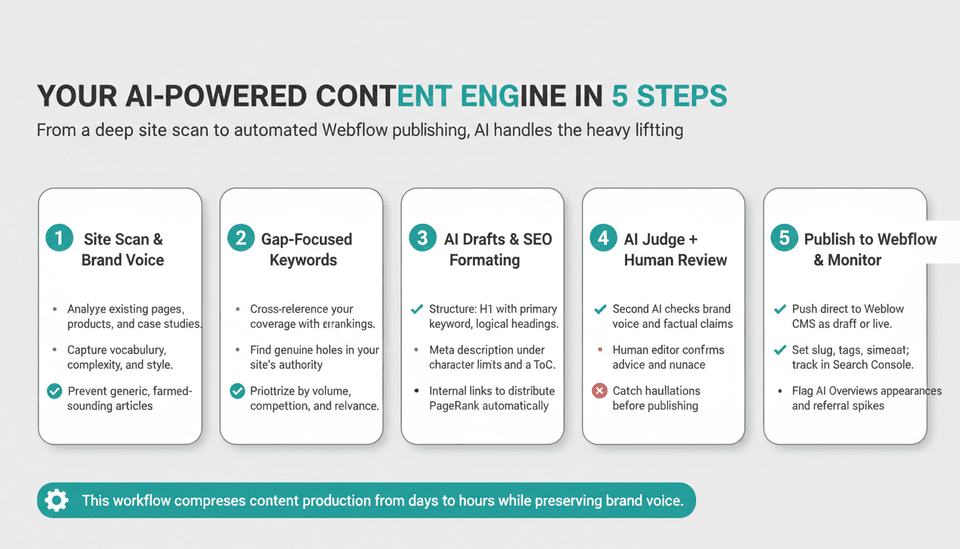
Step 1: Deep site scan and brand voice learning
Before a single word is written, the AI must read your site. It analyzes existing pages, product descriptions, about pages, and any whitepapers or case studies you provide. The goal is to capture your vocabulary, the level of complexity your audience expects, and the stylistic tics that make your brand recognizable. Without this, every article sounds like it was written by a generic content farm—and readers (and search engines) notice.
This step is what separates platforms that learn from those that merely prompt. A deep scan catches things like whether your finance audience prefers “revenue” over “top line” or whether your SaaS users expect screenshots and step-by-step instructions. That subtlety increases dwell time and reduces bounce, which in turn signals relevance to Google.
Step 2: Keyword planning from competitor gaps
How can AI improve keyword research?
AI keyword planning doesn’t just pull a list of terms from a database; it cross-references your site’s existing coverage with what competitors rank for that you don’t. It identifies gap keywords, clusters them by topic, and prioritizes based on search volume, competition, and relevance to your product or service. This process, which could take a human analyst days, runs in minutes.
The result is a content roadmap that fills genuine holes in your site’s authority rather than chasing random high-volume terms. AI can also predict seasonal trends and adjust priorities accordingly. Whatagraph’s 2026 test of AI content optimization tools notes that the most effective platforms now combine keyword discovery with content briefs that include expected word count, related questions, and ideal heading structure—moving the deliverable from a spreadsheet to a ready-to-execute plan.
Step 3: Drafting, headings, meta descriptions, and internal links
How can AI help with SEO content creation?
Once you’ve approved a topic, the AI drafts a complete article. It doesn’t just fill a word count. It structures the piece with an H1 that includes the primary keyword, a logical heading hierarchy, a meta description under character limits, and a table of contents. It weaves in relevant internal links to other pages on your site—a critical step for distributing PageRank and guiding the reader through a content journey. It also generates alt text for any included images.
The output is a first draft, not a final publishable piece, but it arrives with all the SEO paraphernalia already attached. This eliminates the tedious back-and-forth where a writer produces a draft and an SEO specialist later retrofits headings, links, and meta tags.
How does AI help with on-page SEO automation?
On-page SEO automation goes beyond inserting keywords. AI can evaluate competitor pages and recommend a target content score, suggest LSI keywords to include, ensure the primary keyword appears in the first 100 words, and flag readability issues. It can even adjust heading structure in real time to match the search intent behind a query, as identified by analyzing top-ranking pages. Zapier’s review of content optimization tools highlights how modern AI assistants check for passive voice, sentence length, and transition phrases—all factors that affect engagement and, indirectly, rankings.
Step 4: Quality judgment pass and human review
Before publishing, a second AI model can act as a quality judge. It checks the draft against your brand voice model, verifies factual claims against the source material used, and rewrites any sections that veer off message. This step catches hallucinations, tone mismatches, and structural weaknesses that the drafting model might miss. Human review remains a requirement: at minimum, a subject-matter expert should read the final version, confirm that the advice is sound, and tweak any nuance that an algorithm can’t grasp.
The balance that has emerged across the industry is clear: use AI to eliminate the blank-page problem and handle formatting; use humans to own accountability.
Step 5: Automated publishing to Webflow and Search Console monitoring
The finished article can be pushed directly to your Webflow CMS—either as a published post or as a draft awaiting your click. Automation handles the API connection, sets the correct URL slug, applies tags, and updates your sitemap. After publishing, the system monitors Search Console for impressions, clicks, and any new queries the page is ranking for. It can also flag when a page starts appearing in AI Overviews or when an AI assistant referral generates a spike in traffic, provided you’re tracking that separately (more on that below).
What the Ranking Pages Already Agree On
Across the current top-ranking guides, a set of common threads is worth compressing so we can spend our time on the gaps:
- Foundational SEO best practices—site speed, mobile friendliness, crawlability, authoritative backlinks—still determine whether your AI-optimized content gets seen at all.
- AI accelerates research, writing, and on-page work drastically; what once took a content team two weeks can now go from keyword to draft in under an hour.
- Human review is not optional. Every credible source insists that a human must sign off on accuracy, tone, and strategic alignment before publishing.
- Search Console remains the primary tool for measuring visibility, including impressions and clicks from AI search features like Google AI Overviews.
- Scaled content abuse—pumping out hundreds of thin, AI-generated posts—still violates Google’s helpful content guidelines and can earn a site-wide manual action.
- AI Overviews and generative answers are reshaping discovery, but SEO is not dead; it’s evolving toward answer-engine optimization.
Those points form the floor, not the ceiling. Next, we build upward into decisions most guides skip.
The Tradeoffs: Manual, Assisted, Agentic, and Fully Automated Workflows
Manual AI-assisted optimization: maximum control, highest time cost
A practitioner opens a ChatGPT window, pastes a keyword list, and iterates to produce an article. They use a separate tool like Surfer or Clearscope for on-page optimization, manually add internal links in the CMS, and write meta descriptions by hand. This gives total control, but the time investment rarely drops below 2–3 hours per article once research, drafting, optimization, and publishing are accounted for. At 30 articles a month, that’s a full-time-equivalent role. Sustainable for low volume; breaks at scale.
Agent platforms: partial automation with backlink claims
Several agentic platforms promise to handle keyword research, drafting, and even backlink outreach automatically. The risk is that automated link building can easily cross into scaled link abuse. Google’s spam policies explicitly warn against creating links at scale, even when the content itself is technically “written” by AI. Reputable agent platforms, such as those using Salesforce’s AI link-building capabilities, treat outreach as assisted—identifying prospects and drafting personalized emails—but leave the relationship and editorial judgment to a human. The moment a system claims “fully automated backlink building on autopilot,” treat it as a red flag. Semrush’s guide on common AI content mistakes underscores that AI can support outreach but cannot replace editorial judgment about which sites are genuinely relevant.
Fully automated Webflow publishing: speed and cadence tradeoffs
When the entire pipeline—site scan, keyword planning, drafting, quality pass, and Webflow publishing—runs with minimal human intervention, you can sustain daily or even multi-daily posting. The tradeoff is that errors propagate faster. A misaligned brand voice or a factual slip that would be caught by a human reviewer might go live across 10 articles before you notice. The safeguard is to require a draft-approval step and to use a second AI judge that simulates a stern editor. Adobe’s November 13, 2026 announcement of expanding its AI stack with agentic tools to coordinate content and marketing workflows, as reported by MarTech, shows that major enterprise players are betting on exactly this kind of orchestrated automation—with humans in the loop for governance.
What does AI SEO content optimization cost per article?
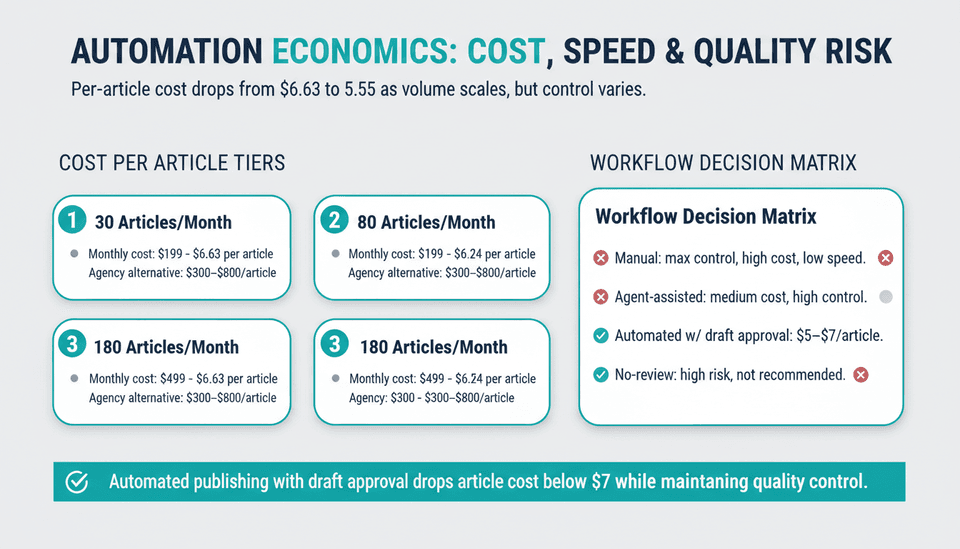
The per-article cost depends on your subscription tier and the number of articles you actually publish. Here is a concrete benchmark using a platform that bundles scanning, writing, images, optimization, and Webflow publishing (Joyrise), compared against typical agency retainers for human-written, AI-assisted content:
| Volume Tier | Monthly Cost | Articles/Month | Cost per Article | Typical Agency Cost per Article |
|---|---|---|---|---|
| 30 articles | $199 | 30 | $6.63 | $300–$800 |
| 80 articles | $499 | 80 | $6.24 | $300–$800 |
| 180 articles | $999 | 180 | $5.55 | $300–$800 |
These numbers assume you publish exactly the plan’s article cap. The marginal cost per extra article beyond the cap is usually much higher, so purchase the tier closest to your realistic monthly output. Agency costs are a rough industry estimate and vary by niche and writer expertise, but even the low end of that range shows why the unit economics of AI-driven content make a material difference for a founder managing a budget. At these per-article costs, AI-driven publishing becomes a compelling SEO agency alternative for businesses scaling their content production.
Decision matrix: cost, control, speed, and quality risk
Use this matrix to match your workflow to your operating priorities:
| Workflow Type | Cost per Article | Control | Speed | Quality Risk | Best For |
|---|---|---|---|---|---|
| Manual AI-assisted | High (labor) | Maximum | Low | Low | Sites under 10 articles/month |
| Agent-assisted (human-reviewed) | Medium | High | Medium | Medium | Teams scaling to 30–50/month |
| Fully automated with draft approval | Low ($5–$7) | Medium-high | High | Medium | 80–180 articles/month, Webflow sites |
| Fully automated, no review | Lowest | Minimum | Very High | High | Not recommended for any brand-sensitive site |
The key insight: cost drops sharply with automation, but quality risk rises unless you maintain a review gate. For a deeper exploration of whether AI can truly own your SEO, see Can AI Do SEO for My Website? Honest Answers.
A Practical Implementation Framework: From Scan to First 90 Days
Here is a step-by-step sequence you can adapt regardless of the tool you choose.
Start with a site scan before writing anything
Give your chosen platform access to your site’s content and let it crawl every page. This is not a quick health check; it’s a foundational step that teaches the AI how you talk about your products.
Set keyword priorities and a publishing cadence
Decide on your target number of articles per month based on your tier’s unit economics. Choose a cluster of gap keywords—not a random list—so that each new article reinforces the authority of the previous one.
Review your first article before you pay
Any reputable service will let you read a sample article for your own site. If the draft sounds generic, the scan wasn’t deep enough. Do not commit to a subscription until you’ve seen your brand’s voice reflected.
Require structured headings, meta descriptions, and internal links
Inspect the draft’s SEO elements. The H1 should contain the primary keyword. Headings should be nested logically (no skipped levels). The meta description must be unique and under 155 characters. Internal links should point to relevant, existing pages—not just the homepage.
Measure clicks, impressions, and AI assistant referrals in Search Console
Track standard metrics for the first 90 days. Also filter by “AI Overviews” in Search Console’s Search appearance report to see if your content is being surfaced in generative answers. Note that this filter does not capture mentions in ChatGPT or Perplexity—you’ll need a separate tracking method (covered next).
What No Ranking Page Tells You: Webflow Automation, AI Assistant Referrals, and Brand Voice
How do automated AI publishing workflows integrate with Webflow?
Webflow’s CMS API enables Webflow SEO automation by allowing third-party platforms to create, update, and publish blog posts programmatically. In a fully automated workflow, the platform generates an article, applies your Webflow collection fields (author, featured image, category), and pushes it as a draft. You log into Webflow, skim the article, and click “Publish” or “Schedule.” If you trust the quality pass sufficiently, you can allow direct publishing—but you’ll want a rollback capability. The best integrations maintain a version history so you can revert to the last human-approved version instantly. For businesses already on Webflow, this eliminates manual formatting, image uploads, and CMS field entry entirely.
Joyrise and similar platforms offer a one-click publish-to-Webflow flow that respects your existing collection structure, tags, and URL conventions. The critical detail is that the AI sets the slug based on your primary keyword and ensures it doesn’t conflict with existing pages.
How do I measure AI assistant referrals in Search Console?
Search Console doesn’t natively report traffic from ChatGPT, Perplexity, or other non-Google AI assistants. To capture that, you need to instrument your site. The most practical method today is to use UTM parameters in the links that AI assistants cite, but since you can’t control those citations, you must rely on indirect signals: spikes in traffic to a specific page that are not attributable to Google Search or known social channels often indicate an AI assistant referral. Some SEO platforms now provide dedicated AI search visibility reports. Positive Surfer, launched on November 12, 2026, offers an AI Tracker that reports brand mentions, visibility, and sentiment across supported AI services—a complement to your Search Console data. You can also use standard analytics to filter referrer URLs from “chat.openai.com” and “perplexity.ai” if your tool captures raw referrer data.
In practice, set up a dashboard that compares Search Console clicks (classic search), AI Overviews impressions (from Search Console’s Appearance filter), and the untagged referral traffic that appears in your analytics. The trend matters more than the absolute number in the early months.
How do I optimize content for Google AI Overviews and AI summaries?
Most guides tell you to use structured data and answer questions clearly. That’s necessary but insufficient. For true Google AI Overviews optimization, the factor that moves the needle is brand voice alignment. AI Overviews preferentially cite sources that don’t just answer the question but do so with a distinct, trustworthy perspective. If your content reads like every other guide, it’s fungible. The deep site scan step described earlier ensures that your articles carry the same terminology, conviction, and examples that your existing customers trust. That distinctiveness increases the likelihood that Google’s summarization model treats your page as the definitive source rather than a crowdsourced answer.
A second tactic: structure the content in a way that directly serves the AI’s extraction model. Use clear, self-contained paragraphs under descriptive headings. Avoid burying the answer in meandering prose. Each H2 should correspond to a likely query, and the paragraph underneath should deliver the answer in three sentences or fewer. This aligns with how generative models sample text for inclusion.
Why deep site scans beat generic prompt-based content
A prompt like “Write a 2,000-word article about [keyword]” will produce a generic, encyclopedia-style piece. It won’t know that your product uses a specific framework, that your customers hate a certain buzzword, or that you’ve already written five articles on adjacent topics that need internal links. A deep site scan solves that by giving the AI a dataset of your brand’s existing publications, allowing the output to feel like an extension of your content team rather than a rented voice. The difference in bounce rate and conversion from a single on-brand article can justify the entire monthly subscription.
Using a second AI quality judge to prevent off-brand drafts
Even with a site scan, first drafts can drift. A second AI model—trained on your brand guidelines and factual references—can act as an editor. It checks for tone deviations, verifies that product names are spelled correctly, and flags passages that contradict your previous content. This is not a replacement for a human editor, but it catches the low-hanging errors before a human ever invests time, keeping your review process to a 10-minute skim instead of a 45-minute rewrite.
Adjudicating the Disagreements: Will AI Replace SEO or Just Change It?
Can AI replace human SEO specialists?
This is the central conflict. Google and Salesforce (through their official AI content guidance) maintain that AI is an assistant: it speeds up tasks but requires human oversight to maintain quality and alignment with guidelines. On the other side, ResearchFDI and some agency pages have published predictions that AI will eventually render the human SEO specialist obsolete. The truth sits between the two.
AI today can replace the repetitive, skill-dependent tasks: keyword clustering, first-draft composition, on-page formatting, and basic technical audits. But it cannot replace strategic judgment. An experienced SEO specialist decides which keyword cluster to attack first, recognizes when a competitor has shifted strategy, and understands the political or regulatory nuance that makes certain content high-risk. Those decisions require context that AI does not have. For a no-bull assessment of the broader “SEO is dead” question, read Is SEO Being Replaced by AI? (A No‑Bull 2026‑2027 Answer).
Our position: AI won’t replace the SEO function; it will compress the team structure. Where once you needed a strategist, a writer, and a link builder, you may now need one strong editor who directs an AI pipeline. The role changes, but it doesn’t disappear.
How do Google's helpful content guidelines apply to AI-generated content?
Google’s helpful content guidelines evaluate content based on the end user’s experience, not the tool used to create it. If a page is written primarily for search engines and lacks genuine expertise, it will be demoted—regardless of whether AI or a human typed the words. This means AI-generated content must be subjected to the same E-E-A-T (Experience, Expertise, Authoritativeness, Trustworthiness) bar. The dangerous myth is that AI content can bypass quality checks because it’s automatically “optimized.” In reality, Google’s classifiers are getting better at detecting shallow, templated content. The safe approach: use AI to draft, but ensure a human editor adds original insight, corrects inaccuracies, and injects first-hand experience.
Automated backlink building vs. scaled link abuse risk
SEO.AI’s claim of fully automated backlink building on autopilot conflicts with Google’s longstanding warning against scaled link campaigns. While AI can identify broken links, find unlinked brand mentions, and draft outreach messages, the act of placing a link must be based on editorial merit. Salesforce’s approach—using AI to support link building by surfacing opportunities—acknowledges this boundary. A platform that promises to build hundreds of links without human involvement is operating in a grey area that can result in a manual action. Separate legitimate outreach automation from manipulative tactics by requiring a human to approve every link placement. If you can’t explain why a link adds value to the reader, don’t publish it.
Mistakes, Myths, and Limitations
Mistake: publishing without a review step – Even the best AI drafts contain factual errors or tone inconsistencies. Publishing directly from the generator to your live site erodes trust with both readers and search algorithms.
Myth: AI content optimization is set-and-forget – Search trends shift, competitors publish, and your own product evolves. A static AI pipeline that never revisits keyword priorities produces diminishing returns.
Limitation: AI still needs brand context and search intent confirmation – AI can misread intent. A keyword like “python deployment” could mean deploying a Python web app or deploying a python snake for pest control. Without human intent confirmation, the AI may write the wrong article.
Myth: AI Overviews are the only AI traffic channel – As we noted, ChatGPT and Perplexity are sending significant traffic to certain niches. Ignoring AI assistant referrals means leaving a growing source of qualified visitors unmeasured and unoptimized.
Next Steps and a Readiness Checklist
Questions to ask before choosing an AI SEO content tool
- Does the tool scan my existing site to learn brand voice, or does it rely on generic prompts?
- Can it publish directly to Webflow with draft approval, or will I need a separate CMS integration?
- What is the per-article cost at my expected volume, and does the plan cap constrain my growth?
- Does it include a second quality-checking AI to reduce off-brand output?
- Will it track AI Overviews appearances and, separately, AI assistant referrals?
A 10-point readiness checklist for automated publishing
| # | Checklist Item | Status |
|---|---|---|
| 1 | Your Webflow sitemap is clean, and all pages are indexed correctly. | ☐ |
| 2 | You’ve completed a site crawl to identify existing content gaps. | ☐ |
| 3 | You’ve defined your brand voice document (tone, terminology, banned phrases). | ☐ |
| 4 | A keyword priority map exists, organized by topic cluster. | ☐ |
| 5 | The AI platform has scanned your site and produced a sample article that matches your voice. | ☐ |
| 6 | Draft approval is enabled; direct publish is off until trust is earned. | ☐ |
| 7 | Internal link templates are set up to cross-link new articles to pillar pages. | ☐ |
| 8 | Search Console access is granted to the platform for performance monitoring. | ☐ |
| 9 | A process is in place for a human to review and sign off on each article’s accuracy. | ☐ |
| 10 | You have a dashboard that shows clicks, impressions, AI Overviews appearances, and untagged referral traffic. | ☐ |
What to measure in the first 90 days
Track these metrics weekly:
- Number of published articles versus the plan’s target.
- Total organic clicks and impressions in Search Console for new pages.
- Appearances in AI Overviews (Search Console → Search appearance → “AI Overviews”).
- AI assistant referral traffic identified by referrer or a tool like Positive Surfer’s AI Tracker.
- Bounce rate and average engagement time on new pages to gauge on-brand quality.
If you see rising impressions but stubbornly low clicks, your meta descriptions or titles likely need adjustment. If AI assistant referrals spike for a particular article, double down on that topic cluster.
Key Takeaways
- AI SEO content optimization can drive your per-article cost below $7 while maintaining brand voice—if you start with a deep site scan, not a generic prompt.
- Automated Webflow publishing eliminates manual CMS work, but you must enforce a draft-review gate to prevent off-brand content from going live at scale.
- Search Console captures Google AI Overviews, but measuring traffic from ChatGPT and Perplexity requires separate analytics tracking, a gap most sites ignore.
- A second AI quality judge reduces editing time, but human review remains your final defense against factual errors and intent mismatches.
- Unit economics at 30, 80, and 180 articles per month make automation a clear alternative to agency retainers—choose the tier that matches your actual output, not your ambitions.
See how your first AI-optimized article reads against your brand voice by starting with a free article at Joyrise.