 Joyrise
Is SEO Being Replaced by AI? (A No‑Bull 2026‑2027 Answer)
 By Alexi · · 14 min read

On this page
- Direct Answer: No, AI Replaces Tasks, Not the Whole SEO Ecosystem
- What AI Is Actually Changing in SEO Right Now
- Humans vs. Machines: Who Does What in SEO Today?
- Will SEO Exist in 5 or 10 Years? The 2026 Perspective
- How to Scale SEO Content with AI Without Losing Control
- Troubleshooting: When Your AI SEO Content Underperforms
- Measuring SEO in the AI Search Era (Zero-Click & AI Assistant Referrals)
- Quick Answers to More Common Questions
- Key Takeaways
AI replacing SEO is a myth. The future of SEO 2026 is about strategy, authority, and AI search traffic, where AI-generated content ranking depends on quality.
These tectonic shifts — zero-click traffic, AI assistants generating answers instead of lists, and search results that pull from the open web without sending visitors — don’t kill SEO. They make foundational SEO more critical, while rewriting what success looks like. The future of SEO 2026 demands blending strategy with AI-driven execution. The teams that win in 2026–2027 are the ones that treat AI as production infrastructure and keep human judgment on strategy, voice, and trust.
Direct Answer: No, AI Replaces Tasks, Not the Whole SEO Ecosystem
SEO is not one thing. It’s a collection of practices: technical site optimization, keyword research, content creation, link building, performance analysis, and now a growing layer of generative-engine optimization (GEO). AI can perform some of these end-to-end with impressive scale, but others still require a human who understands the business, the audience, and the context that no language model can infer from a prompt.
What confuses the debate is that the public-facing side of search is shifting. Google, Bing, and standalone tools like ChatGPT and Perplexity now synthesize answers directly. That means fewer traditional blue links, fewer clicks, and more pressure to earn a mention inside the AI-generated answer itself. This doesn’t signal the end of SEO; it signals that the definition of a winning result is expanding — from ranking a page to being the source the AI cites.
What AI Is Actually Changing in SEO Right Now
AI-powered search assistants and the Rise of Zero-Click Queries
Google’s AI Overviews, ChatGPT, Claude, and other assistants now answer many queries without forcing a site visit. The industry data from early 2026 paints a clear picture: 68% of Google searches resulted in no click at all (O’Dwyer’s PR News). For informational queries, the user gets the answer on the SERP; for transactional queries, the assistant may suggest a brand directly.
That upends the traditional SEO funnel. An impression in an AI Overview that never becomes a click still influences future brand searches, purchase consideration, and the probability of being cited by other AI agents. So optimization shifts from pure click-through optimization to brand mentions for AI search — making sure your name, data point, or product appears when the assistant builds its answer.
The workflow for zero-click SEO is different. It requires tracking the content that Google and other models are pulling for answers, then reverse-engineering why your brand was or wasn’t cited. This is where Google Search Console AI referrals become a core metric (more on that later).
AI-Generated Content: Google Cares About Quality, Not Origin
A persistent fear about AI-generated content ranking is that Google penalizes AI-generated content. It doesn’t — not in any algorithmic or manual action sense. Google’s public guidance, reaffirmed multiple times through 2024–2026, focuses on whether content demonstrates experience, expertise, authoritativeness, and trustworthiness (E-E-A-T) — regardless of who (or what) wrote the first draft.
The real risk is that AI-written content, left unedited, tends to be surface-level, factually stale, and stylistically uniform. Search engines increasingly detect and reward original analysis, fresh data, and distinct perspective. When AI-generated content fails to rank, it’s almost never because it was AI-produced; it’s because it failed a quality or relevance threshold a well-researched human article wouldn’t have.
As Forbes Agency Council member Sergio Stephano put it on Nov 12, 2026, the question from clients has shifted from “Can AI write our content?” to “Will ChatGPT ever pull from our site?” — and that means the SEO task is now about creating material that AI assistants deem cite-worthy, not just keyword-stuffed pages.
SEO and Brand Marketing Are Converging (Brand Mentions in AI Answers)
On Nov 14, 2026, Search Engine Land reported that AI search is actively pushing SEO teams into brand-building territory. When an AI answer cites a source, it’s often because that source is recognized as authoritative off the page — through consistent brand mentions, PR, industry awards, or genuine subject-matter expertise. Traditional SEO levers like backlinks still matter, but they’re now part of a larger picture: the accumulation of brand signals that AI models are trained to trust.
This convergence means SEO strategy with AI now requires working closely with PR, content marketing, and even social teams. A single study your brand publishes could be cited by an AI assistant thousands of times, driving no direct click but building long-term search presence. For many organizations, the biggest SEO impact in 2026–2027 will come from brand-building activities that aren’t technically “SEO” at all.
Humans vs. Machines: Who Does What in SEO Today?
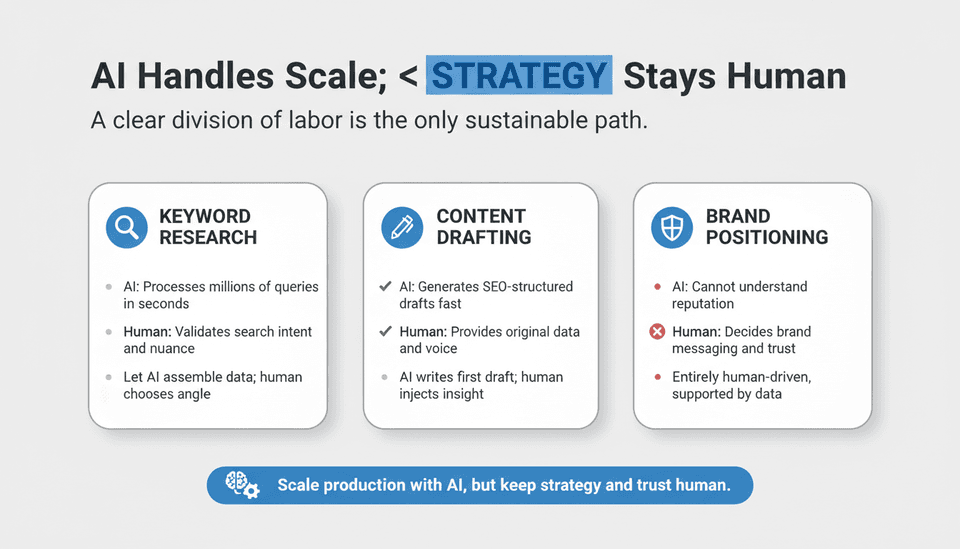
The fastest way to waste budget or get burned is to treat AI as a replacement for human strategy or to ignore AI entirely and attempt to scale manually. The only sustainable path is a clear division of labor. The table below summarizes what you should automate and what you cannot afford to replace.
| SEO Task | AI’s Capability | Human’s Irreplaceable Value | Recommendation |
|---|---|---|---|
| Keyword research & gap analysis | High — processes millions of queries and competitor pages in seconds | Validates search intent, spots nuance, chooses markets | Let AI assemble the data; human decides priority and angle |
| Content drafting | High — generates long-form, SEO-structured drafts fast | Provides original data, case studies, industry voice, and editorial judgment | AI writes first draft; human injects unique insight and fact-checks |
| On-page optimization (meta, H tags, TOC) | High — can follow best-practice templates | Architects content hierarchy for real readability and conversion flow | Automate with tools but audit for user experience |
| Technical audits & monitoring | High — crawls, flags errors, monitors errors continuously | Diagnoses root causes that need business context (e.g., CMS issue vs. strategy) | AI flag, human fix |
| Backlink analysis | High — scores, categorizes, and discovers opportunities | Prioritizes relationships, negotiates, decides on brand-fit outreach | AI supplies the map; human executes the outreach |
| Brand positioning & PR alignment | Low — cannot understand nuance of reputation or audience trust | Decides what the brand stands for, crafts messaging, builds genuine authority that AI assistants will cite | Entirely human-driven, supported by data |
| Content strategy & editorial calendar | Medium — suggests topics based on traffic data | Knows upcoming product launches, customer pain points, seasonal nuance, and can innovate | Co-create: AI suggests gaps, human defines the story |
AI’s strengths are speed, scale, and data crunching; human strengths are strategy, creativity, and building trust that machines cannot simulate. When your AI content underperforms, the root cause almost always comes from a missing human step — no original point of view, no real-world examples, no author who’s visibly an expert.
Will SEO Exist in 5 or 10 Years? The 2026 Perspective
Yes, SEO will exist — but not as a standalone function that ends with a ranking report. By 2030, SEO will be inseparable from brand marketing, content strategy, and the technical management of how your organization’s knowledge appears across all AI interfaces.
Search itself is fragmenting. Users query Google, Bing Chat, ChatGPT, Claude, Perplexity, TikTok, YouTube, and voice assistants. Each has its own version of an AI answer. SEO professionals who adapt will be the ones who understand how to influence retrieval across these systems — through structured data, authoritative content, and the kind of brand authority that makes models default to citing your company.
The foundational principles — being the best, most trusted answer — haven’t disappeared; they’ve become the input raw material for AI, not just ranking signals. The teams reframing their work around content authority, not just keyword rankings, are already outperforming those still chasing the old metric.
How to Scale SEO Content with AI Without Losing Control
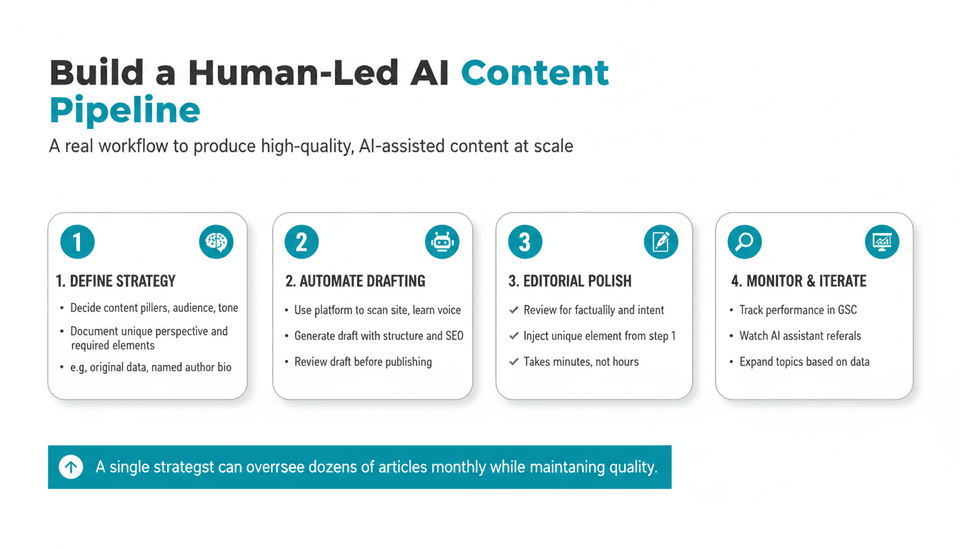
Most teams get this wrong in one of two directions: they either micromanage every word, losing the speed AI offers, or they go hands-off completely and publish generic, low-value pages that dilute their domain authority. The solution is a production pipeline where AI handles heavy lifting under strict parameters, while humans keep editorial control.
A Real Workflow: Automate Production, Keep Strategy Human
Use this four-step process to produce consistent, high-quality, AI-assisted content that maintains your brand voice and ranks:
- Define the strategic layer (human-only). Decide your content pillars, audience segments, brand tone guidelines, and what unique perspective you’ll bring to each topic. Document a brief that includes mandatory sections — e.g., original data, a named author bio, a real customer quote, or your own framework.
- Automate research and drafting (AI + platform). Use an SEO automation platform that can deep-scan your site, learn your voice, identify competitor gaps, and generate a full draft with proper heading structure, internal links, and meta tags. Joyrise, for instance, scans your Webflow site to understand your brand and then plans, writes, and publishes illustrated, SEO-optimized articles daily — all while letting you set your custom voice and review drafts before they go live.
- Apply editorial polish (human). Review the AI draft for factuality, inject that required unique element from step 1, and ensure it delivers on the search intent. This step should take minutes, not hours, because the draft is already structurally sound.
- Monitor and iterate (automated reporting). Track performance in Google Search Console — not just clicks, but also AI assistant referrals. Use that data to decide which topics to expand and what gaps to fill next. Platforms like Joyrise integrate GSC dashboards so you can see traffic trends without leaving your workflow.
A single human strategist can now oversee dozens of articles per month while maintaining a consistent, high-quality blog — a scale impossible with manual production alone. The key is that the platform doesn’t decide what you stand for; you do, and it executes.
How Platforms Like Joyrise Let You Automate While Owning Your Voice
The danger with many AI content tools is that they produce homogenous, on-average content that sounds like a Wikipedia summary. Joyrise addresses this by running a second AI quality-judgment pass on drafts before publishing, rewriting them to be more journalistic, concrete, and aligned with your site’s unique voice — what the platform calls a “quality judgment pass.” It also generates original branded header images and infographics, so every article looks custom-built, not templated.
For marketing teams tired of managing fragmented stacks — one tool for research, another for writing, another for images, another for publishing — an integrated platform that handles from scan to publish cuts coordination cost. More importantly, its built-in Search Console dashboard includes the newer AI assistant referral metrics, so you can see not just if your articles rank, but if they’re being cited by Google’s AI Overviews or other models. That’s the forward-looking metric in 2026.
Troubleshooting: When Your AI SEO Content Underperforms
Not every AI-written post will rank, and early failures often follow predictable patterns. Use these common symptoms to diagnose what went wrong and what to fix.
“Google Isn’t Ranking My AI-Written Posts — What’s Wrong?”
The most common cause is thin content that fails to satisfy the real search intent. AI can fill pages with grammatically correct text that still says nothing useful. If your article doesn’t answer the visitor’s question directly in the first few paragraphs, doesn’t back claims with credible links or data, and doesn’t show any evidence of human experience, Google has no reason to rank it over a thousand similar pages.
What to check:
- Does the article match the search intent (informational, commercial, transactional), or did the AI default to a generic explainer for a buying query?
- Are you missing E-E-A-T signals? Add a named author bio with relevant credentials, link to your About page, and include verifiable statistics or original quotes.
- Have you run a content audit comparing your page to the top three ranking results? If they all include original research, step-by-step processes, or personal anecdotes and yours doesn’t, you’ve found the gap.
For a deeper walkthrough on fixing AI content that won’t rank, see our AI SEO Generator: The Definitive Guide (2026), which breaks down the exact steps to turn a generic draft into a competitive asset.
“My AI Tool Produces the Same Thing Over and Over.”
Repetition happens when your prompts are too similar, the model’s creativity is set too low, or the tool doesn’t re-analyze the source material deeply. If every post reads like a variation of the same template, you’ll quickly see diminishing returns and a drop in rankings.
Fix it by:
- Varying the brief each time — specify a different angle, a new source of data, or a unique question the target audience hasn’t seen answered.
- Using tools that incorporate a second AI review pass specifically to break formulaic writing patterns and introduce fresh sentence structures.
- Inserting a mandatory human step that adds one unpredictable element: a relevant anecdote, an exception to the rule, a counter-intuitive stat.
Most AI content problems aren’t really AI problems; they’re process problems. Build the process around differentiation, and the tool will execute it.
“I’m Getting Impressions but No Clicks — Help”
High impressions with near-zero clicks often indicates your content is being shown in an AI Overview or a featured snippet that answers the query directly. That can be a win — you’re the cited source — but it won’t show up in your click-through rate. Before panicking, isolate how those impressions are classified.
In Google Search Console, filter by Search Appearance for “AI Overview.” If you see impressions there but no clicks, you’re being used as a zero-click source. That’s a brand-mention victory, but you may need to adjust your internal reporting to track it separately. For non-AI organic impressions that don’t convert to clicks, check:
- Meta descriptions: do they promise something the page fails to deliver, or are they too vague?
- Title tags: are they compelling and accurate, or stuffed with keywords?
When you’ve confirmed the content is good but the snippet isn’t driving action, rewrite the meta description with a clear value proposition and a reason to click. In cases where the query is definitively satisfied without a click (like “what is the capital of France”), accept the impression as brand awareness and move on to queries where a click is winnable.
Measuring SEO in the AI Search Era (Zero-Click & AI Assistant Referrals)
Tracking AI Search Traffic in Google Search Console
Google Search Console now includes performance data for AI-powered search features. You can isolate clicks and impressions specifically from AI Overviews and, increasingly, from other AI assistant experiences.
To see your AI search traffic:
- Go to the Performance report.
- Add a filter by “Search Appearance” and select “AI overview.”
- Optionally, use the “Search type” dimension to break out results — “Web” includes AI Overview traffic when that feature ran.
Not all of this traffic will generate visible clicks, but seeing which pages get surfaced lets you know where your content is earning trust. Some teams are already building dashboards that show AI referral impressions as a leading indicator of future branded search, even when immediate clicks are zero.
What the 68% No-Click Stat Means for Your Reporting
When nearly seven out of ten Google searches end without a click, reporting that only measures organic sessions is missing the majority of search visibility. The 68% no-click figure from early 2026 (O’Dwyer’s) doesn’t mean you’ve lost an audience; it means the method by which that audience finds information has changed.
Practical reporting shifts to adopt now:
- Separate AI Overview impressions from traditional organic impressions in your reports, so you can monitor brand presence in both.
- Add a “brand mention” metric — either from manual spot checks or from third-party monitoring tools — to quantify how often your name appears in AI-generated responses.
- Correlate periods of high AI impressions with lifts in branded search volume, direct traffic, or even sales — that’s how you prove value outside the click.
This is a fundamental shift from SEO-as-traffic-count to SEO-as-brand-authority. The platforms that let you integrate this data — like tracking GSC AI referrals directly inside your content workflow — will save you from building yet another custom dashboard.
Quick Answers to More Common Questions
Is SEO being replaced by AI?
No. AI automates parts of the SEO workload, especially content production and data analysis, but it cannot replace the strategic and creative decisions that make content trustworthy. SEO is being reshaped, not removed.
Will SEO exist in 5 or 10 years?
Yes, though it will look different. The core skill of making a brand’s information authoritative and discoverable across AI-driven search interfaces will be just as valuable, but it will merge deeply with brand marketing and content strategy.
How much do you actually know about AI’s impact on SEO?
We monitor this shift daily because our platform, Joyrise, is built entirely around the premise that AI can automate production while humans control strategy. We synthesize insights from Google’s updates, industry research like the Zero-Click data from O’Dwyer’s, and the Search Engine Land coverage, and we test approaches continuously against real site performance.
Does Google penalize AI-generated content?
Google does not penalize content solely because it was written by AI. It penalizes low-quality, unhelpful, or deceptive content regardless of origin. If your AI-written articles demonstrate genuine expertise, answer user intent, and are factually accurate, they can rank well.
Can AI write SEO-optimized content that ranks?
Yes, if the process includes human oversight. AI tools can handle on-page optimization, keyword inclusion, and structure, but only a human can supply the original insights, real examples, and brand voice that separate a ranking article from the sea of generic information.
What should I do if my AI content isn’t ranking?
First, verify the search intent and compare your content against the top-ranking results. Add missing E-E-A-T signals, restructure the article to deliver a faster, clearer answer, and inject your original data or perspective. Then monitor for improvement. If it still doesn’t rank, the topic may need a fundamentally different angle that only a human strategist can define.
Key Takeaways
- AI is not replacing SEO; it’s replacing the tasks that don’t require human judgment, making strategy, brand voice, and trust the new differentiators.
- 68% of searches ended without a click in early 2026, so measure success by brand mentions in AI answers and subsequent branded search, not just raw organic traffic.
- For AI-generated content to rank, it must go beyond information recall — inject original data, genuine expertise, and a clear editorial perspective.
- The convergence of SEO and brand marketing is real: earning citations in AI-generated answers now matters as much as traditional rankings.
- Scale your SEO by automating the production pipeline with platforms that learn your voice and enforce quality, while keeping human strategists in charge of direction and differentiation.
Ready to build a content engine that publishes daily, owns your brand voice, and tracks AI-driven visibility? Sign up for Joyrise and get your first article before you pay anything.