 Joyrise
Can AI Do SEO for My Website? Honest Answers (2026)
 By Alexi · · 14 min read

On this page
- Direct Answer: Can AI Do SEO for My Website? Yes, But It Depends on What You Mean by ‘Do’
- What AI SEO Can Actually Automate Right Now
- What AI SEO Still Can’t Do (Despite the Hype)
- When Should You Use AI for SEO vs. Hiring an Expert?
- Troubleshooting: What to Do When AI SEO Goes Wrong
- How Joyrise Does AI SEO: A Concrete Workflow (Not Just Promises)
- Preparing for AI‑First Search: What Google’s Changes Mean for Your Site
- Key Takeaways
If you’re a business owner or SEO manager asking “can AI do SEO for my website,” the honest answer is: yes, but only specific parts, and only if you understand where it falls short. AI can write articles, find keyword gaps, generate meta tags, and publish to Webflow on a schedule. It cannot strategize through an algorithm update, prove results with split tests, or replicate your brand’s unique voice without heavy fine-tuning. This article gives you the real, no-hype FAQ—including how an SEO automation platform like Joyrise delivers automated SEO for Webflow, when to keep humans in the loop, and how to fix things when AI SEO goes wrong.
Direct Answer: Can AI Do SEO for My Website? Yes, But It Depends on What You Mean by ‘Do’
AI can handle execution‑heavy, repetitive SEO tasks—keyword research, content drafting, technical audits, and on‑page tweaks—faster than any human. It can even publish daily illustrated articles to a Webflow blog and track performance in Search Console. What AI cannot do is think strategically. It won’t decide whether your brand should double down on informational vs. transactional content during a market shift, or interpret the nuance of a Google core update. The more your SEO relies on volume and consistency, the more AI can replace manual effort. The more it depends on brand judgment and creative positioning, the more you need a human. So yes, AI can do SEO for your website—in the sense that an automated platform can plan, write, optimize, and publish content that brings organic traffic. But whether AI content is good for SEO hinges on how well you maintain quality and avoid generic outputs. It won’t replace a skilled SEO strategist for high‑stakes decisions.
What AI SEO Can Actually Automate Right Now
What Are AI SEO Tools?
AI SEO tools are software platforms that use machine learning—often large language models—to streamline optimization work. They range from single‑purpose generators (title tags, meta descriptions) to full‑stack content marketing engines that handle topic discovery, drafting, image creation, and publishing. Many pull data from Google Search Console, competitor sites, and SERP features to make automated decisions. Surfer’s roundup of AI SEO tools highlights that the best ones combine content analysis with real‑time ranking data. When integrated with a platform like Webflow’s built‑in SEO controls, they can push live updates without touching code.
Keyword Research and Competitor Gap Analysis
AI scrapes search results, analyzes competitor content structures, and surfaces low‑competition topics you’d miss manually. Instead of just listing keywords by volume, modern tools look at the pages already ranking, extract the entities they cover, and show gaps where you can win. For example, an AI platform can scan your site’s existing content, find queries where competitors rank but you don’t, and prioritize them by traffic potential and difficulty.
How do AI SEO tools improve keyword research?
They eliminate spreadsheet drudgery. AI tools cluster related terms, predict intent, and surface question‑based queries (like the ones in this article) that traditional keyword tools bury. They also update suggestions as SERPs shift, so your list stays fresh without constant re‑analysis.
On‑Page Optimization (Meta Tags, Headers, Internal Links)
AI can generate title tags, meta descriptions, and H2/H3 structures that match search intent and topical depth. More advanced systems automatically insert internal links between related articles, ensuring your site’s architecture reinforces topic clusters. The key: a model that’s fine‑tuned on SEO data, not just generic text. A generic model might write a clever meta description that ignores the primary keyword; a purpose‑built one follows the rulebook.
How can AI SEO tools improve my website's search rankings?
They improve rankings by ensuring every page is technically optimized—proper hierarchy, keyword placement, schema markup—and by publishing content regularly, which builds topical authority. Consistency matters more than perfection, and AI never misses a publishing date. When done right, this compounds into higher impressions and clicks, especially for long‑tail queries.
Content Generation at Scale
AI article writing for blogs is now a practical reality: AI writes full articles, complete with headings, tables of contents, branded header images, and even infographics. It can produce 30, 80, or 180 posts per month depending on the plan, each researched from current SERP data. The output isn’t exceptional prose on its own, but when paired with a quality‑judgment pass (a second AI model rewriting the first draft) and human spot‑checks, it clears the bar for informational content that answers real questions.
Can ChatGPT Be Used for SEO?
Yes, but narrowly. ChatGPT can draft article outlines, generate meta tags, and brainstorm topic angles. It’s not an AI SEO tool—it has no idea what’s ranking on Google today, can’t access Search Console data, and doesn’t publish anything. Use ChatGPT as a thinking partner, not as the engine. For actual automation, you need a platform that ingests live SEO data and can push content live. For a deeper look, see ChatGPT SEO Workflows: The Complete 2026 Guide.
Technical Audits and Performance Monitoring
AI crawls your site, identifies broken links, missing alt text, slow pages, and canonical errors. It can flag issues faster than Screaming Frog and provide plain‑language fixes. Integrated dashboards pull data from Google Search Console to show clicks, impressions, and—as of late 2026—early tracking for AI‑assistant referrals, which signals that visibility in LLM‑driven search is becoming measurable.
What AI SEO Still Can’t Do (Despite the Hype)
Understanding AI SEO limitations is crucial to avoid costly mistakes.
What Can’t AI Do for SEO?
AI struggles with three things: strategy, originality, and accountability. It’s a master of pattern recognition, not insight. When Google rolls out an update, AI doesn’t know why—it only sees that certain scores dropped. It can mimic voice but doesn’t understand your customers’ unspoken hesitations. And it can’t design a controlled split test to prove whether a change actually caused a ranking lift.
Understand Brand Voice and Nuance Without Fine‑Tuning
Out‑of‑the‑box AI writes like every other generic generator unless you train it on your existing content and give it a style guide. Even then, it misses inside jokes, cultural references, and the exact tone that makes your brand relatable. A platform that offers a custom‑voice feature (like Joyrise’s Pro tier) gets closer, but final review still matters for anything customer‑facing.
Make Strategic Decisions During Algorithm Updates
When Google’s AI overviews suddenly push organic results below the fold, no tool will tell you “pivot to video” or “we need a tool landing page instead of a guide.” Strategic calls require human judgment informed by business goals, not just ranking data. AI can spot the drop; it can’t decide what to do about it.
Guarantee Originality in a Sea of AI Clones
As reported by HackerNoon on November 10, 2026, a solopreneur found that AI‑written clones of their site appeared within a week, and Bing/ChatGPT sent 9x more visitors to the clones than to the original. This is the dark side of AI content generation: the same models produce similar output for everyone. Without a quality‑judgment pass and regular human review, you’re publishing what a hundred other sites already have. The risk is duplicate‑penalty flags and lost trust.
Prove SEO Results with Rigorous Split Testing
Search Engine Journal, on November 9, 2026, outlined how before‑and‑after charts don’t prove SEO results; CFOs need controlled experiments. Current AI SEO tools can show correlation (publishing more pages = more traffic), but they don’t isolate variables. An agency or data‑savvy in‑house team can run a split test—e.g., sending half of category pages to an AI‑optimized version and measuring the difference. AI can execute the test, but it takes a human to design it and interpret with statistical rigor.
When Should You Use AI for SEO vs. Hiring an Expert?
Can AI Replace an SEO Expert Entirely?
No, AI cannot replace a skilled SEO expert for high-level strategy, brand positioning, and interpreting algorithm changes. However, it can handle the bulk of execution work, making a hybrid approach the most effective. The question of “can AI replace SEO expert” surfaces often, but the answer is always a qualified no—while AI automates tasks, human insight remains irreplaceable for critical decisions.
You Run a Small Site and Need Consistent Blogging on a Budget
If you have a Webflow site and your primary goal is to build topical authority with weekly articles, an AI automation platform like Joyrise makes sense. At $199/month for 30 articles, you get daily publishing and Search Console tracking—roughly 1/10th the cost of a junior content writer. The trade‑off: you’ll still need to review for voice and accuracy, but you eliminate the bottleneck of manual research and writing.
You Have an Agency but Want to Scale Content Without Adding Headcount
Many agencies use AI platforms to handle production while their strategists focus on high‑level work. For example, an agency managing multiple Webflow clients might use a Pro plan to publish 80 articles/month per client, letting the strategist focus on technical audits and link building. This hybrid model lowers costs and speeds delivery without sacrificing oversight.
You’re Launching a New Site and Need to Build Topical Authority Fast
A new site needs 40–60 high‑quality articles to start competing. Hand‑writing that takes months. An AI platform can produce that volume in weeks while you refine the product. Just ensure you’re using a quality‑judgment layer—the “second AI rewrite” that filters out hallucinations and blandness.
When an Agency Still Makes Sense (E‑commerce Migrations, Enterprise Strategy)
If you’re migrating a large e‑commerce store on Webflow and even keeping the same URLs, as Search Engine Land warned on November 10, 2026, “Website migrations can hurt SEO even when URLs don’t change” due to shifts in rendering, canonicals, and internal links. An AI tool won’t catch those nuances—an experienced SEO agency will. Likewise, enterprise brands that rely on split testing, competitor shifts, and brand campaigns need a human who can interpret data and adjust strategy, not just push content.
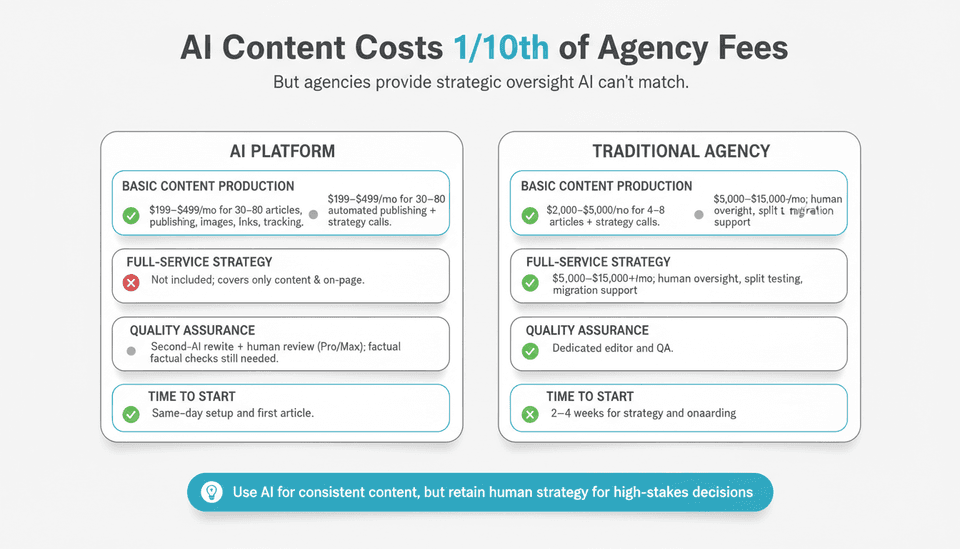
How Much Does AI SEO Cost Compared to Hiring an Agency?
Here’s a breakdown of AI SEO cost vs agency pricing.
| Scope | AI SEO Platform (Example: Joyrise) | Traditional SEO Agency | Note |
|---|---|---|---|
| Basic content production | $199–$499/mo for 30–80 articles, automated publishing | $2,000–$5,000/mo for 4–8 articles + strategy calls | AI platform includes images, internal linking, Search Console tracking |
| Full‑service (strategy, audits, link building) | Not included; platform covers only content & on‑page | $5,000–$15,000+/mo | Agency provides human oversight, split testing, migration support |
| Quality assurance | Second‑AI rewrite + human review (Pro/Max) | Dedicated editor and QA | Human review still needed on AI for factual accuracy |
| Time to start | Same‑day setup and first article | 2–4 weeks for strategy and onboarding | AI faster for execution; slower for custom strategy |
AI SEO costs significantly less for content production, but you give up custom strategy and the safety net an agency provides during algorithm shifts. For a deeper comparison, see SEO Company: What They Do, Cost, and AI Alternatives in 2026.
Troubleshooting: What to Do When AI SEO Goes Wrong
Is AI-generated content penalized by Google?
Google does not penalize AI-generated content specifically; it penalizes low-quality, unoriginal, or unhelpful content regardless of how it was created. Google’s guidelines focus on helpfulness and expertise (E‑E‑A‑T). So, AI content that is high-quality, factually accurate, and adds genuine value is not inherently penalized. The risk comes when AI output is thin, duplicated across sites, or riddled with hallucinations. To stay safe, always run a quality‑judgment pass and include unique insights, author bios, and credible citations.
My Rankings Dropped After I Published AI‑Written Articles
Check for thin, duplicate, or hallucinated content. AI models can generate generic paragraphs that add no value, triggering Panda‑style quality signals. Run your published articles through a plagiarism checker and a factual‑review pass. If you used a tool without a quality‑judgment step, the first draft may be too shallow. Remove or rewrite low‑quality posts, and blend AI output with unique data, quotes, or case studies from your own experience. Then request re‑indexing via Google Search Console.
A Competitor Cloned My Site with AI Content—Now I’m Losing Traffic
The HackerNoon report (November 10, 2026) highlighted how fast this happens. File a DMCA takedown if the clone is verbatim. More importantly, make your site harder to clone: publish unique original research, infographics, and expert commentary that AI can’t replicate. Use clear authorship signals and structured data (Article schema with author property). Bing and ChatGPT often favor authoritative sources; ensure your site has that signaling. Track competitors via Google Alerts and monitor for sudden drops in branded queries.
We Changed Our Site Design and SEO Tanked, Even Though URLs Stayed the Same
As the Search Engine Land article (November 10, 2026) explained, migrations can break SEO through changes in internal link structure, canonicals, or rendering. If you used an AI tool to auto‑generate new page templates or meta data during the redesign, it might have overwritten your carefully built optimization. Roll back to a staging environment, compare old and new versions with a crawler, and verify that canonical tags, H1s, and internal anchor text are intact. AI tools can sometimes reset these to defaults. Manual audit is essential for recovery.
AI Tools Say My Pages Are Optimized, but Google Won’t Index Them
Your pages might lack substantive value or crawl budget priority. AI can score a page 100 on an SEO checklist yet still produce thin content. Check if the content is indexed but ranking poorly (content problem) or not indexed at all (crawl or technical issue). Use Google’s URL Inspection tool to see why. Often, AI‑heavy sites get placed in a “crawl queue” that Google deprioritizes because the content doesn’t demonstrate E‑E‑A‑T. Add author bios, external citations, and unique images to signal real expertise.
What Should I Do if My AI‑Written Articles Hurt My Rankings?
Immediately pause AI publishing and audit every article published in the last 90 days. Remove any that are factually wrong, plagiarized, or under 300 words of genuinely useful text. Replace them with a mix of human‑edited content and AI drafts that have gone through a quality‑judgment pass. Use Google Search Console’s Removals tool for the worst offenders. Over the long term, adopt a workflow where a second AI or human editor approves content before it goes live, and integrate actual customer insights.
How Joyrise Does AI SEO: A Concrete Workflow (Not Just Promises)
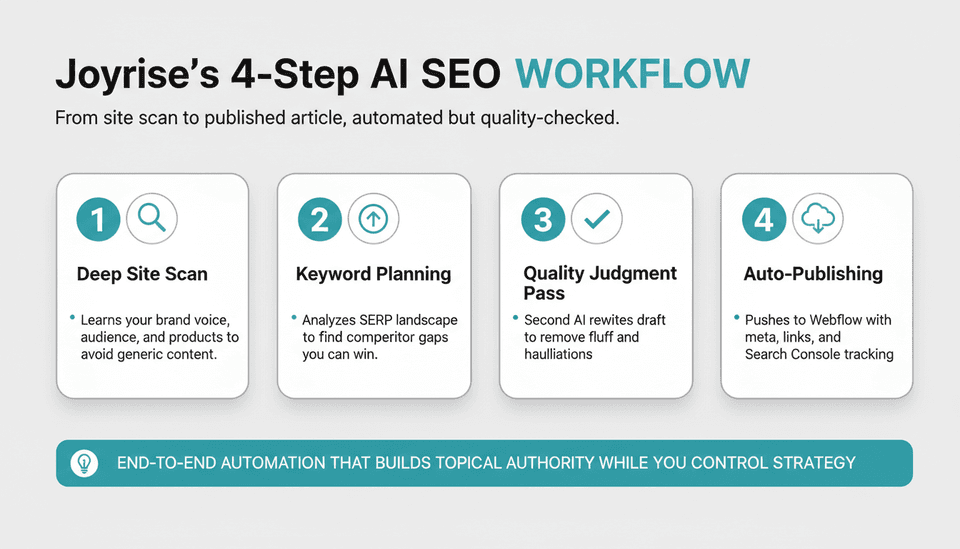
Deep Site Scan to Avoid ‘AI Slop’ That Ignores Your Audience
Before writing anything, the platform scans your existing Webflow site—pages, products, blog posts—and learns your brand voice, audience preferences, and product details. This prevents generic “10 tips for X” slop. Instead, articles reference your actual offerings, talk about problems your customers face, and maintain a consistent tone.
Keyword Planning from Your Actual Competitor Gaps, Not Generic Volumes
Joyrise’s built‑in keyword planner analyzes the SERP landscape for your niche, identifies queries where competitors outrank you, and prioritizes those with attainable difficulty. It’s not a volume list; it’s a gap map tied to what you sell.
Quality Judgment Pass: A Second AI Rewriting the First Draft
On the Pro and Max plans, after the initial article is drafted, a second AI model rewrites it—checking for factual hallucinations, improving readability, and removing fluff. It’s like an automated editor that catches common AI pitfalls. This is the critical step that mitigates Google penalties and keeps content original. A human reviewer can then spot‑check before automated publishing, or the system can push it directly as a draft for your approval.
Automatic Publishing to Webflow + Search Console Tracking
Approved articles go live on your Webflow blog on a schedule you set—no copy‑pasting. Each post includes proper heading hierarchy, meta descriptions, table of contents, and internal links to other relevant articles. The integrated Search Console dashboard then tracks clicks, impressions, and—soon—AI assistant referral traffic, so you see exactly what’s working.
For sites on Webflow, this end‑to‑end automation answers the “can AI do SEO for my website” question with a practical yes: you get daily content that builds topical authority, while you control the strategy and voice. If you’re curious how this compares to other approaches, Best AI for SEO Writing: 4 Full‑Stack Platforms Compared breaks down the alternatives.
Preparing for AI‑First Search: What Google’s Changes Mean for Your Site
Why ‘AI Overviews’ and LLM Answers Change the SEO Game
Google AI search changes, such as AI Overviews and LLM answers, now display prominent website links directly inside AI‑generated answers, as highlighted by Local Marketing Plus SEO’s November 11, 2026 guidance for contractors. That means your page doesn’t just need to rank in the blue links; it needs to be the source the AI overview cites. Getting cited requires clear, factual, well‑structured content that directly answers queries—and appearing in Google’s AI overviews can drive traffic even if your traditional ranking isn’t #1.
Can AI Tools Help Me Optimize for AI Search Results?
Not fully yet, but the direction is clear. You can use AI to format content for featured snippets (short, question‑answer blocks), which increases the chance of being picked up by AI overviews. More importantly, OpenAI is reportedly building a performance dashboard (ALM Corp, November 11, 2026) that will let businesses track how they appear in ChatGPT’s answers. Once that launches, AI SEO tools will likely integrate that data, making LLM visibility optimization measurable. In the meantime, produce content that explicitly answers questions, with structured data and concise definitions—that’s the template these models crave. For more context, Is GEO Replacing SEO? No—But It’s Changing Search explains how generative engine optimization overlaps with traditional SEO.
How to Track Visibility in ChatGPT and Other AI Platforms (Soon, Via Dashboards)
Currently, you can approximate by monitoring referral traffic from “chat.openai.com” or Bing’s chat in your analytics. The upcoming OpenAI dashboard will formalize that, showing impressions and clicks within ChatGPT. Marketers should prepare by ensuring their content is authoritative and citable—include data, original quotes, and clear author attribution. AI platforms that already track Search Console can be updated to pull in this new data, creating a single SEO monitor.
Why Traditional Ranking Reports Aren’t Enough Anymore
As search fragments across Google, Bing/ChatGPT, and other LLMs, a keyword ranking spreadsheet that only shows position 1–10 in Google misses the majority of opportunity. The HackerNoon solopreneur saw 9x more visitors from Bing/ChatGPT than from Google. You need a dashboard that aggregates clicks, impressions, and AI citations across platforms. AI automation platforms that pull both Search Console and (soon) AI platform data become the centerpiece of SEO reporting, not just an add‑on.
Key Takeaways
- AI can automate the full content‑production pipeline for a Webflow site—from keyword research to daily publishing—at roughly 1/10th the cost of an agency, but you stay responsible for strategy and final quality checks.
- The biggest risk is AI‑generated slop that reads like everyone else’s; a second‑AI quality judgment pass (like Joyrise’s Pro/Max feature) is your best defense.
- When Google shifts to AI overviews and LLM visibility, tracking across platforms (Search Console + soon ChatGPT dashboards) becomes essential; traditional rank tracking is increasingly incomplete.
- If you see a sudden ranking drop after AI publishing, pause, audit, and remove thin or duplicate pages immediately—then add human‑edited elements.
- For site migrations, e‑commerce complexity, or enterprise strategy, keep a human expert in the room; AI tools can’t replace strategic judgment.
Ready to see how AI handles your blog from first scan to published article? Start your free trial and read your first article before you pay.