 Joyrise
Ranked Keywords: The Ultimate Guide to Tracking & Growing Positions
 By Alexi · · 15 min read

On this page
- What Exactly Are Ranked Keywords?
- Why Tracking Ranked Keywords Is Non-Negotiable
- How Keyword Ranking Works: A Behind-the-Scenes Look
- Comparing Keyword Rank Checking Tools: Free vs. Paid
- The Missing Piece: Turning Ranked Keywords into Actionable Strategy
- A Practical Workflow to Turn Rankings into Revenue
- Common Myths and Pitfalls in Keyword Ranking
- What to Do When Your Keywords Aren’t Ranking Well
- The Future of Ranked Keywords: Earned Media and AI Visibility
- Frequently Asked Questions About Ranked Keywords
- Conclusion: From Checking Ranks to Driving Growth
- Key Takeaways
Most founders and finance leads treat ranked keywords as a scoreboard. They check positions, smile or frown, and move on. But ranked keywords are raw fuel. If you only track them, you’re leaving the engine off. This guide covers how to identify which ranked keywords matter, turn them into content moves that actually drive revenue, and build a system where ranking data feeds an automated publishing pipeline—so your positions climb without adding headcount.
What Exactly Are Ranked Keywords?
A Plain-Language Definition
A ranked keyword is a phrase for which one of your pages appears somewhere in the search results—be it position 1, 9, or 48. It’s not a guarantee of traffic, but it’s proof that a search engine considers your page relevant enough to show.
The term gets muddy because people use “ranking keyword” and “ranked keyword” interchangeably. Strictly speaking, any keyword where you have a measurable position is a ranked keyword. On a recent WFTV report (November 17, 2026), a litter-counting company even used keyword mentions in Tripadvisor reviews to rank Florida beaches—Daytona Beach and Cocoa Beach made the top 10 based purely on cleanliness terms in text, not actual trash measurements. The same logic applies to your site: if someone searches “B2B payment automation” and your article is the 14th result, that phrase is one of your ranked keywords. Whether it’s valuable is a separate question.
The Difference Between Indexed, Ranking, and Ranked Keywords
The three terms often get conflated, and the difference matters when you’re allocating budget.
- Indexed keyword: A page exists in the search engine’s database for that phrase, but it might not appear in the top 100 results. It’s in the library; nobody’s reading it.
- Ranking keyword: A phrase where your page shows up somewhere in the results, but you don’t know the position yet—or it’s so deep it’s effectively invisible.
- Ranked keyword: You have a concrete position you can track, usually inside the first 100 results. These are the ones you can measure, trend, and turn into strategy.
Confusing indexed with ranked leads to inflated reports. A site might have 10,000 indexed pages for various long-tail phrases, but if only 400 of those rank in the top 20, you’re prioritizing the wrong thing. Focus on ranked keywords with meaningful positions, not the theoretical catalog.
Why Tracking Ranked Keywords Is Non-Negotiable
From Vanity Metric to Business Driver
Founders who’ve never run SEO often ask: “Why not just look at traffic?” Traffic tells you what’s happening now; ranked keywords tell you what’s about to happen. If your position drops from 4 to 8 for a high-converting term, revenue will dip in 2–6 weeks. If you wait for the traffic report, you’re reacting late.
SEO keyword tracking gives you a leading indicator. A finance lead can use it to forecast pipeline. For a SaaS company, organic keyword rankings for “integrations” or “pricing” often predict demo requests more accurately than paid search trends. That’s why teams that treat rank checking as a diagnostic, not a scoreboard, pull ahead.
How AI Search Is Changing the Game
Traditional rank trackers assume a world of ten blue links. That world is dissolving. AI-powered search surfaces, like Google’s SGE experiments or enterprise AI assistants, synthesize answers from multiple sources without a click. According to Fast Company (November 17, 2026), earned media is becoming a critical source of visibility in AI-driven search. These systems don’t just pull the top-ranking URL; they extract authoritative mentions from articles, industry reports, and news—often citing brands that don’t hold the #1 position.
This means your AI search keywords—the phrases that surface your brand inside AI-generated answers—might not correspond to a traditional #1 ranking. You need to track not just your pure rank, but whether your pages and brand are appearing inside those AI responses. Some rank tracking tools have started adding “AI overview visibility” columns, but the space is still immature. For now, the pragmatic move is to pair rank tracking with manual checks for key commercial terms inside tools like Google’s SGE preview, Bard, or ChatGPT searches.
How Keyword Ranking Works: A Behind-the-Scenes Look
Crawling, Indexing, and the Ranking Algorithm
This is the part every guide covers, so I’ll compress it. A search engine crawls pages, stores them in an index, and runs a ranking algorithm when someone types a query. The algorithm considers relevance, quality, user signals, and hundreds of other variables to order results. Your page ends up at a specific position for a keyword—that’s your Google keyword ranking.
Standard rank checkers simulate a neutral search (no personalization, no location bias) to report a position. But the underlying mechanism is identical whether you’re using a browser extension or an enterprise platform: a query gets sent, the engine returns results, and the tool parses where your URL falls.
Factors That Influence Your Positions
The big three haven’t changed much: content depth, backlink authority, and technical setup. But a handful of factors now disproportionately move the needle:
- E-E-A-T signals (experience, expertise, authoritativeness, trustworthiness) for YMYL topics.
- SERP feature cannibalization—if a featured snippet or “People Also Ask” box takes the top spot, even the #1 organic link gets far fewer clicks.
- Page experience and Core Web Vitals, especially on mobile.
- Entity recognition: whether Google’s Knowledge Graph connects your brand to the topic.
For practical monitoring, you don’t need to obsess over all 200+ factors. You need to know whether your rank tracker shows a dip, then cross-reference against a known algorithm update or competitor content change. Most fluctuations of 1–3 positions are noise, not signal.
Comparing Keyword Rank Checking Tools: Free vs. Paid
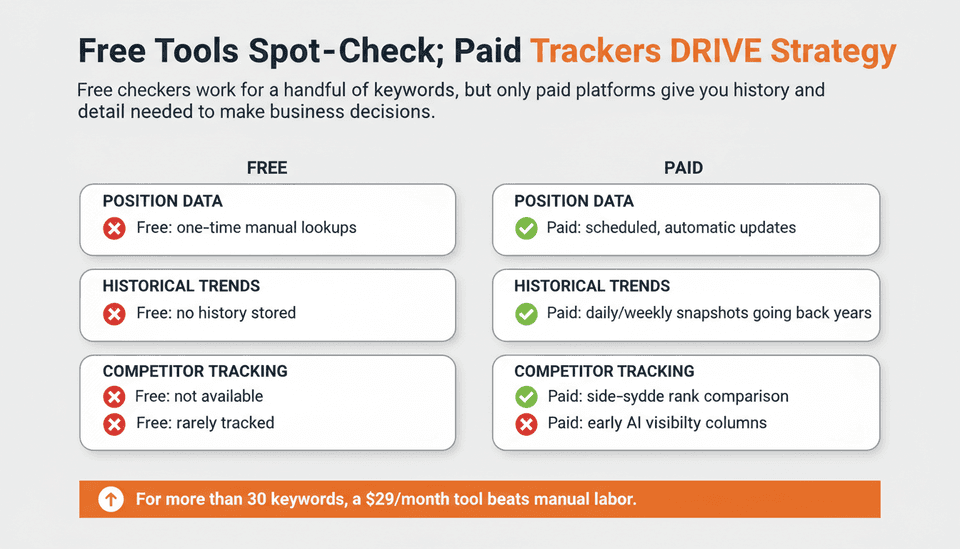
| Feature | Free Tools (extensions, single-check sites) | Paid Trackers (Ahrefs, SEMrush, SE Ranking, etc.) |
|---|---|---|
| Position data | Instant, manual check | Scheduled, automatic tracking |
| Historical trends | Rare or none | Daily/weekly snapshots going back years |
| Location & device simulation | Limited or absent | City-level, desktop vs mobile |
| Competitor rank tracking | Not available | Standard, side-by-side comparison |
| SERP feature reporting | None | Feature snippets, image packs, video carousels |
| AI visibility tracking | Emerging in some, not standard | Early adopters starting to add columns |
| Cost | Free | $30–$500+ per month depending on scale |
Browser Extensions and Free Checkers
Tools like SEO.ai’s free rank checker let you paste a keyword and URL to see position instantly—no login, no history. Browser extensions overlay rankings directly on the SERP. They’re fine for spot-checks if you just need a quick keyword position checker. But when a CFO asks “What’s our weighted average position for tier-1 terms?” you’ll have no answer. Free tools don’t store data, so trends are invisible.
Paid Trackers and Their Advanced Features
Paid platforms provide comprehensive SEO keyword tracking with historical data, scheduled monitoring, location-based searches, and exportable reports. Some integrate with Search Console to marry click data with rank. SE Ranking’s free keyword tool, for instance, suggests terms and tracks them in a dashboard. The real value, however, is in historical trajectory: you can see that your position for “enterprise workflow software” improved from 23 to 11 after publishing a comparison piece, then plateaued. That context justifies content investment to a finance lead.
When Free Tools Are Enough—and When They Aren’t
If you track fewer than 20 keywords and only need to check once a month, a manual free tool works. If your business relies on organic traffic as a primary acquisition channel, you’re flying blind without a paid rank tracking tool—or at minimum a platform that bakes tracking into content ops. Once you cross 100 tracked keywords, the labor cost of manual checks exceeds a subscription. Don’t let a $29/month tool be the bottleneck on a channel generating six figures.
The Missing Piece: Turning Ranked Keywords into Actionable Strategy
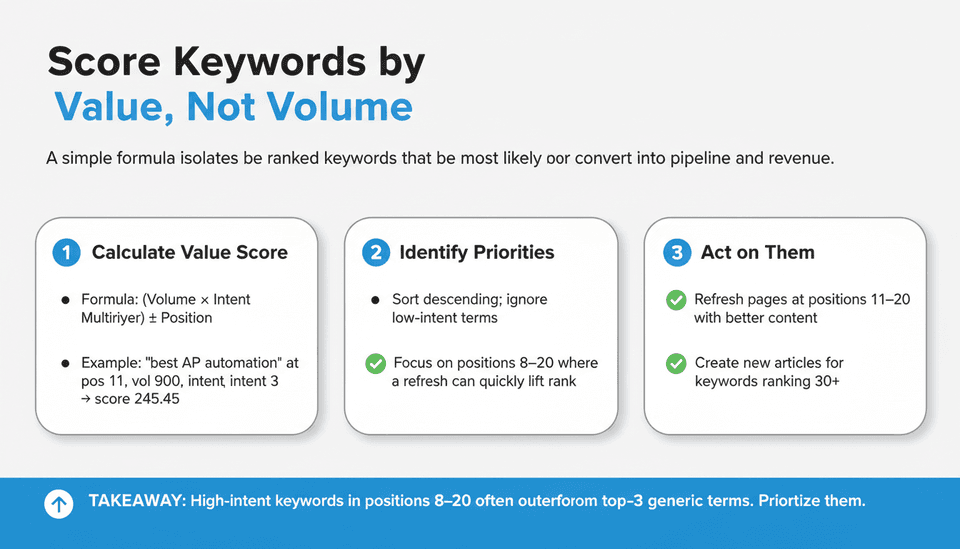
This is where most teams stall. They have a list of 500 ranked keywords in a spreadsheet. Nobody knows what to do with them. The secret: you don’t need to act on all of them. You need a framework that sifts the 5% that can move revenue.
Identifying Your Most Valuable Ranked Keywords
Create a simple scoring model. For each ranked keyword, note:
- Current position
- Estimated search volume (via any keyword planner)
- Business value: does this term align with a product, service, or buying intent?
- Proximity to a conversion point: is it top-of-funnel (information) or bottom (comparison)?
Then calculate a quick “Value Score”: (Search Volume × Business Value Multiplier) / Position. Give high-intent keywords a multiplier of 3, mid-intent 1, low-intent 0.3. Sort descending. The keywords that surface at the top are your priorities—regardless of raw volume. A low-volume term at position 9 with high buyer intent often outperforms a high-volume term at position 3 for a generic blog topic.
Here’s a worked example:
| Keyword | Position | Monthly Volume | Intent | Multiplier | Value Score |
|---|---|---|---|---|---|
| “best AP automation software” | 11 | 900 | Bottom | 3 | 245.45 |
| “what is accounts payable automation” | 14 | 2,400 | Top | 0.3 | 51.43 |
| “AP automation pricing” | 7 | 320 | Bottom | 3 | 137.14 |
| “manual vs automated AP” | 18 | 600 | Middle | 1 | 33.33 |
The clear winner is “best AP automation software” despite lower volume than the educational term. The framework forces you to ignore the instinct to chase raw impressions.
Using Ranked Keywords to Inform Content Creation
Once you’ve isolated your high-value ranked keywords, you don’t just stare at them. You ask two questions for each:
- Can I improve the existing page’s rank through on-page optimization? If a page is at position 11–20, a refresh—adding an up-to-date statistic, better heading structure, or clearer call-to-action—can push it into the top 10 within weeks. This is the fastest win.
- Is there a content gap I can attack with a new page? If you rank at position 30+ for a valuable keyword but your page isn’t fully answering the query, you need a dedicated article, not a patch. That’s where content creation scales.
How Automated Platforms Close the Loop
This is where the workflow breaks without automation. You’ve got a prioritized list of keywords that need fresh, long-form content. A human team would take weeks. An automated content marketing platform like Joyrise can ingest your top-of-funnel ranked keywords, perform brand-voice analysis, and generate researched, illustrated articles that publish directly to your Webflow blog—removing the manual gap between rank data and live content. The loop becomes: track ranked keywords → identify high-value gaps → generate and publish targeted articles automatically → track new positions. No handoffs, no waiting.
For finance leads, this cuts the time-to-content from discovery to live URL to under 48 hours, while costing a fraction of an agency retainer. The tradeoff is that you trade human nuance for scale, but for most SEO-driven programs, the net ROI flips positive fast once you move beyond ultra-premium thought-leadership pieces.
A Practical Workflow to Turn Rankings into Revenue
Step 1: Set Up Reliable Tracking
Choose a rank tracking tool that supports your volume—start with a paid tool if you plan to track more than 30 keywords. Configure it to monitor desktop and mobile, plus at least one location if your business is geo-sensitive. Connect Google Search Console to cross-reference impressions and clicks with rank data.
Step 2: Analyze Gaps and Opportunities
Every two weeks, export your ranked keywords. Run the Value Score formula above. Flag any high-value keyword that has:
- Dropped more than 4 positions in a month.
- Plateaued between positions 8 and 20 for 60+ days.
- A strong CTR but low position, indicating the snippet isn’t great.
Use those flags to build a short priority list—ideally no more than 10 keywords at a time. Trying to fix 50 at once leads to nothing getting done.
Step 3: Create Targeted Content at Scale
For keywords that need new articles, outline a blog post that directly addresses the intent. For keywords where an existing page needs a boost, schedule an update. If you’re a small team, consider a platform that automates content generation and publishing. Joyrise, for example, can take a keyword list and output complete, illustrated articles on your site with daily publishing. The key is that content creation must be a direct, fast output of your rank analysis, not a separate initiative.
Step 4: Monitor, Iterate, and Automate
Two weeks after publishing, check if positions moved. For pages that improved, let them run. For those that didn’t, revisit the content quality or internal linking. Map authority-building efforts like earning mentions in industry publications—important because, as Fast Company reported (November 17, 2026), earned media visibility is increasingly what AI search engines use to decide who to cite, even when rank is only one signal.
Common Myths and Pitfalls in Keyword Ranking
“My Site Ranks #1 for a Keyword, So I’m Done”
Rank isn’t static. Competitors publish, algorithm updates roll out, and SERP features shift. The #1 position for a keyword with a featured snippet might only get 40% of the clicks it did six months ago. Every #1 needs maintenance—fresh stats, updated internal links, and monitoring for new SERP features that steal traffic.
“I Should Check My Rankings Every Day”
Daily checking teaches nothing actionable. Positions fluctuate by 2–3 spots due to personalization, data center latency, and testing. You’ll make reactionary changes that hurt more than help. Check high-value keyword rankings weekly and run a full portfolio review monthly. That cadence is enough to catch real trends without noise paralysis.
“Rankings Are the Only Metric That Matters”
Rankings measure visibility potential, not outcome. A page ranked #3 with a poorly written meta description might get fewer clicks than a #6 result that courts the curious. Pair rank with organic click-through rate, conversions, and assisted conversions. If rank improved but revenue didn’t, you optimized the wrong page.
What to Do When Your Keywords Aren’t Ranking Well
Diagnosing Drops: Algorithm Updates vs. Competition
A sudden drop across multiple keywords often signals a core algorithm update. Check industry chatter on the date of the dip. A gradual decline on a single keyword is usually a competitor out-investing you in content or links. Tools like the SEOptimer keyword tracker can compare your page against the rising competitor’s to surface specific gaps—word count, heading structure, page speed, or backlinks.
Quick Wins to Boost Underperforming Keywords
To improve keyword ranking for pages on the edge of the top results, these high-impact tweaks work fast:
- Improve the meta title and description to increase click-through rate, which is a ranking signal.
- Add a table of contents or answer the query in the first 100 words to win featured snippets.
- Internal link from a high-authority page on your site to the underperforming one; this passes equity cheaply.
- Refresh old data points: if your article cites a 2022 stat, update it to a 2026 source.
When to Pivot Your Keyword Strategy
If a keyword consistently doesn’t move after two rounds of optimization attempts, it’s time to shift resources. Either the intent is dominated by massive brands you can’t outrank, or the search engine now interprets the query differently (e.g., a commercial term that now shows only maps packs). In that case, deprioritize the keyword and move your budget to adjacent terms where you can actually win.
The Future of Ranked Keywords: Earned Media and AI Visibility
Why AI Search Engines Rely on Earned Mentions
When an AI assistant answers “what’s the best project management tool for remote teams,” it doesn’t crawl the live web like a traditional search. It pulls from its training data and from a curated set of authoritative sources. Fast Company (November 17, 2026) highlighted that earned media—citations in articles, industry publications, analyst reports—is becoming the primary signal these AI systems use to decide which brands to mention. That means your traditional rank for “best project management tool” still matters for Google, but an AI like ChatGPT might cite a brand because it appeared in a Wall Street Journal roundup, not because it’s #1.
For modern SEO, you need to track both your organic keyword rankings and your presence in unstructured mentions across the web. Some newer platforms are starting to offer “AI answer visibility” tracking, but for now, most teams run manual searches inside AI tools for their core money keywords.
How to Prepare for a World Without Traditional SERPs
- Build earned media deliberately: pitch expert commentary to journalists, publish original data studies, and get listed in third-party comparison pages—these are the sources AI assistants mine.
- Structure your content so it’s easily extractable: use clear headings, Q&A formats, and concise definitions. AI summaries thrive on digestible snippets.
- Don’t abandon rank tracking. For the foreseeable future, high organic keyword rankings still correlate strongly with AI visibility because the same authority signals—links, mentions, structured data—feed both systems.
Frequently Asked Questions About Ranked Keywords
What is a keyword ranking?
A keyword ranking is the specific position a webpage holds for a search phrase on a search engine results page. It’s a snapshot of your visibility at that moment, influenced by factors like relevance, authority, and personalization.
How often should I check my keyword positions?
You should check keyword rankings for high-priority terms weekly and run a full audit monthly. Daily checks surface meaningless noise. If a sudden algorithm update hits, do a spot check immediately, but otherwise stick to a routine cadence to avoid overreacting.
How can I check my website keyword ranking on Google?
Use a rank tracking tool that simulates a neutral Google search. Free browser extensions like SEO Minion overlay rank on live results, while paid tools schedule checks and store history. You can also use Google Search Console to see average positions from actual user queries, though that data is aggregated and delayed.
Is the keyword rank checker free?
Many rank checkers offer free tiers, such as single-keyword lookups or limited daily checks. Tools like SEO.ai’s rank checker are free with no login. Paid checkers unlock bulk tracking, history, and location-specific data. For professional use, a paid tool is almost always necessary.
How does the keyword rank checker work?
It sends a query to the search engine from a controlled environment—clearing cookies, setting location—and scrapes the results page to identify where your URL appears. The result is a position number, often with SERP feature information like featured snippets or ad presence. Checkers don’t change your actual ranking; they merely report it.
What can I do if I’m not ranking well for keywords?
First, confirm you’re targeting keywords where your site has realistic authority. Then, improve the page’s content depth, refresh outdated information, earn internal links from your own high-authority pages, and consider building relevant backlinks. If the keyword is intensely competitive, shift focus to long-tail variations where you can rank and capture intent earlier in the buyer journey.
Why do I see different rankings when I search?
Personalization (search history, location, device), data center differences, and A/B testing by the search engine cause variation. That’s why a properly configured rank checker simulates a neutral, location-controlled search to give a consistent baseline. Manual checks from your own browser will always differ from what most users see.
Conclusion: From Checking Ranks to Driving Growth
Ranked keywords aren’t a trophy. They’re raw material for content decisions that move revenue. The operators who win don’t just track positions; they build a system where ranking data flows directly into content creation, earned media efforts, and AI visibility monitoring. Whether you use a spreadsheet and a rank checker or an automated platform, the goal is the same: close the loop between insight and action before a competitor does.
Key Takeaways
- Ranked keywords are only valuable when you prioritize them by business intent, not just volume—use a simple value score to focus on terms that actually convert.
- Free rank checkers work for a handful of queries, but any serious SEO program needs a paid tool or integrated platform to track trends, location differences, and AI SERP features.
- The gap between spotting a ranking opportunity and publishing content is where growth stalls—automated content platforms can cut that gap to under 48 hours and eliminate manual handoffs.
- AI search engines increasingly rely on earned media mentions, not just top-10 rankings, so build brand citations in industry publications and track your presence inside AI-generated answers.
- Check high-value keyword rankings weekly, not daily, to avoid noise; use a monthly review to pivot strategy and reallocate resources to terms where you can realistically win.
Start publishing articles based on your highest-value ranked keywords every day, automatically—see how Joyrise turns your rank data into live, illustrated blog posts on Webflow.