 Joyrise
Types of SEO: AEO, GEO, and Traditional Search Explained
 By Alexi · · Updated · 12 min read

On this page
- Executive Summary: Stop Picking One Type of SEO
- The Three Pillars of Modern Search (Without the Jargon)
- The Hidden Cost of Manual Multi-Type Optimisation
- How to Choose Your Mix: A Decision Framework for Founders and Finance Leads
- Automating the Whole Stack: From Research to Publishing
- Measuring What Actually Matters Across SEO, AEO, and GEO
- Direct Answers to Common Questions
- 5 Mistakes That Waste Budget and Credibility
- What’s Next: Beyond AEO and GEO
- Key Takeaways
The types of SEO AEO GEO—AEO, GEO, and traditional search—are not three competing strategies. They are three different reading surfaces for the same underlying content, and picking one is the expensive mistake. SEO means ranking in the 10 blue links. AEO means being the answer a voice assistant reads aloud or the featured snippet Google pulls above the results. GEO means being the source an AI engine quotes, even when that quote sends no click. Most guides define the acronyms and stop. This one gives you an operational framework for automating the work across all three—research once, structure once, publish daily—without multiplying headcount or burning budget on agencies.
Executive Summary: Stop Picking One Type of SEO
The core problem in search visibility 2026 is not choosing between SEO, AEO, and GEO; it is running three disconnected workflows for what is fundamentally one job: making your content findable, quotable, and readable across every surface where a customer asks a question. Most agencies and in-house teams still treat them as separate projects with separate tools, separate checklists, and separate retainers. The result is a content assembly line that costs too much and publishes too slowly to matter.
This guide gives you the operational framework most ranking pages leave out: how to build one content pipeline—research, writing, structure, publishing, monitoring—that satisfies all three types of SEO from a single page, and where automation actually breaks the cost curve. I won't present survey data as original research; where numbers appear, they come from the cited source and stated date.
The market is signaling this shift in real time. A November 3, 2026 roundup in Technology Org noted that most AI SEO agencies now list GEO, AEO, ChatGPT, AI Overviews, citations, and generative search in their service descriptions. The same day, The National Law Review reported that Happy Growth Marketing expanded its services to cover SEO, AEO, GEO, and AI search optimisation, with the agency's founder stating that search is "evolving beyond traditional rankings." The acronyms are converging; the operational problem is what remains unresolved.
The Three Pillars of Modern Search (Without the Jargon)
SEO: Crawlers, Keywords, and the 10 Blue Links
Traditional SEO is the original surface: Google and Bing crawl your pages, index them, and rank them by relevance and authority. It is still where high-intent, click-driven traffic lives. The mechanics are well documented: technical crawlability, keyword-mapped content, internal linking, and backlinks as trust signals. SEO remains the only one of the three that reliably converts clicks on commercial queries. That matters when you are optimizing for revenue, not just visibility.
AEO: Speaking the Language of Voice and Featured Snippets
Answer engine optimization (AEO) targets surfaces that return one answer instead of ten links: featured snippets, People Also Ask, structured knowledge panels, and voice assistants that read answers aloud. The optimization difference is mostly structural—write a direct, self-contained answer in the first 40–60 words, frame headings as questions, and add schema markup. Local businesses lean on AEO hardest because "near me" and "who does X in [city]" queries are answered, not clicked.
GEO: Being the Source AI Quotes (Even When It Doesn’t Send Traffic)
Generative engine optimization (GEO) is the newest surface: ChatGPT, Google AI Overviews, Perplexity, and Bing Copilot synthesize an answer and cite sources. You can optimize for ChatGPT and other generative engines by being the source they quote—which requires authority signals, clean crawlable content, and original information. Google's developer guidance on optimizing for generative AI features points back to the same fundamentals: clear structure, crawlable pages, and entity-rich writing. Reforge's guide to optimizing for AI search and discovery frames GEO as an authority game in which being cited matters more than ranking.
The market is still learning this vocabulary. In an October 29, 2026 piece on openPR, AI SEO consultant Sunil Pratap Singh noted that businesses wanting to be recommended by ChatGPT and Google AI Overviews rarely search for "GEO"—they use different language. The demand exists; the terminology hasn't caught up.
The Hidden Cost of Manual Multi-Type Optimisation
Why Most Teams Can’t Keep Up—and What Breaks First
When you run SEO, AEO, and GEO as separate manual programs, the first thing that breaks is structured data maintenance. Schema markup rots—it goes unvalidated after template changes, gets duplicated, or silently drops required properties. The second thing that breaks is answer formatting: editorial teams write for the article page, not for the 45-word snippet or the AI citation. The pattern is predictable: structured data maintenance breaks first. Then monitoring fails, because nobody wired a dashboard for AI citations.
Cost-to-scale is the part most strategy documents skip. A traditional SEO agency retainer varies widely by scope, but a realistic floor for ongoing content plus technical SEO is in the low thousands per month; an in-house SEO hire is a full-time salary plus tooling before a single article ships. By comparison, Joyrise publishes plans at $199/month (30 articles), $499/month (80 articles, deep research, quality-judge rewrite pass, news-driven articles), and $999/month (180 articles, priority support). At any plausible agency retainer, the gap is thousands of dollars a month before you count the time recovered. The breakeven case for automation is not theoretical—it is arithmetic.
From Strategy to Execution: The Content Assembly Line Problem
Even with a clear plan, executing across surfaces means: keyword research, entity mapping, competitor gap analysis, drafting, structuring headings, writing answer blocks, marking up schema, generating images, internal linking, publishing, then monitoring rankings and snippet eligibility and AI-citation appearance. Manually, that is a 6–10 hour per piece job at the quality bar that gets cited. Most teams solve it by publishing less often than the market rewards, or by outsourcing pieces to freelancers who don't know the SEO AEO GEO strategy. The assembly line is the bottleneck—not the strategy.
How to Choose Your Mix: A Decision Framework for Founders and Finance Leads
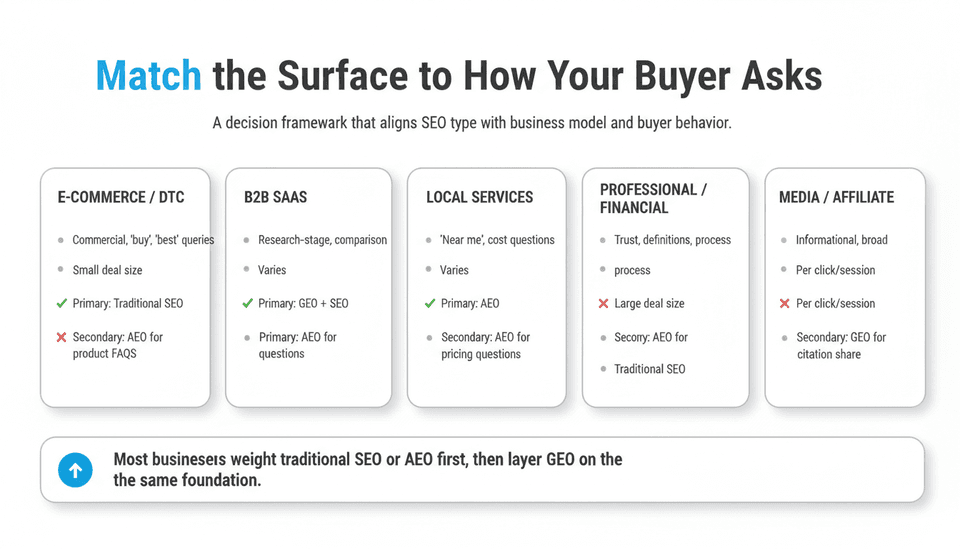
The answer to "which type first" is a business-model question, not a trend question. Match the surface to how your buyer actually asks.
When Traditional SEO Still Delivers the Highest Marginal ROI
If your revenue depends on high-intent commercial queries—"pricing," "best X for Y," "review," "buy"—traditional SEO still wins because those queries end in clicks. E-commerce category pages, B2B comparison pages, SaaS pricing pages. Searchers want to land somewhere and act. For a fuller breakdown of which type matches which business, see Types of SEO: Choosing What Your Business Really Needs.
When AEO Wins: High-Intent, Question-Based Queries and Local Positioning
Service businesses with high average deal sizes—legal, medical, home services, B2B professional services—win on AEO because their customers ask questions and call. "How much does a roof replacement cost in Denver?" gets answered in a snippet, not clicked. Local positioning compounds this: Google Business Profile completeness, review velocity, and FAQ content structured for answer extraction.
When GEO Pays Off: Top-of-Funnel Authority Building and Future-Proofing
If your business sells something buyers research long before they buy—B2B SaaS, financial services, complex hardware—GEO compounds. PC Tech Magazine reported on October 29, 2026 that 50% of consumers already use AI-powered search in their buying journeys, and that $750 billion in consumer spending is projected to be influenced by generative AI by 2028. Those research-stage prompts cite sources; you want to be one. For a practical starting point, see ChatGPT GEO: A Practical Guide to AI Answer Visibility.
The 80/20 Overlap: Writing One Page That Performs Across All Three
Most of the win comes from overlap, not specialization. One page can rank, get excerpted, and get cited if you do five things: write a direct answer in the first 50 words; structure headings as candidate questions; add FAQ schema; write entity-rich sentences that name brands, people, categories, and numbers; and include one original specific—a workflow, a table, a cost breakdown—that an AI engine would quote because it needs the detail. This is the same logic behind What Is the 80/20 Rule in SEO?.
| If your business is... | Dominant query pattern | Average deal size | Primary surface | Secondary surface |
|---|---|---|---|---|
| E-commerce / DTC | Commercial, "buy," "best" | Small | Traditional SEO | AEO for product FAQs |
| B2B SaaS | Research-stage, comparison | Varies | GEO + SEO | AEO for pricing questions |
| Local services | "Near me," cost questions | Varies | AEO | Localized SEO |
| Professional / financial services | Trust, definitions, process | Large | GEO + AEO | Traditional SEO |
| Media / affiliate | Informational, broad | Per click/session | Traditional SEO | GEO for citation share |
Automating the Whole Stack: From Research to Publishing
How AI Platforms Learn Your Voice and Identify Gaps (Without 10 Tools)
The fragmented stack—separate tools for keyword research, content briefs, writing, schema, images, publishing, rank tracking—is the cost driver. An AI content platform that performs deep site scans can learn your brand voice, product set, and audience from your existing pages, then plan content against competitor gaps. The automation point is not "AI writes a blog post"; it is removing the handoffs between research, drafting, structuring, and publishing. Automated SEO works when the pipeline is continuous, not per-piece outsourced.
Writing for Bots That Read for Bots: Structure, Entities, and Answer Tags
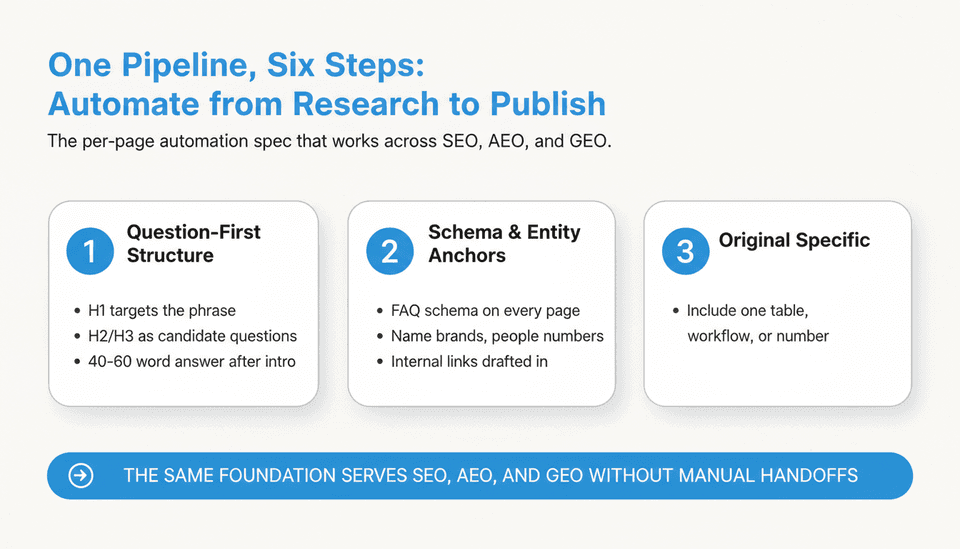
Here is the per-page automation spec that works across all three surfaces:
- H1 with the target phrase; H2/H3s phrased as candidate questions.
- A 40–60 word direct answer immediately after the intro.
- FAQ schema on every page; HowTo or Product schema where applicable.
- Entity anchors: name the brands, people, numbers, and categories explicitly.
- Internal links drafted into the piece, not retrofitted after publishing.
- At least one original specific—a table, a workflow, a number from your own operation—that an AI engine can cite and a human can use.
Publishing and Monitoring on Autopilot: A Real-World Workflow with Joyrise
Joyrise's published model is the clearest worked example of this pipeline on Webflow: deep site scans to learn voice and identify gaps, daily long-form articles with original branded images and infographics, built-in SEO features (headings, meta, table of contents, internal links), a second AI quality-judgement pass on Pro and Max tiers, and automated publishing to Webflow or drafts for review. Its Search Console dashboard tracks clicks, impressions, and AI assistant referrals. The workflow becomes: scan > gap plan > generate > quality judge > publish > monitor—without manual handoffs between stages.
Measuring What Actually Matters Across SEO, AEO, and GEO
Traditional Metrics Aren’t Enough: Impressions, Cited Queries, and Answer Visibility
Clicks and rankings measure SEO. But AEO and GEO demand different signals: featured snippet presence, People Also Ask appearances, voice-assistant answer share, and—hardest of all—whether a generative engine cited or paraphrased you. Citations, not clicks, are the new north star for GEO. Google Search Console captures some AI Overview visibility; Bing Webmaster Tools has similar evolving coverage. SEMrush's guide to AI search optimization is a useful reference for which signals are actually trackable in 2026.
Tools and Dashboards That Show You Whether AI Engines Are Using Your Content
- Google Search Console: impressions and clicks, plus AI-feature visibility where reported.
- Bing Webmaster Tools: Copilot and chat visibility reporting where available.
- Third-party citation monitors: verify methodology before trusting percentages—recommendation engines vary widely.
- Manual prompt audits: prompt ChatGPT, Google AI Overviews, and Perplexity on your target questions monthly and log whether your brand appears. This is the only audit that doesn't depend on a tool's guesswork.
Be honest about the limitation: no tool currently captures complete generative-engine coverage. Attribution is immature. Keep a log of prompts and answers; it is imperfect but it is yours.
Direct Answers to Common Questions
What is AEO?
Answer engine optimization: structuring content so answer engines—featured snippets, voice assistants, People Also Ask—select and surface your content as the single answer. The signal difference is format: direct, self-contained answers backed by schema markup.
What is GEO?
Generative engine optimization: positioning your content so generative AI engines—ChatGPT, Google AI Overviews, Perplexity—cite or paraphrase you in synthesized answers. It is an authority game plus structural clarity, and it does not require a click to deliver value.
How is AEO different from SEO?
SEO optimizes for ranking among ten links; AEO optimizes for being the one answer extracted from a page. The same page can do both, but AEO adds a structural layer: question-formatted headings, direct-answer blocks, FAQ schema.
How is GEO different from SEO?
SEO targets keyword-to-page matching and click-through. GEO targets being selected as a source inside an AI-generated synthesis, where the user may never leave the chat. Links and crawlability still matter; the conversion point is citation, not click.
Is AEO the same as GEO?
No. Both are answer surfaces, but AEO tends to return your content as the visible answer, often with attribution or a click opportunity. GEO involves your content being summarized and cited among several sources, possibly without a click. They overlap but are measured differently.
Which type of SEO is best for my business today?
Use the decision matrix above. Traditional SEO if you monetize high-intent commercial clicks; AEO if your customers ask questions and call; GEO if buyers research for months and you need authority before demand. Most businesses should weight traditional SEO or AEO first, then layer GEO on the same foundation.
Do I still need traditional SEO if I invest in AEO and GEO?
Yes. Crawlers still index what search engines and AI systems retrieve; backlinks and technical crawlability still signal authority. AEO and GEO do not replace SEO—they extend it. The same foundation serves all three.
Can I automate content creation for all three types?
Yes, with constraints. Automation handles research, drafting, structuring, images, schema, internal links, and publishing. Human review should protect accuracy on money-claims, pricing, and anything regulated. A quality-judgement pass—a second AI rewriting against a rubric—is a useful gate, but final sign-off on risky claims stays human.
How do I measure whether AI search engines are using my content?
Use Google Search Console and Bing Webmaster Tools for official visibility signals, add a citation-monitoring tool for generative-engine references, and run monthly manual prompt audits logging which engines name your brand. Expect partial data; attribution is still immature.
What are the biggest mistakes when optimising for AI search?
The five mistakes in the next section—treating AEO and GEO as afterthoughts, over-optimising for AI at the cost of human readers, ignoring structured data, assuming one off-page strategy fits all, and hiring agencies without verifying AI-search competence—are the pattern. Over-optimising for AI is the costliest: engines tune for what humans trust, so gutting readability to please a model backfires over time.
5 Mistakes That Waste Budget and Credibility
Treating AEO and GEO as Afterthoughts
The "we'll do it later" tax compounds. AEO and GEO reward accumulated authority and structured content; you cannot retrofit years of answer-format pages in a quarter.
Over-Optimising for AI at the Expense of Human Readers
The biggest structural mistake. If you strip voice, examples, and specifics to make content "AI-clean," you make it worthless to the humans whose citing behavior signals trust. Write for the human; structure for the bot.
Ignoring Structured Data Until It’s Too Late
Schema is cheap to add at publish and expensive to retrofit across hundreds of pages. Add FAQ schema as part of the publish step, not a site-wide cleanup later.
Assuming One Off-Page Strategy Fits All
Backlinks remain a strong ranking signal for traditional SEO and a trust input for AI training, but their weight differs by surface. A local service business needs reviews and directory consistency for AEO; a thought-leadership play needs citations in industry roundups for GEO. One off-page retainer does not cover all three.
Hiring Generalist Agencies Without Verifying AI-Search Competence
The market is catching up—per Technology Org's November 3, 2026 industry roundup, most AI SEO agencies now list GEO, AEO, ChatGPT, AI Overviews, and generative search in their service descriptions. The risk now is people listing these services without doing them. Ask agencies to show you the prompt log, a sample citation report, and a live schema audit before you sign.
What’s Next: Beyond AEO and GEO
The future of search optimization is consolidation, not more acronyms. As agents browse and act on user behalf, the line between "search result," "answer," and "cited source" will blur further. The durable skills remain the same: clear entities, original specifics, crawlable structure, and authority signals you earn rather than claim. Watch agentic frameworks and multimodal retrieval; the operational logic in this guide transfers, because the bottleneck—content produced at quality, at scale, without manual handoffs—will move to whatever surface appears next. Predictions here are speculative; the cited trends are snapshots from their stated dates.
Key Takeaways
- SEO, AEO, and GEO are not competing strategies but three reading surfaces for the same content; build one pipeline, not three programs.
- Match the surface to how your buyer asks: traditional SEO for commercial clicks, AEO for question-and-call business, GEO for research-stage authority.
- The real cost problem is the content assembly line; automating research, writing, structure, and publishing removes the handoffs that make manual multi-type optimization unprofitable.
- Measure citations, answer visibility, and featured-snippet presence alongside clicks—and accept that generative-engine attribution data is still partial.
- Write for the human, structure for the bot: direct answers, FAQ schema, entity-rich sentences, and original specifics pull triple duty across all three surfaces.
If running this kind of research-to-publish pipeline on your Webflow blog sounds like the missing piece, create an account and read your first article before you decide.