 Joyrise
Types of SEO Keywords: A Practitioner's Guide
 By Alexi · · Updated · 18 min read

On this page
- Executive summary: what 'types of SEO keywords' actually decides
- What a keyword type is — plain-language definition and scope
- How the system works: from query to page format
- The four intent types that do the real work
- Modifiers mistaken for types: branded, local, short-tail vs long-tail, LSI/semantic
- Reading intent off the live SERP instead of a checklist
- Which keyword types are worth targeting when answers appear in the results page
- Allocating a fixed content budget across keyword types
- How the keyword-type mix shifts by business model
- Measuring keyword types after publishing
- Mistakes, myths, and limitations
- Next steps: a one-week plan to turn this into a keyword mix
- Direct answers to recurring questions
- Key Takeaways
The phrase types of SEO keywords usually triggers a taxonomy list: informational, navigational, commercial, transactional, plus long-tail, branded, local. That list is easy to memorize and mostly useless when you are holding a fixed publishing budget. This guide treats keyword types by search intent as a decision about what page to build, not a label to assign. The four intent types change the page format. Everything else is a modifier that changes the brief. I will show how to read intent from the live SERP instead of a checklist, allocate a 30-article month across keyword types, and measure each type after publishing.
Executive summary: what 'types of SEO keywords' actually decides
The four types that change what you build
Four keyword types drive the page format, the internal linking path, and the success metric: informational keywords, navigational keywords, commercial keywords, and transactional keywords. An informational query earns a guide or explainer. A commercial query earns a comparison or alternatives page. A transactional query earns a product, pricing, or signup page. A navigational query usually means you should defend an existing asset, not publish something new.
The modifiers that only change the brief
Branded versus non-branded, local and geo-targeted, short-tail versus long-tail, and so-called LSI or semantic keywords all behave as modifiers layered on top of an intent. They change the title, the audience, the internal link anchor, or the measurement split. They do not change the core page format. Treating them as separate types is the main reason content plans end up with 14 overlapping pages that all target the same underlying decision.
What this guide does not claim
This is a decision framework, not a measured effect. The supplied material for this article includes no public dataset that settles the aggregate effect of AI-generated answers on long-tail informational queries. Where the evidence runs out, I say so. This guide also does not cover crawl budget, indexing, schema, site speed, or technical SEO mechanics.
What a keyword type is — plain-language definition and scope
Keyword type vs search intent vs match type vs topic cluster: the terms people mix up
A keyword type is a classification of a query based on what the searcher wants and what page format the search engine rewards for that query. Keyword intent is the inferred goal behind the query. Match type is an advertising concept: broad, phrase, exact, and negative matches in paid search. It has nothing to do with organic content planning. A topic cluster is a content architecture method, not a keyword type. One cluster can contain informational, commercial, and transactional queries around the same subject.
Why 'how many types are there?' has no single correct answer
Sources disagree because they are counting different things. Semrush and SmartSites work with four intent types. CausalFunnel lists nine. GeeksforGeeks implies more through clustering and relevance. The disagreement exists because some writers count modifiers as separate types. A local transactional keyword is not a new type; it is a transactional keyword with a geo modifier. A long-tail informational question is not a new type; it is an informational keyword on the specific end of the specificity axis. The useful question is not "how many types exist?" but "which categories change the thing I actually build?"
Scope: what this guide covers and what it leaves to a technical SEO resource
This guide covers choosing page formats, reading SERPs, allocating production capacity across a keyword mix, and measuring outcomes by type. It leaves crawling, rendering, schema, JavaScript, internal link graph mechanics, and page performance to a technical SEO resource. Those disciplines change whether a page gets indexed and how fast it renders; they do not change which page format a query demands.
How the system works: from query to page format
Query → inferred intent → SERP layout → content format the engine rewards
A search engine receives a query, infers the dominant intent, and assembles a SERP layout that matches that inference. If the engine shows a how-to featured snippet, the implied format is a structured step-by-step article. If it shows a shopping carousel, the implied format is a product or category page. If it shows a local pack, the implied format is a location or service area page. Build for the SERP layout, not the keyword label.
Where classification breaks: ambiguous queries and mixed-intent SERPs
Classification breaks when a query can satisfy multiple intents at once. "Best accounting software for small business" mixes commercial investigation with a transactional outcome. "What is a fiduciary" can be informational, but some searchers are comparing financial advisors. In mixed-intent SERPs, the engine often hedges by showing multiple blocks: a definition, a carousel, and a forum thread. That ambiguity is information. It tells you whether one page can satisfy the SERP or whether you need two pages aimed at different stages.
What your CMS and metadata actually do with a keyword (headings, title, internal links)
A keyword does not live in a vacuum inside your CMS. It becomes the title, the H1, the URL slug, the meta description, and the anchor text of internal links. If you label a transactional query as informational and build a guide, your metadata will invite searchers who want to buy, but your article will fail them. Internal links then route that wrong-intent traffic deeper into a path that does not match the page. The practical fix is to decide the intent first, then let the page format and metadata all follow from that decision.
The four intent types that do the real work
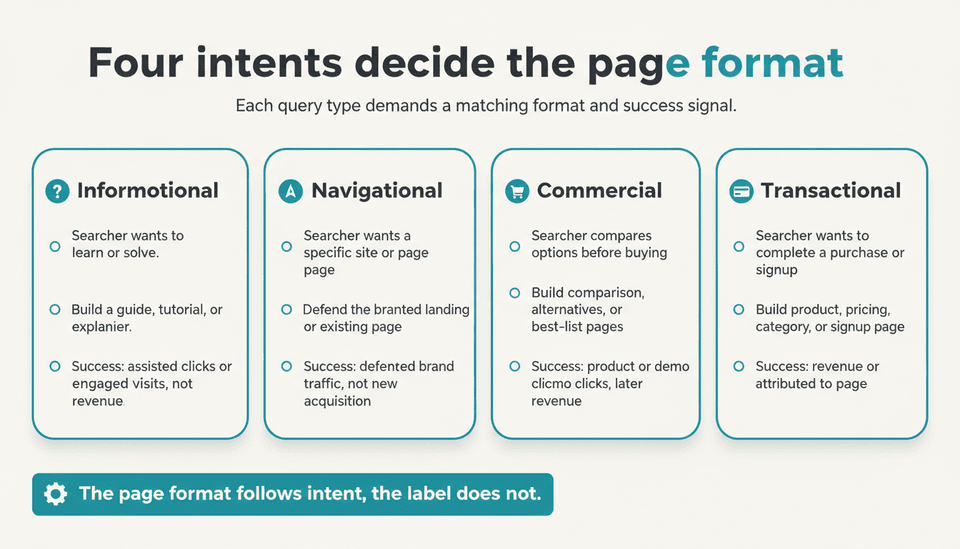
The four-way split is the baseline taxonomy in essentially every ranking page, including Backlinko's search intent guide and Moz's search intent explainer. The mistake is stopping at the label.
| Intent type | What the searcher wants | Page format that matches | Success signal |
|---|---|---|---|
| Informational | Learn, understand, solve | Guide, tutorial, explainer, definition | Assisted clicks or engaged visits; not revenue |
| Navigational | Reach a specific site or page | Branded landing or existing page | Defended brand traffic; not new acquisition |
| Commercial | Compare options before buying | Comparison, alternatives, best lists, reviews | Product page or demo clicks, later revenue |
| Transactional | Complete a purchase or signup | Product, pricing, category, signup page | Revenue or signups attributed to page |
Informational: what to build and what 'success' looks like
Informational keywords ask for explanation, instruction, or context. The page should be a guide, tutorial, explainer, or definitional reference. Success is not a sale on that page. Success is a reader who stays, follows an internal link to a commercial or transactional page, or returns later as a branded visitor. Informational pages earn their cost when they have a clear next step. An informational article with no internal path to the product produces traffic that bounces.
Navigational: why these queries are usually a brand asset, not a content target
Navigational queries are people typing your company name, a product name, a login URL, or a specific page name. They already know where they want to go. The right response is usually to make sure your branded page outranks impostors and directory listings. Building new content to target someone else's brand name is usually a waste of production capacity. Navigational queries are a defense and retention surface, not an acquisition strategy.
Commercial: comparison, alternatives, and 'best' queries
Commercial keywords sit one step before the transaction. The searcher is comparing options, reading reviews, or looking for alternatives. The page should be a comparison, an alternatives list, or a best-in-category guide with real tradeoffs. Commercial pages should never hide the product. They should name competitors honestly, explain who each option suits, and route the ready-to-buy reader to a transactional page.
Transactional: product, pricing, and signup paths
Transactional keywords include product names, pricing pages, signup flows, and high-intent actions like "buy X online" or "start free trial." The page should remove friction. A pricing page should show pricing or a clear path to it. A product page should answer the four questions that block a purchase: what it does, what it costs, how it compares, and how to start. Transactional pages are the last click, not the first article.
Modifiers mistaken for types: branded, local, short-tail vs long-tail, LSI/semantic
Branded and non-branded: a measurement split, not a page type
Branded vs non-branded keywords is a measurement split. Branded queries include your company, product, or founder name. Non-branded queries do not. You should separate them in every report because branded traffic inflates performance and hides whether your content is actually acquiring new demand. Branded queries are worth ranking for defensively, but they are not a page type. A branded informational query still gets an informational page; a branded transactional query still gets a product or signup page.
Local and geo-targeted: a modifier applied on top of an intent
Local is a modifier. "Plumber near me" is a transactional or commercial query with a geo modifier. "How to fix a leaky faucet" is informational and may be answered nationally. Local keywords imply a location page, a service area page, or a Google Business Profile. The intent still decides whether the page is informational, commercial, or transactional. A local service business should not write a nationally aimed informational article when the query is local transactional; it should build a city-level service page.
Short-tail vs long-tail: a specificity axis, not a category
Short-tail keywords are broad and high-volume. Long-tail keywords are specific and lower-volume per query. This is a specificity axis, not a separate intent category. A long-tail query can be informational ("what causes a car battery to drain overnight"), commercial ("best trickle charger for winter storage"), or transactional ("buy CTEK MXS 5.0 battery charger"). The label tells you the query is specific. It does not tell you what page to build.
Why 'LSI keywords' is a legacy term — what people actually mean by semantic coverage
LSI, or latent semantic indexing, is a technical term from information retrieval that SEO tools borrowed and then misapplied for years. The practice people actually mean is semantic coverage: writing about the adjacent terms, subtopics, and related questions that a genuinely useful page would cover. You do not need to "add LSI keywords." You need to cover the subtopic space. A page about "types of SEO keywords" should naturally cover search intent, long-tail, branded, local, and SERP features because those are the related concepts, not because a tool returned a list of magic phrases.
Reading intent off the live SERP instead of a checklist
A ten-minute SERP teardown: features present → format implied
Open an incognito or logged-out search window. Look at the features above the organic results, not just the blue links. The features tell you what format the engine is rewarding.
| SERP feature present | Implied intent | Likely page format |
|---|---|---|
| Featured snippet or AI Overview with how-to | Informational | Definitive guide or step-by-step |
| People Also Ask block | Informational with subquestions | FAQ plus strong headings |
| Shopping carousel or product grid | Transactional | Product or category page |
| Local pack or map | Local commercial or transactional | Location page or service area page |
| Video block | How-to or visual informational | Video-led post with transcript |
| Forum or Reddit block | Informational with judgment or lived experience | Experience-based post or expert contributor |
| No organic blue links above the fold | Mixed or zero-click | Reconsider format and click-through model |
The free tools in Google SEO Tools: A 2026 Guide to What to Trust can help you inspect SERP features without guessing which ones appear in your target region.
Mixed-intent SERPs: when to build one page and when to split into two
A mixed SERP shows two or more formats with roughly equal prominence. If the query shows a product carousel and a "best" list, the engine is hedging between transactional and commercial. Build one page when the searcher's next step is the same. Build two pages when the searcher's next step diverges. For example, "best accounting software" may merit a commercial comparison page plus a transactional category page if the SERP shows both. If the SERP shows only a comparison list, one commercial page is enough.
Worked example: three queries that look identical as strings and demand different pages
Query one: "what is a 1099 form." The SERP likely shows a definitional featured snippet and People Also Ask. Build an informational explainer. Do not build a product page.
Query two: "1099 form software." The SERP likely shows software comparison results and vendor homepages. Build a commercial comparison page that routes to transactional signup pages.
Query three: "buy 1099 form online." The SERP likely shows product listings. Build a transactional purchase or category page. The same root topic, three different page formats, because the intent differs.
Which keyword types are worth targeting when answers appear in the results page
A defensibility test for a keyword before you write it
Before you write, ask five questions. One: can the answer be fully delivered in a zero-click result or AI Overview? Two: does the query require judgment, a workflow, or updated context? Three: does the SERP already contain a strong incumbent with more authority than you? Four: can you add information the current results lack? Five: does this keyword map to a page format that leads to a commercial or transactional next step?
If the answer is fully absorbed in a knowledge panel or AI answer, and the query requires no judgment, the keyword is likely a poor content investment. If the query requires a workflow, a comparison, or a decision framework, the click still has a reason to exist.
Where informational keywords still earn their cost, and where they don't
Informational keywords earn their cost when the topic is complex, evergreen, and connected to a purchasing decision. They do not earn their cost when the answer is a single sentence, a date, a formula, or a definition the engine can display in full. A guide to "how to choose a business bank account" still works. A page answering "what is the FDIC insurance limit" is mostly absorbed before a click. The same rule applies to short-tail and long-tail informational queries equally: the answer shape, not the query length, determines whether the work repays itself.
Explicit evidence gap: this is a decision framework, not a measured effect
No public dataset supplied for this article settles whether AI-generated answers have reduced aggregate clicks for long-tail informational queries across all industries. The defensibility test above is a reasoning tool. Use it to filter your own keyword list. Then verify the result in your own Search Console before committing a full quarter of budget. For a deeper look at visibility inside AI answer engines, see ChatGPT GEO: A Practical Guide to AI Answer Visibility, which covers the adjacent measurement question without pretending the data is settled.
Allocating a fixed content budget across keyword types
A worked allocation for a 30-article monthly capacity
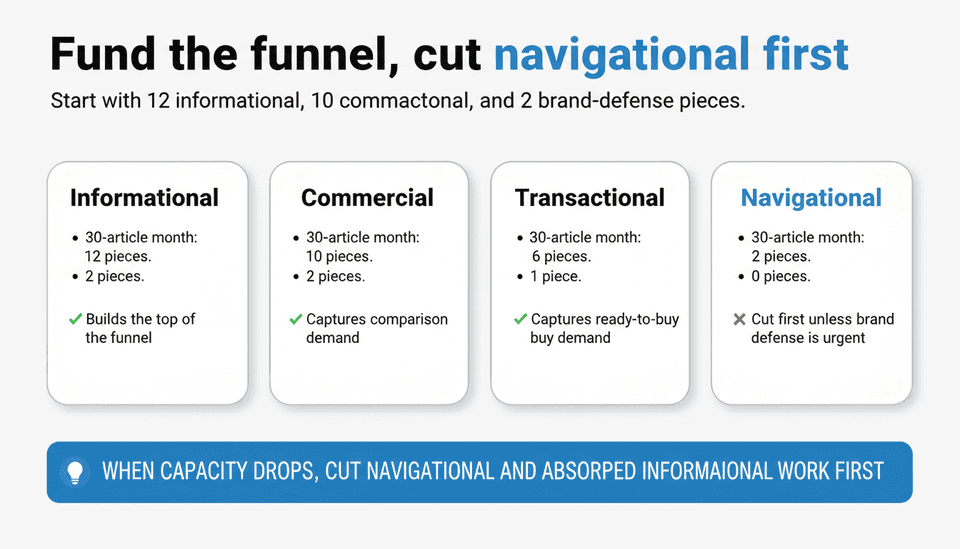
A fixed capacity forces tradeoffs. For 30 articles a month, I would allocate as follows:
| Monthly capacity | Informational | Commercial | Transactional | Navigational or brand defense |
|---|---|---|---|---|
| 30 articles | 12 | 10 | 6 | 2 |
| 5 articles | 2 | 2 | 1 | 0 |
This is a starting mix, not a universal law. The logic is simple. Informational pages build the top of the funnel. Commercial pages capture comparison demand. Transactional pages capture ready-to-buy demand. Navigational work is usually a maintenance task, not a production task.
What to cut first when capacity is 5 articles a month rather than 50
When capacity is five articles a month, cut navigational content first, unless your branded SERP is under active attack. Then cut broad informational topics that are absorbed by zero-click results. Keep two informational pieces that feed a commercial page, two commercial pieces that feed a transactional page, and one transactional page. Cut navigational and short informational first when capacity is low.
Sequencing: which type to target first, second, and never
Start with transactional pages if you have a working product and a way to convert. Then build commercial pages that feed those transactional pages. Then build informational pages that feed the commercial pages. Never build navigational pages for other brands. That sequence means every article you publish has a downstream page to send traffic to.
How the keyword-type mix shifts by business model
Ecommerce: category-level commercial vs product-level transactional
Ecommerce sites should spend heavily on transactional category and product pages, then support them with commercial "best" and "alternatives" content. One category page can target many short-tail and long-tail transactional queries. Informational content should exist only where it influences the buying decision directly.
B2B SaaS: problem-aware informational vs competitor-aware commercial
B2B SaaS needs a heavier informational and commercial mix. A prospect searching "why does my spreadsheet keep breaking" is problem-aware, not solution-aware. That informational query should lead to an article that names the problem and routes to a problem-focused product page. A prospect searching "HubSpot alternatives" is competitor-aware commercial. The page should be a comparison, not a product page pretending to be neutral.
Local services: intent plus geo modifier, and the pages that combination implies
Local services need city-level pages for transactional and commercial queries with a geo modifier. The page format is a service area page, not a blog post. A plumber targeting "drain cleaning near me" needs a city or neighborhood page with pricing, service area, reviews, and a call path. A national informational guide on "how drain cleaning works" may earn traffic but will not fill the appointment calendar unless it links clearly to the local service pages.
Measuring keyword types after publishing
Grouping Search Console queries by type, including branded vs non-branded
Export your Search Console queries into a sheet. Create a column for keyword type: informational, commercial, transactional, navigational. Create a second column for branded versus non-branded. Branded queries should be filtered out of non-branded growth reporting. Free tools for this workflow are covered in Best Free SEO Tools in 2026: What's Actually Free, but Search Console itself is the source of truth.
Per-type success criteria: what 'working' means for informational vs transactional
An informational page is working when it earns engaged visits, internal link clicks, or returning branded visits. A commercial page is working when it sends clicks to product or signup pages. A transactional page is working when it produces revenue or signups attributed to that page. A navigational page is working when it retains the top branded position. Do not hold all types to the same conversion metric.
Why blended traffic numbers hide a failing keyword mix
Blended traffic numbers hide failure because a spike in informational visits can mask a decline in transactional visits. If your traffic grows but revenue does not, you may have optimized for informational keywords that don't convert. Split the report by type and by branded versus non-branded, and the problem becomes visible. Blended traffic hides a broken keyword mix.
Mistakes, myths, and limitations
Myths: keyword density targets, 'LSI keywords', 'one keyword per page', 'long-tail is always easier'
Four myths persist. Keyword density targets are a relic of pre-semantic engines; nobody should write to a percentage. "LSI keywords" is a legacy term, as covered above. "One keyword per page" is false because one page naturally ranks for many related queries. "Long-tail is always easier" is only sometimes true, especially for single-answer informational queries now absorbed into zero-click results.
Legitimate limitations of any keyword taxonomy
Any taxonomy is a simplification. Real searchers move between intents within one session. The same query can be informational for one user and transactional for another. Tools classify intent imperfectly because they often read the string, not the searcher's context. The taxonomy is useful as a planning decision, not as a permanent label.
What to verify with your own data before committing budget
Verify three things. First, confirm the SERP layout matches your assumed intent. Second, confirm that queries grouped as the same type in your account actually produce the same page format. Third, confirm that your informational pages send clicks to commercial or transactional pages, not just to other informational pages. If the internal path is missing, the traffic will not compound.
Next steps: a one-week plan to turn this into a keyword mix
Days 1–2: classify what you already rank for
Export your Search Console queries for the last 12 months. Tag each query by the four intent types and by branded versus non-branded. Look for patterns. Are you earning informational traffic with no commercial page to receive it? Are you ranking for transactional queries with no matching product page? This step takes a spreadsheet, not a new tool.
Days 3–5: teardown the SERPs for your shortlist
Take the 20 to 50 keywords that matter most to revenue. Run each in an incognito window. Record the SERP features, the implied format, and whether the SERP is mixed. Mark each query as build, split, or skip. This is the step where the page format decision becomes concrete.
Day 6–7: set the allocation and the per-type success metric
Decide your 30-day or 90-day article allocation by intent type. Set one success metric per type: engaged visits for informational, product-page clicks for commercial, revenue or signups for transactional, and branded position for navigational. Then hand the resulting brief to whoever writes or publishes. If you are using an automated content platform like Joyrise to produce and publish articles at scale, the mix still has to come first. The platform can execute the brief; it cannot decide the strategy for you.
Direct answers to recurring questions
What are keywords in SEO?
Keywords are the queries people type into search engines. In SEO, they are the bridge between what a searcher wants and the page you build. A keyword is not just a string of words; it carries an expectation about the page format that should appear.
What are the different types of keywords?
The four core types by search intent are informational keywords, navigational keywords, commercial keywords, and transactional keywords. Beyond those, there are modifiers and second axes: long-tail keywords, short-tail keywords, branded vs non-branded keywords, local keywords, and semantic or related terms.
How many types of keywords are there in SEO?
There is no single correct number. The useful answer is four intent types that change the page format, plus modifiers that change the brief. Sources listing nine or more are usually counting modifiers as separate types, which creates false distinctions.
Which type of keyword should you target first?
Start with transactional keywords if you have a product and a conversion path. Then target commercial keywords that feed those pages. Then target informational keywords that feed the commercial pages. Target navigational keywords only for your own brand, as a defensive measure.
How do I find the intent of a keyword?
Look at the live SERP. Record the features present and the page formats ranking. A featured snippet and People Also Ask imply informational intent. A shopping carousel implies transactional intent. A local pack implies local commercial or transactional intent. The SERP layout is a stronger signal than any label.
What is keyword optimization in SEO?
Keyword optimization is the practice of matching a page's title, headings, body, metadata, and internal links to the query and the intent behind it. It does not mean repeating a phrase to a density target. It means building the page format the searcher expects and routing the reader to the next step.
How does a search engine use keywords for ranking?
A search engine uses keywords as one of many signals. It matches the query to documents, infers the searcher's intent, and ranks pages based on relevance, authority, usability, and how well the page format matches the inferred intent. Keywords are the entry point, not the entire ranking mechanism.
What is keyword gap analysis?
Keyword gap analysis is the process of finding queries your competitors rank for that you do not. The output is a list of potential targets. But the list is only useful if you run each gap through the intent and SERP teardown before assigning a page format.
What is keyword clustering and mapping?
Keyword clustering groups related queries into one page target. Mapping assigns each cluster to a specific existing or new page. The clustering axis should be intent first, then specificity, then geo. Clustering by string alone will put an informational query and a transactional query in the same group, which produces a page that satisfies neither.
Key Takeaways
- Four intent types — informational, navigational, commercial, and transactional — decide the page format; branded, local, short-tail, long-tail, and semantic terms are modifiers, not separate types.
- Read intent from the live SERP features, not from a keyword label, and split mixed-intent SERPs into two pages only when the searcher's next step diverges.
- Allocate a fixed publishing budget by intent type, and cut navigational and short informational work first when capacity is low.
- Measure each keyword type separately: informational pages earn engaged visits, commercial pages earn product-page clicks, transactional pages earn revenue, and branded traffic should never inflate non-branded growth claims.
- Use the defensibility test before writing any keyword: if the answer is fully absorbable in a zero-click result and requires no judgment, it likely does not repay the cost.
Start your keyword mix with the four intent types and a SERP teardown, not a longer list — build and publish your plan at Joyrise.