 Joyrise
How Can I Use ChatGPT for SEO? A Practical FAQ
 By Alexi · · 15 min read

On this page
The question isn’t whether you can use ChatGPT for SEO—it’s where it actually saves time and where it creates more work than it’s worth. This FAQ answers How can I use ChatGPT for SEO? by walking through the tasks it handles reliably, the workflow automation that cuts manual copy-pasting, and the specific quality issues that cause AI-generated pages to fail in search. If you’re evaluating whether to stitch together a DIY stack or adopt an integrated platform, you’ll find plain-language guidance and concrete steps, not a list of generic ChatGPT SEO tips.
Getting Started: How Does ChatGPT Fit into an SEO Workflow?
What specific SEO tasks can ChatGPT handle reliably?
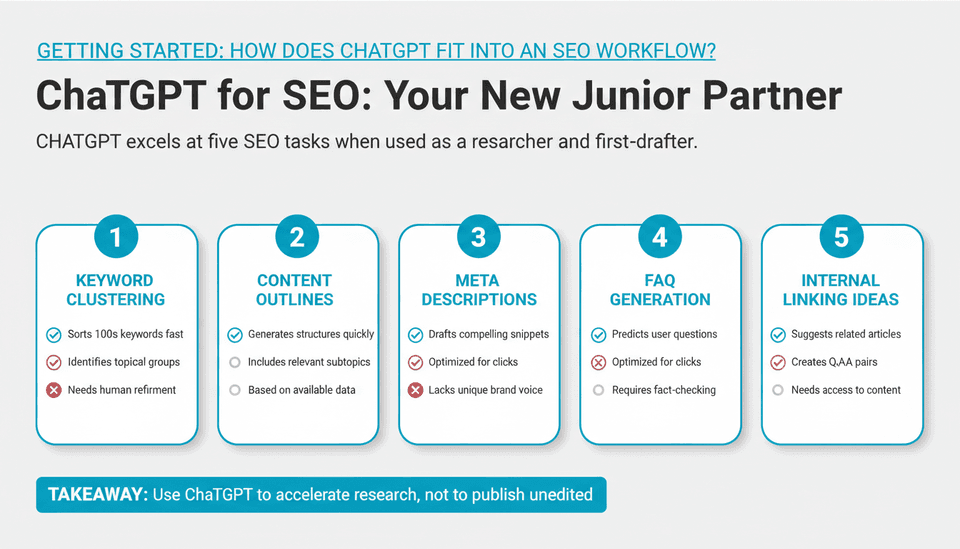
ChatGPT consistently delivers on five SEO tasks when you treat it as a junior researcher and first-drafter, not a publisher.
Keyword clustering and semantic grouping
Feed it a seed list of 50–100 keywords, and ChatGPT groups them into topic clusters far faster than manual sorting. It identifies parent topics, search intent overlaps, and gaps you can use to structure pillar pages. This works best when you provide actual search volume data from a tool like Ahrefs or Semrush so it doesn’t guess demand.Outline generation for long-form content
Given a target keyword and a short competitor content sample, ChatGPT builds a logical H2/H3 outline that covers the same subtopics. The output often mirrors the structure of well-ranking pages, making it a solid starting point for writers.Meta title and description drafting
With the page’s primary keyword and a one-sentence summary, ChatGPT produces 5–10 title tag variants that stay within pixel-width limits. It follows constraints like “include a number” or “mention the year” when prompted explicitly.Schema markup generation
It writes structured data—FAQ, Article, BreadcrumbList—with correct syntax. Always validate with Google’s Rich Results Test; the model occasionally swaps required properties.Content briefs for writers
It synthesizes target keyword, audience question, and competitor headings into a one-page brief that reduces back-and-forth.
What to skip: ChatGPT often fails at factual data retrieval (dates, statistics, product specs) when its knowledge cutoff is behind current events—even with browsing enabled, it sometimes fabricates citations. For more on where AI falls short and where it delivers real SEO value, see How Good Is AI for SEO? A No-Hype 2026 Reality Check.
What do I need to know before I start using ChatGPT for SEO?
Treat ChatGPT as a production assistant, not an SEO strategist. It lacks access to live ranking data, backlink profiles, or your site’s crawl health. That means you still need a dedicated SEO platform for technical audits, rank tracking, and competitor analysis. ChatGPT for SEO prompts work best when you supply the context yourself—audience demographics, current topical authority, and editorial guidelines—rather than expecting it to infer them.
Three non-negotiables before you begin:
- Have a Search Console and analytics baseline. Without historical click and impression data, you cannot measure whether AI-generated content moves the needle.
- Define your brand’s fact-checking threshold. Will you accept industry estimates from AI without verification? If not, you’ll need a documented verification step for every statistic.
- Lock in your style guide. Generic ChatGPT content writing reads like every other AI SEO article. A ready-made brand voice document (sentence length, tone words, banned phrases) prevents homogenized slop.
Content Creation and Optimization
What prompts work best for generating SEO-optimized blog posts?
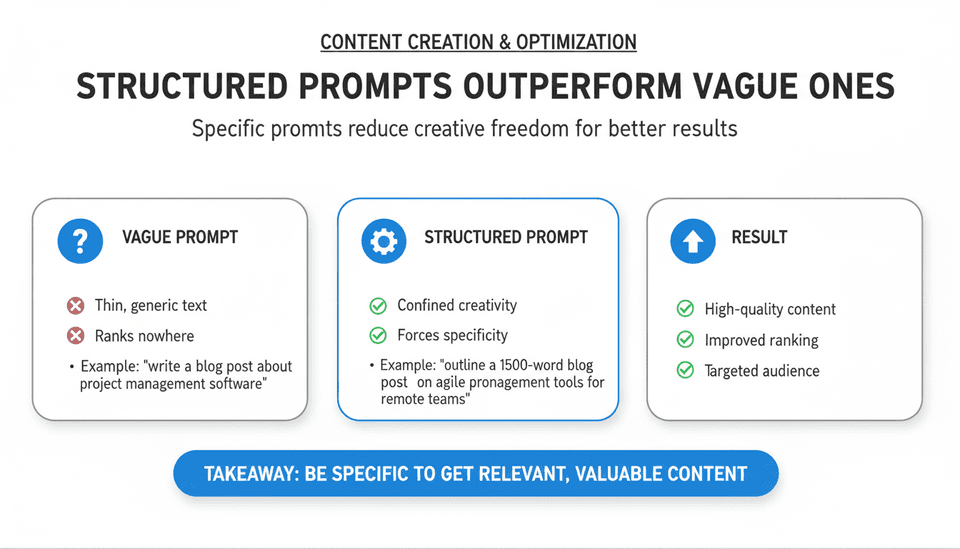
The highest-performing prompts share one characteristic: they confine the model’s creative freedom while forcing specificity. A vague prompt like “write a blog post about project management software” produces thin, generic text that ranks nowhere.
Instead, structure your prompt as a layered set of instructions. Here’s a prompt template that yields first drafts at a publish-ready structure level:
You are an experienced B2B SaaS content writer. Write a draft blog post for [target keyword]. Use these constraints:

Tone: [e.g., authoritative but approachable, no jargon]
Target audience: [job title, pain point, awareness level]
Article goal: [e.g., help procurement leads compare three tool categories]
Structure:
- H1: [provided]
- H2s: [list compulsory headings, including a “Common mistakes” and “How to choose” section]
- Intro must hook by referencing [specific cost / time metric] that our research shows.
Inclusion requirements:
- Mention [statistic from our internal data or trusted third-party source] with a plain-language explanation.
- Compare [X vs Y] in a small comparison paragraph.
- End with a clear “next step” that our ideal reader can take without sales language.
Do not: use the phrase “in today’s fast-paced world,” ask rhetorical questions, or add a generic conclusion paragraph.
This prompt forces a structured article that matches a typical advice-listicle format. It also prevents the model from lapsing into filler when it lacks real insight. Forbes published a set of 5 ChatGPT prompts to improve SEO that follow a similar constraint-based pattern, though they lean heavily on manual editing afterward.
If you need to scale across dozens of topics with consistent structure, consider building a workflow that feeds this prompt template with variables from a keyword research sheet—this is one way platforms move from one-off prompts to automated AI SEO ranking content.
How can I ensure ChatGPT’s output matches my brand voice?
Feed it a style guide, not a description. “Professional but friendly” means nothing to a language model. What works is a list of 10–15 concrete rules:
- Sentence length: keep sentences under 25 words.
- Contractions: use “we’re” not “we are.”
- Banned words: robust, leverage, seamless, cutting-edge, innovative.
- Transition style: never start a sentence with “However,” or “Moreover,”.
- Paragraph structure: every paragraph must serve exactly one point and include a concrete example or stat in the second half.
- Tone: write as if explaining a process to a peer over coffee, not presenting to a board.
Save this as a system prompt or include it at the top of every conversation. After generating a draft, run it through a separate “voice check” prompt: “Review this draft against our style guide. List 5 sentences that break the rules and rewrite them.” On a platform like Joyrise, this style enforcement happens through a deep site scan that learns your existing content’s patterns before generating articles, but you can approximate it manually by pasting three of your best-performing posts into ChatGPT and asking it to extract a style profile first.
Can ChatGPT help with on-page elements like headings and internal links?
Yes, but only if you supply the list of target headings and the existing URL structure. ChatGPT can:
- Rewrite an H1 to be more descriptive and include a primary keyword naturally.
- Suggest H2/H3 variations that mirror top-ranking competitor pages.
- Generate a table of contents from headings with brief anchor link ideas.
For internal links, give it a CSV with page titles, URLs, and a short description. Prompt: “Based on this page about [topic X], which 3 internal pages from this list would make the most relevant natural links? Suggest the anchor text.” The model identifies topical relevance better than many manual editors, but it cannot know which pages already link to each other—so check for loops and link equity distribution manually. Semrush’s guide to ChatGPT SEO notes that internal linking suggestions from ChatGPT work best when combined with a site audit tool that flags orphan pages.
Automation and Scaling
How can I move beyond manual copy-pasting into an automated publishing workflow?
Manual copy-paste kills scale. The step-change happens when you connect three components:
- A prompt orchestration layer that feeds keyword data, brand guidelines, and content structure into ChatGPT’s API.
- A quality gating mechanism that runs a second AI pass to flag hallucinations, repetitive phrasing, and voice breaks before a human ever sees the draft.
- A CMS connector that pushes the final HTML—complete with headings, meta tags, and internal links—directly to your site as a draft or live post.
Without automation, a single article might take 90 minutes of human time even with AI-assisted drafting. With an API-driven workflow, that time shrinks to a 5-minute review. The biggest bottleneck shifts from writing to fact-checking, which is why a second quality model matters. Look for a system that auto-strips fabricated statistics and flags claims that lack a source—otherwise you’ll spend 30 minutes per article fact-checking and lose the speed advantage. Building this yourself requires stitching together Make or Zapier, the OpenAI API, and your CMS’s publishing endpoint. For a detailed walkthrough, refer to How to Build Workflows With ChatGPT (2026 Guide).
What platforms or APIs can connect ChatGPT directly to my CMS?
You have three paths, each with different trade-offs.
| Option | Integration method | Best for | How it handles SEO |
|---|---|---|---|
| OpenAI API + Make/Zapier | No-code webhooks to Webflow, WordPress REST API | Small teams with 1-2 posts/week | You must manually add meta tags, headings structure, and internal links |
| Custom Node.js/Python script | Direct API calls to CMS and LLM | Dev teams that want full control | Build all checks yourself: hallucinations, duplicate content, brand tone |
| All-in-one AI SEO platforms | Native Webflow integration, automated publishing | Marketing teams that need 10+ posts/month | Handles deep site scans, keyword gap analysis, headings, images, and internal links in one pass |
For most business owners, the all-in-one route avoids the hidden cost of maintaining fragmented tools. Platforms like Joyrise automate the entire ChatGPT SEO integration by scanning your site to learn brand voice, researching competitor gaps, generating articles with original images, and publishing them to Webflow on a schedule. The subscription cost replaces the labor of manual prompt engineering and CMS wrangling. For smaller-scale test cases, the API-plus-connector route works if you have someone technical on the team and publish infrequently enough that manual reviews don’t bottleneck.
Quality Control and Pitfalls
How do I fact-check and remove hallucinations from ChatGPT drafts?
Hallucinations—invented statistics, fake expert quotes, and wrong dates—are the most common ChatGPT SEO pitfalls. A systematic check takes 10–15 minutes per draft and prevents a ranking penalty or, worse, a newsletter correction.
A practical fact-checking framework:
- Flag every numeric claim. Scan the draft for any sentence containing a percentage, year, dollar amount, or “study finds.” Highlight each one.
- Require an active, live source. For each flagged claim, search Google with the exact phrase in quotes. If no original source appears within the first page, cut the claim. Do not keep it because “it sounds right.”
- Date-validate claims from the model’s knowledge cutoff. As of November 2026, the base ChatGPT model typically has a knowledge cutoff in early 2024. Any reference to an event or statistic from 2023 onward could be fabricated, even if the phrasing seems authoritative. Use a site: search with a date filter to confirm.
- Run a contradiction check. Feed the entire draft back into ChatGPT with a fresh prompt: “Identify any factual statements in this article that contradict each other or that you cannot verify from your training data. List them with line numbers.” This catches internal inconsistencies, though it still misses external falsehoods.
For teams publishing at volume, a second AI quality judge—separate from the drafting model—acts as a mandatory gate before a draft reaches a human. Platforms that automate SEO content (like Joyrise’s Pro and Max tiers) include this as a built-in step, rewriting drafts that fail internal consistency and hallucination checks.
What are the most common mistakes when using ChatGPT for SEO?
One mistake dominates: thinking ChatGPT understands your domain. It doesn’t. The model predicts the next token based on patterns; it has no mental model of your product, your customers’ real frustrations, or what differentiates you from the three competitors ranking above you.
Specific errors to avoid:
- Using an unmodified “system” role without brand constraints. The default ChatGPT tone is sanitized, upbeat, and vague—exactly what produces undifferentiated AI content SEO pages.
- Treating ChatGPT output as final copy. Even with perfect prompts, the model generates paragraphs that sound plausible but lack the concrete examples and specific data that make content trustworthy. Without human editing, you ship hollow pages.
- Ignoring depth for speed. Prompts that request “a 1,500-word article” without specifying what knowledge must be conveyed produce wordy, thin content. Specify the key arguments, comparisons, or step-by-step instructions you need covered; word count will follow organically.
- Forgetting that ChatGPT cannot do link building, technical SEO, or rank tracking. It writes. It does not fetch backlink data, annotate server logs, or tell you why a page dropped from position 4 to 18. You still need a rank tracking and audit tool. Why Your Rank SEO Tool Must Do More Than Track in 2026 explains the modern requirements for a tool that works alongside AI content.
Measuring Success and ROI
How can I track the performance of AI-generated content in search results?
The playbook is the same as for manually written content, with one addition: you must isolate AI-generated pages to measure their true impact.
- Segment in Google Search Console. Create a regex filter that matches URLs published after your AI content trial start date, or use a custom URL slug pattern (e.g.,
/ai-guides/). Compare the click and impression trends of that segment against the rest of your site. - Track time-to-index. AI content that closely resembles existing high-quality pages often indexes within 3–7 days. If pages sit in “Discovered—currently not indexed” for over two weeks, suspect thin content or duplicate header structures, both common in unedited ChatGPT output.
- Monitor engagement metrics in your analytics platform. Look at average engagement time and scroll depth on AI-generated pages versus your hand-written cornerstone content. A drop of more than 30% on AI pages signals readers are bouncing—usually because the content reads like an encyclopedia entry.
- Add a “last reviewed” datestamp to each AI article and re-evaluate pages monthly for the first quarter. If impressions climb but clicks sputter, the meta descriptions might be misaligned. If clicks rise but engagement tanks, the content promises more than it delivers.
An integrated Search Console dashboard (like the one inside Joyrise’s platform) simplifies this by showing clicks, impressions, and AI assistant referrals per article without regex fiddling. For manual setups, exporting Search Console data to Google Sheets and applying conditional formatting on the segmented pages gives you a quick weekly pulse check.
Is using ChatGPT more cost-effective than hiring an agency or using a full platform?
The answer depends on your time cost and publishing volume. Here’s a concrete comparison, assuming a business needs 30 long-form articles per month.
| Option | Monthly cost (approx.) | Human time per month | Comments |
|---|---|---|---|
| ChatGPT Plus + manual workflow | $20/mo subscription | 60–90 hours (prompting, editing, fact-checking, CMS upload) | Lowest cash outlay; highest labor cost if owner/team time is valued at $50+/hr. Inconsistent output quality. |
| ChatGPT API + freelance editor | $300–600 API usage, $1,500–$3,000 editor | 20–30 hours managing editor | Reduces writing burden but still relies heavily on human oversight for hallucinations. |
| Traditional SEO agency | $3,000–$10,000+ | 2–4 hours client review | High cost, professional optimization, slow iterations. |
| All-in-one AI SEO platform | $199–$999/mo (e.g., Joyrise) | 5–10 hours final review | Automates prompt, research, image creation, publishing, and quality pass. 1/10th the cost of an agency. |
The cost advantage of a pure ChatGPT setup vanishes the moment you factor your team’s time. At a fully loaded cost of $50/hour, one in-house marketer spending 60 hours per month costs $3,000—far more than an automated platform subscription. Platforms that replace the entire manual stack (prompt engineering, hallucination checking, image generation, CMS publishing) deliver the strongest ROI when volume exceeds 10 articles per month. For a deeper look at the economics of AI versus agencies, see What Are the Best AI SEO Companies? Platforms vs. Agencies.
Google’s View and Long-Term Strategy
Does Google penalize AI-written content?
No, Google does not penalize content solely because it is AI-generated. Its public guidance, last updated in March 2026, states that the focus is on content quality, not production method. The E‑E‑A‑T framework (Experience, Expertise, Authoritativeness, Trustworthiness) applies uniformly whether a human, an LLM, or a team of three wrote the piece.
In practice, AI-written content often triggers manual review signals not because of the source but because it exhibits patterns Google has learned to associate with low quality: thin content, factual errors, lack of original analysis, and generic advice. AI-generated content Google ranking success depends on whether the final page demonstrates first-hand experience, cites trustworthy sources, and satisfies the user’s query fully. If your ChatGPT draft summarises the same five top-ranking articles without adding unique insight or an expert’s perspective, it will likely sit on page two or worse regardless of whether a human touched it.
To align with Google’s quality guidelines, always add an editorial layer—author bios, cited data with links, and a domain expert’s review stamp. Google’s own systems look for signals that a real person with relevant experience stands behind the content.
Troubleshooting Common Issues
Why does ChatGPT sometimes produce outdated or incorrect information?
The root cause is the model’s training data cutoff. As of November 2026, the standard ChatGPT model (without browsing) typically reflects information up to early 2024. Any event, regulation change, product launch, or market statistic from after that window is either unknown or confabulated.
Even when browsing is enabled, the model can misinterpret search results, cite dated sources as current, or fabricate plausible-sounding statistics when it cannot find a direct answer. This is a core limitation of the architecture, not a bug you can prompt away.
Workaround checklist:
- For time-sensitive topics, always feed ChatGPT the relevant facts from a manual search before asking it to write. Treat it as a writing tool, not a research tool.
- For evergreen topics, date-stamp every draft with the month and year of last update. Re-run fact-checks quarterly.
- When using automation, ensure the system injects current data from trusted APIs (e.g., financial data from an official feed) rather than relying on the model’s training.
My AI-generated pages aren’t ranking — what should I check?
When AI-generated pages flatline, the problem is rarely the model. It’s almost always one of four fixable issues. Run this diagnostic in order:
- Check indexation. Open Search Console and inspect a sample URL. If it’s “Crawled – currently not indexed,” the content likely reads as thin or substantially duplicate. Compare the page body with competing pages using a tool like Copyscape or Siteliner; AI drafts often mirror competitor structure too closely without realizing it.
- Evaluate search intent mismatch. Does your page actually answer the query the way a human searcher expects? If the top results are listicles and your page is a dense tutorial, no amount of keyword optimization will help. Re-prompt ChatGPT with the top-performing page formats as a reference and rewrite.
- Audit on-page SEO fundamentals. Common gaps: missing or vague H1, no internal links to supporting pages, meta description that doesn’t include the primary keyword phrase, images without alt text, and a page title that exceeds the pixel width.
- Assess for factual trustworthiness. If the page contains even one clearly wrong statistic or claim, users will pogo-stick back to search, and Google will lower the page’s ranking. Run the fact-checking framework from the quality control section. For an exhaustive breakdown of why AI content fails in search and how to fix it, Can AI Do SEO for My Website? Honest Answers (2026) digs into real-world failure patterns.
Summary Table: When to Use Which ChatGPT Approach for SEO
| Scenario | Best approach | Key risk | Mitigation |
|---|---|---|---|
| 1–2 articles/week, tight budget | ChatGPT Plus + manual editing | Time drain, inconsistent quality | Use strict prompt templates; fact-check every statistic |
| 5–10 articles/week, small team | ChatGPT API + Make integration + part-time editor | Hallucinations slip through | Add a second AI quality gate; sample-check 20% of articles |
| 10+ articles/day, scaling | All-in-one AI SEO platform | Over-reliance on automation | Weekly manual spot-check; maintain updated brand style guide |
| Enterprise, multi-site | Custom API pipeline + editorial team | Coordination overhead | Build dashboards for quality metrics; train editors on AI editing |
Key Takeaways
- ChatGPT reliably handles outlines, meta tags, keyword clustering, and schema generation, but it cannot replace rank tracking tools or fact-check itself.
- A rigid prompt template that defines tone rules, banned words, and compulsory structure cuts editing time by half and prevents generic AI content SEO output.
- Automating away copy-paste through API connections or a platform eliminates the largest hidden cost—marketer hours spent on routine CMS tasks.
- Fact-check every numeric claim and date against a live source; fake statistics are the fastest way to tank AI-generated content Google ranking performance.
- At volumes above 10 articles per month, integrated platforms like Joyrise match or beat DIY ChatGPT stacks on cost when you account for labor, while adding automatic quality gates and publishing.
Ready to see what a fully automated content engine can produce for your Webflow site? Start your free Joyrise trial and read your first AI-written, brand-tuned article before you pay a cent.