 Joyrise
What Are the Best AI SEO Companies? Platforms vs. Agencies
 By Alexi · · 16 min read

On this page
- What exactly is an “AI SEO company”?
- The two main types of AI SEO companies
- How do AI SEO tools improve search engine rankings?
- Who are the notable players in each category?
- How to decide between an agency, a tool, or an automated platform
- Do AI SEO companies actually work? What results can you expect?
- What most “best of” lists miss: the Webflow ecosystem
- Common questions from founders and marketing leads
- The bottom line: start with your needs, not someone else’s list
- Key Takeaways
If you’re running a Webflow blog and searching for “What are the best AI SEO companies?”, you’ve probably noticed the noise. One list ranks software tools. Another ranks service agencies. A third treats the term like it only means “someone who does SEO with AI.” The real answer depends on what you actually need to buy: a human team, a piece of software, or an automated platform that does the work without you micromanaging it. This guide cuts through that confusion. We’ll cover both types — AI SEO agencies and AI SEO tools/platforms — and give you a concrete way to choose based on your workflow, budget, and how much control you want. We’ll weight it for Webflow teams, because the CMS you use changes which partner actually works.
What exactly is an “AI SEO company”?
An AI SEO company is any business that sells a service or software product that uses machine learning or large language models to improve a site’s search visibility. The term gets murky because some companies are agencies — you pay a retainer and a team does the work — while others sell self-serve software you log into. Still others are fully automated content platforms that plan, write, and publish articles without human intervention.
The confusion isn’t academic. If you search for “best AI SEO companies” and pick a list that only includes agencies, you’ll miss the platforms that might actually solve your problem. If you pick a list of software tools, you’ll think you have to stack four subscriptions and hire someone to run them. The first decision you need to make isn’t which company to hire; it’s which category matches the way your team works.
What is AI SEO or “Generative Engine Optimization”?
AI SEO is the practice of using AI to perform or augment the tasks of traditional search engine optimization — keyword research, content creation, technical audits, link building analysis, and performance monitoring. Generative Engine Optimization (GEO) is a subset that focuses specifically on getting content surfaced in AI-generated answers, like those in Google’s AI Overviews or ChatGPT’s browsing mode. GEO is not the same as AI SEO, but it’s part of the same shift. If you want to understand GEO’s mechanics without the hype, the What Is GEO in the AI World? A Practical FAQ breaks down what actually matters.
The two main types of AI SEO companies
You’re either buying hours or you’re buying output. That’s the split.
AI SEO agencies (hands-on, service-based)
These are teams of strategists, writers, and SEOs who use AI tools internally but sell you a managed service. You’ll get a strategy call, a content calendar, and humans who review the AI’s work before it goes live. The value is oversight and customization. The trade-off is cost and speed — you’re limited by how many articles a team can review in a week, and retainers start in the thousands per month.
AI SEO tools and platforms (software you run yourself, including all-in-one solutions)
This category splits further. On one end, you have point solutions: Surfer for content optimization, Clearscope for keyword intent, ChatGPT for drafting, and Zapier to stitch them together. On the other end, you have all-in-one automated platforms like Joyrise that plan, research, write, and publish articles directly to your CMS. The value here is scale and speed — you can publish daily without adding headcount. The trade-off is less human creative input and the risk that a fully automated system may publish something off-brand if it lacks quality controls.
How do AI SEO tools improve search engine rankings?
AI SEO tools improve rankings through three mechanisms, none of which are magic:
- Scale of relevant content publishing. A site that publishes 30 well-structured articles a month on topics its audience actually searches will outrank a site publishing four, all else equal. AI makes that volume possible without a writing team.
- Automated on-page optimization. Modern tools handle heading hierarchy, meta descriptions, internal linking, and schema markup at a consistency level humans rarely match. Surfer’s 2026 analysis of top performers showed that AI-optimized content consistently matches or beats manually optimized pages on technical SEO metrics¹.
- Pattern recognition across thousands of SERPs. AI models trained on search result data can identify what structures, entities, and answer formats correlate with high rankings, then apply those patterns to new content. This is what AI SEO Ranking: A Complete Guide to AI-Driven Search Success calls “search-intent modeling.”
These don’t replace fundamentals like domain authority or backlinks, but they accelerate the content production that builds those signals over time.
Who are the notable players in each category?
The lists change quickly, but as of November 2026, here’s who actually gets mentioned by people paying for these services — not just in affiliate roundups.
Agencies worth knowing in 2026
Agencies that explicitly brand themselves as AI SEO shops include Coalition Technologies, First Page Sage, and several smaller B2B-focused consultancies². They typically combine proprietary AI tools with human strategists. Their differentiator is usually vertical expertise — some focus on SaaS, others on ecommerce. When evaluating them, ask for a Webflow portfolio specifically. Most agencies build their workflows around WordPress; a Webflow blog’s CMS structure, dynamic pages, and API publishing endpoints are different enough that a generalist agency will slow down or need custom development.
Platforms and tools gaining traction
On the tool side, Surfer, Clearscope, and MarketMuse remain the go-to content optimization layer. Ahrefs and Semrush now have generative AI assistants built into their keyword tools. But the growth in 2026 has been in automated content platforms that bypass the tool-stacking approach entirely. Joyrise, for example, is an AI content generation platform that scans your site, learns your voice, builds a keyword plan, writes illustrated articles, and publishes them directly to Webflow — no human in the loop unless you want one. It’s an SEO automation tool in the fullest sense: planning, creation, and publishing are all handled inside one system.
When a hybrid approach makes sense
Some teams buy a platform for scale but keep an agency for high-stakes pages — product launches, cornerstone content, or technical audits. That hybrid works if you have $10k+/month to spend and clear internal owners for each stream. For everyone else, mixing an agency and a tool stack usually creates duplication: you’ll pay for keyword research twice, get conflicting recommendations, and end up with a workflow that no one fully owns.
How to decide between an agency, a tool, or an automated platform
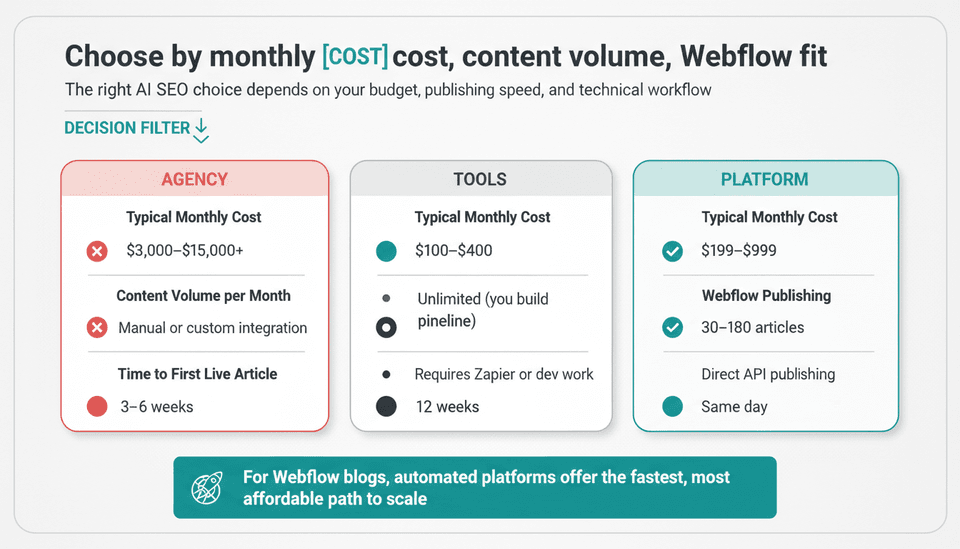
The table below condenses the trade-offs. Use it as a decision filter, not a final answer.
| Factor | AI SEO Agency | AI SEO tools (point solutions) | Automated content platform (e.g., Joyrise) |
|---|---|---|---|
| Typical monthly cost | $3,000–$15,000+ (varies by scope)² | $100–$400 (stack of 3–5 tools) | $199–$999 (fixed subscription) |
| Content volume/month | 4–12 articles (human-bandwidth limited) | Up to you — but you build the pipeline | 30–180 articles, published automatically |
| Control over output | High — you brief humans and review | Complete — you operate the tools | Configurable — you set voice, brand rules, and review/draft preferences |
| Webflow native publishing | Usually requires manual publishing or a custom integration | Requires Zapier or custom dev | Direct API publishing, built-in |
| Quality assurance | Human review on every piece | You are the QA | Automated quality judge pass (tier-dependent) |
| Time to first live article | 3–6 weeks (onboarding, strategy, writing) | 1–2 weeks to build the workflow | Same day (after initial site scan) |
Cost and budget realities
A full-service AI SEO agency retainer of $5,000/month gets you maybe 4–8 articles, a strategist, and monthly reporting. A platform like Joyrise at $499/month (Pro tier) publishes 80 articles/month with deep research, custom voice, and automatic quality checks. The platform’s cost per published article is roughly 1/10th to 1/20th of an agency’s. That’s the core economic argument driving automated content marketing for Webflow and other platforms. The counter-argument is that an agency writes articles with deeper original research and human nuance — but for most B2B and SaaS blogs, the incremental traffic gain from that nuance doesn’t justify the 10x cost delta.
Control and customization needs
If you need every article to reflect nuanced technical expertise, an agency gives you that. If you need to hit a publishing cadence that builds topical authority quickly, an automated platform that learns your brand’s voice gets you there without sacrificing consistency. Joyrise’s Pro tier, for instance, uses a second AI model to judge and rewrite drafts against your brand guidelines, reducing the risk of generic output. You can also choose to publish as drafts and approve before going live, preserving editorial control.
Speed and scale of content production
The math is simple. An agency writing 8 articles a month will need 10 months to publish 80 articles. A platform configured to publish 5 per day will produce those 80 articles in 16 days. For a site targeting hundreds of low-competition, long-tail keywords — the foundational layer of most organic strategies — speed to comprehensive coverage is the single biggest ranking lever. This is why automated content platforms are taking market share in the AI SEO companies conversation: they solve the volume problem that agencies structurally can’t.
Workflow integration (especially for Webflow blogs)
This is where most “best of” lists fail. Webflow’s CMS isn’t just a different editor; it’s an API-driven system where publishing requires structured data, correct collection references, and sometimes Webflow’s specific image handling. An agency that copies content into a Webflow rich-text field and forgets to set the alt text or map the author collection creates technical debt you’ll have to clean up later. An automated platform built for Webflow — with direct CMS integration — publishes correctly every time. If you’re on Webflow, only consider an agency that can show you live Webflow blogs they manage, or use a platform designed for that CMS. Otherwise, you’re paying someone to learn your stack on your dime.
Do AI SEO companies actually work? What results can you expect?
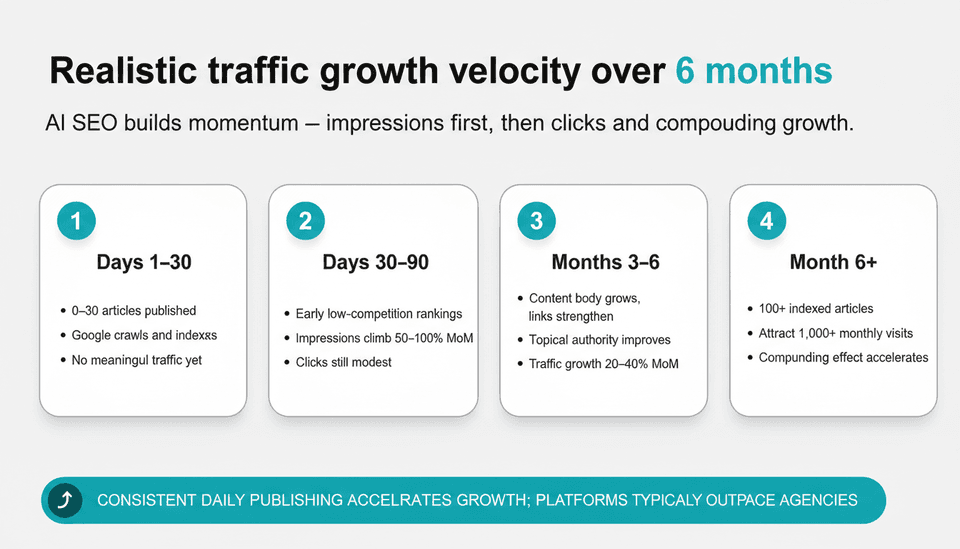
Yes, but “work” means different things depending on what you bought. If you hired an agency for a six-month engagement, you should expect demonstrable organic traffic growth and a clear content ROI by month 6. If you’re using an automated platform, you should see a steady climb in impressions and clicks as your indexable page count increases — typically within the first 90 days, though some pages rank in weeks for low-competition queries.
Realistic timelines for traffic growth
- First 30 days: 0–30 articles published, Google begins crawling and indexing. No meaningful traffic yet.
- Days 30–90: Early rankings for very low-competition terms appear. Impressions climb 50–100% month-over-month in Search Console, but clicks are still modest.
- Months 3–6: As the body of content grows, internal linking strengthens, and site-level topical authority improves, traffic enters a consistent growth phase — often 20–40% month-over-month for a site that was previously blog-sparse.
- Month 6+: The compounding effect kicks in. 100+ indexed articles on related topics start attracting 1,000+ monthly organic visits. This timeline is faster with an automated platform that maintains daily publishing; it’s slower with an agency due to output caps.
These numbers are directional. A domain with strong existing authority will compress them; a brand-new domain will extend them. The key point: the single biggest accelerator is publishing velocity, not content perfection.
How to measure success when rankings aren't the whole story
Traditional keyword ranking tools show only part of the picture. In 2026, an AI SEO strategy must also track:
- Impressions and clicks from AI-generated answers (Google AI Overviews, ChatGPT). Joyrise’s integrated Search Console dashboard, for example, surfaces these referrals alongside standard search metrics.
- Non-branded organic traffic growth. Set a monthly goal for new users arriving on blog pages via non-branded search.
- Conversion events from blog traffic — even if it’s just email signups or demo requests. Tie content to a goal in Google Analytics 4.
- Indexation rate and crawl efficiency. If your content is indexed quickly and Googlebot crawls your blog daily, you’re doing something right; if it takes weeks, there’s a technical issue.
Stop evaluating AI SEO success by whether a single article ranks #1. Look at the aggregate trend of the blog as an acquisition channel.
What most “best of” lists miss: the Webflow ecosystem
Search for “best AI SEO companies” and the results are almost always written for WordPress or generic SaaS. Webflow users have fundamentally different needs, and ignoring them leads to bad purchases.
Why Webflow blogs need a different kind of AI SEO partner
Webflow blogs handle content through CMS Collections — structured data fields for title, body, author, date, featured image, and custom fields. Publishing isn’t a simple paste; it requires mapping AI-generated content to those fields via API or manual entry. An agency that says they can work with any CMS usually means they’ll send you a Google Doc and you’ll be responsible for the Webflow part. That handoff is where delays, formatting errors, and missing meta data happen.
The ideal AI SEO partner for Webflow either:
- Offers a direct Webflow API integration and publishes articles without you touching the CMS, or
- Has a proven, documented workflow for Webflow that your team can audit.
A Joyrise review from a Webflow practitioner would highlight this: the platform scans the live site, understands the CMS schema, and publishes articles into the correct Collection, with images, meta descriptions, and internal links all set. That’s not a luxury; it’s the difference between a content engine and a content bottleneck.
How Joyrise fits: automated content for Webflow, from planning to publishing
Joyrise is an AI content generation platform built for this specific workflow. It runs a deep site scan to learn your brand voice, audience, and product. It generates an SEO-optimized keyword plan based on your site data and competitor gaps. It writes long-form, researched articles with original branded header images and infographics. A second AI model performs a quality judgment pass on drafts (Pro and Max tiers). Articles then publish directly to your Webflow blog or save as drafts for your review. The platform also includes a Search Console dashboard to track clicks, impressions, and AI assistant referrals.
For marketing teams that want to scale publishing while cutting agency costs, it replaces three point solutions and the manual labor connecting them. The cost at the Pro tier is $499/month for 80 articles, compared to the $5,000–$10,000 monthly retainers common among agencies. That is the economic reality driving adoption in 2026.
Common questions from founders and marketing leads
These are the questions that come up in sales calls and internal Slack debates. Each answer includes conditions, not just opinions.
Can ChatGPT be used for SEO?
Yes, but only as one component of a workflow. ChatGPT alone does not do keyword research, analyze search intent, optimize on-page elements, handle images, or publish to a CMS. Stacking ChatGPT with other tools can work — as this guide on building workflows with ChatGPT explains — but you’ll spend significant time on prompt engineering, quality checking, and manual publishing. For teams with an SEO specialist who enjoys tool orchestration, that’s viable. For teams that just need articles to go live consistently, a purpose-built platform eliminates the assembly work.
Is GEO replacing SEO?
No. GEO is a new layer on top of traditional SEO, not a replacement. If your content doesn’t rank in Google’s organic results, it’s unlikely to surface in AI-generated answers either — because those answers are often synthesized from the top organic results. Adobe’s 2026 analysis confirms that AI overviews still draw heavily from authoritative, well-structured web pages³. The practical takeaway: optimize for traditional search signals (expertise, structure, backlinks) and you’ll gain GEO visibility as a byproduct. Treating GEO as a separate discipline you can buy without a strong organic foundation is a mistake.
How long does it realistically take to see results from AI SEO?
For a site starting from low blog content volume, expect the first meaningful traffic uptick in 2–4 months, with compounding growth over 6–12 months. This timeline assumes daily or near-daily publishing of relevant, well-structured content. If you publish 4 articles a month through an agency, stretch that to 8–12 months for comparable traffic. The bottleneck isn’t AI quality; it’s the human-driven publishing cadence.
How much does an AI SEO agency cost?
A credible AI SEO agency retainer typically runs $3,000 to $15,000+ per month, depending on scope, content volume, and whether the agency includes link building or technical SEO². At the low end, you might get a monthly content plan and four blog posts; at the high end, you’re getting a comprehensive managed service. The comparison with platforms is stark: Joyrise’s Max tier costs $999/month for 180 articles with priority support and daily publishing. The AI SEO cost comparison isn’t ambiguous — platforms win on pure content economics, agencies win on full-service oversight.
What should I ask before hiring an AI SEO company?
Regardless of whether you’re talking to an agency or evaluating a platform, here’s a five-question checklist:
- “Show me a site you’ve worked on that uses my CMS.” If they can’t, ask how they’ll handle the technical publishing workflow. Don’t accept “our team will handle it” without specifics.
- “What’s your quality control process?” For agencies, ask how many humans review an article. For platforms, ask whether there’s an automated quality layer — Joyrise’s Pro tier uses a second AI judge; some tools have none.
- “What happens when I need to pause, change direction, or cancel?” The answer reveals how much lock-in you’re signing up for. Joyrise’s no-questions-asked cancellation policy is an example of the low-friction model platforms can offer.
- “How do you track performance beyond keyword rankings?” Look for mentions of Search Console, AI-generated answer referrals, and conversion tracking. If the answer starts and ends with “rankings,” walk away.
- “What’s the first 30 days going to look like?” Get a concrete timeline: site scan, strategy doc, first article live, reporting cadence. If they can’t give one, they’re improvising.
Is an AI SEO tool integrated with Google Search Console and Google Analytics 4?
Not all are. Many AI content tools stop at generation and leave reporting to you. Platforms built for the full workflow often include a Search Console dashboard to show clicks, impressions, and indexation status — Joyrise includes this as a standard feature. GA4 integration is less common but emerging; some platforms pull traffic and conversion data into their reporting layer. Ask for a screenshot of the reporting interface before buying. If you’re stacking point solutions, you’ll need to connect each tool’s data manually or use Looker Studio.
How do I know if my brand is already showing up in AI-generated answers?
Manually test by asking ChatGPT (with browsing enabled) or Google’s AI Overviews questions relevant to your industry. Use queries like “What is [your product category]?” or “Best [your service] for [use case]?” and note whether your brand is cited. Then check your Search Console for queries containing “ai overview” or “generative” — Google’s reporting on AI Overview referrals is improving. Finally, a pragmatic approach: if you’re already ranking on page 1 for relevant informational queries, you’re likely appearing in AI answers for those queries already. If not, the fastest path to inclusion is to publish more authoritative content on those topics, which brings us back to publishing velocity.
Not sure whether you need a platform, an agency or both?
Start with this decision tree:
- If your primary bottleneck is content volume and your CMS is Webflow, start with an automated platform. You’ll get more articles live in a month than an agency could deliver in a quarter, at a fraction of the cost.
- If you need a full-funnel SEO strategy including technical fixes, link building, and conversion optimization, an agency is the right call — but only if you can afford the retainer and the slower publishing cadence.
- If you have in-house SEO expertise and want to build differentiated, deeply researched content for a small set of high-value pages, stack point solutions. You’ll need to own the integration work, but the control is total.
For the majority of Webflow teams, the most direct path to organic traffic is an automated platform that handles the heavy lifting of daily blogging without adding headcount or waiting six months for an agency to ramp up.
The bottom line: start with your needs, not someone else’s list
The question “What are the best AI SEO companies?” produces a different answer depending on whether you’re an ecommerce brand with a $20k monthly budget or a SaaS startup on Webflow trying to get 50 articles live before the next product launch. The companies that top the lists are often the ones with the biggest affiliate programs, not the best fit for your stack.
Judge an AI SEO company — agency or platform — by three criteria:
- Does it integrate with my CMS without manual workarounds?
- Can it publish at the volume my keyword strategy requires?
- Does its pricing model align with my current budget and growth expectations?
If you can’t check all three, keep looking. If a platform like Joyrise checks them and lets you read your first article before paying, it’s a low-risk way to test whether automated content marketing for Webflow actually delivers for your site.
Key Takeaways
- AI SEO companies split into agencies (you buy human oversight) and platforms/tools (you buy software output) — the right choice depends on your budget, CMS, and need for speed.
- For Webflow teams, a platform that publishes directly to the CMS eliminates the integration friction that breaks most agency relationships.
- Publishing velocity is the biggest controllable ranking accelerant, and automated platforms deliver it at roughly 1/10th the cost of an agency retainer.
- Don’t measure AI SEO success by single rankings; track aggregate organic traffic growth, AI-generated answer referrals, and blog conversion events over a 6–12 month horizon.
- Ask every potential partner to show you a live site they’ve worked on using your CMS, and walk away from vague promises about workflow.
Start publishing daily content to your Webflow blog without the agency overhead — try Joyrise and get your first article before you pay.