 Joyrise
Why Your Rank SEO Tool Must Do More Than Track in 2026
 By Alexi · · 16 min read

On this page
- Executive Summary: What a Rank SEO Tool Must Do in 2026
- What is a rank SEO tool, and what can it actually do?
- Core Concepts: The Old Model vs. the New Model of SEO Tools
- How a Modern Rank SEO Tool Actually Works: From Data to Deployment
- Types of Rank SEO Tools and Their Tradeoffs
- Practical Framework: Choosing and Implementing a Rank SEO Tool
- Mistakes, Myths, and Limitations You Need to Know
- The Future: Rank SEO Tools in an AI‑First World
- Next Steps: What to Do This Week
- Key Takeaways
Executive Summary: What a Rank SEO Tool Must Do in 2026
A rank SEO tool that only tells you where you stand is running on fumes. In 2026, the tools that actually move the needle are the ones that bridge the gap between monitoring and production. The best rank SEO tool now produces content, not just rankings. It scans your site, finds keyword opportunities you’re missing, generates researched, long-form articles matching search intent, injects internal links and images, and publishes directly to your CMS—all while feeding performance data back into the next planning cycle. This guide explains why the category is being redefined around content creation engines that automate the path from keyword gap to published, ranking article, and how to evaluate these tools against your real business goals.
What is a rank SEO tool, and what can it actually do?
A rank SEO tool is any software that helps you understand where your website appears in search engine results for specific keywords, diagnoses technical health, and identifies opportunities to improve organic visibility. This now necessarily includes SEO rank tracking alongside broader capabilities. But what counts as a “rank SEO tool” has fractured into multiple—and often misleading—definitions. To see the whole picture, you need to separate the original purpose from what’s now required.
The original purpose: monitor and alert
The first rank SEO tools were simple rank checkers. You’d give them a domain and a list of keywords, and they’d return position numbers—sometimes daily, sometimes on demand. Over time, they added features: mobile vs. desktop tracking, local map pack positions, competitor comparisons, and basic alerts when a target keyword dropped out of the top 10. These tools remain valuable for an operational snapshot, and many are free or extremely low cost (see a roundup of the 12 best rank tracker tools for current examples). For instance, PCMag recently covered a lifetime deal for SEOAgent (November 10, 2026) that bundles keyword discovery, 50‑keyword tracking, and AI‑driven visibility monitoring for a one‑time $69—proof that basic rank checking is now a commodity.
How the definition has expanded (and why monitoring is no longer enough)
Modern rank SEO tools have absorbed functions that used to live in separate software: site audits, backlink analysis, content suggestions, and even AI‑written drafts. Many now include built‑in SEO audit tools that crawl your site for technical issues. But the real expansion isn’t just feature creep—it’s a shift in the job the tool does. Monitoring only tells you what happened. It doesn’t write the page that fills the gap or publish it where Google can find it. A rank SEO tool in 2026 must at minimum connect keyword intelligence to a publishable asset. If it stops at a chart, you’re paying for a dashboard while competitors are buying output.
Core Concepts: The Old Model vs. the New Model of SEO Tools
To evaluate any rank SEO tool, you have to separate the concepts that shaped the old model from the capabilities that define the new one. The distinction isn’t about features on a comparison grid; it’s about whether the tool is backward‑looking or forward‑acting.
Rank tracking vs. rank building
Rank tracking answers “Where am I?” Rank building answers “How do I get there and who will create the page?” Old‑model tools assume you’ll take the tracked data, interpret it, brief a writer, and wait. New‑model tools assume much of that chain can be automated. They see a keyword gap and generate a draft within the same interface. That’s not just a timesaver; it changes the unit of value from a data point to a publishable article.
SEO suites vs. content creation engines
Most all‑in‑one SEO software (Semrush, Ahrefs, Moz) are deep toolboxes that give you extensive data and content ideas, but they still require you to produce the content manually or through separate software. A content creation engine goes further: it plans, writes, formats, and publishes content directly to your site. The engine might still monitor rankings, but that’s a feedback loop, not the product. Think of it like this: an SEO suite is a diagnostic lab; a content creation engine is a manufacturing line that ships finished goods.
Commonly confused terms: DA/DR, AI visibility, GEO
- DA/DR (Domain Authority / Domain Rating): Third‑party metrics that estimate a site’s link‑based “strength.” They are not used by Google. Don’t build your strategy around them. Domain Name Wire reported on November 12, 2026, that scores like these are being recalibrated, and if your tool treats them as gospel, you risk optimizing for a proxy that doesn’t reflect real ranking power.
- AI visibility: A measure of how often your brand or content appears in AI‑generated answers (like ChatGPT or Google AI Overviews). It requires separate tracking because traditional rank positions don’t capture these placements.
- GEO (Generative Engine Optimization): The practice of optimizing content so it gets surfaced by AI‑powered search experiences. It overlaps with SEO but often demands different formatting and authority signals. For deeper background, see What Is GEO in the AI World? A Practical FAQ.
How has the role of a rank SEO tool changed with AI and automation?
The role has flipped from passive recorder to active participant. AI and automation have made it possible for a rank SEO tool to not only identify what’s missing but to generate the missing piece, check it for quality, publish it, and then measure the impact. Search Engine Land’s enterprise tool guide (November 12, 2026) underlined that at scale, you need tools that optimize content production, not just audit it. This means the tool now carries responsibility for output quality, brand voice alignment, and publishing cadence—not just data accuracy.
What is AI visibility tracking, and why does it matter?
AI visibility tracking monitors whether your site is cited or summarized by AI search engines and chatbots. It matters because Google’s own AI Overviews and external tools like ChatGPT are redirecting traffic away from traditional blue links. If your rank SEO tool only tracks ten blue links, you’re blind to a growing slice of search real estate. Modern platforms increasingly include AI visibility dashboards that show impressions from AI assistants—turning that blind spot into an optimization target.
How a Modern Rank SEO Tool Actually Works: From Data to Deployment
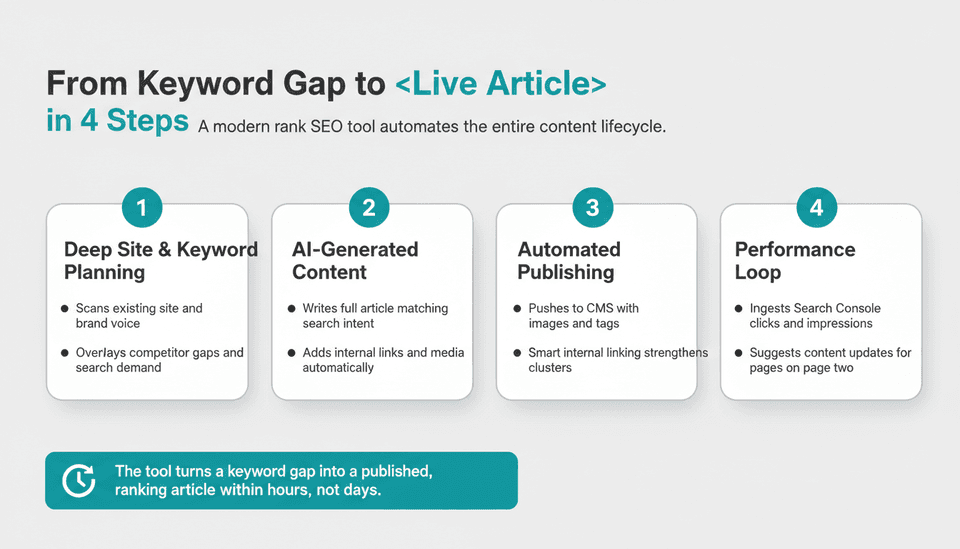 To see why the definition has to change, walk through what a content‑first rank SEO tool does in practice. This is the engine that moves you from monitoring to growth.
What features should a modern rank SEO tool include?
It must cover the full cycle: site analysis and keyword planning, AI‑generated content tuned to intent, automated publishing with internal linking, and a performance loop that feeds results back into the planning stage. Effective SEO rank tracking is part of that loop, informing what content to update next. Anything less leaves a manual handoff where speed and consistency break down.
Step 1: Deep site analysis and brand‑aware keyword planning
The tool scans your existing site—pages, structure, product descriptions, and existing content—acting as a powerful keyword research tool that learns your brand voice, audience, and topical authority. It then overlays competitor gaps and search demand data to build a keyword plan that’s both aggressive and realistic. Instead of a generic list of “best shoes for running,” it might surface “trail running shoes for overpronators” because it sees you already rank for related terms and your product line supports it.
Step 2: AI‑generated, long‑form content that matches intent
Once keywords are prioritized, the tool generates a full article—headings, body, meta description, internal links to related pages, and even branded images or infographics. The output isn’t a random GPT paragraph; it’s structured to satisfy the search intent of that specific query. For example, a comparison keyword might produce a side-by-side breakdown, while an informational query yields a comprehensive guide with a table of contents. Some platforms pass the draft through a second AI quality judge that rewrites anything off‑brand before it reaches you.
Step 3: Automated publishing and internal linking
The article isn’t left in a text file. The tool pushes it directly to your CMS—say, Webflow—as a drafted post or live page, complete with optimized images, canonical tags, and smart internal links that strengthen your site’s topical clusters. This removes the bottleneck of manual uploading and ensures every new article plugs into your existing architecture without a developer.
Step 4: Performance loop – Search Console integration and refinement
After publication, the tool ingests data from Google Search Console: clicks, impressions, average position, and even AI assistant referrals. It correlates that performance with the original keyword plan and suggests adjustments—maybe a content update for a page that’s ranking on page two but needs a fresh statistic. This closes the loop so you’re not just publishing into a void; you’re tuning based on real signals.
Types of Rank SEO Tools and Their Tradeoffs
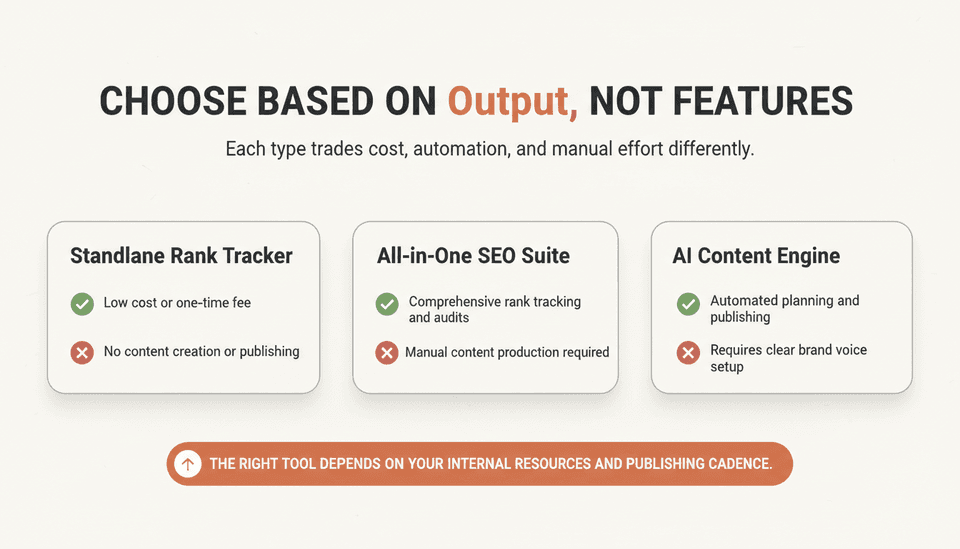 Not every business needs a full content engine. But you should know what you’re trading away with each choice. The table below breaks down the three main categories.
| Tool Type | Example / Cost | Core Capability | Limitation |
|---|---|---|---|
| Standalone website ranking checker | SEOAgent ($69 lifetime, 50 keywords), free checkers | Reports keyword positions, basic site audits, often low cost or one‑time fee | No content creation; data accuracy increasingly suspect due to SERP changes |
| All‑in‑one SEO platform | Semrush ($129–$499/mo), Ahrefs ($129–$449/mo) | Broad toolkit: rank tracking, site audit, backlinks, content suggestions, competitor analysis | Manual content creation required; publishing workflow still depends on separate resources |
| Automated content platform / AI content generation engine | Joyrise ($199–$999/mo), similar platforms | Automated content planning, writing, formatting, publishing, and rank monitoring as feedback | Varies in niche expertise; requires clear brand voice setup; best for sites that publish frequently |
Standalone rank trackers (low cost, narrow scope)
These are fine if all you need is a simple “did my ranking move” signal and you have plenty of time to act on the data. But as Search Engine Journal reported on November 7, 2026, rank data can now contain one‑word results and redirect URLs, which inflates or hides real positions. A cheap tracker that doesn’t filter out this noise might give you a false sense of security.
All‑in‑one SEO platforms (broad features, manual content creation)
This category dominates the market because it offers depth. You get a massive feature set and can run an entire SEO program from one dashboard. For example, Semrush provides comprehensive position tracking alongside its broader toolkit. The tradeoff is that you still need to staff the content production—writers, editors, designers—or hire an agency. The tool tells you what to write; it doesn’t write it.
AI content generation engines (proactive, publishing‑focused)
These tools treat rank tracking as a piece of the output cycle, not the center. They produce published articles and measure their impact. The risk is quality control: AI drafts can drift off‑brand if the tool lacks strong guardrails. The best of them use site scans to train a custom voice model and include a second‑pass quality judge. For an honest breakdown of how AI fits into SEO, see Can AI Do SEO for My Website? Honest Answers (2026).
When each type makes sense (and when it doesn’t)
- Standalone tracker: Low‑volume, information‑only sites where you publish rarely and just want to watch a handful of terms.
- All‑in‑one platform: Mid‑sized marketing teams with dedicated content creators who can execute on the tool’s recommendations; or agencies managing multiple clients.
- AI content engine: Growth‑focused businesses that need to scale organic content fast without adding headcount, particularly when publishing daily or weekly. If you’re spending $3,000–$10,000 per month on an agency for blog content, this model can deliver equivalent output at a fraction of the cost—but you must stay involved in strategy and quality oversight.
Practical Framework: Choosing and Implementing a Rank SEO Tool
Selecting the right tool is a business decision, not a feature checklist exercise. Run this framework to ground your choice in real workflow and cost.
Audit your current stack: what’s already automated?
List every step between “we need a new article” and “it’s live and ranking.” For most teams, that spans keyword research → brief → writing → editing → image sourcing → formatting → publishing → internal linking → performance review. Count how many steps rely fully on human effort. The more manual steps, the stronger the case for a tool that automates the entire chain.
Map the full content lifecycle: plan → create → publish → measure
Draw this as a circle, not a line. A rank SEO tool should feed measurement back into planning. If your current tool only covers “measure,” you have a broken feedback loop: you’re tracking positions for pages you won’t improve because you haven’t produced anything new.
Evaluate total cost, not just subscription price (agency vs. tool)
Here’s where finance leads get value from re‑thinking the category.
Can a rank SEO tool replace an SEO agency?
A content‑first rank SEO tool can replace the content production part of an agency retainer—often the biggest line item—effectively providing content marketing automation that publishes articles without the usual manual effort. But it cannot replace strategic oversight, brand narrative, or high‑level technical SEO decisions. The realistic answer: it replaces the labor of writing and publishing 30+ articles a month, which for many businesses is 70–80% of what they pay an agency for. The remaining strategic work can stay in‑house or with a fractional consultant. If you’re evaluating this trade, compare the best AI SEO companies vs. agencies to see where platforms end and human expertise still leads.
How much does a comprehensive rank SEO tool cost?
Cost doesn’t sit on a single spectrum. A standalone rank tracker might be free or a one‑time $69. An all‑in‑one platform typically runs $129 to $499 per month, and that’s just the software license—you still pay for the content separately. A full content creation engine like Joyrise ranges from $199 to $999 per month depending on article volume and features like news‑driven writing or custom voice. When you compare that to an agency charging $3,000–$8,000 per month for a similar output, the tool is often 1/5th to 1/10th the cost, but you trade the agency’s strategic brain for a defined workflow you must manage. The real cost is not the subscription fee; it’s the combined price of software plus the internal time (or external fees) required to turn data into published pages.
How do I integrate a rank SEO tool with my existing CMS and workflows?
For tools that publish automatically, integration should be near‑zero friction. Look for native connectors—Webflow, WordPress, Shopify—that push formatted articles directly into your CMS as drafts or live pages. The workflow benefit is speed: an article goes from keyword gap to published post in hours, not days. For all‑in‑one platforms without publishing, integration means manual exports or copy‑paste, so factor that time into your cost calculation. If your team already uses a project management tool, choose a platform that can trigger notifications or Slack alerts when new content goes live, keeping everyone in sync without extra meetings.
Example: How a content‑first tool fills the gaps a tracker leaves behind
Imagine a B2B SaaS company that sells financial analytics. Their standalone rank tracker shows they dropped from position 4 to position 8 for “cash flow forecasting software.” That’s useful to know, but the tracker stops there. A content‑first rank SEO tool would scan the site, see that no existing page comprehensively targets that long‑tail topic, identify related subtopics (e.g., “cash flow forecasting with AI,” “small business cash flow tools”), generate a 2,000‑word article with comparison tables and an infographic, link it to the product page and three supporting blog posts, publish it to Webflow, and start measuring clicks within 72 hours. The rank tracker gave a warning; the content engine built the solution.
Mistakes, Myths, and Limitations You Need to Know
Adopting a rank SEO tool without understanding what it can’t do leads to wasted money and false confidence.
Myth: AI content can’t rank (the data says otherwise)
AI content can rank when it matches intent, adds original structure, and is reviewed by a human (or a strong quality control AI). Numerous case studies show AI‑written pages capturing featured snippets and top‑3 positions across competitive niches. The risk isn’t ranking; it’s publishing bland, thin articles that lack a unique point of view. For a deeper dive into the evidence, see What Is AI SEO? A No-Nonsense FAQ for 2026.
Mistake: Obsessing over rank positions while ignoring organic traffic growth
A #1 position for a keyword that sends 20 visits a month is not a business result. The more dangerous trap: celebrating a rank increase while overall organic traffic stays flat. Always tie rank changes to click and conversion data. If your tool can’t overlay Search Console clicks on top of position data, you’re flying half‑blind.
Limitation: No tool can replace a coherent brand voice and strategy
Even the most advanced content engine needs a clear input: your brand’s tone, target audience, and strategic priorities. If you can’t articulate those, AI will produce generic content that sounds like everyone else. The tool accelerates execution; it doesn’t invent your company’s reason for being.
Reality check: Rank tracking is still useful – but only as a feedback loop
Rank tracking isn’t dead. It tells you whether the content you published is gaining traction. Used as a feedback loop—triggering refreshes, deeper research, or new related articles—it’s essential. Used as a standalone KPI, it leads to decision paralysis.
Do I need technical SEO knowledge to use a rank SEO tool effectively?
You don’t need to be a developer, but you do need to understand the basics of how search engines crawl, index, and rank pages. A modern tool should handle technical details like meta tags, structured data, and internal linking automatically. However, you still need to configure your CMS permissions, verify domain ownership, and occasionally troubleshoot a page that isn’t being indexed. The bar is low: if you can connect a Google Search Console account and set up a blog, you have enough technical knowledge to run a content‑first rank SEO tool.
The Future: Rank SEO Tools in an AI‑First World
The next two years will force rank SEO tools to answer harder questions about data reliability and measurable output.
Rank data reliability problems and what they mean for your decisions
The November 7, 2026, SEJ report on Google rank data containing one‑word results and redirect URLs isn’t a one‑off glitch—it’s a sign that the SERP itself is fragmenting. When a rank checker can’t reliably distinguish between a real listing and a redirect, your “position 3” might actually be a phantom. The response is not to abandon tracking but to weight trend lines over absolute numbers. If your tool can’t flag these anomalies, you’ll make decisions on dirty data.
AI training opt‑outs and the rise of LLM‑ready intelligence
As more sites opt out of AI training via robots.txt, the pool of content available to train models shrinks. That makes your owned, original content more valuable—both for traditional rankings and for earning citations in AI‑generated answers. A rank SEO tool that combines traditional rank tracking with AI visibility monitoring positions you for a future where LLM citations drive significant referral traffic.
Why the next generation of tools will be judged on output, not just dashboards
The winners won’t be the tools with the most metrics. They’ll be the ones that reliably turn a competitive keyword gap into a live, ranking article that brings in qualified traffic. Search Engine Land’s November 2026 enterprise evaluation made that point implicitly: scale isn’t about monitoring more keywords; it’s about producing more optimized content without a linear increase in headcount. The tools that survive will be those that look less like monitoring stations and more like publishing engines.
Next Steps: What to Do This Week
Getting started doesn’t require a massive migration. Two concrete actions move you forward.
Run the 5‑minute audit that tells you if your tool is holding you back
Pull your last 30 days of rank tracking data. Count how many keywords moved significantly (up or down) and then ask: did we publish any new content targeting those keywords in that period? If the answer is no, your tracking tool is just a rearview mirror. You need a tool that not only tells you where you are but creates the pages that move the needle.
Start a trial with a tool that writes your first article before you pay
Look for platforms that let you see a real draft based on your site before you commit. Joyrise, for example, offers a “read your first article before you pay” model—you give it access to scan your site, and it generates a full, illustrated article you can review. That tangible output is a better evaluation criterion than any feature list.
Key Takeaways
- A rank SEO tool in 2026 must produce content, not just track positions—the most valuable tools bridge the gap between keyword gap and published, ranking article.
- AI content creation engines replace the manual writing and publishing work, often at 1/5th to 1/10th the cost of an agency, but they still require strategic direction.
- Rank tracking reliability is eroding due to SERP changes like one‑word results and redirects; trend data and AI visibility metrics now matter more than absolute position numbers.
- Choose a tool based on the full content lifecycle, not just feature lists: it should plan, create, publish, and measure, with Search Console integration closing the feedback loop.
- The future belongs to tools judged on output—the ones that turn competitive intelligence into live, optimized pages without manual handoffs.
Ready to see a rank SEO tool that writes and publishes your content instead of just reporting on it? Start with a platform that delivers your first article before you pay.