 Joyrise
What Is AI SEO? A No-Nonsense FAQ for 2026
 By Alexi · · 11 min read

On this page
If you’re asking “What is AI SEO?” the answer isn’t one thing—it’s two. AI SEO is a term that now carries two distinct meanings, and confusing them leads to wasted budget. It refers, first, to using artificial intelligence to automate and sharpen traditional SEO tasks—keyword research, content drafting, on-page fixes—and second, to optimizing your content so it appears in AI-driven search engines like Google’s AI Overviews or ChatGPT’s retrieval. This FAQ gives you the honest, risk-aware map you need to navigate both sides of that coin in 2026. In this FAQ, we’ll explore AI search optimization, AI content SEO, AI SEO strategy, SEO with AI, and AI SEO risks—so you can separate the hype from the practical.
What Does “AI SEO” Actually Mean?
The phrase splits into two concrete disciplines. You either use AI as a better tool to rank in plain blue links, or you restructure your content to get cited inside generative answers. Most teams need a bit of both, but treating them as one thing leads to sloppy execution.
AI for SEO: Using AI to Improve Traditional Search Rankings
Here, AI automates or accelerates the familiar SEO workflow. An LLM clusters keyword ideas, produces a first draft that already matches search intent, or suggests schema markup. This is efficiency play: the core ranking factors haven’t changed, but the speed of execution does. When you read that an AI SEO tool helped a team publish 80 articles a month, that’s AI for SEO.
AI-SEO (or GEO): Optimizing for Generative AI Search Results
AI-SEO, often called Generative Engine Optimization (GEO), is the practice of designing content so that AI search engines like ChatGPT, Perplexity, and Google’s AI Overviews choose your page as a source and represent it accurately in answers. This means adopting clear Q&A structures, entity-rich citations, and strong E-E-A-T signals that AI models recognize. For a deeper look at how GEO differs from traditional SEO, see What Is GEO in the AI World? A Practical FAQ.
Why AI SEO Is a Boardroom Priority in 2026
Two forces are pushing AI SEO into budget meetings: the exploding supply of specialized services and the undeniable reshaping of how search traffic works.
The Rise of Specialized AI SEO Agencies
On November 12, 2026, OtterlyAI announced that more than 170 GEO and AI SEO agencies across 40+ countries had joined its partner program (GlobeNewswire). That’s not a cottage industry—it’s a global signal that companies are willing to pay for AI search visibility. In parallel, AI Authority Engine’s certification program, reported on November 10, 2026, is already producing graduates who win paying clients, proving that AI-SEO skills now drive real procurement decisions (EIN Presswire). If your competitors aren’t hiring for this yet, they will be within two quarters.
Search Engines Are Changing—Fast
Google’s AI Overviews now answer a significant slice of informational queries inline. Bing Chat and ChatGPT’s browsing modes pull facts from indexed pages. Even routine search queries are being answered by generative boxes that shrink the clickable area. As Search Engine Land noted six days ago, chatbots can produce plausible but incorrect reasoning, making verification a new SEO discipline. The old playbook of just chasing position #1 no longer fully captures value—you now need to chase presence inside the answer.
How to Use AI for SEO: Practical Workflows
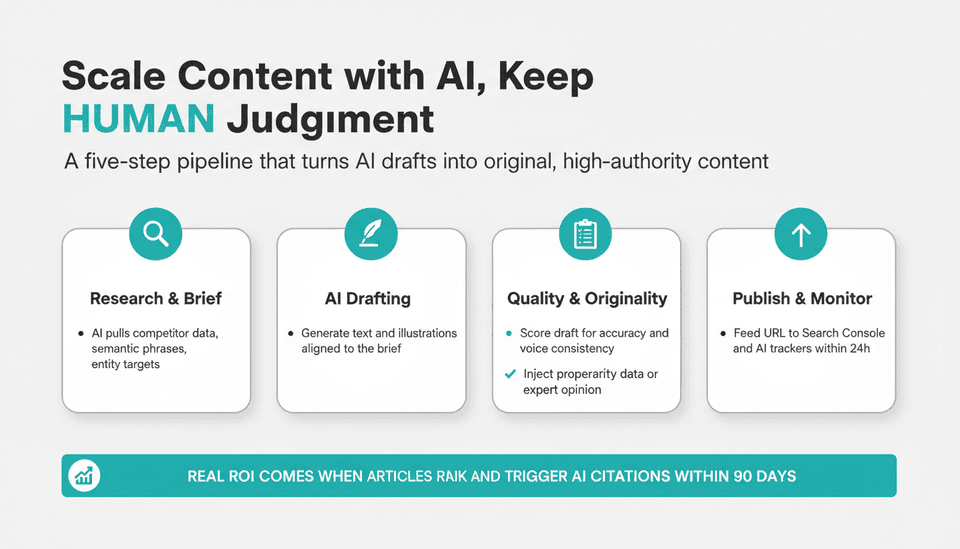
Using AI for SEO is not about handing everything to a bot; it’s about redesigning your production line so that repetitive, data-heavy steps run on AI, while decisions stay human.
Keyword Research and Topic Clustering
Modern AI SEO tools ingest your competitor data, your existing content, and search intent signals to output not just a keyword list but a topic cluster map. Things you used to spend days doing in a spreadsheet now take minutes. Tools from companies like Siteimprove and UC Davis’s communications team (cited in their guides) show that AI can pattern-match subtopics, reveal question gaps, and even predict seasonal trends. But the operator still picks which clusters match the brand’s expertise. I recommend always sense-checking three keyword suggestions manually before committing to them.
Drafting and Optimizing Content at Scale
This is where platforms like Joyrise come into the picture: they combine deep site scans for brand voice, keyword gap analysis, and automated drafting into a single pipeline that publishes directly to Webflow. The right approach keeps a quality judgment layer—whether it’s a second AI model re-evaluating the draft (as Joyrise’s Pro tier does) or a human editor. The workflow that maintains E-E-A-T and avoids thin content looks like this:
- Pull a detailed SEO brief from AI: target entity, internal links, semantic phrases, and pre-analyzed competitor structure.
- Generate a first draft aligned to that brief, complete with original illustrations or data visualizations.
- Run a quality rubrik: score the draft on factual accuracy, helpfulness, and voice consistency using a separate AI pass or human checklist.
- Inject original insight: add at least one section that draws on proprietary data, a case study, or a practitioner’s opinion—this is the single highest-leverage step to avoid Google’s helpful content system penalties.
- Publish and connect to monitoring: feed the published URL into Search Console and any AI visibility tracker (e.g., OtterlyAI) within 24 hours.
Tools like onelittleweb’s 2026 AI SEO tool test note that the best platforms now include built-in quality checks, but none yet fully replace editorial judgment. A true at-scale operation pairs automated production with a weekly audit by a human SEO specialist. For the full operating manual on building this type of efficient content engine, see the SEO in Digital Marketing: A 2026 Operating Guide.
On-Page and Technical SEO Tweaks
AI quickly identifies missing schema, duplicate H1s, or slow-loading pages, then proposes fixes. It can also rewrite meta descriptions at scale, but be careful: Google has signaled that purely AI-generated meta tags that don’t reflect page content can be overridden. Use AI to flag issues, then implement selectively.
Optimizing for AI Search Engines: The New Frontier
Winning inside AI-generated answers means thinking less about “ranking” and more about “being cited accurately.” Google’s AI Overviews and ChatGPT’s retrieval patterns reward clarity, entity connections, and source reliability.
Structuring Content for AI Overviews and Answers
AI search engines extract facts best from content that uses:
- Descriptive headings that pose real questions (like this FAQ)
- FAQPage or Q&A schema markup (applied only where the page genuinely answers a question)
- Short, authoritative definitions within the first 100 words of a paragraph
- Tables and comparison blocks that an LLM can parse cleanly
Avoid hiding crucial context in videos or complex JavaScript; the AI model might not crawl it.
Building Credibility: E-E-A-T and Verified Sources
An AI’s retrieval mechanism often weights author expertise signals, citations of recognized institutions, and fresh publication dates. The Search Engine Land piece on AI reasoning flaws (six days ago) stressed that verification is essential: if an AI model pulls your content and misrepresents it, you need to be able to show the source material clearly. That means every statistic must be traceable to an original study or primary source and dated explicitly. Additionally, On November 13, 2026, Search Engine Journal reported that site owners now have a shared AI training opt-out signal—meaning you can instruct crawlers not to use your content for training models. However, that same signal may limit your visibility in AI-generated search results, creating a trade-off you must evaluate.
The Risks and Trade-Offs of AI SEO
The worst mistakes happen when teams think AI removes all risk.
Quality Pitfalls and Algorithmic Penalties
Publishing AI-generated content that lacks original insight or simply remixes what’s already on page one of Google will trigger the helpful content system. The pattern is predictable: a spike in indexed pages, then a sitewide classifier demotion. To avoid that, every AI-generated piece must pass a “who cares?” test—does it include something beyond what a user would get from reading the top three results? A simple safeguard: no article goes live without at least one claim, statistic, or observation that a writer researched independently. Even if the AI drafts 90% of the piece, that 10% of original input is the moat.
AI Training Opt-Outs and Data Privacy Implications
The new shared AI training opt-out signal lets you prevent your content from directly training large language models, which can protect proprietary data and subscription gated content. But if you’re optimizing for AI search engines, those models need to have ingested your content to cite it. Blocking training can reduce your chance of being surfaced in some generative answers. The pragmatic move: segment your content. Allow training for your public, traffic-driving assets; block it for private documentation or product blueprints.
How to Evaluate and Choose Your AI SEO Path
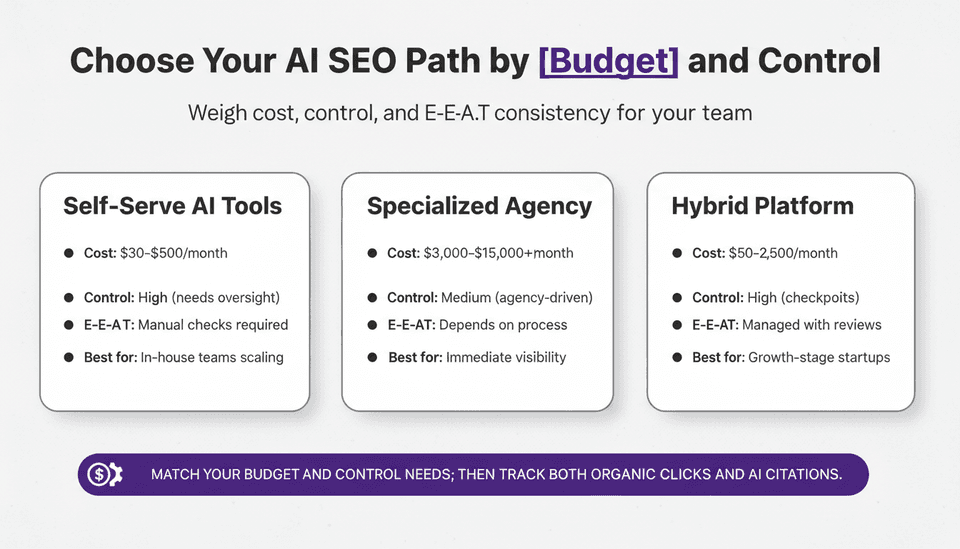
Your budget, in-house expertise, and risk tolerance will steer you toward pure AI tools, a specialized agency, or a hybrid model. Use this table as a starting filter.
| Path | Typical Cost Range (Monthly) | Control Level | E-E-A-T Consistency | Best for… |
|---|---|---|---|---|
| AI SEO tools (self-serve) | $30–$500 | High | Requires heavy oversight | Teams with an in-house SEO manager who wants to scale content production |
| Specialized AI SEO agency | $3,000–$15,000+ | Medium | Agency driven; depends on their process | Companies needing immediate AI search visibility without building an internal team |
| Hybrid (platform + human) | $500–$2,500 | High | Managed with editorial checkpoints | Growth-stage startups that need speed and control without headcount bloat |
An AI SEO platform like Joyrise fits the hybrid model for Webflow-based teams: it automates scanning, writing, and publishing, but leaves final control in your hands with draft reviews and quality judgment passes. It claims to operate at roughly 1/10th the cost of a traditional agency for ongoing blog work, making it a candidate if you’re already comfortable managing Webflow.
Measuring Success: KPIs and ROI
You can’t manage what you don’t count in two parallel channels now: traditional organic and AI-generated referrals.
- Traditional SEO KPIs: Clicks, impressions, average position, CTR per page (via Search Console), plus conversions from organic traffic.
- AI Visibility KPIs: Impressions in AI Overviews (Google Search Console now reports these), mentions in ChatGPT or Perplexity (tracked via third-party tools like OtterlyAI), and referral traffic from AI search engines.
- Operational ROI: Measure (publishing output / cost) vs. the equivalent cost of human production or agency retainers. A proven content-at-scale workflow can often deliver 3–4× the publishing velocity at half the cost, but the real ROI comes when those articles start ranking and triggering AI citations—typically not before month 3. One practical yardstick: track how many of your AI-assisted articles earn a featured snippet or an AI Overview impression within 90 days. For a deep look at tracking AI-driven search success, refer to AI SEO Ranking: A Complete Guide to AI-Driven Search Success.
Frequently Asked Questions About AI SEO
What is AI-SEO?
AI-SEO is the discipline of optimizing content specifically so that AI-powered search engines (like ChatGPT, Google’s AI Overviews, or Bing Copilot) select it as a source and represent it faithfully in generated answers. It focuses on structure, entity clarity, and verifiable credibility rather than just keyword density and backlinks.
What is GEO?
GEO, or Generative Engine Optimization, is the subset of AI-SEO concerned with surfacing in generative AI outputs. It employs techniques like citing authoritative primary sources, answering queries directly with structured data, and building citation graphs that LLMs use during retrieval. Think of it as making your content the “footnote” that the AI prefers.
How can AI improve keyword research?
AI identifies search intent clusters, extracts related questions from competitors, and surfaces keyword gaps by analyzing thousands of pages in seconds. It can group keywords by topic and even predict which terms will be high-converting based on user behavior patterns found in ranking data.
How can AI help with SEO content creation?
AI can draft entire articles from an SEO brief, generate meta descriptions and headings that satisfy search intent, and create original supporting imagery. It also suggests internal links and related content to build topic authority. The key is to use AI as a drafting assistant, not a final publisher, with human review for originality and accuracy.
How does AI help with on-page optimization?
AI audits pages for missing alt text, broken internal links, unoptimized header hierarchies, and thin content. It can then propose or even implement fixes—like rewriting prompts for CTAs or restructuring paragraphs for readability—at a speed no manual review can match. However, over-optimization (e.g., keyword stuffing through AI) still triggers filters.
Can AI replace human SEO specialists?
No, not in strategy or editorial judgment. AI handles pattern recognition and rote tasks, but it cannot understand a brand’s unique audience, negotiate editorial trade-offs, or defend decisions during an algorithm update. In 2026, AI replaces the drudgery, not the strategist.
What are the benefits of using AI in SEO?
The primary benefits: drastically faster content production, more comprehensive topic coverage, lower per-article costs, and the ability to scale E-E-A-T safeguards through consistency checks. It also enables real-time monitoring of AI search placements, which manual processes cannot achieve.
How do I choose an AI SEO tool?
Start by defining whether you need end-to-end content automation or a point solution for keyword research/technical audits. Then evaluate tools against three criteria: quality of output without human intervention (check real user examples), integration with your CMS and analytics, and the presence of a transparent verification layer to prevent factual errors. Always run a trial with three pieces of your own content before committing.
What are the risks of AI-generated content for SEO?
The biggest risk is publishing generic, surface-level content that Google’s helpful content system flags as unoriginal, leading to sitewide ranking suppression. There is also a reputational risk if AI hallucinations produce incorrect information under your brand. Finally, if you do not implement the AI training opt-out correctly, you might inadvertently train competitors’ AI models while losing control of your content’s representation in search.
How do I optimize for AI-generated search results?
Structure content with question-based headings, include fact-checkable claims linked to authoritative sources, and implement structured data that explicitly marks Q&A and entity relationships. Ensure your core service pages and authoritative blog posts are crawled and indexed without JavaScript roadblocks. And monitor: when your page gets cited in an AI answer, verify that the cited claim matches your original content.
How do I measure ROI of AI SEO?
ROI in AI SEO is the sum of traditional organic traffic gains (conversions from SEO landing pages) plus the value of being cited inside AI-generated answers—traffic from those citations, brand lift, and reduced paid search dependency. Calculate cost per new article produced (tool + human editing costs) versus the lifetime value of the traffic it attracts. A concrete metric: articles that earn an AI Overview impression within their first 90 days typically pay back production cost within 5–7 months at moderate traffic levels.
Key Takeaways
- AI SEO means two things: using AI to speed up traditional SEO, and optimizing content to get cited inside AI-generated search results—and you likely need both.
- The explosion of 170+ specialized GEO agencies and AI SEO certifications proves this is no side trend; AI visibility is now a budget line item for 2026.
- Scaling content with AI requires a hard quality gate: every piece needs at least one original insight, or you risk triggering Google’s helpful content classifier.
- The new AI training opt-out signal offers privacy control, but blocking training may reduce your content’s chance of appearing in generative answers—plan your segmentation carefully.
- Measure success in two streams: traditional organic clicks and AI-specific impressions/referrals, tracking cost per article and the time to earn an AI answer citation.
When you’re ready to move from manual publishing to a fully automated, quality-checked blog that feeds both traditional search and AI channels, Joyrise can write and publish daily illustrated articles to your Webflow site.