 Joyrise
SEO in Digital Marketing: A 2026 Operating Guide
 By Alexi · · 20 min read

On this page
- What SEO in digital marketing actually means in 2026
- Core concepts and commonly confused terms
- How the search system actually works
- The three pillars every guide covers, compressed
- SEO operating options and their real tradeoffs
- A practical 90-day implementation framework
- Where SEO fits in the 2026 digital marketing stack
- Mistakes, myths, limitations, and next steps
- Key Takeaways
SEO in digital marketing is no longer about stuffing keywords and waiting for Google to notice. In 2026, it’s a measurable channel that can be built with automated publishing, human oversight, or an agency—but the cost, speed, and quality tradeoffs are real. This guide gives you a 90-day decision framework to choose your approach, read AI-search signals, and avoid the five-figure retainers that produce vanity rankings instead of revenue.
What SEO in digital marketing actually means in 2026
What is SEO in digital marketing?
SEO, or search engine optimization, is the practice of improving a website’s visibility in organic (non-paid) search results for queries that matter to your business. In 2026, that visibility extends beyond the familiar blue links to AI-generated answer boxes, People Also Ask sections, and voice assistant citations that pull from indexed pages. You optimize your content, site structure, and authority signals so that search engines and the AI models that sit on top of them surface your brand when someone types a question.
This isn’t a one-time project. It’s an operating function—much like finance or product—that compounds over months. When done methodically, it delivers qualified traffic without per-click ad spend. The mechanisms haven’t changed in essence: crawl, index, rank. What has changed is how quickly you can produce credible content and how you measure success beyond just rankings.
Scope: what this guide covers and what it skips
This guide focuses on organic search as an acquisition channel for businesses that already have a website—whether a Webflow blog, Shopify store, or B2B SaaS product. We cover:
- How search engines and AI answer engines work in 2026.
- The four types of SEO work (on-page, off-page, technical, local) in compressed, operational terms.
- Real cost comparisons between in-house, agency, freelance, and automated publishing models.
- A specific 90-day execution calendar for a small team.
- How to read Search Console for AI referral signals, not just blue-link clicks.
We’re skipping deep dives into enterprise server configurations, programmatic SEO at scale with millions of URLs, and multimedia SEO (YouTube, podcasts) that deserves its own guide. We’re also not covering paid search ads—that’s SEM, not SEO—though we’ll clarify the difference.
The shortest honest answer to how long until results
How long does SEO take? For a new site or a site starting from near-zero domain authority, expect to see meaningful traffic growth—visitors, not just impressions—in 6 to 12 months. Quick wins like fixing broken internal links, optimizing existing high-impression pages, or adding schema markup can produce a noticeable improvement in 4 to 8 weeks. But the compounding curve that builds a sustainable organic channel requires consistent publishing, indexing, and backlink acquisition over quarters, not weeks.
If you’re using automated content publishing to accelerate output (more on that later), you may see indexed pages accumulate faster, but the authority signals that move them from page two to page one still take time. No tool shortens that wait to zero.
How long until I see impact in search results?
The same timeline applies: meaningful traffic growth typically starts between 6 and 12 months, with early quick wins possible in 4–8 weeks from targeted on-page fixes. The compounding curve that builds a sustainable organic channel requires consistent publishing, indexing, and backlink acquisition over quarters—no tool shortens that wait to zero.
Core concepts and commonly confused terms
What are the types of SEO in digital marketing?
The work splits into four buckets, and conflating them is how founders burn budget:
- On-page SEO – everything visible and structural on the page itself: title tags, meta descriptions, headings, keyword placement, content quality, internal links, and image alt text. This is the type you control directly.
- Off-page SEO – signals that originate outside your site, primarily backlinks from other domains, but also brand mentions, social shares, and citations that build authority.
- Technical SEO – crawlability, indexing, site speed, Core Web Vitals, mobile-friendliness, structured data (schema markup), and site architecture.
- Local SEO – specific to brick-and-mortar or service-area businesses: Google Business Profile optimization, local citations, and reputation management for “near me” queries.
SEO vs SEM vs paid search vs local SEO
These terms get mixed up in budget discussions.
- SEO is organic: you don’t pay the search engine for each click. You invest in content, site improvements, and authority building.
- SEM (search engine marketing) is often used to refer to paid search ads, though some define it as the umbrella covering both SEO and paid. In practice, when a founder says “we’re spending on SEM,” they usually mean Google Ads.
- Paid search is exactly that: you bid on keywords and pay per click (PPC) to appear in the sponsored results slots.
- Local SEO is a flavor of organic optimization focused on geography, often intertwined with Google Maps and Business Profile rankings.
The important budgeting insight: organic SEO traffic, once established, is zero marginal cost per visit; paid search stops the moment you stop spending.
On-page, off-page, and technical: what each controls
An operational cheat sheet:
- On-page controls the relevance of a page to a query. If your page is the best answer on the internet for “how to fix a leaky faucet,” on-page is what communicates that.
- Off-page controls the authority. Even the best answer won’t rank without signals that other reputable sources vouch for you.
- Technical controls the access. If Googlebot can’t crawl your page, or it loads in 8 seconds on mobile, none of the above matters.
There’s a persistent disagreement worth addressing head-on. Google’s own SEO Starter Guide warns against treating link building and keyword density as primary levers, while many agency guides present off-page optimization and backlinks as a core pillar without equivalent risk framing. The 2026 reality is this: backlinks remain a strong ranking signal, but chasing them through outreach-for-links campaigns without first building a base of genuinely useful content is a losing long-game. Focus first on creating linkable assets—data studies, templates, definitive guides—and let link acquisition be a byproduct of content marketing. If you hire an agency and their off-page strategy is 90% “link building,” ask to see the editorial plan that supports it.
Clicks, impressions, rankings, and AI referrals
You’ll live in Google Search Console, so define these early:
- Impressions: How many times a URL appeared in search results for a user, even if not clicked. High impressions and low clicks signal a mismatch between what your title says and what the user wants.
- Clicks: Visits to your site from search results. This is the number that matters for traffic, not rankings.
- Rankings: Average position for a keyword. Important directionally, but a #1 ranking for a zero-volume query earns nothing.
- AI referrals: A new metric in 2026. When your content is cited by a Google AI Overview, or surfaced in a Bing Copilot response, Search Console now reports “AI Assistant” traffic separately. This is not a ranking—it’s a citation from an answer engine. We’ll cover how to read that signal later.
How the search system actually works
How do search engines work?
At its core, a search engine does three things:
- Crawl: Software robots (spiders) follow links from page to page, discovering new URLs and revisiting updated ones.
- Index: Discovered pages are parsed, their content and metadata stored in a massive database. A page that’s crawled but not indexed won’t appear in results.
- Rank: When someone enters a query, the engine retrieves indexed pages, scores them against hundreds of factors, and orders them with the intent to provide the most useful answer.
In 2026, this loop now feeds not just the classic search results page but also the training data and retrieval-augmented generation (RAG) pipelines that power AI answers.
How does Google rank pages?
Google ranks pages using a combination of relevance, authority, and user experience signals, processed through machine learning models. Relevance means the content matches the query’s intent. Authority is largely measured by the quantity and quality of other sites linking to you, but also by brand signals and topical expertise. User experience includes page load speed, mobile rendering, and interactivity (Core Web Vitals). The search engine runs the query through its algorithms—including BERT, MUM, and newer AI models—to understand nuanced meaning and then scores pages against its index.
While the exact weightings are never public, one thing is clear in 2026: publishing helpful, original content that actually resolves a searcher’s question remains the single most reliable ranking lever. Everything else is amplification.
Classic blue links vs AI answers and answer engines
The biggest change for SEO in digital marketing over the past 18 months is the rise of AI-generated answers appearing above or instead of the traditional list of links. Google’s AI Overviews, Microsoft Copilot in Bing, and standalone tools like ChatGPT search (which often pulls from Bing’s index) can answer a query directly in the results page, citing a handful of sources.
For a site owner, this means two things:
- You can get a citation (and some click-through) even if your page ranks #4 or #5, as long as your content is clear, structured, and authoritative enough to be summarized.
- You may also lose clicks for informational queries where the AI answer satisfies the user without a visit.
As FinancialContent reported on November 10, 2026, demand for specialized AEO (Answer Engine Optimization) and GEO (Generative Engine Optimization) skills is growing rapidly. These are not separate disciplines from SEO; they’re extensions. To optimize for AI answers, you need to structure content with clear sections, FAQ schemas, and concise definitional paragraphs—all classic on-page SEO techniques, tightened for a machine reader. For a deep dive, see our guide on the difference between LLM and GEO.
The three pillars every guide covers, compressed
On-page checklist on one screen
- Title tag under 60 characters, includes primary keyword naturally, describes the page’s reward.
- Meta description 120–155 characters with a clear value prop; not a ranking factor but drives click-through rate.
- Single H1 that matches the title intent, plus H2–H4 structure that breaks the topic into scannable chunks.
- Internal links from 2–5 other relevant pages on your site, using descriptive anchor text.
- Keyword usage in the first 100 words, in at least one subheading, and naturally throughout—without counting density.
- Image alt attributes that describe each image plainly (for accessibility and image search).
- Schema markup (Article, FAQ, HowTo, Product) to earn rich results and AI citations.
- Unique content that demonstrates firsthand insight, data, or examples—not just a rehash of existing SERPs.
Off-page and technical essentials without jargon
Understanding technical SEO basics is critical before diving into off-page tactics.
- Off-page: earn links by publishing original research, templates, or definitive guides that others voluntarily reference. A few high-authority links from relevant domains outweigh hundreds of low-quality directory links. Avoid link networks and paid-for-link services—Google’s SpamBrain detection is aggressive in 2026.
- Technical: ensure your site is indexable (robots.txt not blocking important pages, no unintentional noindex tags). Fix 404s by redirecting broken pages. Get Core Web Vitals into “good” range via lazy loading, a CDN, and compressed images. Submit an XML sitemap to Search Console. Use a tool like Screaming Frog’s free version for a once-over; don’t drown in audit reports you won’t act on.
Why checklists fail without an operating workflow
A 50-point on-page checklist is useless if you publish one article per quarter. The missing piece in most SEO guides is editorial rhythm. You need a process that: identifies topics with traffic potential, creates a brief, drafts or commissions content, publishes to a schedule, and reviews performance every 30 days. The next section tackles exactly how to set up that rhythm and compares the operating models available.
SEO operating options and their real tradeoffs
Who should use SEO marketing?
If your business answers customer questions online and your audience uses a search engine (or an AI assistant backed by one), you should invest in SEO. That covers ecommerce stores, B2B SaaS companies, local service providers, content sites, and many more. The channel makes the most sense when:
- You can define conversion events from organic traffic (demo requests, purchases, phone calls).
- You’re willing to commit resource—money, time, or both—for at least 6 months before judging ROI.
- You have a defensible point of view or unique data to build pages around, not just commodity comparison content.
The main exception: if 90% of your revenue comes from outbound sales or highly competitive paid keywords where organic ranking would require years of investment, you might allocate a smaller SEO budget as a long-tail support channel or delay it until you have brand differentiation.
In-house, agency, freelance, and automated publishing compared
Founders commonly pick one of four paths, each with different economics and operational overhead:
- In-house team: A content marketer or SEO manager plus freelancer writers. You get maximum control over voice and quality, but total cost often exceeds $6,000/month for salary, tools, and freelancer fees. Suited for companies where organic traffic is a top-three revenue channel.
- SEO agency: Monthly retainers typically range from $2,000 to $5,000 for a blended service that includes technical audits, keyword research, and a handful of articles plus link outreach. The risk: you pay for strategic planning but may get 4–8 articles a month, and agency link building can be low-quality if not vetted. As an indicator of ongoing demand, Citybiz reported on November 6, 2026 that SEO Growth Partners, a Portland agency with over 200 five-star reviews, relocated its headquarters to accommodate expansion—traditional agency SEO isn’t disappearing.
- Freelancer per-article model: Paying $150–$400 per article to specialist writers, plus a coordinator. You can scale content volume linearly, but quality assurance and topic selection remain your burden. Cost per article can drop to $100 if you go offshore, but revision cycles balloon.
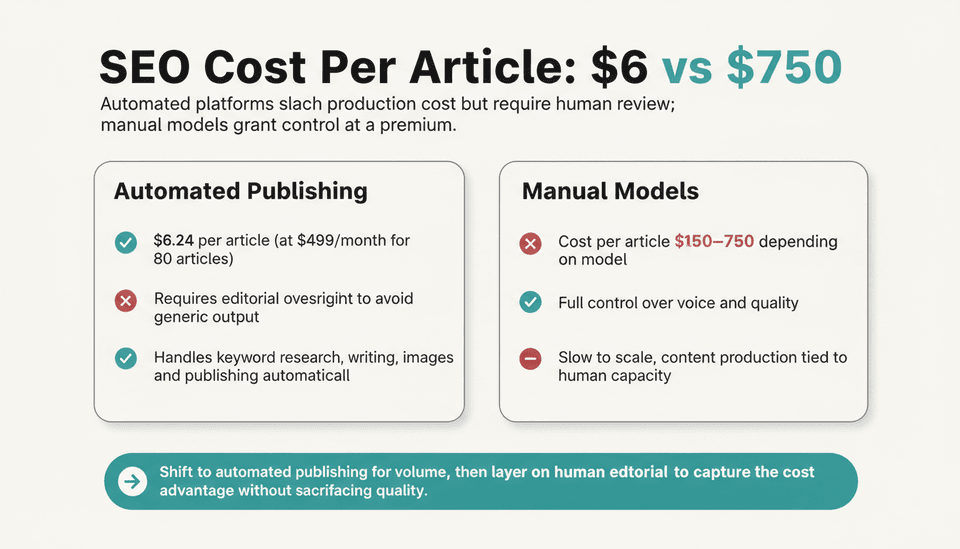
- Automated content publishing: AI-driven platforms like Joyrise handle keyword research, writing, images, and direct publishing to your CMS for a flat monthly fee. For example, at $499/month for 80 articles, the cost per article drops to about $6.24. This shifts the tradeoff: speed and cost are dramatically lower, but editorial oversight and brand voice require a human review step (Select AI-rewritten drafts, check facts, and tweak tone) to avoid generic output. The unit economics are compelling for startups that need a base of search-optimized content quickly, without committing to a full-time hire.
A cost-per-article lens for small teams
When evaluating your options, understanding the true SEO cost per month across different models is essential. Here’s a concrete comparison for a small team aiming to publish 20 articles per month:
| Approach | Typical monthly cost | Articles/month | Cost per article | Who does the editorial governance? |
|---|---|---|---|---|
| In-house (1 content manager + 2 freelancers) | $7,000–$9,000 | 16–20 | $350–$450 | In-house manager |
| SEO agency (mid-tier) | $3,000–$4,000 | 4–8 | $500–$750 | Agency, but limited to their deliverables |
| Freelancers only (no coordinator) | $3,000–$6,000 | 15–20 | $150–$300 | You (founder/team) |
| Automated platform (e.g., Joyrise Pro) | $499 | 80 (max) | $6.24 | Platform plus optional human review |
The automated option doesn’t replace a senior strategist, but it removes the grinding work of drafting, formatting, and scheduling. That lets a small team focus on editorial direction and conversion optimization, not on hiring writers. Whenever you compare, ask: “How much of this monthly fee actually buys me published, live pages that can earn traffic?” Many agency retainers are weighted toward reports you’ll read once.
Traditional agency growth and AI specialist demand do not remove measurement
Even as agencies incorporate AI into their workflows, the fundamental requirement to tie SEO spend to business outcomes remains. The recent FinancialContent piece highlights the new category of AEO/GEO specialists, but that doesn’t change the accountability framework: if you pay $4,000 a month, you need to see growth in qualified clicks and conversions—not just ranking reports. Whether your traffic comes from classic blue links or AI answers, the measurement loop is the same.
A practical 90-day implementation framework
Week 1-2: audit a small site without drowning in tools
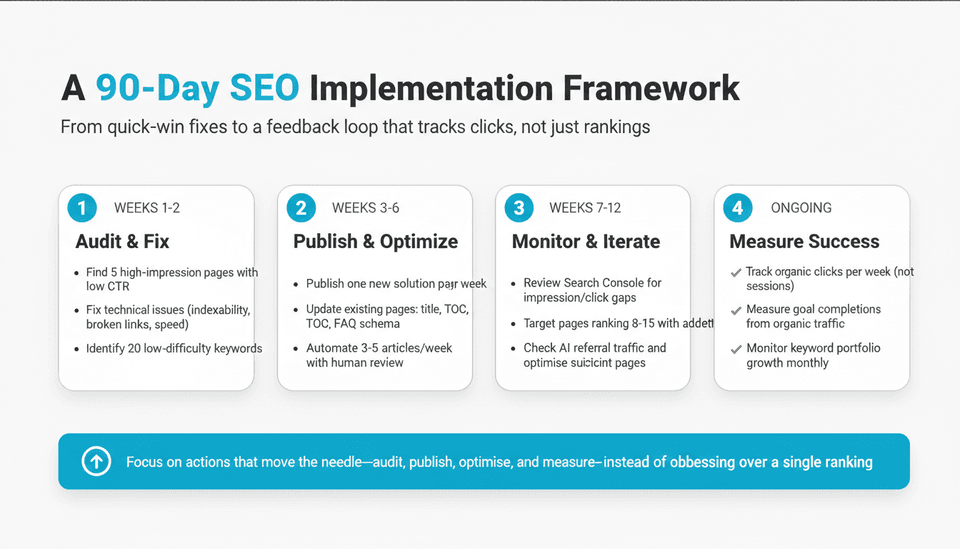
Don’t buy an enterprise suite. Open Google Search Console, connect your analytics, and run a free crawl with Screaming Frog (500 URLs max). Your goal: find five pages that already have a decent impression count (say, 100+ impressions per month) but low click-through rate or a ranking below position 6. These are your quick-win candidates. Also check:
- Are all important pages indexable? (Just look at the Coverage report in Search Console.)
- Are there broken internal links? (Screaming Frog will list them.)
- Is the site mobile-friendly and loading in under 2.5 seconds on a 4G connection? (Use PageSpeed Insights, free.)
Spend the rest of week 2 fixing those technical basics and identifying a content topic list—not hundreds, just 20 phrases where your domain could realistically compete within 6 months (low-to-medium difficulty, high relevance). Use a free keyword tool like Google Keyword Planner or Ahrefs’ free version to estimate monthly search volume.
Weeks 3-6: choose five pages and publish on a schedule
For the new content, pick five pages from your topic list that are not just blog posts but solution pages (service descriptions, comparison pages, or in-depth guides) that can drive conversions. Publish at least one per week. For existing pages with untapped potential, run a focused on-page SEO update:
- Improve the title tag to match user intent more precisely.
- Add a table of contents and FAQ schema if missing.
- Insert 2–3 internal links from higher-authority pages.
- Update the publish date and add a “Last updated” note for freshness.
If you’re using automated content publishing, set a cadence of 3–5 articles per week, but ensure you review the first two articles for tone and accuracy before scaling up. The platform handles keyword selection, drafting, and internal linking, which dramatically reduces the production bottleneck so you can focus on editorial review. Consistency is the ranking factor that no one talks about: a site that publishes regularly signals freshness and competence to both users and crawlers.
Weeks 7-12: read Search Console impressions, clicks, and AI referrals
Now you start the feedback loop. Each Monday, open Search Console for the previous 28-day window. Look at:
- Pages with the highest impression growth but low click growth: these need better title/meta description hooks.
- Queries where you rank in positions 8–15: these are candidates for additional content depth to push into the top 5.
- The “AI Assistant” or “AI Overview” impressions and clicks report (if enabled) to see which pages are being surfaced in answer engines. If a page gets AI impressions but zero clicks, the content might be too succinct—adding a “why this matters” analysis can entice the click.
- Pages that dropped in rank: check if a competitor updated their content; if so, you need to do the same.
How to measure and track SEO success?
Fix your dashboard on three non-vanity metrics:
- Organic clicks per week (not total sessions—filter to search traffic only).
- Goal completions or purchases from organic traffic (must be tied to events in your analytics).
- Keyword portfolio growth: number of keywords you rank for in positions 1–20, tracked monthly.
Avoid obsessing over a single keyword’s position. A classic trap is celebrating ranking #1 for “best CRM for freelancers” when the term gets 10 searches a month and clicks to the signup page are zero. Instead, watch the aggregated traffic curve and conversion rate.
Where SEO fits in the 2026 digital marketing stack
What is the role of SEO in digital marketing?
Moz defines it well: SEO’s primary role is to make your website visible and accessible to people who are actively searching for what you offer, building a cost-efficient, long-term traffic channel that complements other marketing activities. In practice, SEO creates a compounding asset. Every article you publish can earn traffic for years, acting as a salesperson who never sleeps. A solid SEO marketing strategy aligns your on-page, off-page, and technical efforts with your business goals, ensuring every piece of content serves a measurable purpose.
Shopify’s 2026 ecommerce digital marketing strategy guide, released on November 9, positions SEO alongside email, paid, and social as a core pillar for reaching and converting customers. This reflects the industry consensus: SEO isn’t a standalone discipline but part of an integrated stack. What that guide doesn’t detail is the budget sequence for a founder, which I’ll address now.
SEO, email, paid, and social: budget sequence for founders
When cash is tight, allocate in this order:
- Paid search/social first – to validate demand and get immediate conversion data. Once you know your customer acquisition cost, you can scale back once organic kicks in.
- Email capture second – build a list from day one, even with a simple landing page. SEO will later feed this engine with free traffic.
- SEO third – start with a modest investment (a few hundred dollars/month on automated publishing or a freelance writer). The goal is to plant seeds that will sprout in months 6–12 and reduce your blended CAC.
- Social organic and community – low cash cost, high time cost; layer in when you have capacity.
This sequence avoids the trap of burning $10k on an SEO retainer before you have proof the unit economics work with paid traffic.
AEO and GEO: what to optimize and what to ignore
Answer Engine Optimization (AEO) and Generative Engine Optimization (GEO) are the 2026 buzzwords. AI search optimization boils down to making your content easily digestible for AI models. Here’s the practical take: you don’t need a completely new skill set. Most of the work is just aggressive on-page SEO with a focus on clarity, structure, and source credibility. Specifically:
- Optimize for snippets: Use clear Q&A pairs, lists, and tables where appropriate. Google’s AI Overviews prefer content that can be summarized into a concise paragraph.
- Schema markup is non-negotiable: Article, FAQ, HowTo, and Organization schemas help AI models parse your content and attribute it correctly.
- Author entity and E-E-A-T: Include author bios with credentials, link to real profiles, and cite primary sources. AI engines are increasingly citing sources with visible expertise.
What to ignore: tools that promise to “optimize for ChatGPT ranking” with magic prompts. ChatGPT’s training data isn’t real-time, and its browsing mode uses Bing’s index. You optimize for Bing and Google, and the AI assistants that draw from them will follow. For a detailed walkthrough, see our practical GEO guide.
News-driven freshness as a compounding lever
One underused tactic in 2026: embedding your product in a recurring news cycle. Instead of only creating evergreen content, publish a short commentary on an industry announcement that relates to your key topic. For example, if a major platform changes its API pricing and your software helps with cost management, you can have an article indexed within 24 hours. That page earns immediate relevance for queries about the change, then gains residual traffic over time. Automated publishing platforms with news-driven features (like Joyrise’s Pro tier) can produce this type of article near-instantly, but a human editorial check ensures your unique take is there. The freshness signal can temporarily boost rankings for other pages on your site through association.
Mistakes, myths, limitations, and next steps
Mistakes that delay results
- Publishing content nobody searches for. If you write a heartfelt brand story but no one queries that topic, it earns zero traffic. Research intent before drafting.
- Ignoring technical debt. A site with broken pages, slow mobile speed, or missing canonical tags will hold back even excellent content. Fix the foundation in weeks 1–2.
- Measuring rankings instead of conversions. Ranking #1 for “project management software” is a trophy; 50 qualified signups per month from long-tail comparison pages is cash. Optimize for the latter.
- Hiring an agency without auditing their past content samples. Many agencies sell you on strategy and deliver thin, surface-level articles. Verify what you’ll actually get each month: ask for a sample content plan with live examples from current clients.
Myths that keep wasting founder time
- “SEO is dead because of AI.” AI answers still link to sources. Studies from SEO tool vendors in 2026 show that while some informational queries lose click-through, commercial and long-tail queries still drive significant traffic. The channel is shifting, not dying.
- “AI-written content ranks instantly and doesn’t need editing.” Google’s March 2024 core update and subsequent spam policies reward content that demonstrates expertise and experience. Purely raw AI output, without a human quality layer, will eventually be demoted or hit by helpful content classifiers. The second AI rewrite pass that platforms like Joyrise’s Pro tier use can close some of that gap, but a human eye on value-add is still necessary for high-stakes pages.
- “More pages = more traffic.” Not linearly. A site with 500 thin product listings can be outranked by a competitor with 20 deep, useful guides. Quality density matters more than page count.
Limitations and evidence gaps to verify
Any aggregation of online claims has limits. I can’t tell you that your specific site will hit 10,000 visitors in exactly 183 days. Published case studies from SEO tool vendors often suffer from selection bias—they feature winners, not the many sites that plateaued. The cost-per-click data from automated platforms is transparent (Joyrise publishes its plan pricing), but your mileage with indexing and ranking will depend on your domain’s existing authority and the competitiveness of your niche.
When an agency or tool claims “guaranteed #1 rankings,” walk away. No ethical provider can guarantee organic rank; they can guarantee a process. Verify all promises by asking to see a Search Console screenshot (not a rank tracker) of actual click growth for a client that started from a similar position as yours, 12 months prior.
A 90-day dashboard and when to revisit the channel mix
Set up a lightweight weekly check:
- Tuesday morning: Open Search Console. Check top 10 pages by clicks, any new indexing errors, and AI referral clicks.
- Once a month: Pull total organic sessions, goal completions, and SEO cost (total spend on tools, content, or platform). Divide cost by monthly organic goal completions to get your CAC from SEO. If that CAC is below your paid channel CAC, increase investment. If after 9 months it’s still higher or non-measurable, reduce allocation and redirect to channels that are working. The dashboard is your honest broker.
Key Takeaways
- SEO in digital marketing is a compounding acquisition channel: it demands 6–12 months of consistent effort before you can fairly judge ROI, and the fastest path in 2026 combines automated publishing velocity with human editorial oversight.
- Optimize for AI answers by doing on-page SEO exceptionally well: clear structure, schema markup, and source credibility are the same signals that earn both blue link clicks and AI citations.
- Unit economics dictate your operating model: at roughly $6 per article, automated platforms shift the cost curve so dramatically that small teams can focus budget on conversion optimization rather than writer management.
- Measure clicks and conversions, not rankings: a Search Console dashboard that tracks organic goal completions and AI referral traffic gives you a real-time read on whether your investment is working.
- Verify before you commit: demand real Search Console evidence from any provider, and never pay for a strategy deck when you need live pages earning traffic.
If your site needs a steady stream of SEO-optimized articles without the retainer, start your free trial with Joyrise and read your first article before you pay—publish every day, automatically.