 Joyrise
How Good Is AI for SEO? A No-Hype 2026 Reality Check
 By Alexi · · 14 min read

On this page
- How good is AI for SEO?
- What Does “Good” Actually Mean for AI SEO?
- Where AI SEO Actually Works (and Where It Falls Short)
- Real ROI: How Good Is AI SEO for Your P&L?
- When AI SEO Content Gets Penalized (and How to Fix It)
- AI Search and AI Answers Are Rewriting the Rules
- Is SEO Still Worth It in 2026? The Operator’s Verdict
- Key Takeaways
If you’re running a business and paying for organic growth, you’re not asking whether AI can write a blog post. You’re asking how good is AI for SEO? The answer depends entirely on whether you treat it as a force multiplier you control or a cheap replacement you ignore. Under the right conditions, AI can cut content production costs by 60–80% while holding or improving rankings. Under the wrong ones, it burns your domain authority and wastes months of recovery time. This article gives you the operator’s view: what works, what fails, and how to tell the difference.
How good is AI for SEO?
It’s good—sometimes great—when you use it to handle the repeatable, time-consuming parts of SEO that don’t require strategic judgment. That includes keyword clustering, first-draft content generation, meta tag creation, and internal linking suggestions. It’s poor at tasks that demand original research, genuine relationships (outreach, link earning), or knowing when a page should not exist. The real measure of AI SEO effectiveness is not whether a tool gives you more content; it’s whether your cost per acquisition drops without trashing your brand.
What is AI for SEO?
AI for SEO means using machine-learning models—large language models, natural-language processing, or specialized ranking predictors—to automate or augment tasks like keyword research, content drafting, on-page optimization, and performance monitoring. Unlike old rules-based software, today’s AI tools can read your site, study competitors, and generate complete, structured articles. For a deeper breakdown on how the technology works and where it fits, see our What Is AI SEO? A No-Nonsense FAQ for 2026.
What Does “Good” Actually Mean for AI SEO?
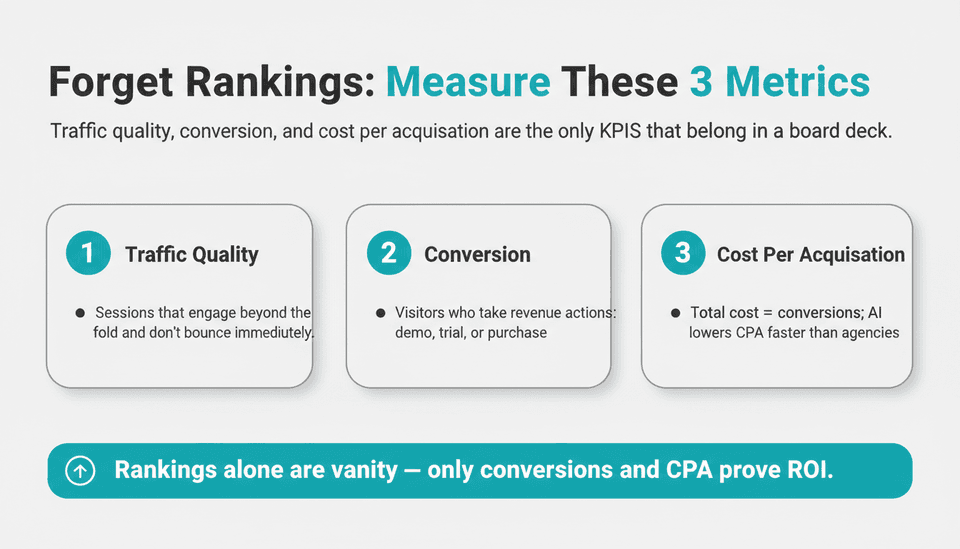 Most vendors point to a ranking graph. You should ignore it.
Rankings alone are a vanity metric
A page sitting at position 3 for a term nobody clicks on, or for a query where Google shows an AI Overview that answers everything without a click, won’t pay your bills. If your AI-driven campaign reports only keyword positions, you’re missing the only numbers that belong in a board deck: traffic that converts and the cost to get it.
The three success measures: traffic quality, conversion, and cost per acquisition
Measure AI SEO exactly like you’d measure a paid channel:
- Traffic quality: Are the sessions coming from people who read past the fold, visit a pricing page, or sign up—not just bounce at 8 seconds?
- Conversion: Do those visitors take the action that generates revenue (demo, trial, purchase)?
- Cost per acquisition (CPA): Total spend (tool subscription + any editorial review time + publishing overhead) divided by converting customers. A good AI SEO setup lowers CPA faster than an agency retainer because it removes the hourly-billing ceiling.
Where AI SEO Actually Works (and Where It Falls Short)
How can AI improve keyword research?
AI spots semantic clusters a human might group in hours, not days. It can pull your site’s existing pages, compare them against competitor gap data, and output a prioritized list of topics where you have a realistic chance to rank. Some platforms—including automated content marketing SEO engines like Joyrise—scan your entire site and competitor domains to build that map automatically, then generate article briefs that cover related questions and subtopics. The speed is the advantage: what took an SEO manager two afternoons now takes 20 minutes of review.
What kind of data does AI analyze for SEO?
AI ingests structured and unstructured data from multiple sources: your site’s pages and crawl reports, Google Search Console query and click data, competitor content and backlink profiles, SERP features (featured snippets, AI Overviews, People Also Ask boxes), and even user behavior signals when available. The models use this to estimate topic authority gaps, cannibalization risks, and content freshness needs. Quality tools let you close the loop with Google Search Console AI content tracking, so you see exactly which AI-generated pages are gaining impressions—and which are flatlining.
Drafting articles that pass the “write for humans” test
The first draft from a frontier model is rarely ready to publish, but with the right prompts and a second-pass quality judge (a second AI that rewrites for voice and factual tightness), the output can be 80–90% of the way there. The remaining 10–20% is where you inject original data, anecdotes, quotes, and judgment calls that no model has. If you skip that step, you get surface-level content that ranks for a week, then slides.
How does AI help with on-page optimization?
This is the part AI gets right almost every time. Upon generating an article, a good AI SEO tool can simultaneously produce:
- Title tag and meta description that respect pixel width and include the primary term
- Proper HTML heading hierarchy (H1, H2, H3) with related keywords
- Table of contents with anchor links
- Descriptive alt text for images
- Internal links to relevant existing pages on your site
When you multiply that across 50 or 100 articles, the time savings are substantial. One operator I know used to spend 15 minutes per post on on-page formatting alone; the AI reduces that to a 90-second sanity check.
How can AI help with link building?
This is AI’s weakest link. AI can find prospects—scraping lists of sites that linked to competitors, generating outreach email drafts, or identifying unlinked brand mentions—but actually earning a link requires a human relationship, a compelling asset, or an original study. No automated platform will get a journalist at a major publication to include your citation because the AI asked. Treat AI as a research assistant for link building, never a replacement for the outreach itself.
How do AI SEO tools improve search engine rankings?
They don’t directly influence Google’s algorithm. They improve the inputs that lead to rankings: topical coverage depth, on-page signals, content freshness, and the removal of technical issues. A tool that publishes daily, well-structured articles on neglected subtopics creates more entry points for organic traffic, and over months that compounding effect lifts the whole domain. But if the underlying content doesn’t meet the user’s intent, even perfect on-page SEO won’t save it.
Real ROI: How Good Is AI SEO for Your P&L?
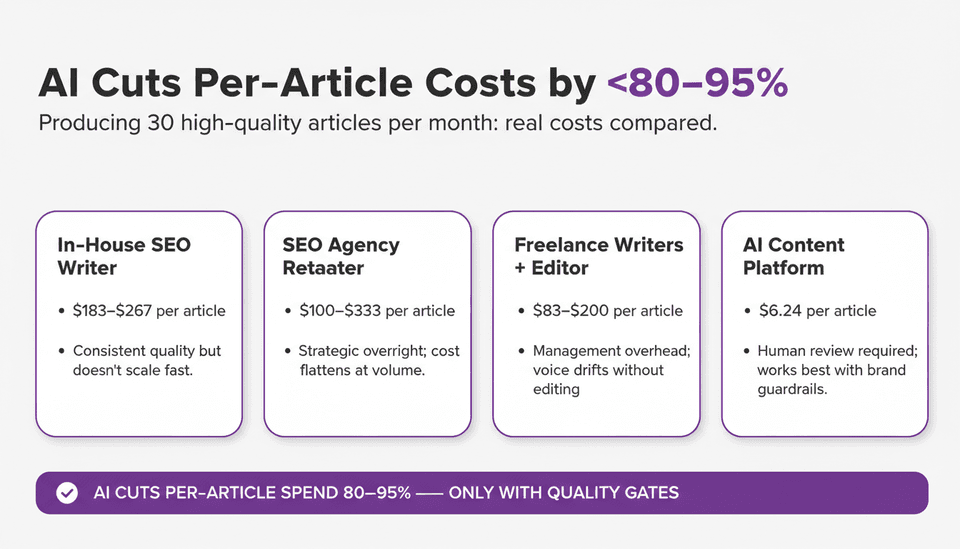 AI SEO ROI isn’t theoretical. You can measure it after 90 days with a simple formula: (revenue from AI-assisted organic conversions – total AI content cost) / total AI content cost. The table below compares realistic costs for producing 30 high-quality, long-form articles per month.
| Approach | Typical cost/month (30 articles) | Average cost per article | Time to first content | Main trade-off |
|---|---|---|---|---|
| In-house SEO writer (full-time) | $5,500–$8,000 (salary + benefits) | $183–$267 | 2–4 weeks to hire | Quality and brand voice are consistent; doesn’t scale fast |
| SEO agency retainer (content + strategy) | $3,000–$10,000 | $100–$333 | Often 3–6 weeks for strategy, 1–2 weeks per piece | Strategic oversight included; cost flattens at higher volumes |
| Freelance writers + editor | $2,500–$6,000 | $83–$200 | Variable | Management overhead; voice drifts without tight editing |
| AI content platform (e.g., Joyrise Pro plan) | $499 (80 articles) | $6.24 | 24 hours | Human review still required; works best when brand guardrails are set |
Sources: author-compiled market data; see also Bulldozer-colective’s ROI calculator for modeling traffic-value estimates. The cost per article AI vs agency gap is real—AI can reduce per-article spend by 80–95%—but only if you’re disciplined about quality gates.
Speed-quality trade-offs when you scale past 30 articles/month
Once you cross 30 articles per month, the bottleneck isn’t the AI; it’s your ability to review. At 80 articles/month (one Joyrise Pro plan’s cap), a single editor spending even 8 minutes per piece is looking at over 10 hours of weekly review work. The solution: use a quality-judgment pass that applies a second AI model to fact-check, tighten structure, and align with brand voice before a human ever sees the draft. That way, the human reviewer only needs to spot-check 15–20% of articles, not line-edit all of them.
Case scenarios: when AI SEO pays back in month 1 vs month 6
- Month-1 payback: An e-commerce site that already has strong domain authority but thin category pages. If you use AI to expand 20 category pages with unique product-comparison tables and buyer’s guides, you can see ranking lifts and conversions within weeks. The content is filling immediate intent gaps.
- Month-6 payback: A new SaaS startup on a fresh domain with zero authority. Publishing 30 AI-assisted articles per month builds topical depth, but you won’t see meaningful traffic until month 4–6. The early cost is front-loaded; ROI turns positive only when the content flywheel starts attracting links and repeat visitors. This is when an automated platform that keeps publishing despite no early feedback makes sense—if you had to pay agency rates for every article during that ramp, you’d likely kill the program too early.
What are the best AI SEO content optimization tools?
The short answer: the one that connects content generation, on-page optimization, and real performance data in a single workflow, instead of making you jump between three tools. Standalone content optimizers (Surfer, Frase) are excellent for tuning a single page, and tools like SE Ranking give deep audit capabilities—see our SE Ranking: A No‑Fluff Definitive Guide for 2026 and Beyond. But if you’re scaling to dozens of articles a week, the SEO automation platforms that plan, write, optimize, and publish directly to your CMS while feeding Search Console data back into the loop eliminate the fragmented tool stack tax. Joyrise does this for Webflow sites; the integrated approach cuts context-switching and makes the “what happened after publishing?” question answerable in a single dashboard.
When AI SEO Content Gets Penalized (and How to Fix It)
Does AI-generated content actually rank?
Yes, AI-generated content ranks—when it meets the same bar as human-written content: it satisfies user intent, provides unique insight, and doesn’t trigger spam signals. The problem comes when publishers treat AI as a set-and-forget pipe. The Search Engine Journal piece from November 11, 2026, “Good Vs. Bad pSEO,” lays this out clearly: scaled programmatic publishing without unique data, launch checks, and pruning rules becomes spam, and Google’s systems are increasingly good at detecting it. So the published page that ranks today may be deindexed in the next core update if it was produced purely by template without oversight.
Symptom: impressions but no clicks
Your page appears in search results for a query, but the click-through rate is under 1%. This usually means the title tag and meta description are technically optimized but fail to promise something the user actually wants. AI can write a meta description that includes the keyword; it doesn’t know that your audience responds to “2026 tax deduction guidelines” not “complete tax deduction rules.” Fix: manually rewrite titles and meta descriptions for your 20 highest-impression pages, using language that matches the Google Search Console AI content tracking query report. Test variations, not just one.
Symptom: content deindexed after a core update
A batch of AI-written articles disappears from the index weeks after a broad core update. This often traces back to thin, duplicate, or purely reworded content that offered no original value. The remediation steps:
- Audit all deindexed URLs. Identify what they share: too-similar structure, lack of citations, zero first-party data.
- Prune ruthlessly—delete or noindex pages that cannibalize each other or cover trivially different angles.
- For the pages you keep, inject unique data (a survey result, an internal test, a customer interview), rework the intro to state a clear, original angle, and resubmit.
Symptom: brand voice disappearing in AI-written drafts
This happens when your prompts are generic. Without a custom voice guide, the model defaults to a helpful-but-vanilla tone that could belong to any competitor. Fix: build a short brand voice document—three bullet points about what you sound like (e.g., “direct, no corporate fluff, uses short paragraphs”) and three examples of published content that nail the voice. Feed that into your AI platform’s settings. Platforms that offer a “custom voice” layer (Joyrise’s Pro tier, for example) use that to constrain the output so your AI brand voice SEO stays consistent across dozens of posts without you rewriting every conclusion.
What does good vs bad AI-driven content look like?
Here’s a practical lens I use when auditing teams:
Good AI-driven content:
- Starts with an angle that a human strategist chose (not just the highest-volume keyword)
- Contains one original data point, example, or process no competitor has
- Reads as if one person wrote it, not a committee
- Uses internal links that genuinely help the reader navigate
- Updated after 3 months if the topic moved (e.g., pricing changes, regulations)
Bad AI-driven content:
- 2,500 words that could have been 500; no reader walks away with a decision
- Zero references, no dates, nothing that couldn’t be written by reading five search results
- The same paragraph structure across 30 pages (you can spot it in 10 seconds)
- Over-optimized: the primary keyword appears in every H2 and four times per paragraph
When in doubt, read the piece aloud. If it sounds like a Wikipedia summary, it’s bad AI content.
AI Search and AI Answers Are Rewriting the Rules
Why brand marketing and SEO are merging now
On November 14, 2026, Search Engine Land published a piece titled “Why AI search is bringing SEO and brand marketing together.” The article points to growing evidence that the signals that make a brand memorable to buyers—consistent mentions, clear positioning, off-site discussions—also influence whether an AI answer engine cites your brand in a generative response. This isn’t theoretical. I’ve seen brands with strong identities get pulled into AI Overviews more often than generic competitors even when their on-page content wasn’t markedly better.
At the same time, the U.S. Chamber of Commerce reported on November 14 that consumers increasingly use AI for product discovery, which means the path to purchase now often starts with an AI-generated recommendation, not a blue link. This forces a merge: you can’t just optimize for keywords anymore; you must also optimize for being the brand the AI remembers.
How does AI contribute to personalized search results?
Search engines use AI to tailor results based on a user’s location, device, search history, and even inferred intent. That means your page might rank well for a logged-in user in Chicago but not for an incognito user in Paris. While you can’t control personalization, you can ensure your content signals relevance broadly: include geographic context where it matters, structure pages so they answer multiple related intents without cannibalizing, and monitor performance in Search Console across queries, not just positions.
Can AI tools help me optimize for AI search results?
Yes, but the optimization is indirect. No tool can force Google’s AI Overview or ChatGPT’s browsing mode to cite you. What you can do: use AI-driven analysis to identify the query patterns and content structures that get cited in AI answers. For instance, clear definition paragraphs, well-structured comparison tables, and “key takeaways” sections are disproportionately pulled into AI summaries. Some SEO automation platforms now also track AI search visibility 2026 metrics alongside traditional rankings—the Mashable piece from November 9 noted that lifetime deals like SEOAgent for $69 are springing up specifically to track rankings and AI visibility in one place. But more important than any tool is this: your brand must be the obvious answer. That means investing in the same things that make a brand memorable—distinctive research, clear POV, and consistent publishing—which is exactly where automated content marketing SEO platforms that learn your voice can reduce the cost of staying visible.
Is SEO Still Worth It in 2026? The Operator’s Verdict
Will SEO exist in 5 or 10 years?
Yes, but not as a standalone function. As Priority Marketing noted on November 11, 2026, “AI and generative search gain traction,” yet SEO continues to play a key role that requires blending traditional SEO with AI-driven search tactics. The discipline of making your digital assets findable won’t vanish; it will absorb brand marketing, data analysis, and AI operations. In 5 years, I expect the job title “SEO manager” to be less common than “growth content strategist” or “organic acquisition lead,” but the underlying work—understanding intent, creating useful content, building authority—will remain.
Can AI replace human SEO specialists?
Only for execution, never for strategy. AI can do keyword research, draft content, suggest internal links, and report on performance. It cannot decide which bets are worth making, when to kill a content vertical, or how to adjust when a competitor launches a countercampain. The best setup I see in 2026 is one senior SEO strategist overseeing an AI-heavy production pipeline, plus a part-time editor. That replaces what would have been a team of three or four a few years ago. For a closer look at how to think about the people-versus-machine split, read our Can AI Do SEO for My Website? Honest Answers (2026).
What part of SEO is non-negotiable even with AI overviews
Technical foundations. If your site loads in 6 seconds, has broken canonicals, or can’t be crawled properly, no amount of AI content will save you. Core Web Vitals, proper indexation, and a clean internal link structure are still prerequisites. AI can detect these issues, but humans must prioritize and fix them.
When an automated platform makes sense vs when to keep manual control
Use an automated platform (like a content pipeline that scans your site, plans keywords, writes, and publishes) when:
- You’re in a content-heavy niche where volume and freshness matter (finance, SaaS education, e-commerce guides)
- Your team is small, and writing from scratch would take 40+ hours per week
- You have the discipline to review a sample of output daily and feed corrections back into the system
Keep manual control when:
- Your brand depends on a single authoritative voice (think a solo consultant whose insights are the product)
- You’re in a YMYL (your money, your life) category where EEAT signals are scrutinized aggressively, and AI-generated content without a credentialed author byline invites manual review
- You have only 5–10 evergreen pages and each needs to be years-defining
For most mid-market businesses on Webflow, the automated approach wins on unit economics. The SEO Finance: Definitive Guide walks through how to model that decision on a spreadsheet.
Key Takeaways
- AI SEO effectiveness depends entirely on your quality gates: AI can cut per-article costs by 80–95% versus agencies, but only if you review, inject unique data, and prune underperforming content.
- Rankings alone are a vanity metric; the only KPIs that matter are traffic that converts and the cost to acquire a customer.
- AI search is merging SEO and brand marketing: brand recall, consistent positioning, and distinctive content are now SEO inputs because AI answer engines favor memorable brands.
- Scaled AI publishing without unique data becomes spam—Google’s core updates will deindex it, so build launch checks, pruning rules, and a voice guide into your process.
- SEO won’t die, but it will be run by fewer humans using automation; the non-negotiable workload is technical hygiene and strategic direction.
When you’re ready to replace the manual blog treadmill with a system that writes and publishes daily illustrated SEO articles straight to your Webflow site—complete with Search Console feedback and a quality-judgment pass—see how Joyrise works on a free first-article trial.