 Joyrise
SEO Finance: The Definitive Guide to Strategy, Automation & ROI (59 chars)
 By Alexi · · 15 min read

On this page
- Executive Summary
- What Is SEO for Finance?
- Why SEO for Finance Matters More Than Ever
- The Unique Challenges of Financial Services SEO
- A 6‑Step SEO Framework for Finance
- Measuring SEO Success: KPIs That Actually Matter in Finance
- Options and Trade‑Offs: How to Resource Your SEO
- Common Mistakes and Myths in Financial SEO
- Recent Developments and the Future of SEO for Finance
- Getting Started: Your First 90‑Day Plan
- Key Takeaways
SEO finance demands authority, compliance, and trust. This guide covers finance content marketing, YMYL SEO, automated SEO for finance, and how to measure SEO ROI finance.
Executive Summary
SEO for financial services has evolved from a niche discipline into a core growth channel, but the playbook for consumer brands falls apart the moment you’re dealing with retirement accounts, lending disclosures, or insurance claims. This guide gives you a practical, step-by-step approach to building an SEO engine that drives qualified traffic while satisfying regulatory, brand, and E-E-A-T requirements. You’ll learn how to structure topic clusters that signal authority, automate content production safely, measure ROI using metrics your CFO will recognize, and resource the work without wasting six figures on an agency that doesn’t understand your compliance constraints. We’ll ground every recommendation in what works right now — not recycled theory.
What Is SEO for Finance?
SEO for finance is the practice of optimizing websites so that banks, insurers, fintechs, credit unions, wealth managers, and other financial services firms appear prominently in organic search results for queries that matter to their business. It’s the work of making sure someone searching “how to open a high-yield savings account” or “GLP-1 drug coverage Medicare Part D” finds your institution’s page — not a generic blog from a comparison site, and not a competitor with deeper authority signals. Effective finance content marketing underpins this effort, guiding users from awareness to conversion.
What is financial services SEO?
It’s the application of search engine optimization to the unique content, technical, and off-page requirements of the finance industry. That means going far beyond keyword placement: it requires publishing content that demonstrates expertise, earning links from trusted financial and government domains, and architecting sites in a way that communicates security and transparency to both users and search engines. When people talk about SEO for finance, they’re really talking about building a digital presence that can survive the next Google core update without losing its rankings or its compliance standing.
Scope: Banking, Insurance, Fintech, and Beyond
The term covers retail banking, commercial lending, investment management, insurance carriers, broker-dealers, payment processors, neo-banks, cryptocurrency platforms, and SEO for fintech companies that touch money or personal data. Each sub-sector has its own regulatory overlay — SEC, FINRA, CFPB, state insurance departments, GDPR, or a mix — which directly shapes what you can say, how you say it, and which claims need disclaimers. A financial SEO strategy that works for a robo-advisor will break a Medicare supplement insurer, and vice versa.
How It Differs from General SEO
Two differences dominate. First, Google applies strict YMYL SEO standards: your content can directly impact a person’s financial health, so the algorithm demands much higher levels of authority, accuracy, and trustworthiness than a lifestyle blog. Second, the purchasing and consideration cycles stretch across months or years, not days, which means your content must nurture a prospect from “what is a CD ladder” through to “open an account” — a much longer funnel than general SEO typically handles. You’re not chasing clicks; you’re building the informational infrastructure of a financial decision.
Why SEO for Finance Matters More Than Ever
The High-Stakes, Low-Trust Digital Landscape
Financial decisions are personal and frightening to get wrong, and consumers are more skeptical than ever. They’ll read reviews, check regulatory filings, and compare three providers before they fill out a form. If your content is missing from the search results during that research phase, you lose the chance to be the trusted source. According to a 2024 Matomo guide on financial SEO, the compounding effect of ranking for high-intent queries in finance means that early wins build dominance that competitors find extremely expensive to dislodge. Paid search costs in finance continue to climb; organic visibility is the only moat that improves over time.
Proving ROI in a Tight Economy
What are the benefits of improving SEO for financial services?
The benefits go straight to the bottom line. Improved SEO for financial services drives:
- Qualified, high-intent traffic from people actively seeking financial products.
- Lower customer acquisition costs compared to paid search and display.
- Brand authority that reduces price sensitivity and increases conversion rates.
- Asset protection against algorithm changes if you’ve built genuine E-E-A-T.
- Compliance-safe visibility when content is properly reviewed and disclosed.
In a budget environment where every line item must justify itself, SEO delivers measurably. Finance teams are tracking attribution much more closely now, and they want to see a clear line from organic traffic to applications, funded accounts, or policies bound.
The Unique Challenges of Financial Services SEO
What are the SEO challenges within financial services?
The core challenges include:
- Regulatory review cycles that slow content publishing to a crawl.
- YMYL classification that makes it harder to rank without a deep library of expert, current content.
- Legacy competitors with decades-old domains and massive backlink profiles.
- Extreme keyword competition on transactional terms like “best credit card.”
- Jargon-heavy topics that alienate the very people you need to help.
Tackling these requires a process, not wishful thinking.
Regulatory Compliance and YMYL Scrutiny
Google’s Quality Rater Guidelines explicitly call out financial pages as YMYL. That means the algorithm is tuned to prioritize sites that demonstrate clear editorial standards, author expertise, and factual accuracy. For a bank or insurer, this doesn’t just mean having a good About page — it means showing real credentials, keeping content updated, and avoiding claims that could be considered misleading. Compliance and SEO have to work together, not against each other. The fastest way to get buried in rankings is to publish AI-generated content that makes promises your legal team hasn’t reviewed. But the other extreme — crushing every piece of content through a 12-week review — guarantees you’ll never build topical authority. The answer is a structured workflow where legal reviews templates and frames, not every article verbatim, and where automated compliance checks flag high-risk language before publication. This is the essence of SEO compliance finance: designing processes that protect both your rankings and your regulatory standing.
Building E-E-A-T in a Skeptical Niche
Expertise, Experience, Authority, and Trustworthiness are table stakes. You build E-E-A-T by:
- Having qualified authors (CFPs, licensed agents, attorneys) produce or review content, with bios that prove it.
- Citing primary sources: FINRA data, NAIC reports, peer-reviewed studies, not other blogs.
- Earning links from .gov sites, major financial press, and industry bodies.
- Keeping a clean, accessible site architecture that doesn’t hide disclaimers.
This isn’t a one-off project. Every time you publish a piece on tax-advantaged retirement planning, you’re asking Google to trust you with someone’s future. That trust is built in layers.
Outranking Established Legacy Brands
Chase, Fidelity, Allstate — these domains have been accumulating authority for 20 years. Competing head-to-head on “life insurance quotes” is a recipe for frustration. The pragmatic approach is to dominate long-tail informational queries, build topic clusters that answer every adjacent question, and gradually earn the right to rank for transactional terms. Over time, a well-structured SEO for finance industry strategy that covers “catastrophic health plan vs bronze plan” and “how disability insurance underwriting works” will accrue enough subject-matter authority to push into the money pages.
Turning Complex Jargon into Accessible Content
Financial services content SEO often fails because writers assume readers understand terms like “expense ratio,” “surrender charge,” or “Medicare Advantage star ratings.” The best finance content does two things at once: it respects the sophistication of the audience while explaining concepts as if to a smart, curious non-expert. That means defining terms inline, using clear headings, and never burying an answer under regulatory boilerplate. If a user lands on your page confused, they bounce — and Google notices.
A 6‑Step SEO Framework for Finance
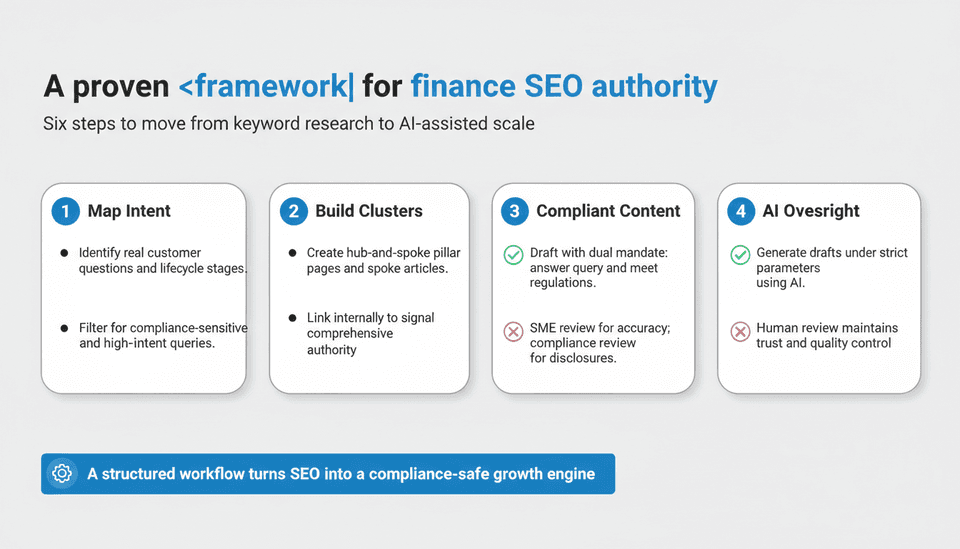
This framework moves from research through publication and link-building. Use it as your operation’s checklist.
Step 1: Audience and Keyword Research That Respects Intent
Start by mapping every financial product or service to the real questions your customers ask — before they know your category exists. Use tools like Ahrefs or Semrush, filter for informational queries with commercial intent, and cluster by lifecycle stage. Example for a credit union promoting HELOCs:
- “what is a heloc” (awareness)
- “heloc vs cash-out refi calculator” (comparison)
- “can I use a heloc to pay off credit card debt” (consideration)
- “open a heloc in [state]” (transaction)
Research must also surface compliance-sensitive terms. If you claim “lowest rates,” you need a way to substantiate and disclose that claim. Avoid targeting terms you can’t legally own.
Step 2: Topic Clusters and Pillar Pages to Build Authority
Organize findings into a hub-and-spoke model. A pillar page on “Medicare Supplement Plans” covers the big picture and links to in-depth spoke articles: Plan G vs. Plan N, underwriting rules by state, rate increase history, guaranteed issue rights. This structure signals to search engines that your site is a comprehensive resource, not a thin collection of product pages. Every spoke should link back to the pillar with descriptive, natural anchor text.
Step 3: Content Creation That Satisfies Regulators and Users
Write with a dual mandate: answer the query completely and stay within your compliance framework. Start with a clear brief that includes the target query, required disclosures, and the subject-matter expert who will review. Editorial first drafts should be drafted by someone who understands the product. Then, route through a SME check for factual accuracy and a compliance review for disclosure language — not for tone or style. This keeps the pipeline moving.
Where automation enters the picture, you need guardrails. Platforms that generate drafts from a structured prompt and a knowledge base of approved claims can speed up production dramatically, but the output must be reviewed by a human who knows the business. As covered in What Is AI SEO? A No-Nonsense FAQ for 2026, AI-generated content is not inherently penalized, but Google’s guidelines are clear: content that could impact a person’s finances must be accurate, authoritative, and trustworthy. If you use AI to scale, your review process must be more rigorous, not less. That means a second pair of qualified eyes on every page before it goes live.
Step 4: Technical SEO and Site Architecture for Trust
Finance sites need a technical foundation that radiates security and clarity. Non-negotiable items:
- HTTPS everywhere, with strong TLS configuration.
- Clear, breadcrumbed navigation so users and crawlers understand the site hierarchy.
- Fast load times — financial customers will not wait for a rate table to render.
- Structured data to mark up FAQs, how-tos, articles, and product schema when applicable.
- A logical URL structure: /retirement/ira-rollover/ not /blog/article-452.
- An easily accessible, up-to-date privacy policy and disclosures page.
Crawl budget also matters for large insurance or banking sites. Ensure that outdated paginated pages, thin tag archives, and low-value faceted search results are managed via canonical tags or noindex.
Step 5: Link‑Building and Digital PR for Financial Brands
Financial sites earn links differently. Paying for guest posts on irrelevant blogs will hurt, not help. Effective tactics include:
- Publishing original research: commission a survey on savings behaviors or claim denial rates.
- Creating truly useful calculators and tools that other sites embed and link to.
- Getting quoted in national press as a subject-matter expert; this often requires a PR function that feeds journalists data.
- Earning links from .edu and .gov domains by creating resources for financial literacy.
A single link from an SEC or Treasury page is worth more than 50 links from low-authority blogs. Quality, not quantity.
Step 6: Automating and Scaling with AI (Without Losing Quality)
For financial brands, automated SEO for finance is not about replacing human judgment but about scaling production while maintaining rigorous review. This is the point where most finance CMOs get nervous — and with reason. But automation doesn’t mean publishing unvetted AI articles. It means building a production system where AI handles the heavy lifting of research, outlining, and first-draft generation under strict parameters, while your internal experts focus on review and strategic guidance.
Platforms designed for automated content marketing can scan your existing site to learn your voice, identify keyword gaps, and draft articles that include compliant language patterns you’ve approved. For example, Joyrise generates researched articles, handles internal linking, and publishes directly to your Webflow blog after your team’s review — a workflow that can slash content production time while keeping your compliance team in control. The key is to treat AI output as a well-structured starting point, never as final copy. You must define your brand’s risk tolerance upfront: no dental claims without underwriter sign-off, no investment projections without disclaimers, and no medical advice without a licensed reviewer. Build those rules into your publishing checklist, and automation becomes a force multiplier, not a liability.
Measuring SEO Success: KPIs That Actually Matter in Finance
How do you measure SEO success in finance?
Stop staring at vanity metrics. Finance brands need to measure what moves the business, and that often means building custom attribution dashboards.
Beyond Traffic: Compliance Signals and Conversion Quality
Traffic is an input, not an outcome. Track:
- Organic goal completions: form starts, phone calls, funded account applications, quotes started.
- Content compliance score: a simple internal rating of whether pages meet disclosure and accuracy standards, checked quarterly.
- E-E-A-T signal strength: number of pages with verified author bios, freshness of key articles, number of citations to primary sources.
- Keyword position for intent clusters: not just “#1 for IRA rollover” but the coverage breadth across the topic cluster.
Tracking ROI with Attribution That Finance Teams Recognize
The 3.7x benchmark is useful as a conversation starter. As reported on Yahoo Finance (November 9, 2026), Outpace SEO disclosed that its data-driven campaigns average a 3.7x return on investment. While that’s a paid press release from an agency, the number aligns with what well-run in-house programs see: for every dollar spent on SEO, $2 to $4 in attributable revenue is a realistic, defensible target in financial services.
To get credit, you need attribution models that connect the first touch (a long-tail informational query) to the final conversion, which might happen six months later. Use multi-touch attribution in your analytics platform, or, at minimum, track assisted conversions in Google Analytics. Also build an internal P&L line for organic search: cost of content production + technical SEO tools + salary allocation vs. revenue from organically sourced customers. No fudge factor.
Options and Trade‑Offs: How to Resource Your SEO
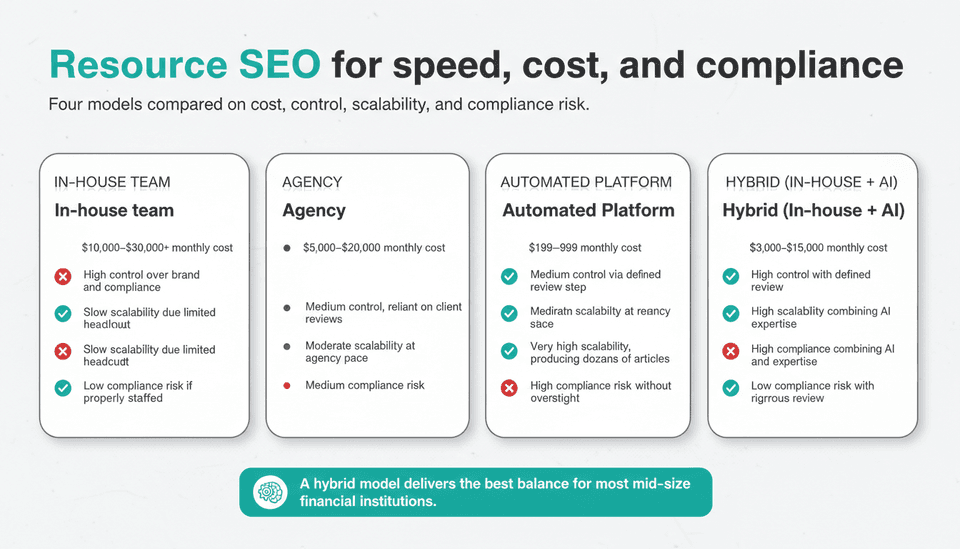
There’s no single correct answer, but there’s a right answer for your stage and compliance appetite.
| Model | Monthly Cost Range | Control | Scalability | Compliance Risk | Best For |
|---|---|---|---|---|---|
| In‑house team | $10,000–$30,000+ | High | Slow | Low (if properly staffed) | Enterprises with strict legal/PR requirements |
| Agency | $5,000–$20,000 | Medium | Moderate | Medium | Firms that need strategy + execution, clear SLAs |
| Automated platform (e.g., Joyrise) | $199–$999 | Medium (via review) | Very high | High without oversight | Scaling content while keeping team lean |
| Hybrid (in‑house + AI platform) | $3,000–$15,000 | High | High | Low (with defined review) | Most mid-size banks, fintechs, insurers |
In‑House Teams: Full Control, Steep Cost
You get total alignment with brand, legal, and product. But hiring a finance-savvy content strategist, an SEO lead, a compliance editor, and a writer costs more than most smaller institutions can stomach. Even then, velocity is limited because every new hire adds management overhead. For companies publishing 10 articles a month, in-house is often slower than a machine-augmented competitor.
Agencies: Expertise, but Slow and Expensive
Specialized financial services content SEO agencies exist, and the best of them understand nuance — but they cost accordingly and typically move at agency pace. Also, most agencies will not embed deeply enough into your compliance process; they’ll rely on your team for reviews, which creates a bottleneck.
Automated Platforms: Speed and Scale, but Requires Oversight
AI-native content platforms let you produce 30, 80, or 180 articles a month at a fraction of the cost of an agency. The trade-off is clear: you must invest in a review step. But with a well-written prompt, a vetted brand voice, and a compliance checklist, this becomes a manageable 15-minute review per article. For teams who need to build authority fast, it’s often the only way to keep up with the content velocity required to compete. However, as explained in The Definitive Guide to SEO AI Agents (2026), the quality of the AI model matters enormously — generic GPT wrappers output generic content that sounds confident but is often subtly wrong, which is the most dangerous kind.
A Hybrid Model That Works for Modern Finance Marketers
Set up an automated platform to generate research-backed drafts and publish after your SME gives a quick signoff. Keep one in-house strategist to own keyword selection, topic clusters, and performance analysis. This combination gives you the speed of AI and the authority of human expertise, at roughly one-third the cost of a full agency retainer.
Common Mistakes and Myths in Financial SEO
Myth: You Can Ignore Technical SEO if Your Content Is Great
Plenty of brilliant financial articles sit on sites that load in six seconds, have broken internal links, and no structured data. Search engines don’t give charitable rankings. Technical hygiene is the foundation; if your site is a mess, even the best content won’t save you.
Mistake: Copying Consumer SEO Tactics into a YMYL Space
Listing “Top 10 Best IRA Accounts” without any methodology, disclosures, or expert reviewers might work for a comparison site that’s already authoritative — but not for a bank or fintech trying to establish trust from scratch. That type of content can trigger E-E-A-T gaps that lead to ranking drops. You need to show your work.
Myth: AI Content Will Get You Penalized
Google has explicitly stated that it cares about content quality, not how it was produced. The danger isn’t the AI; it’s publishing synthetic content that lacks evidence, makes unsubstantiated claims, or fails to serve the user. Penalties come from low-quality output, not the tool that wrote it. Finance marketers who conflate the two end up leaving a massive efficiency lever on the table.
Mistake: Overlooking Internal Linking and Site Architecture
A well-structured internal link graph can do more for rankings than a dozen mediocre backlinks. Yet finance sites often neglect this because it’s unglamorous. Every pillar page should link to its spokes, every spoke back to the pillar, and every article should pass relevance through contextual anchor text. It’s free equity you’re leaving unused.
Recent Developments and the Future of SEO for Finance
The 3.7x ROI Benchmark and What It Means for Budgets
On November 9, 2026, Yahoo Finance published a press release from Outpace SEO stating that their data-driven campaigns generate an average 3.7x client ROI. Whether or not you believe a single agency’s self-reported number, it reflects a shift: finance marketers now expect SEO investments to show documented returns, not just vague traffic gains. This pressure is healthy. It forces programs to tie every article and technical fix to a revenue pathway. The benchmark gives you a conversational anchor when requesting budget: if you can’t project at least a 2-3x return in 12-18 months, your strategy needs tightening.
AI‑Native Workflows Are Reshaping How Finance SEO Gets Done
The combination of fine-tuned language models, automated publishing pipelines, and structured compliance checks is redefining what’s possible. Instead of waiting eight weeks for an agency to turn around one pillar page, a lean team can launch an entire topic cluster in a month. The winners are finance brands that treat AI as an assembly line: the machine does the drafting, the human applies judgment. Those still treating SEO as a completely manual craft are being outpublished and outranked.
Getting Started: Your First 90‑Day Plan
This isn’t a generic onboarding checklist. It’s designed to produce measurable movement while building the operational foundation for scaling.
Days 1–30: Audit and Foundation
- Complete a technical SEO audit and fix critical errors (page speed, HTTPS, broken links).
- Inventory existing content and map it to product categories.
- Define your compliance review workflow and create a style guide with approved language.
- Identify 10 high-intent, low-competition keyword clusters using research tools.
Days 31–60: Build the Core Cluster
- Publish one pillar page and at least four supporting spoke articles, all reviewed by SMEs.
- Implement internal linking and structured data.
- Begin outreach to 20 trusted domains (industry groups, .edu financial literacy programs) for link opportunities.
Days 61–90: Scale and Optimize
- Ramp up content production using an automated drafting process with human review.
- Add three more clusters.
- Connect organic data to CRM conversions and build an SEO P&L.
- Report on the first material conversions attributed to organic.
Key Takeaways
- SEO finance is defined by regulatory scrutiny and YMYL standards; generic SEO tactics fail without deep authority signals.
- The most efficient model for most financial brands today is a hybrid system: AI drafts content at scale while human experts review for accuracy and compliance.
- A 3.7x ROI is a defensible target for data-driven finance SEO, but you need attribution that traces organic content through long buying cycles.
- Topic clusters, internal linking, and technical integrity are non-negotiable — they form the trust infrastructure Google evaluates.
- You can safely use AI in finance content if you treat every draft as a starting point and build a rigorous review step around it.
Ready to scale your financial content engine without sacrificing trust? Start publishing thoughtful, reviewed articles with Joyrise.