 Joyrise
SEO Prompts for ChatGPT: A 2026 Playbook
 By Alexi · · 21 min read

On this page
- Executive summary
- What are SEO prompts for ChatGPT?
- How ChatGPT actually works on SEO tasks
- The core prompt library
- A practical ChatGPT SEO workflow from prompt to published page
- Manual prompting vs team workflows vs automation
- Industry-specific prompt patterns
- Mistakes, myths, and limitations
- Next steps: build your first five-prompt system
- Key Takeaways
Executive summary
SEO prompts for ChatGPT are no longer just a way to speed up a blog draft. In 2026, the same prompts you use for content ideation also determine whether your brand appears — or disappears — in the answers buyers see before they ever open a search engine. This guide treats ChatGPT as a distribution channel you can measure. You will find prompts that audit AI-search visibility, a ChatGPT SEO workflow that logs Search Console answer impressions, and a clear breakdown of manual prompting versus automated publishing platforms like Joyrise. You will also get industry-specific patterns for dealer purchase queries and B2B vendor shortlists, drawn from recent shifts in how people shop and evaluate. By the end, you will have a five-prompt starter system and a way to judge whether the effort pays for itself — without mistaking a good prompt for a guaranteed ranking.
What are SEO prompts for ChatGPT?
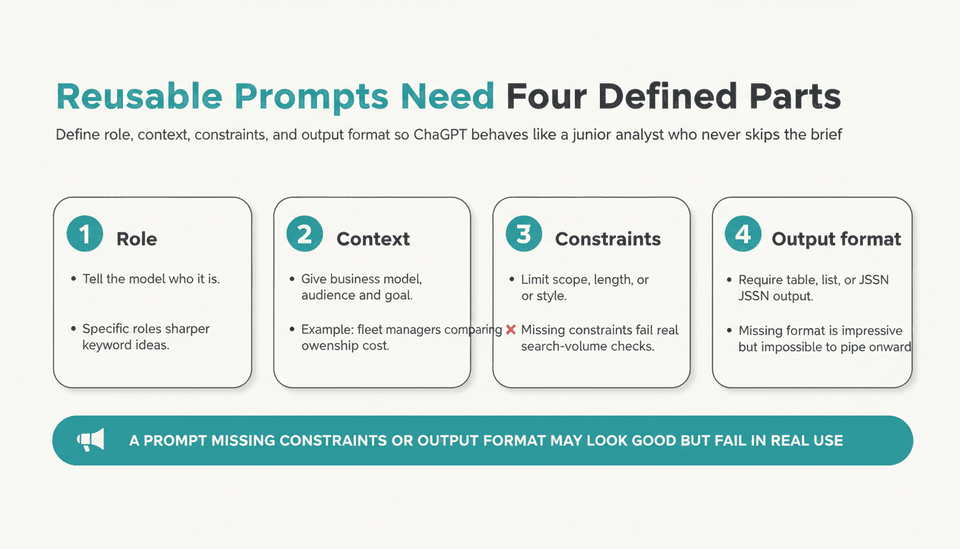
An SEO prompt for ChatGPT is any instruction that directs the model to produce output useful for search engine optimization — a keyword cluster, a content brief, a meta description, or even a list of sources it would cite if asked about a topic. These prompts work best when they define role, context, constraints, and output format so precisely that the model behaves like a junior analyst who never skips the brief.
In 2026, the term also covers prompts aimed at AI search visibility: asking ChatGPT which brands it would name for a query, whether it would recommend a specific page, and how often it references a site across multiple comparison-style questions. This second layer turns a drafting assistant into an audit tool.
The four parts of a reusable prompt: role, context, constraints, output format
Every reusable SEO prompt needs four elements to produce reliable output:
- Role: Tell the model who it is. “You are an SEO content strategist for a direct-to-consumer auto parts brand” will produce sharper keyword ideas than “act as an SEO expert.”
- Context: Give it the business model, audience, and a specific content goal. For example, “Our audience is fleet managers comparing total cost of ownership. We need a cluster around electric van maintenance schedules.”
- Constraints: Limit the output in scope, length, or style. “Only include keywords with a realistic commercial intent that a small team could rank for within six months. Skip obvious head terms.”
- Output format: Require a table, a nested list, or a JSON object so the result can feed the next step in a workflow. A prompt that ends with “return a CSV with columns: topic, primary keyword, difficulty estimate in plain English” is easier to operationalize than one that just says “give me a list.”
A prompt missing the constraint layer often produces plausible-looking suggestions that fail when you check search volume. A prompt missing format may be impressive to read but useless to pipe into a CMS or a planning spreadsheet. For a comprehensive set of ready-to-use examples, refer to 30 Best ChatGPT Prompts for SEO (with Examples).
Commonly confused terms: SEO prompts, AI SEO, and post-search agent relations
Three terms get tangled:
- SEO prompts for ChatGPT refer to the instructions you give ChatGPT itself — the text you type.
- AI SEO is the broader practice of optimizing content so that AI search engines, voice assistants, and answer engines surface your brand. It includes technical optimizations, entity coverage, and citation building.
- Post-search agent relations is a newer concept, popularized by Y Combinator-backed startup Manicule (Detroit Free Press, October 27, 2026), which builds automated “execution rails” so that technical brands get discovered, recommended, and used across AI assistants rather than just passively tracking visibility. Agent relations treats ChatGPT, Claude, and similar tools as channels where you need a presence, not just a backlink profile.
Understanding the difference matters because a prompt that works for a blog outline may do nothing for your AI-search visibility. The prompt itself is the tool; the strategy is which prompts you run and how you act on the output.
What are AI SEO prompts and why do they work?
AI SEO prompts work because they reduce the cost of the repetitive, judgment-light parts of SEO — clustering concepts, drafting variants of meta descriptions, or generating 50 title tag alternatives — and let a human spend time on the decisions that move the needle. They also work for discovery: when you prompt ChatGPT to surface gaps in your topic coverage or to list competing brands it would mention before yours, you learn something a keyword tool cannot tell you.
The mechanism is not magic. The model has been trained on a large corpus that includes billions of web pages, product descriptions, and editorial comparisons. A well-framed query can retrieve patterns from that corpus that approximate a market scan — provided you verify the output with real data afterward.
How do you build a reusable prompt for SEO?
Start with the four-part template above. Write the prompt in a note or a team library, test it on three topics, and adjust the constraints until the output fits your next action without manual reformatting. A reusable prompt should produce predictably shaped output every time.
Example reusable prompt for keyword clustering:
You are a search-focused content planner for a B2B payroll software company. Audience: small business owners who employ 10–50 people and want to switch from spreadsheets. Given the seed topic [automated payroll tax filing], generate 12 keyword clusters. Each cluster should contain a primary topic, 3–5 related subtopics, and an estimate of the commercial intent (low/medium/high). Return a table with columns: Cluster Name, Subtopic Keywords (comma separated), Intent.
This prompt gives role, context, constraint (12 clusters, specific columns), and output format. It runs consistently whether you paste it once a month or embed it in a no-code automation.
How ChatGPT actually works on SEO tasks
ChatGPT is a text generator built on a large language model. It does not crawl the web in real time (even with browsing mode, it is not a crawler), does not know your site’s rankings, and cannot authenticate into a Google Search Console account. It works by predicting token sequences that match the pattern of useful SEO output it has seen in training data.
Tasks it handles well: keyword clustering, briefs, outlines, rewrites, metadata
The highest-return tasks for ChatGPT in SEO are high-volume, low-risk text operations:
- Keyword clustering: Grouping hundreds of keywords into thematic buckets after you export them from Ahrefs or Semrush.
- Content briefs: Producing a skimmable brief with target audience, intent, suggested headings, and questions to answer — faster than a human template.
- Outlines: Generating first-draft article structures that a subject-matter expert can correct in minutes.
- Rewrites: Reframing a product page’s value proposition for a different audience, like turning technical specs into a comparison table for buyers.
- Metadata: Writing 30 unique title tags and meta descriptions for a category page template; a human editor reviews and selects the best.
In every case, the model saves time on the first draft. It does not replace the judgment that decides which keyword cluster actually deserves a dedicated pillar page.
Tasks it cannot do reliably: live rankings, site audits, citation guarantees, brand-name verification
There is a hard line between text work and site-access work. ChatGPT cannot audit a live site — it has no way to run a crawl, validate structured data, or detect a 404. If you feed it a Screaming Frog export or a Search Console coverage report, it can help interpret patterns, but the prompt must include the raw data and a clear instruction to “act as an SEO auditor reviewing the attached CSV.” The same boundary applies to verifying that your brand is present in ChatGPT’s own answers: it cannot self-report with certainty because it does not store a fixed memory of past responses, and logged-out behavior varies.
A common disappointment is asking the model to “find technical SEO issues on my site.” Without the actual crawl data pasted in, it will generate plausible but made-up issues. The reliable pattern is: export real data, then use a prompt to cross-reference it against best practices.
What are the benefits of using ChatGPT for SEO?
The primary benefit is throughput. A single marketer can complete in an afternoon what used to require a content agency and a week. The cost per brief or meta description drops by an order of magnitude, which matters for teams that need to optimize thousands of pages. ChatGPT also surfaces unexpected angles — related questions, competitor gaps — during ideation, which a purely formulaic process can miss.
What are the limitations of using ChatGPT in search engine optimization?
Hallucinated sources, outdated training cutoffs, and no live ranking data are the obvious limitations. The subtler one is false confidence: a prompt that produces elegant prose can feel authoritative enough to publish without a fact check. That gap has caused brands to publish content with invented statistics and ghost citations. Another limitation is context window; lengthy prompts that include full articles may lose coherence. You will still need a human editor, a trustworthy source list, and a measurement loop that connects content to actual search performance.
The core prompt library
Below are prompt patterns organized by the task they solve. Every prompt here has been selected because it requires minimal adaptation and feeds a real workflow step.
Keyword research and topic clustering prompts (ChatGPT for keyword research)
Best used with a seed list exported from a keyword tool. This prompt groups by shared intent:
You are an SEO strategist specializing in home services. Given this keyword list [paste], group keywords into no more than 8 clusters based on shared user intent. Name each cluster, list the keywords, and suggest a pillar page title. Return as a table.
For finding keywords a tool may miss, use a prompt that simulates a customer’s question chain:
A homeowner who just noticed a water stain on the ceiling will search for information in stages: diagnose, DIY fix, hire a pro, prevent. For each stage, list 5 long-tail questions and the keyword phrase a search might start with.
After you have clusters, connect the output to your site’s structure: feed the model a list of existing URLs and ask which cluster has no matching page. This gap analysis becomes an editorial calendar.
Competitive and content-gap analysis prompts
Feed the model a competitor’s article title or an outline and ask:
I will paste the H2 and H3 headings from a competing article on [topic]. Tell me which user questions it answers, which it avoids, and what a superior article would include that this one misses. Use a checklist format.
For a broader scan, ask ChatGPT to simulate a buyer’s comparison journey:
A B2B buyer searching for “inventory management software for manufacturers” will evaluate at least 5 vendors. Name the vendors you would naturally mention, what criteria you would use to compare them, and which evaluation questions the search results rarely answer well.
This second prompt feeds directly into content planning: you can write a piece that addresses the unanswered questions. B2B buyers now ask ChatGPT for vendor shortlists before they open Google (BBN Times, October 29, 2026), so a content-gap prompt that reveals evaluation criteria also becomes a discovery prompt.
On-page, technical, and content optimization prompts (ChatGPT on-page SEO prompts)
On-page prompts are straightforward. Feed the model a draft and ask for an SEO pass:
You are an editor optimizing for both Google and answer engines. Improve the following draft for readability and entity coverage: add clear definitions, break walls of text, and suggest where to insert internal links to pillar pages about [related topics]. Keep the original voice.
As highlighted in 5 ChatGPT Prompts To Help You Improve The SEO Of Your Content, this kind of structured rewrite can lift on-page engagement metrics when an editor verifies accuracy. For technical SEO, do not ask ChatGPT to audit a site. Instead, paste a snippet of structured data output or a list of URLs with status codes, and prompt:
I will paste a list of URLs and their indexability status from Search Console. Identify patterns in crawl waste, such as parameter-heavy URLs or thin pages indexed in error, and suggest a prioritization order for noindex or canonical fixes.
This method uses the model as a pattern spotter, not a diagnostic tool. It is fast and often catches things a busy SEO might overlook in a raw export.
What are the best ChatGPT SEO prompts?
The best ChatGPT prompts for SEO are the ones that output a directly actionable deliverable for the next step of your workflow, not a lecture. The keyword clustering prompt above, the content-gap checklist prompt, and the brand mention audit prompt (next section) top the list because they replace hours of manual sorting. A prompt that simply asks “write an SEO-optimized article about X” without source material and structure constraints is not among the best — it produces generic content that rarely ranks well or gets cited in AI answers.
AI-search visibility and brand mention audit prompts (brand mentions in ChatGPT)
This is the layer that almost no ranking page covers. In 2026, your visibility in ChatGPT’s answers is a separate metric from Google rankings, and you can prompt the model to surface signals about your presence.
How can you check whether ChatGPT will name your brand or cite your page?
Run a set of comparison prompts in a fresh chat session (logged out or in incognito mode if available) that mimic how a purchaser or researcher queries the tool. For each query, ask a follow-up: “Would a specific brand or article be a better source for that answer? Name one.” Track whether your brand appears. A prompt sequence for a DTC mattress company might be:
- “What are the three most durable hybrid mattresses under $1,500?”
- “For each mattress mentioned, cite a review source or test result.”
- “If a shopper wanted a brand that offers a 365-night trial, which of those would you recommend?”
New research from Graphite, reported by Search Engine Journal (October 27, 2026), found that brands ChatGPT rarely named without search also showed up less when it searched, even when pages had cited coverage. That means a brand that does not appear organically in a prompt like the one above also tends to be skipped when the model is given a search-enabled prompt. The opposite holds too: brands that ChatGPT mentions readily in unaided prompts often appear when the model “searches.” This pattern upgrades the simple brand-mention check from a vanity exercise to a leading indicator of AI-search visibility.
A reusable audit prompt that you can run monthly:
Without searching, list the top 5 [product category] providers you would mention to a buyer who asks for a trustworthy option under [price threshold]. For each provider, state why you chose it, then suggest one specific page URL that could support the recommendation. I am testing brand recall, not purchasing your service.
Run it for your category and note whether your brand makes the cut. If it does not, your next SEO task is not more blog posts — it is building the citations, third-party coverage, and entity clarity that might change the model’s retrieval patterns. For a deeper dive on how to influence these answers, see ChatGPT GEO: A Practical Guide to AI Answer Visibility.
A practical ChatGPT SEO workflow from prompt to published page
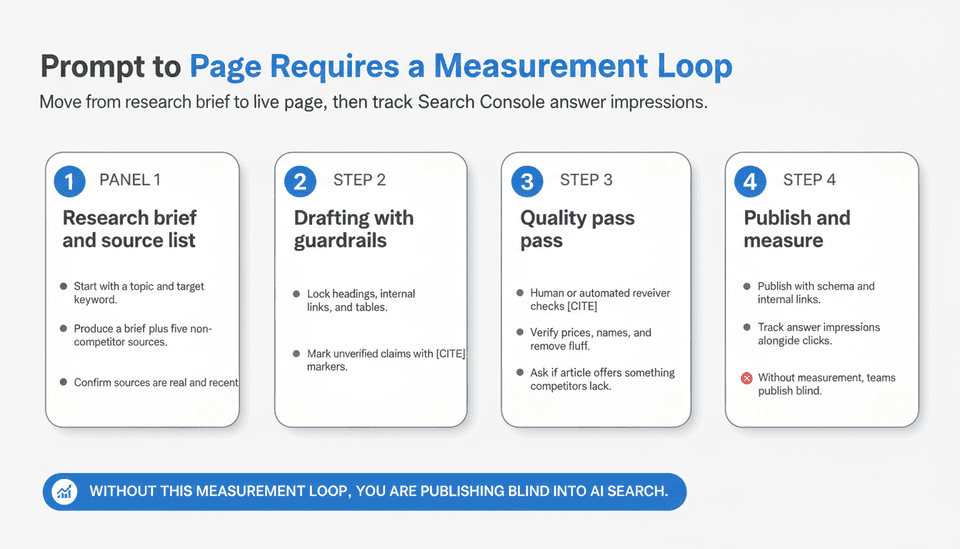
A good prompt is worthless if the output sits in a text file. The following workflow moves from research brief to a live page with a measurement loop attached. It assumes you are using ChatGPT as the drafting assistant, with a human or automated quality reviewer, and that you publish to a CMS where you can see Search Console answer impressions.
Step 1: Research brief and source list
Start with a topic and a target keyword. Use a prompt to produce a brief that includes user intent, questions to answer, and a source list of at least five non-competitor pages you will fact-check against. Example:
Create a content brief for a long-form article targeting the keyword “home battery backup cost 2026.” Audience: homeowners who already have solar. Output sections: primary intent, secondary intents, questions to answer, suggested H2s, and a source list of 5 authoritative pages (government, utility, or journalistic) I should reference. Do not invent data.
The source list is the most important output. It gives you a fact-checking trail and reduces the chance you will publish a hallucinated statistic. After the brief, manually confirm the sources are real and recent.
Step 2: Drafting with guardrails for headings, internal links, and tables
Feed the brief and the verified source list into a drafting prompt that locks the structure:
Using the brief below and the source list (I will paste), draft an article of approximately 1,500 words. Follow these rules: use exactly the H2 headings from the brief; include at least one comparison table with price ranges drawn only from the sources; insert internal link placeholders in brackets where a link to our pillar page on [topic] fits naturally. Do not invent figures not found in the sources. Mark any claim that needs a citation with [CITE].
The [CITE] markers force a second human pass, while the table format gives the article a visual element that often gets featured in AI answers. For a detailed breakdown of using ChatGPT specifically for keyword research within this step, see How to Use ChatGPT for SEO Keyword Research.
Step 3: Human or automated quality pass
A human editor reviews [CITE] markers, verifies prices and names, and removes fluff. In a team, this step is non-negotiable. Automated publishing platforms like Joyrise add an AI quality judge — essentially a second model that reviews the first draft against the brief before publishing — which can catch obvious errors at scale. Whether human or machine, the pass answers three questions: Are the claims anchored in the sources? Is the brand’s view clearly stated? Does the article contain at least one thing a competing page does not?
Step 4: Publishing and measuring Search Console answer impressions
Publish the page with proper schema, a table of contents, and the internal links you marked. Then switch from production to measurement.
What should an SEO plan include now that Search Console counts answer impressions?
Google Search Console now reports answer impressions — instances where your page appeared as a source or influence for an AI-generated answer (CMSWire, October 27, 2026). Your plan must include the following:
- Track answer impressions alongside clicks. A page with high answer impressions but low clicks may still be supplying authority to AI answers, which can drive downstream conversations that never touch your site.
- Use answer impression data to identify topics where your content is being cited but not visited; optimize those pages to convert visitors when they do arrive, and add a prominent brand mention and call-to-action because the answer may be the only “visit.”
- Set up a quarterly audit prompt that asks ChatGPT for sources on those high-impression queries. If your page has stopped being cited, investigate whether fresher competitor content has displaced you.
Platforms that integrate Search Console directly — Joyrise, for instance, bundles an answer impression dashboard — let you see the trend without manual exports. Without this measurement loop, you are publishing blind into the AI-search environment.
Manual prompting vs team workflows vs automation
Choosing how you use ChatGPT for SEO is a resource-allocation question, not a prompt-engineering one.
Manual ChatGPT templates and their tradeoffs
You keep a library of prompts in a Notion page or a shared doc. For each article, you paste, run, copy the output, and format for your CMS. Cost is near zero; time investment is high if you publish more than a few pieces per month. Quality depends entirely on your editor. This approach works for a founder who writes one pillar post a quarter but breaks down when you want to publish three times a week.
Shared prompt libraries and team tools
Teams often move prompts into a tool like Team-GPT or a custom Slackbot so multiple writers use the same instructions. This raises consistency. The bottleneck shifts to the manual steps of image sourcing, internal linking, and publishing. You still need a person to hit “publish” and another to check Search Console. The tradeoff is coordination overhead versus output volume.
Full automation platforms like Joyrise
When a business needs daily published articles without scaling headcount, full automation becomes the rational choice. Joyrise is a subscription platform that plans posts from deep site scans, drafts long-form illustrated articles with original images, applies an AI quality pass, and publishes directly to a Webflow blog — all while logging answer impressions in an integrated Search Console dashboard. For $199/month (Basic tier), it replaces the manual chain of research, drafting, image generation, and scheduling. The tradeoff is you give up line-by-line control in exchange for speed and volume. For a marketing team that currently pays an agency thousands per month for a handful of posts, the unit economics shift dramatically. The key is that the platform is not just a prompt wrapper; it orchestrates the entire workflow, including an automated quality judge that rewrites a draft if it fails the brief — a guardrail that plain ChatGPT cannot offer on its own.
How do manual ChatGPT prompts compare with full automation for SEO content?
Manual prompts give you fine-grained control — every sentence can be tweaked — but they do not scale. Full automation trades control for consistent output at volume, with built-in SEO structure and measurement. The right answer for a startup founder with a high-touch audience may be manual; the right answer for a dealer group that needs to answer hundreds of local purchase queries is automation. The middle ground — shared libraries plus a VA — often fails because the VA cannot do the SEO quality pass quickly enough, and the feedback loop breaks. Decide based on how many pages per month you actually need to publish to move the needle.
Industry-specific prompt patterns
General SEO prompts miss the intent that drives revenue. Two patterns that emerged in late 2026 show how specific these need to get.
Local and dealer purchase queries from ChatGPT
Three days ago, Automotive News reported that a shopper opens ChatGPT on their lunch break and types “which all-wheel-drive midsize SUV holds its resale value best after five years, and which dealers…” (Automotive News, October 27, 2026). This is not a generic search; it is a prompt that includes a purchase decision, a product attribute, and a dealer selection in one query. Dealer marketing teams must now prompt-engineer their way into those answers.
A dealer-specific prompt pattern for your own audit:
Without searching, name the three midsize AWD SUVs you would recommend for 5-year resale value. Then, name one specific dealer for each recommendation within 50 miles of [zip code]. Explain your choice.
If your dealership does not appear, your content and entity profile need work. You likely need location pages that explicitly match the attributes the model favors — resale value data, awards, inventory feeds — and a knowledge graph presence that connects your dealership to the manufacturer. This is a prompt you run monthly per franchise.
B2B vendor shortlist and evaluation prompts
BBN Times (October 29, 2026) confirmed what many operators already suspected: B2B buyers now ask ChatGPT for vendor shortlists before they open Google. This makes the shortlist prompt the new top-of-funnel battleground.
A recurring prompt you can use to gauge your position:
A VP of Operations at a mid-market manufacturer needs a predictive maintenance platform. List 5 vendors you would suggest, the main differentiator for each, and a weakness a buyer should watch for. Do not search.
If your company should be on that list but is not, run a gap analysis: feed the model a list of competitors that did appear and ask what entity signals (case studies, G2 reviews, professional association mentions) it thinks made the difference. Then build those signals. The same prompt, run after you publish a new case study, becomes a before-and-after measurement tool for AI-search visibility.
Mistakes, myths, and limitations
Myth: A good prompt guarantees a high-ranking article
A well-engineered prompt can produce a structurally sound, well-researched article, and that article may rank — if the domain authority, backlink profile, and internal linking are in place. Prompt quality alone does not rank a page. The Search Engine Journal piece from October 27 made this clear: ChatGPT rarely named certain brands even when articles from those sources were cited in other contexts. AI-search visibility depends on entity associations, citation frequency, and consistency across the web, not just how you phrased a briefing instruction. Treat prompt engineering as a drafting accelerator, not a ranking lever.
Hallucinated sources, brand omissions, and the measurement gap
Two persistent risks: hallucinated citations and silent brand omissions. When ChatGPT invents a study, you publish misinformation. When it omits your brand in a comparison prompt, you lose a sale you will never know about. The measurement gap — no alert when your brand drops from ChatGPT’s answers — means you must manually re-run audit prompts or rely on a platform that monitors answer impressions over time.
Can you use SEO prompts for ChatGPT to create high-ranking articles?
You can create a publish-ready draft that, after editing, has a chance to rank for long-tail queries if your site already has authority for the topic. But the answer to the literal question is: no, the prompt itself does not ensure high rankings. The confusion arises because some ranking pages imply that prompt quality leads to ranking success. The reality is that the ranking system depends on hundreds of signals outside the prompt. In 2026, you should measure two separate pipelines — Google rankings from published pages, and AI answer visibility from the prompts you use to check brand mentions — and optimize both.
When not to use ChatGPT for SEO
Do not use it when you have no way to verify the claims. If you cannot fact-check a source, do not publish it. Do not use it for real-time decisions like “should I disavow these links” without a human audit. Do not use it as a substitute for reading the actual Search Console data yourself. And do not use it to generate critical product specifications or safety information that carries legal risk. In those cases, the speed gain is not worth the liability.
Next steps: build your first five-prompt system
Stop reading and scaffold a small, repeatable system. Five prompts will cover 80% of the tasks a content team faces weekly.
The five prompts to start with
- Research brief prompt (produces a brief and source list)
- Keyword clustering prompt (groups a keyword export into topics)
- Content-gap analysis prompt (compares your outline to a competitor’s and finds missing questions)
- Brand mention audit prompt (checks whether ChatGPT would name you for a purchase query)
- Post-publish measurement prompt (feeds your latest article and asks what citation it would need to recommend your page next time)
Save these in a shared document with clear titles and an example output. Run them on the same day each month, note the results in a spreadsheet, and you have a baseline.
How to evaluate and iterate your prompt library
After four weeks, look at what each prompt produced and what happened. Did the keyword clusters lead to topics that traffic came from? Did the brand audit prompt surface a gap you addressed with a new partnership or guest post? Revise the prompts that did not yield meaningful action. Add constraints — “exclude topics where we have no domain authority” — and tighten the output format so the result flows into the next tool without a copy-paste tax.
Below is a quick-reference table that condenses the core prompt types and what to expect:
| Prompt type | What it produces | What it cannot do | Iteration signal |
|---|---|---|---|
| Keyword clustering | Thematic groups from a keyword list | Validate search volume; check SERP features | Clusters lead to posts that get clicks |
| Content-gap analysis | Missing questions and evaluation criteria | Judge which gap is worth targeting first | Traffic from the new article surpasses competitor’s page |
| On-page optimization | Rewrite, internal link suggestions, metadata | Fix technical issues; re-crawl the site | Page moves from position >10 to top 5 |
| Brand mention audit | Whether ChatGPT names your brand for a query | Change the model’s retrieval patterns directly | Mentions increase after you build entity signals |
| AI-search visibility monitoring | Before/after snapshot of citations | Provide real-time alerts | Answer impression count in Search Console rises |
Key Takeaways
- A reusable SEO prompt for ChatGPT defines role, context, constraints, and output format to produce predictable, actionable deliverables — not just plausible text.
- ChatGPT speeds up keyword clustering, briefs, rewrites, and metadata at scale, but it cannot audit live sites or guarantee rankings; use it as a drafting accelerator and a pattern spotter for crawl data.
- AI-search visibility is a separate metric that you measure by running unaided brand mention audit prompts monthly and cross-referencing the new Search Console answer impression report.
- A high-ranking article depends on domain authority and backlinks, not prompt craftsmanship alone; treat prompt quality and ranking as two parallel tracks.
- Choose manual prompting when volume is low and control is paramount; choose a full automation platform like Joyrise when you need daily published articles with built-in SEO structure and a measurement loop without scaling headcount.
Ready to move from prompts to a fully automated publishing system that measures answer impressions out of the box? Start your free trial at Joyrise.