 Joyrise
Healthcare SEO: The 2026 Guide to AI-Ready Search
 By Alexi · · 19 min read

On this page
- Executive Summary
- What Is Healthcare SEO? A Plain-Language Definition
- Core Concepts and Terms You’ll Hear
- How the Healthcare SEO Machine Actually Works
- Three Paths to Execution: DIY, Traditional Agency, or Automated Platform
- A 90-Day Implementation Framework
- Integrating SEO with Patient Journey Orchestration
- Common Mistakes and Myths That Derail Healthcare SEO
- Limitations of Healthcare SEO (and What to Do Next)
- Conclusion: Stay Ahead of the AI-Powered Search Revolution
- Key Takeaways
SEO for healthcare in 2026 is a coordination problem as much as a ranking problem. Patients search for symptoms, providers, and care options across Google, ChatGPT, and voice interfaces while marketing teams face tightening budgets and rising content demands. This healthcare SEO guide walks through the new operating model: technical hygiene, authoritative medical content, local signals, AI answer visibility, and patient journey orchestration. The goal is not just more traffic; it is getting the right patient to the right service before a competitor's message does.
Executive Summary
Healthcare SEO is the practice of making medical practices, clinics, hospitals, and health systems visible in organic search and AI answer engines. In 2026, it has two interlocking jobs: traditional search — technical performance, local rankings, reviews, authoritative pages — and generative visibility — being cited, summarized, or recommended by AI Overviews, ChatGPT, Perplexity, and other answer engines.
The organizations winning at healthcare SEO are not chasing traffic volume. They are treating content as a conversion asset connected to patient messaging. The decision rule for 2026 is simple: if your content cannot be extracted by a human or an AI in one clear answer, it is not doing its job.
Recent signals make the shift concrete. WP Intelligence reported on November 13, 2026 that AI is disrupting traditional SEO and affecting the trade deficit, signaling a new era where search strategies must adapt to AI-generated answers. Built In reported on November 18, 2026 that healthcare companies are among those hiring SEO specialists with generative engine optimization skills for ChatGPT and Google AI Overviews. Unite.AI's November 12, 2026 piece on patient journey orchestration describes fragmented messages from multiple healthcare systems — a direct warning that marketing content must align with clinical messaging.
This guide gives founders, marketing leads, and finance teams a plain-language framework: what healthcare SEO is, how it works, where to spend, and how to avoid the mistakes that waste budget. It includes a 90-day implementation plan, a cost comparison, and specific GEO techniques. It does not promise guaranteed rankings or pretend that AI has replaced clinical judgment. Where public sources do not offer exact numbers, this guide says so rather than inventing them.
What Is Healthcare SEO? A Plain-Language Definition
Healthcare SEO is the systematic work of making health-related content visible, trustworthy, and useful when a patient or caregiver searches online. It covers technical site infrastructure, content production, local listings, review management, and — increasingly — generative engine optimization for AI answer engines.
A medical practice doing healthcare SEO well has a site that loads quickly on mobile, service pages that answer real patient questions, provider bios with verified credentials, consistent name-address-phone data across directories, and content structured so Google and ChatGPT can both cite it.
How It Differs from Regular and Medical SEO
Healthcare SEO differs from regular SEO because health queries are treated as high-stakes, or "your money or your life" content. Search engines apply stricter quality expectations around expertise, clinical review, source transparency, and privacy. Industry guides such as WheelhouseDMG's healthcare SEO overview emphasize the same core point: medical search requires credible authors, clear sourcing, and a site architecture that supports patient action.
Health content also has regulatory layers. A blog post about medication side effects, a page about treatment costs, or a telehealth landing page may need legal review, HIPAA-conscious analytics, and careful claims about outcomes. General SEO rarely has to manage that.
Medical SEO is a subset of healthcare SEO. It tends to focus more narrowly on physician practices, provider directories, appointment pages, and local visibility. The broader healthcare category includes hospitals, health systems, insurers, medical device companies, dental groups, urgent care chains, and behavioral health.
Why It Matters: The Business Case for Founders and Finance Leads
The case for healthcare SEO is not that rankings are vanity metrics. It is that search captures demand at the moment of need. A person looking for "sports physical near me open Saturday" or "does my insurance cover a sleep study" has already qualified themselves. Writing and optimizing for that query costs less to convert than interrupting someone with display ads who is not looking.
From a finance view, healthcare SEO is a capital allocation question: should you build an owned organic channel or keep renting access through paid search and third-party lead sites? Owned content compounds. A service page that ranks for a high-intent query can produce appointments for years with limited marginal cost. But it requires technical discipline, authority, and local consistency.
The other business reason is defensive. AI answer engines are already summarizing health information. If your practice is not the source being cited, a competitor or a general health publisher will be. Some of that shift will reduce click-throughs, but the practice that is cited becomes the default answer — and the one patients remember when they book.
What is healthcare SEO, and how is it different from regular SEO?
Healthcare SEO is the practice of optimizing a health organization's web presence for search engines and AI answer engines under higher trust, regulatory, and local-intent constraints. It differs from regular SEO in three ways.
First, intent is predominantly local and urgent. A person searching for a primary care provider, urgent care hours, or a dermatologist usually wants someone nearby, in-network, and able to schedule. Second, content must meet medical E-E-A-T expectations: named reviewers, credentials, publication dates, and honest source citation. Third, AI answer visibility is no longer optional. Traditional SEO focuses on blue links; healthcare SEO now also focuses on being quoted in AI Overviews and ChatGPT responses, where the answer may come from one source and the click never happens.
Core Concepts and Terms You’ll Hear
E-E-A-T for Healthcare: Expertise, Authority, Trust
E-E-A-T stands for experience, expertise, authoritativeness, and trust. It is not a single ranking factor, but it is the framework Google uses to evaluate whether content is credible enough to recommend for high-stakes queries.
In healthcare, E-E-A-T translates into specific practical choices. A page about hypertension medication should have a named author, a reviewer credential such as MD, PharmD, NP, or PA, a clear publication or review date, and references to clinical guidelines. Anonymous blog posts, content written by uncredited AI, and pages that disappear behind gatekeepers all send weak trust signals.
The most underrated part of E-E-A-T in healthcare is experience. A physical therapy practice writing about what recovery actually feels like, including billing friction and scheduling logistics, can differentiate itself from large publishers that only summarize clinical literature. That does not mean sharing patient details without consent; it means reflecting the real questions patients ask in the clinic.
Local SEO and NAP Consistency
NAP stands for name, address, phone number. Local SEO for healthcare depends on NAP consistency across Google Business Profile, Apple Maps, Bing Places, insurance directories, and health-specific listings. Inconsistent data creates doubt and can depress local pack visibility.
Beyond NAP, local listings should include service categories, accepted insurance, appointment scheduling links, provider specialties, languages spoken, and accessibility information. The more a search engine can match your listing to a specific patient need, the more likely it is to surface.
What is the role of local SEO for medical practices?
Local SEO is the highest-leverage channel for most brick-and-mortar practices. A patient searching for a gastroenterologist, OB-GYN, or urgent care is not researching the entire internet. They are asking a proximity question: who is close, credible, and available?
Local SEO helps a practice appear in Google's local pack, Google Maps, and AI Overviews for "near me" queries. It also influences patient perception. Consistent listings and prompt review responses signal operational competence. Missing hours, wrong phone numbers, and conflicting provider names make a practice look disorganized before a patient ever calls. For SEO for doctors, local pack placement can be the difference between filling a new-patient schedule and disappearing into a directory.
Generative Engine Optimization (GEO): The AI Shift You Can’t Ignore
Generative engine optimization, sometimes called AI search optimization, is the practice of improving how your content appears in AI-generated answers, not just traditional organic results. Built In reported on November 18, 2026 that healthcare companies are among those hiring SEO specialists with generative engine optimization skills for AI platforms like ChatGPT and Google AI Overviews. That means the job market itself is already pricing in a shift from blue links to synthesized answers.
WP Intelligence reported on November 13, 2026 that AI is disrupting traditional SEO and affecting the trade deficit, signaling a new era where search strategies must adapt to AI-generated answers. The economic ripples matter because marketing budgets built on old organic assumptions are being reallocated.
For healthcare, GEO is particularly important because AI answer engines often consolidate medical information into a single summary. A practice that publishes clear, structured, citable content is more likely to be the source behind that summary.
How can healthcare providers optimize for AI Overviews and ChatGPT?
Providers cannot game ChatGPT, but they can make themselves the easiest source to cite. The techniques are concrete.
First, write answer-first content. Put a 40-60 word plain-language answer near the top of each page. AI systems extract direct answers more reliably than they parse 1,200 words of background.
Second, structure pages with real patient questions as H2 and H3 headings. "How much does a colonoscopy cost with insurance?", "What happens after a knee arthroscopy?", and "Can I see a doctor today without an appointment?" all make the page more extractable.
Third, use schema. MedicalClinic, Physician, MedicalProcedure, FAQPage, and Organization schema help machines understand who you are, what you do, and where you practice.
Fourth, cite named sources and clinical guidelines. AI answer engines favor content that shows provenance. A claim without a source is less useful to an answer engine trying to defend its answer.
Fifth, maintain consistent entity signals. Use the same provider names, titles, and addresses across your site, Google Business Profile, and external directories. Entity ambiguity is one of the biggest hidden reasons a local practice gets skipped in AI answers.
Sixth, test your pages. Ask ChatGPT or Google AI Overview a nearby query for your specialty and see whether your practice appears. If not, compare the content that did surface and identify what it states more explicitly.
How the Healthcare SEO Machine Actually Works
The healthcare SEO system has four moving parts: technical foundation, content authority, local signals, and AI readiness. When one part breaks, the others underperform.
Technical SEO Foundations for Health Sites
Technical SEO is non-negotiable. The site must load quickly on mobile, use HTTPS, avoid broken internal links, and give search engines a clean crawl path. For healthcare sites, that also means keeping patient-related forms and analytics on compliant infrastructure and refusing to load third-party scripts that expose protected health information.
A diagnostic first step is to run a full crawl and see what is indexable. If service pages are blocked, duplicate, or orphaned, no amount of content will help. One caution: Can ChatGPT Do an SEO Audit? Yes — But Only Up to a Point — it can identify patterns, but it will not replace a hands-on crawl with Search Console and a dedicated crawler.
Content Strategy: Authority, Empathy, and Compliance
Healthcare content marketing is not a volume game. It is an intent-matching game with a compliance layer. A useful content strategy starts with the questions your front desk already answers every day: insurance, prep instructions, wait times, provider availability, and what to expect after a procedure. Most thoughtful healthcare SEO guides, such as GuidewayCare's healthcare SEO overview, reinforce the same point: authority and empathy have to show up before the booking step.
The strongest healthcare content assets are service pages, condition pages, treatment pages, provider bios, insurance FAQs, local landing pages, and pre-visit guides. Each should have an owner, a reviewer, and a clear next step. A page that explains "what causes shoulder pain" but does not tell the reader how to book an evaluation wastes the visit.
The most underused healthcare content type is the logistics page. Insurance coverage questions, referral requirements, parking, telehealth availability, and same-day appointment policies rank for high-intent long-tail queries and reduce call volume.
Local Listings and Review Signals
Review volume, recency, and diversity affect local pack rankings and patient choice. Practices should have a consistent post-visit process for requesting feedback on Google, Apple, and specialty sites. Responses should thank the patient, remain general enough to avoid acknowledging a clinical relationship, and never reveal protected health information.
Local listing optimization also includes uploading accurate provider photos, services, insurance networks, and appointment links. The more complete the listing, the easier it is for Google to match it to nearby patient queries.
Optimizing for AI Overviews and Answer Engines
AI optimization is an extension of good technical and content work, not a separate tactic. The pages most likely to appear in AI Overviews tend to have clear headings, direct answers, schema, and named authority.
A practical checklist for every core page:
- One plain-language answer of 40-60 words in the first 100 words.
- A key facts table with dosage, timeline, cost range, or eligibility.
- H2/H3 headings that mirror patient questions.
- Named author and reviewer with credentials.
- Links to clinical sources or internal pages with more detail.
- Organization, physician, and procedure schema as applicable.
The shift to AI answer engines means SEO is no longer just about click-through rate. It is also about being the source of truth inside someone else's answer.
Three Paths to Execution: DIY, Traditional Agency, or Automated Platform
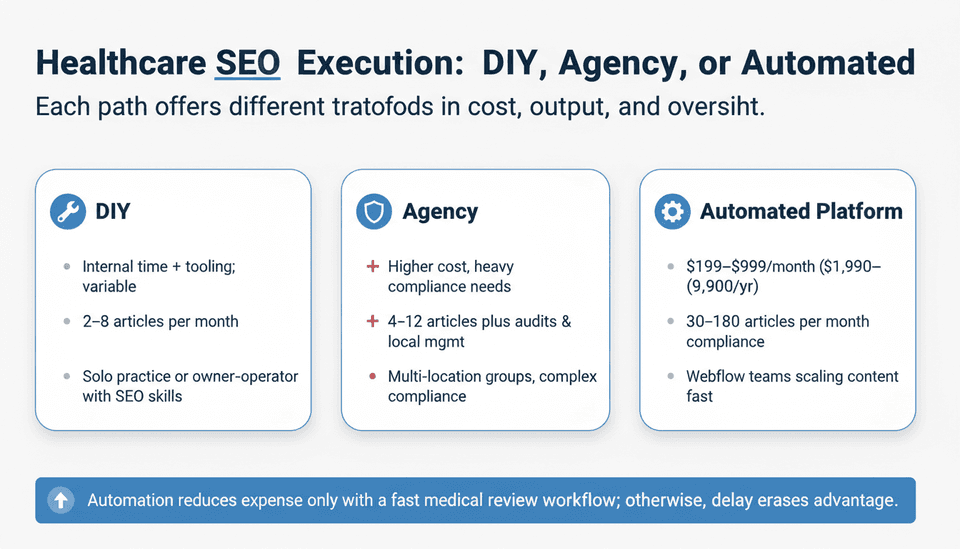
The right execution path depends on budget, review capacity, and speed. Each path has tradeoffs.
When a Hands-On Approach Works
DIY makes sense for a solo practice or a small clinic where the owner has SEO knowledge and the discipline to maintain consistency. A physician-owned clinic can train one front-office staff member to update Google Business Profile, publish monthly service-logistics content, and monitor reviews.
The tradeoff is time. DIY work often slows after the first few pages because clinical work takes priority. The site may rank for a few local terms but never build enough authority to compete for broader service queries.
The Agency Model: What You Get for the Price
Agencies provide strategy, technical audits, content production, local listing management, and often medical review oversight. The agency model works well for multi-location groups, hospitals, and compliance-heavy organizations that need external accountability.
The downside is cost and output. Healthcare agency retainers vary widely by scope and market, but many organizations report monthly commitments that would fund a full content operation elsewhere. Typical deliverables may include four to twelve pieces of content per month, plus technical and local work. Reporting can also be difficult to compare against direct spend.
The Case for AI-Powered Automation (Using Joyrise as a Real-World Example)
Automation changes the unit economics of content production. Joyrise is an automated SEO platform that plans, writes, and publishes daily illustrated articles directly to Webflow blogs. It runs deep site scans to learn brand voice and audience preferences, does SEO-optimized keyword planning based on site data and competitor gaps, generates long-form researched articles with original branded header images and infographics, includes headings, meta descriptions, table of contents, and internal links, and can publish automatically or save drafts for review.
For healthcare teams, the draft review mode is the critical feature. A marketing lead can schedule content, route drafts to a nurse or compliance reviewer, and publish only after sign-off. That keeps humans in the loop while removing the manual research, formatting, and posting work.
The main tradeoff is nuanced. Automated production increases volume and consistency, but volume without clinical review is dangerous. The right AI workflow uses the platform as a drafting and publishing engine, not as an unsupervised medical writer. For more on building that pipeline, see How to Use AI in SEO: Build an Automated Content Pipeline.
How much does healthcare SEO cost, and can automation reduce expenses?
Healthcare SEO costs vary by market, scope, and execution path. Agency retainers can vary widely by geography and service level. DIY costs mostly time and software. Automation can reduce the marginal cost per published page and compress the timeline for building content coverage.
The table below summarizes the execution paths using published pricing for the automated option and a qualitative range for the others.
| Execution path | Monthly cost | Typical output | Best fit |
|---|---|---|---|
| DIY | Internal time plus tooling; variable | 2-8 articles per month | Solo practice or owner-operator with SEO skills |
| Traditional agency | Varies widely; often several thousand dollars per month | 4-12 articles plus audits and local management | Multi-location groups with heavy compliance needs |
| Joyrise automated platform | $199-$999 per month, or $1,990-$9,990 billed yearly | 30-180 articles per month | Webflow marketing teams scaling content at lower cost |
Automation can reduce expenses, but the real savings only appear when the organization has a fast review workflow. If automated drafts sit in a queue waiting for a physician reviewer, the marginal cost advantage disappears into process delay. The financial win is not just writing cheaper; it is publishing faster without sacrificing medical review.
A 90-Day Implementation Framework
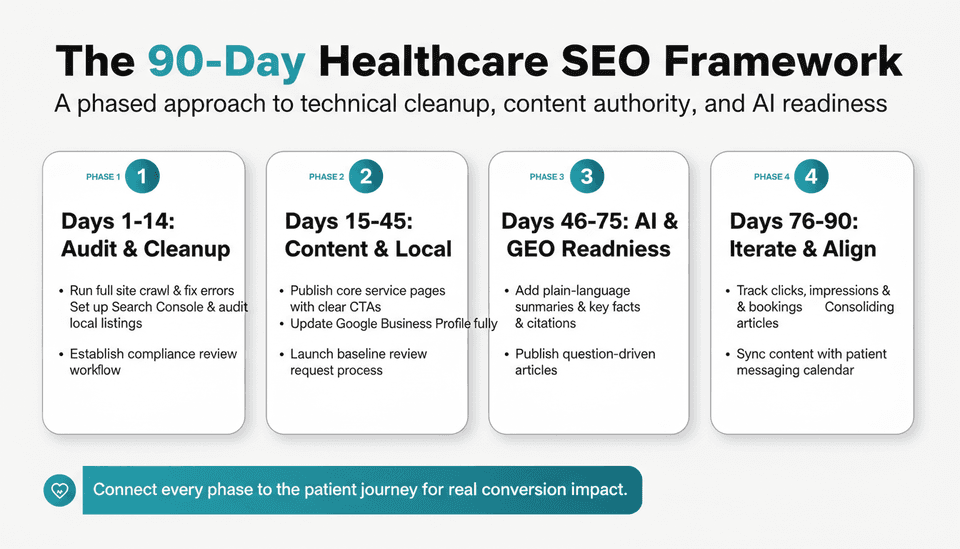
This is the sequence that works for a practice or health system starting from a functioning site with weak organic visibility. The goal is to build technical trust, content authority, local signals, and AI readiness in the right order.
Phase 1: Audit and Technical Cleanup (Days 1–14)
Run a full site crawl and compare indexed pages with intended pages. Fix broken links, unblock important pages, remove duplicate title tags, and verify mobile rendering. Set up Google Search Console and Bing Webmaster Tools with correct sitemap submission.
Create a compliance and review workflow before publishing anything new. Identify the named reviewer for each content category: clinical pages, billing pages, provider bios, and patient stories.
Audit local listings. Record every directory where the practice appears, correct NAP inconsistencies, and claim or verify Google Business Profile, Apple Maps, and Bing Places.
Phase 2: Content Foundation and Local Optimization (Days 15–45)
Publish or rewrite the core service pages that generate revenue. For a primary care clinic, those are annual physicals, urgent visits, chronic disease management, women's health, and vaccinations. For a surgical practice, they are specific procedures, recovery, insurance, and consultation pages.
Each page should have a direct answer, structured headings, a named reviewer, and a clear booking or contact action. Update Google Business Profile categories, services, service areas, insurance information, and appointment links for each location.
Generate a baseline review request process. Do not ask for only positive reviews; ask every eligible patient for honest feedback after the visit. Responsive review management is part of local SEO.
Phase 3: AI Search Readiness and GEO (Days 46–75)
Take the top 20 high-intent pages and optimize them for AI extraction. Add 40-60 word plain-language summaries, key facts tables, FAQ schema, and citations. Ensure the named provider or clinician appears consistently across pages and directories.
Publish a series of question-driven articles that answer specific patient queries: "Does Blue Cross cover physical therapy in [city]?", "What should I bring to a new patient appointment?", "How long does a sleep study take?" These logistics questions are often ignored by large publishers but are directly monetizable for local practices.
Monitor Search Console for AI assistant referrals and the queries that generate them. If a competitor's page is being cited, look at its structure and source transparency.
Phase 4: Measure, Iterate, and Coordinate Patient Messaging (Days 76–90)
Review clicks, impressions, local pack appearances, booking completions, and AI assistant referrals. Use the Ranked Keywords: The Ultimate Guide to Tracking & Growing Positions framework to separate vanity positions from revenue-relevant ones.
Consolidate pages that compete for the same query and redirect them to the stronger page. Expand whatever content type is producing conversion events, not just traffic.
The final 15 days should be spent aligning search content with the broader patient messaging calendar. If the clinical team is sending flu shot reminders, the website should have a flu shot page with eligibility, insurance, and booking. If a new provider joins, every local listing and bio page should go live at once.
Integrating SEO with Patient Journey Orchestration
How Coordinated Messaging Boosts Search Visibility
The link between search and patient messaging is no longer a metaphor. Unite.AI reported on November 12, 2026 that fragmented messages from multiple systems leave patients unable to separate signal from noise, and that orchestration connects every channel so patients get the right message at the right time. The article highlights a stark operational reality: nearly six in ten patients juggle multiple portals without any tool to combine them.
For search, that fragmentation creates bounce. A patient receives a text saying "schedule your annual wellness visit" but lands on a page that only lists provider bios and no scheduling link. The page did its ranking job but failed the patient journey.
Coordinated patient journey orchestration fixes that by mapping search content to the next action. The page that ranks for "annual wellness visit near me" should state what the visit includes, who can book it, how long it takes, what insurance is accepted, and what to bring. It should not read like a generic definition.
Aligning Content with Care Journeys to Reduce Noise
The practical method is to build content around care journeys, not isolated keywords. A patient researching knee pain follows a sequence: symptom search, insurance verification, provider selection, appointment booking, pre-visit instructions, procedure preparation, recovery milestones, and billing questions.
Each stage has its own search queries and its own conversion goal. Align content to those stages. The symptom article should link to the provider page. The provider page should answer insurance and scheduling. The post-visit page should link to billing and follow-up. When the clinical team sends a message, the message should land on a page that answers the next question.
This reduces noise because the patient no longer has to open three portals and call twice. The website becomes the connective tissue, and the search page becomes the handoff point.
Common Mistakes and Myths That Derail Healthcare SEO
What are the most common mistakes in medical SEO?
The most common mistakes are not technical; they are strategic and compliance-related.
Publishing volume content without a named medical reviewer. AI can write about "what causes fatigue" in seconds, but if the page has no clinical review and no local relevance, it will not rank and may create liability.
Ignoring local listings while chasing national keywords. A single-location practice cannot win "diabetes symptoms" against national publishers, but it can win "endocrinologist in [city] accepting new patients."
Tracking traffic instead of conversion events. A page that ranks and attracts visitors but never generates a call, booking, or form fill is not working.
Treating AI Overviews as a traffic threat rather than a citation opportunity. The practice that is not structured to be cited is invisible in a growing share of health queries.
Letting search content conflict with patient messaging. One department says call to book, another says book online, and the website says neither. Fragmented messages reduce trust.
Believing that automation removes the need for human oversight. Automated publishing without a compliance workflow may produce short-term traffic and long-term regulatory risk.
For a fuller comparison of old and new approaches, see AI SEO vs Traditional SEO: Which Actually Wins in 2026?.
Limitations of Healthcare SEO (and What to Do Next)
Healthcare SEO cannot fix a broken patient experience, a poor clinical reputation, or an inaccurate directory. It cannot guarantee that ChatGPT will cite you or that Google will rank your page first. Some queries will be answered by national health systems, professional associations, or large publishers, and no local practice will displace them.
The content here is based on public sources and platform documentation. This guide does not replace legal advice on HIPAA, state medical board rules, or advertising regulations. Compliance requirements vary by jurisdiction, practice type, and service.
What you can do next is narrow and specific. Own the queries your practice can actually win: local service lines, insurance logistics, wait times, provider availability, and procedure-specific recovery information. Make your site the most structured, citable, and action-ready source in your service area. Then connect search content to patient messaging so the click becomes a booked appointment, not just a bounce.
Conclusion: Stay Ahead of the AI-Powered Search Revolution
The healthcare SEO strategy that survives the AI upheaval is not built on trying to outsmart algorithms. It is built on being the clearest, most trustworthy, most structured answer for the queries your practice can actually win. That requires technical hygiene, local consistency, named clinical review, GEO readiness, and patient journey orchestration.
Some of that work is manual and some of it can be automated. The organizations that thrive will automate the mechanical parts — drafting, formatting, publishing, reporting — while keeping humans in charge of medical oversight and final decisions. The ones that ignore AI search will not just lose traffic. They will lose the chance to be the answer.
Key Takeaways
- Healthcare SEO in 2026 is no longer just blue links; it is being the citable source inside AI Overviews, ChatGPT, and local answer engines.
- Local SEO for healthcare is the highest-leverage starting point because most medical searches are proximity-driven and high-intent.
- GEO techniques are concrete: answer-first content, schema, entity consistency, named reviewers, and quotable clinical sources.
- Automation can reduce content production costs, but only if medical review workflows keep pace with publishing volume.
- Patient journey orchestration turns ranked pages into booked appointments by aligning search content with the next step in the care journey.
If you want to put this framework to work without expanding headcount, start with a plan that publishes your first article before you pay.