 Joyrise
Can ChatGPT Do an SEO Audit? Yes — But Only Up to a Point
 By Alexi · · 12 min read

On this page
- Can ChatGPT do an SEO audit? The short answer.
- What parts of an audit can ChatGPT handle reliably?
- What ChatGPT can’t audit — and why that matters
- Does ChatGPT give accurate SEO recommendations?
- How to run a ChatGPT SEO audit step by step
- What is the new ChatGPT Business Hub and how does it affect my audit?
- How does a ChatGPT SEO audit compare to using professional tools?
- What are common mistakes when using ChatGPT for SEO audits?
- Can ChatGPT perform a full SEO audit?
- Key Takeaways
You can run an SEO audit with ChatGPT, but you can’t run a full one. The real answer to “Can ChatGPT do an SEO audit?” is that it can audit the text and on‑page elements you paste into the prompt—flagging weak titles, thin content, or missing keywords—but it cannot crawl your site, check backlinks, or diagnose technical health. What’s changed in November 2026 is that OpenAI launched Businesses in ChatGPT (beta), allowing site owners to claim a profile and submit business information via Business Hub. That gives ChatGPT a verified understanding of your brand, which subtly influences its on‑page recommendations. Yet even with that profile, ChatGPT won’t replace a purpose‑built auditor. We’ll walk through exactly where it adds value, where it falls short, and how to use the new Business Hub to make your audits smarter—and when you need to stop and switch to a dedicated platform. For the broader playbook on using ChatGPT in SEO workflows, see our How Can I Use ChatGPT for SEO? A Practical FAQ.
Can ChatGPT do an SEO audit? The short answer.
ChatGPT cannot perform a full SEO audit because it lacks crawling capabilities, a live backlink index, and access to technical signals like page speed or indexation status. It can, however, handle a subset of on‑page tasks when you supply the raw page data. Think of it as a quick text‑level spot‑check, not a site‑wide health scan. The new Business Hub profile (rolling out November 10, 2026) adds a layer of known business context, so an audit on a claimed domain may produce slightly more tailored guidance, but it doesn’t grant crawl access. In short: ChatGPT audits what you give it, not your actual site.
What parts of an audit can ChatGPT handle reliably?
When you feed ChatGPT your page’s HTML, content, or meta data, it can perform several on‑page checks with acceptable consistency. The rule is: the more structured the input, the better the output.
On‑page elements (title tags, meta descriptions, headings)
This is ChatGPT’s sweet spot. Paste a page’s title, meta description, and H1‑H6 structure, and ask it to audit length, keyword placement, uniqueness, and hierarchy. For example: “Here are the title tags and meta descriptions for three URLs. Flag any that are missing, duplicate, or longer than 60 characters, and suggest rewrites.” It will spot obvious gaps. One caution: ChatGPT estimates character counts—it doesn’t actually count them. Always verify lengths with a tool before publishing.
Content quality and relevance
ChatGPT on-page SEO shines when evaluating whether body text covers the user’s intent. You give it a target keyword and the full content. It can point out missing subtopics, readability issues, or thin paragraphs. A ChatGPT SEO checklist for content might include: does the article address every question a top‑ranking page answers? Is there at least one internal link per 300 words? Is the readability below a 10th‑grade level? ChatGPT can score these if you provide the criteria.
Internal linking structure from existing page data
Export your site’s URLs, titles, and current internal link destinations (from a crawler or CMS). Feed ChatGPT the list and ask: “Which pages are orphans? Which have fewer than two incoming internal links? Suggest 10 new internal linking opportunities with anchor text.” For a site under 100 pages, this often surfaces actionable fixes. But ChatGPT doesn’t know link equity, so it can’t prioritize the way a tool like Ahrefs would. Double‑check every suggested link—the AI sometimes creates plausible‑sounding pages that don’t exist.
Basic keyword usage and semantic gaps
By analyzing the text, ChatGPT can identify if your primary keyword appears in the first 100 words, how naturally it’s used, and which semantically related terms are missing. This feeds into a generative engine optimization audit: it understands the kinds of entities large language models associate with a topic, so it can suggest additions that help both traditional search and AI‑driven answer engines. Just remember, it has no real‑time search volume data—you’ll need a keyword research tool for that.
What ChatGPT can’t audit — and why that matters
The gap list is critical. Recognizing these limitations prevents you from mistaking a partial text review for a complete audit.
Can ChatGPT crawl my website?
No—ChatGPT cannot crawl your website. It has no built‑in crawler. Even if you provide a URL, it can’t fetch the page. You must manually copy and paste content or HTML into the prompt. That means it cannot discover HTTP status codes, page load speed, mobile usability issues, or improper canonical tags. Submitting your site through Business Hub doesn’t change this; it only informs ChatGPT’s business knowledge, not its ability to crawl. So, for any ChatGPT technical SEO audit aspirations, you’ll need a dedicated crawler—it’s completely off the table here.
Live backlink profiles
Backlink analysis requires access to a constantly updated web index—something ChatGPT lacks entirely. It cannot tell you how many referring domains point to your site, which anchor texts they use, or whether they’re toxic. Any specific backlink claim it makes is a hallucination.
Competitor gap analysis at scale
You can paste a single competitor page and ask ChatGPT to compare it to yours—that’s fine for a quick text gap check. But a real competitor analysis demands crawling thousands of pages and comparing keyword portfolios. Tools built for this, like OtterlyAI (which on November 12, 2026 reported more than 170 agency partners across 40+ countries, all answering the question “What does ChatGPT say about our clients’ brands?”), handle the scale and the GEO dimension that ChatGPT alone cannot.
Indexation and sitemap health
ChatGPT has no access to Google Search Console, server logs, or sitemap files. It can’t tell you if a page is indexed, blocked by robots.txt, or accidentally tagged noindex. For indexation health, you must use a dedicated platform.
Does ChatGPT give accurate SEO recommendations?
Generally, yes—when the task stays within text‑level, best‑practice advice and you provide complete data. For a well‑framed prompt like “Audit this category page’s title, H1, and first 200 words for the keyword ‘running shoes for flat feet’,” the recommendations are usually on par with a junior SEO’s sanity check. But accuracy drops sharply when ChatGPT must infer data it doesn’t have. It hallucinates numbers, invents competitor names, and may suggest outdated tags. As Search Engine Land reported on November 16, 2026, the ease of AI execution makes testing more essential than ever. So treat every specific claim—a traffic figure, a broken link URL, a “recommended” schema—as unverified until proven. In practical terms, ChatGPT SEO recommendations are first‑draft suggestions, not final instructions.
How to run a ChatGPT SEO audit step by step
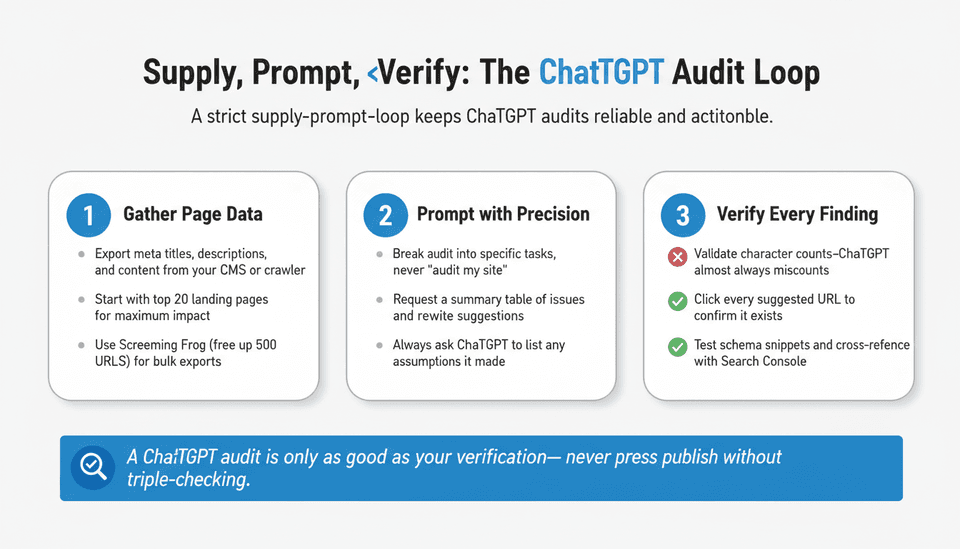
A reliable audit with ChatGPT follows a strict supply‑prompt‑verify loop. For a comprehensive walkthrough, see this ChatGPT SEO Audit Guide 2026.
Gathering your page data to feed ChatGPT
You’ll need exported meta data and content. Options:
- Run a Screaming Frog crawl (free up to 500 URLs) and export titles, meta descriptions, H1s, and word counts.
- Export from your CMS if it produces the required fields.
- For one‑off audits, copy the rendered HTML from a browser’s “View Source.”
For larger sites, start with only your top 20 landing pages from Google Analytics—that’s where impact matters most.
How do you prompt ChatGPT for an SEO audit?
Never prompt “audit my site.” Break the job into specific tasks. A worked example for on‑page elements:
“I’ll give you the title, meta description, H1, and first 300 words of 10 blog posts from a project management SaaS company. For each URL, audit: (1) Does the title contain the primary keyword in the first 60 characters? (2) Is the meta description between 120 and 155 characters and does it include a call to action? (3) Is the H1 unique and descriptive? (4) Does the body text mention the target keyword naturally within the first 100 words? Provide a summary table of issues and specific rewrite suggestions.”
For content quality, ChatGPT SEO prompts like this one work: “Act as a senior on‑page editor. This page targets ‘ChatGPT Business Hub SEO.’ Score its coverage of these subtopics from 1 to 5: claiming a profile, verification steps, influence on recommendations, referral tracking, and GA4 setup. Suggest exactly where to add content.” Always end with: “List any assumptions you made or data you would need to verify before acting.” That surfaces hallucinations. For a ready-made prompt you can adapt, check out this SEO audit prompt for Claude.
How do I verify ChatGPT’s SEO findings?
Use a short, repeatable checklist:
- Validate character counts with a simple online counter; ChatGPT almost always miscounts.
- Click every suggested URL—it may have invented a page.
- Test schema snippets in Google’s Rich Results Test.
- Cross‑reference keywords with Search Console to confirm they have impressions and aren’t already ranking well.
- Recrawl after changes with Screaming Frog to confirm nothing broke.
- Track the impact: after implementing changes, monitor the pages in GA4 and Search Console weekly for at least a month. As Search Engine Land stressed on November 16, 2026, testing and change tracking matter more as AI makes execution easy—you need hard performance data.
What is the new ChatGPT Business Hub and how does it affect my audit?
On November 10, 2026, OpenAI began rolling out Businesses in ChatGPT (beta). According to Search Engine Journal (November 12, 2026), site owners can now submit their website through Business Hub, verify ownership, and provide business details. For an auditor, this shifts a few gears.
Claiming your business profile and what ChatGPT then knows about your site
After you verify your domain and submit your business name, description, category, and logo, ChatGPT can recall that information in relevant conversations. When you then tell it, “This page I’m pasting belongs to my claimed business,” it can cross‑reference your submitted data. That means it can check if your brand name, core offering, or contact details consistently appear—a light form of brand consistency auditing that no free tool offered before.
How this changes on‑page recommendations from ChatGPT
A ChatGPT Business Hub SEO audit gets slightly more contextual. For instance, if your submitted profile says “B2B analytics SaaS for finance teams,” and you audit a landing page, ChatGPT might note that the page never mentions finance departments or omits the registered product name. It’s not a deep technical audit, but it’s a unique on‑page sanity check tied to your verified identity. For a deeper dive into claiming and optimizing your profile, see our ChatGPT Business Claim: The Strategic Guide and the broader GEO context in What Is GEO in the AI World? A Practical FAQ.
Tracking ChatGPT referrals in GA4 to measure audit impact
A practical breakthrough reported by Practical Ecommerce on November 16, 2026: you can now track product referrals from ChatGPT conversations in GA4, with traffic attributed to “chat.openai.com.” If your audit‑driven content improvements lead to more ChatGPT mentions, you’ll see the sessions rise. Set up an exploration report filtered for that source and look for correlation with the pages you optimized. This closes the loop: for the first time, you can measure whether a ChatGPT‑assisted audit leads to actual AI‑referral traffic, not just traditional organic.
How does a ChatGPT SEO audit compare to using professional tools?
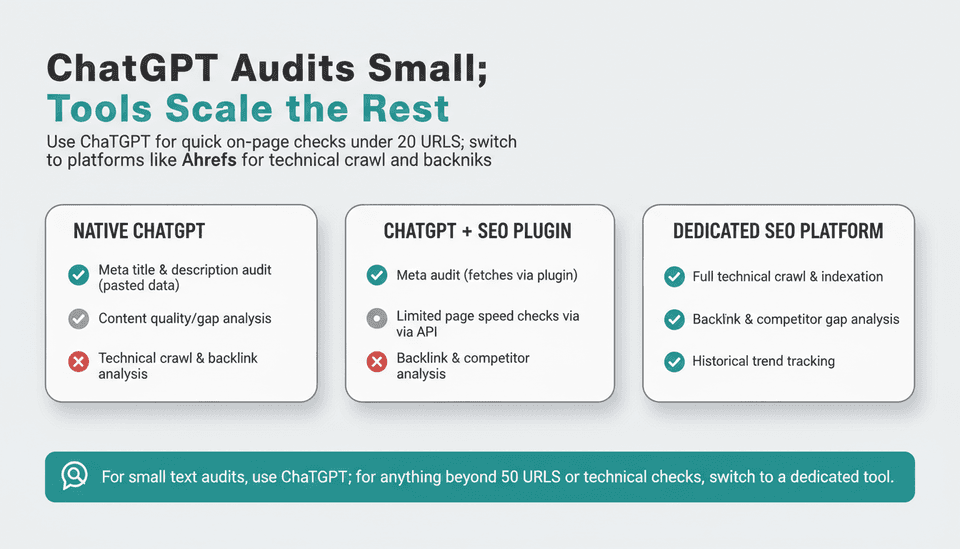
A ChatGPT vs SEO tools comparison isn’t about replacement; it’s about scope. ChatGPT handles small, text‑based audits you initiate; professional tools handle large, automated ones with data you don’t have to paste.
Native ChatGPT vs. ChatGPT with SEO plugins
With native ChatGPT, you bring all the data. Plugins like those on the ChatGPT marketplace can fetch meta data or check HTTP status codes when you provide a URL, and on November 12, 2026, a free Claude Code plugin (Claude SEO) debuted with /seo audit and /geo commands—signaling that AI SEO audit capabilities are spreading across platforms. These plugins speed up data collection, but they still depend on third‑party APIs and don’t rival a dedicated crawler.
When should I use a dedicated SEO platform instead of ChatGPT?
Stick with a ChatGPT audit when:
- You’re auditing fewer than 20 URLs and the focus is on‑page text.
- You need a quick sanity check on meta data or content depth.
- You want to spot semantic gaps and improve GEO alignment.
- Your budget is zero and you accept manual verification.
Switch to a dedicated SEO platform (e.g., Semrush, Ahrefs, Screaming Frog, OtterlyAI) when:
- You need a full technical crawl (status codes, page speed, mobile usability).
- Backlink or competitor gap analysis at scale is required.
- Indexation and sitemap health must be audited across hundreds of pages.
- You need historical trend data for monthly reporting.
- You’re tracking keywords automatically.
A simple rule: if the audit requires more than 50 rows of data to be compared across multiple dimensions, a dedicated tool is the right call—ChatGPT’s attention to detail degrades when it juggles large, cross‑referenced datasets.
| Audit Task | Native ChatGPT | ChatGPT + SEO Plugin | Dedicated SEO Platform (Ahrefs, Semrush, Screaming Frog, OtterlyAI) |
|---|---|---|---|
| Meta title & description audit | ✅ (pasted data) | ✅ (can fetch via plugin) | ✅ (bulk analysis) |
| Heading structure check | ✅ | ✅ | ✅ |
| Content quality/gap analysis | ✅ | ✅ | ✅ (some have content optimizers) |
| Internal linking suggestions | ✅ (limited pages) | ✅ | ✅ (full site crawl, link equity) |
| Keyword usage & semantic gaps | ✅ | ✅ (pulls from APIs) | ✅ |
| Technical crawl (status codes, speed, mobile) | ❌ | ⚠️ (limited API) | ✅ |
| Backlink analysis | ❌ | ❌ | ✅ |
| Competitor gap analysis at scale | ❌ | ❌ | ✅ |
| Indexation & sitemap health | ❌ | ❌ | ✅ |
| GEO visibility tracking | ⚠️ (after Business Hub claim, subjective) | ⚠️ | ✅ (OtterlyAI) |
| Historical trend tracking | ❌ | ❌ | ✅ |
✅ = reliable; ❌ = not feasible; ⚠️ = possible but limited or requires manual effort.
For businesses that want to transform audit insights into published content automatically, platforms like Joyrise can take your audit’s content recommendations and produce optimized, illustrated articles daily—but they still depend on you or a technical tool to supply the crawl and backlink data.
What are common mistakes when using ChatGPT for SEO audits?
Even experienced operators make these three errors.
Hallucinated data and how to spot it
ChatGPT may declare that a page returns a 404, that a specific competitor ranks for a keyword, or that a backlink exists—none of it real. Spotting hallucinations requires treating any numeric or URL‑based claim as suspect until you verify it manually. The 2026 guidance from Search Engine Land is spot‑on: verification is the new optimization.
Outdated information (ChatGPT’s knowledge cutoff)
ChatGPT’s training data ends in early‑to‑mid 2025 for most models. If you don’t provide current context, it may recommend a deprecated SEO tactic or miss the Business Hub feature entirely. At session start, ask: “What is your knowledge cutoff?” and supply any recent guidelines you need referenced.
Overreliance on ChatGPT without human review
An automated SEO audit from an AI becomes dangerous when you implement suggestions blindly. I’ve seen title‑tag rewrites that stripped brand names and tanked CTR. Treat ChatGPT like a junior auditor: its work always needs a senior review. Audit the highest‑traffic pages first, verify the changes with one manual check, and then scale carefully.
Can ChatGPT perform a full SEO audit?
As we’ve seen, ChatGPT cannot perform a full SEO audit; it’s limited to on‑page text checks and lacks crawling, backlink data, and technical analysis. You’ll always need a dedicated tool to complete the picture.
Key Takeaways
- ChatGPT can audit on‑page text elements, content quality, and internal linking for small sets of pages—but it cannot crawl your site or assess technical health.
- Claiming your business via the new ChatGPT Business Hub adds brand‑contextual checks to your audits and lets you track referral traffic from ChatGPT in GA4.
- A disciplined prompt, paired with a verification checklist, makes ChatGPT a useful first‑draft auditor for content‑focused tasks.
- Switch to a dedicated SEO platform as soon as your audit involves technical crawl data, backlinks, competitor analysis at scale, or more than 50 URLs.
- Never act on ChatGPT’s output without cross‑checking key claims and tracking real‑world performance after changes.
When you’re ready to turn SEO audit findings into daily, optimized content that publishes automatically to Webflow, try Joyrise with a free trial at Joyrise.