 Joyrise
Which AI Agent Is Best for SEO? (2026 Decision Guide)
 By Alexi · · Updated · 13 min read

On this page
- What Counts as an AI SEO Agent? (Beyond Standalone Tools)
- Five Criteria for Choosing an AI Agent for SEO
- Safety, Accuracy, and Google’s Stance on AI Content
- Can AI SEO Agents Replace SEO Professionals?
- How Joyrise’s Platform Addresses These SEO Automation Needs
- Frequently Asked Questions on AI SEO Agents
- Three-Question Test: Is an End-to-End Agent Right for You?
- AI SEO Agent Comparison: Standalone Tools vs Full-Platform Agents
- Key Takeaways
Which AI agent is best for SEO? The best AI agent is whichever one fully automates the parts of your content pipeline you need to stop doing manually. For a business that wants researched, illustrated, and published blog posts every single day without touching a CMS, an end-to-end platform like Joyrise is the number one contender. But if you only need AI to handle keyword clustering or first-draft copy that you’ll heavily edit, point solutions or tool stacks work fine. The real question is whether you want a single system that replaces an entire agency workflow—or a helper that still depends on your team to connect the dots. This guide helps you compare AI SEO tools, so you can identify the best SEO AI agent for your specific business needs.
What Counts as an AI SEO Agent? (Beyond Standalone Tools)
The broad spectrum: from keyword assistants to full AI-powered content marketing
An AI SEO agent is any software that can plan, create, or optimize content with minimal human intervention— not just generate text. The term now covers everything from a simple GPT-powered keyword suggestion tool to platforms that run every step of an AI-powered content marketing schedule. At one end you have assistants that draft outlines or rewrite meta descriptions; at the other, you have agents that research topics, write long-form articles, design unique header images, and handle automated content publishing to a Webflow blog on a set cadence.
On November 5, 2026, MerchantFloor launched a Product Listing Agent that turns a product photo and a few bullet points into a complete, SEO-friendly Shopify listing in under five minutes (markets.businessinsider.com). That’s an AI SEO agent for ecommerce. On November 3, 2026, Keytomic released an AI Visibility Tracker and a Reddit AI Agent, which automatically engage in discussions to boost visibility—proof that agents are moving beyond content drafting into live-platform interaction (The National Law Review). These examples show that “AI SEO agent” no longer means a chatbot you prompt; it means a service that does real work inside your marketing stack.
Why a complete content workflow changes the evaluation criteria
When you evaluate agents as a pipeline rather than a toolbox, criteria shift. Standalone tools are judged on output quality in a vacuum—how good is the generated meta description? Does the article need heavy editing? A full-platform agent is judged on how little you have to do after you set it up: does it publish clean, on-brand posts that actually drive traffic with zero copy-paste steps? For a Webflow blog automation setup, that means the agent must handle CMS API calls, internal linking rules, and image generation without choking.
Five Criteria for Choosing an AI Agent for SEO
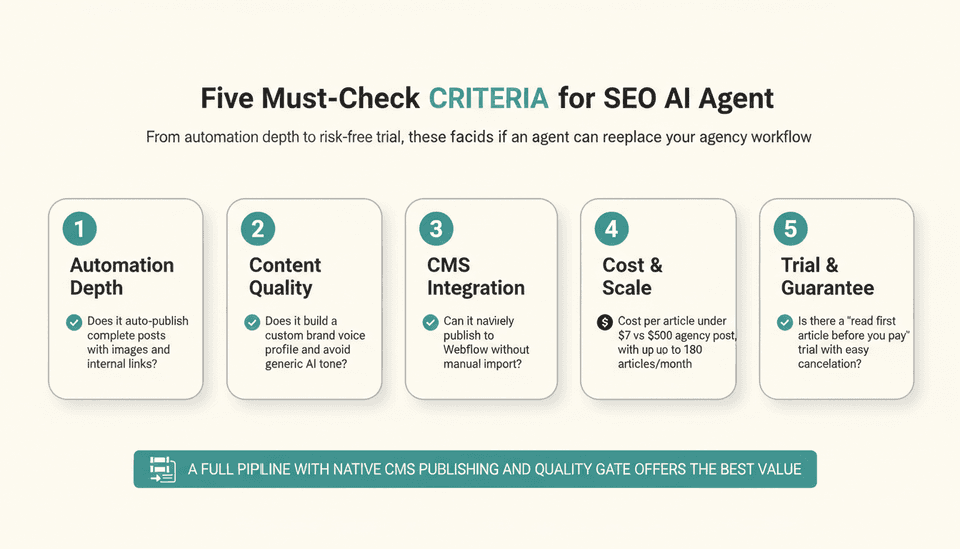
Automation depth: research, writing, illustrations, and automated content publishing
The single most important differentiator is whether the agent publishes a complete, illustrated post without human handoffs. Some “agents” still require you to export text, upload images, and hit publish. Others act as a full SEO content platform: they scan your site to understand your topic gaps, pull in real search data, write the article with in-line citations, generate original branded graphics, and push the entire post live—every day. Check if the agent can schedule posts and if it respects your editorial calendar.
For example, Joyrise’s platform claims to run automatic site scans, create an SEO-optimized keyword plan, generate long-form articles with branded header images and infographics, and handle automated content publishing to Webflow. A tool like Nightwatch’s SEO AI agent focuses on audit reports and ranking monitoring but does not write or post content. That’s the difference between a diagnostic aide and a production machine.
Content quality and brand-voice consistency
AI drafts are only useful if they sound like your company. A full-platform agent should first learn your brand voice from existing site content, product descriptions, and tone guidelines. Without that, you get generic-sounding blogs that fail to build trust. Look for a system that includes a brand-voice modeling step, not just a prompt template. Joyrise, for instance, builds a custom voice profile after a deep site scan and then applies it across articles; this is far more scalable than tweaking each ChatGPT prompt.
CMS integration (with focus on Webflow and auto-publishing)
If you run a Webflow blog, the agent must natively publish to Webflow. Many AI content generators output Markdown or HTML but cannot push content to the CMS—forcing you to do manual import. Joyrise is built specifically for Webflow, with direct auto-publishing. A protocol like WebMCP, recently explained by Semrush (semmush.com), is an emerging standard that could let AI agents navigate websites more safely. A well-built agent should already handle the integration without waiting for new protocols; but the existence of WebMCP signals that safe website interaction is an industry priority. If you use a different CMS, verify the agent’s integration depth—otherwise you’ll spend hours bridging the gap.
Scalability, pricing, and agency cost comparison
Content volume and cost map directly to business size. An AI agent subscription costs a fraction of a traditional agency. As a rule of thumb, an SEO agency retainer might run $3,000–$10,000/month for a handful of posts; an end-to-end platform runs $199–$999/month for dozens or hundreds of articles with illustrations. For the price of one agency post, you can get 30 fully automated blog entries. The trade-off is strategic oversight—more on that later. If you need to replace agency costs entirely, compare the per-article cost: Joyrise’s Basic plan delivers 30 articles/month for $199, which is roughly $6.60/article, while an agency post often exceeds $500.
Trial and satisfaction guarantee as risk mitigation
Adopting an AI agent is a bigger commitment than trying a keyword tool. The only way to evaluate end-to-end quality is to see a finished, published article on your own blog. Platforms that offer a trial where you receive the first complete article before you pay—like Joyrise’s “Read your first article before you pay” model—let you assess everything from voice to image quality without touching your credit card. A no-questions-asked cancellation policy reduces your risk further. Always check if the guarantee covers early termination or if you’re locked into an annual deal.
Safety, Accuracy, and Google’s Stance on AI Content
What Google actually says about AI-generated content
Google’s public position, last updated significantly in early 2023 and still valid in 2026, is that AI-generated content is not inherently penalized. The search engine rewards content that demonstrates E-EA-T (experience, expertise, authoritativeness, trustworthiness) regardless of how it’s produced. In practice, however, many AI drafts lack original insight and factual depth. Publishing raw, unreviewed AI text is risky—Google may not deindex it, but it often won’t rank because it fails to meet quality thresholds. The conflict among sources is real: some SEOs report that “AI content ranks fine” for low-competition terms, while others see short-lived spikes followed by declines. Our reasoned position: AI content is safe only if it passes a thorough quality check, whether human or a second AI quality-judgment pass, and is backed by genuine data.
Built-in accuracy checks: the role of a quality-judgment pass
One effective mitigation is a second AI that acts as a fact-check and rewrite layer. For instance, Joyrise’s Pro and Max tiers run a “quality judge” pass that rewrites the draft to improve clarity, fix contradictions, and remove unsupported claims. This is not a human review, but it catches many of the hallucinations and thin-content issues that would otherwise slip through. It’s a middle ground between pure AI generation and expensive human editing. For safety-critical or YMYL (Your Money or Your Life) topics, you still need a human to verify facts. But for most commercial blog content, a secondary AI rewrite paired with a solid research pipeline significantly reduces risk.
Data reliability and where AI SEO agents get their information
Agents that pull data from live search results, internal site analytics, and trusted news APIs produce more accurate content than those that rely solely on static language model training data. Joyrise, for example, uses a deep-research mode that scans current web sources before writing. Without this, an agent might reference outdated statistics or miss recent developments—such as Keytomic’s Reddit agent launch or the new WebMCP concept. Always ask where the agent’s research layer draws its facts and whether it can cite sources.
Can AI SEO Agents Replace SEO Professionals?
Tasks AI agents handle well
Routine, high-volume content production, technical on-page optimization (headings, meta, internal links), keyword gap identification, and even image creation are tasks where AI agents excel. An agent can produce 30 blog posts a month with consistent formatting and SEO tags, something that would overwhelm a single writer. As noted by Marketer Milk’s tests, AI agents can help a solo operator manage dozens of articles per month without external writers. As an SEO agency alternative, these agents eliminate the recurring cost of content writers, graphic designers, and CMS managers.
Where human oversight remains critical
Strategy, brand narrative, deep editorial judgment, and link-building outreach still need human insight. An AI might suggest related topics but won’t design a product-led content flywheel or negotiate guest post placements. Moreover, any content that makes medical, legal, or financial claims must be reviewed by a qualified human—Google’s latest guidelines stress expertise. So, while an AI agent can replace the execution of an SEO team, it doesn’t replace the SEO strategist. The best setup is a hybrid: the agent runs the daily publishing machine, and a human owner oversees the direction and spot-checks content once a week.
How Joyrise’s Platform Addresses These SEO Automation Needs
(Transparency: Joyrise is the company behind this guide, so we use its platform as a concrete example of the end-to-end model—not as the only option. Other platforms like SEO.ai also offer automated content pipelines.)
Joyrise is an AI-powered content marketing platform that handles planning, writing, and automated content publishing of daily illustrated SEO articles directly to Webflow. It is designed for businesses that want to increase organic traffic without manual blogging. Here’s how its specific capabilities map to the needs we’ve described.
Deep site analysis and brand-voice modeling
The platform starts by scanning your Webflow site to understand your products, tone, and existing content. It then builds a custom brand-voice profile that all future articles follow. That means the output sounds like your company, not a generic AI.
Automatic daily publishing to Webflow with illustrations
Once activated, Joyrise can publish up to 10 articles per day (on the Max plan), complete with original branded header images and infographics generated by AI. The posts include SEO-standard features: hierarchical headings, meta descriptions, table of contents, and internal links pointing to other site pages. This is a full Webflow blog automation solution.
Quality judge: a second AI rewrites for safety and accuracy
On the Pro and Max tiers, a second AI model acts as a quality gate. It rewrites the draft to fix errors, improve flow, and ensure factual consistency—a crucial safety net given the risks of raw AI content.
News-driven articles to capture timely traffic
Pro and Max plans include news-driven content. For example, when Keytomic or MerchantFloor launch major updates, a system like Joyrise can automatically create a relevant article covering the industry shift, capitalized on emerging search interest. This is a capability that most standalone AI writers lack.
Transparent pricing and the ‘read your first article before you pay’ trial
Joyrise’s pricing is straightforward: Basic $199/month (30 articles), Pro $499/month (80 articles), Max $999/month (180 articles). You can start with a trial that delivers your first completed, illustrated article before any payment is due. That lets you test the full output risk-free—a standard that should be table stakes for any AI agent you’re considering as a primary content engine.
Frequently Asked Questions on AI SEO Agents
What counts as an AI SEO agent?
It’s any tool that autonomously handles at least one core SEO task—keyword research, content creation, or technical optimization—with minimal manual input. In 2026, the term has expanded to include agents that research, write, design images, and publish. A simple GPT-powered text generator is not an agent unless it can initiate actions without a prompt, just as Nightwatch’s SEO AI agent runs audits on a schedule without you clicking each time.
Are AI SEO agents safe to use with my content?
They’re safe if you implement a quality review step. Publishing raw AI text can lead to factual inaccuracies and thin content. Use an agent with built-in quality checks, such as a second AI rewrite pass, and manually verify any claims that could affect your credibility or legal standing. AI SEO optimization best practices always include a review layer.
Can AI agents handle technical SEO?
Some can run technical audits (crawl errors, broken links, meta data checks) but can’t directly fix server-side issues or implement structured data code changes unless integrated with your CMS via API. Many AI agents excel at on-page technical tasks like header hierarchies, slug optimization, and internal linking. For full technical SEO overhauls, you’ll still need a developer or a platform that can autoload fixes—Joyrise, for example, automatically sets up proper heading structures and internal links but doesn’t change your site’s code.
How accurate is AI-generated SEO content?
Accuracy depends on the quality of the research layer and the model. General-purpose models often hallucinate statistics and dates. Agents that perform live web searches before writing and then run a quality-judgment rewrite (like Joyrise’s Pro tier) are much more reliable, but they can still miss nuance. On typical commercial blog topics, accuracy is high enough to reduce fact-checking to a spot check; for sensitive topics, treat AI drafts as starter material.
Do AI SEO agents replace SEO professionals?
They replace the execution side—content production, on-page formatting, publishing—but not the strategic oversight. An SEO manager or team lead should still define the overarching strategy, monitor performance, and occasionally review content for brand alignment. An agent can cut an agency’s content production cost by 90%, but it won’t design a unique link-bait campaign. The net effect: you need fewer people, but you still need a brain behind the wheel.
What are the differences between a standalone tool and a full-platform AI agent?
A standalone tool (like a ChatGPT interface, Surfer, or a keyword clusterer) does one thing and requires you to integrate its output into a workflow. A full-platform agent covers the entire pipeline from research to publishing. The operational difference: a standalone tool saves you a few minutes per task; a full platform can save you 10+ hours per week. For a small business that needs consistent content without staff, the full platform is the only viable AI SEO tool path.
Which AI agent is best for a Webflow blog?
For Webflow blogs, the best AI agent is one that natively publishes to Webflow, generates on-brand images, and handles automatically internal linking. The Joyrise SEO agent is purpose-built for this; alternative end-to-end platforms like SEO.ai offer similar content generation but often don’t have Webflow-specific auto-publishing at the same depth. Before choosing, confirm that the agent can handle your full content pipeline without requiring a Zapier glue layer.
How does Joyrise ensure content quality and brand voice?
Joyrise scans your existing site to extract tone, vocabulary, and audience signals, then uses that data to write all articles in your brand’s voice. The Pro and Max plans add a quality-judge AI layer that rewrites for accuracy, removes fluff, and improves readability. This dual-model approach gives you content that’s stylistically consistent and factually safer than a single-pass agent.
What is the cost of an AI agent compared to an SEO agency?
A typical SEO agency charges $3,000–$10,000 per month for fewer than 10 blog posts. Joyrise’s highest tier delivers 180 articles per month for $999—roughly one-tenth the cost for 18x the volume. While agencies bring strategic consulting and distribution, the content production cost gap is enormous. For an in-depth breakdown, see SEO Company: What They Do, Cost, and AI Alternatives in 2026.
Three-Question Test: Is an End-to-End Agent Right for You?
- Do you need more than 8 blog posts a month? If yes, an agent’s per‑post cost becomes so low that stacking tools and manual labor is no longer competitive.
- Does your CMS have direct integration with the agent? Without it, you’ll still be copy-psting. If the agent doesn’t auto-publish to your platform, assume you’ll spend 30–60 minutes per post on formatting.
- Are you willing to spot-check 10% of published articles? A quality-judgment pass covers most issues, but a 10-minute review once a week catches brand voice drift or outdated facts.
If you answered yes to all three, an end-to-end platform like Joyrise will likely replace your entire content production stack.
AI SEO Agent Comparison: Standalone Tools vs Full-Platform Agents
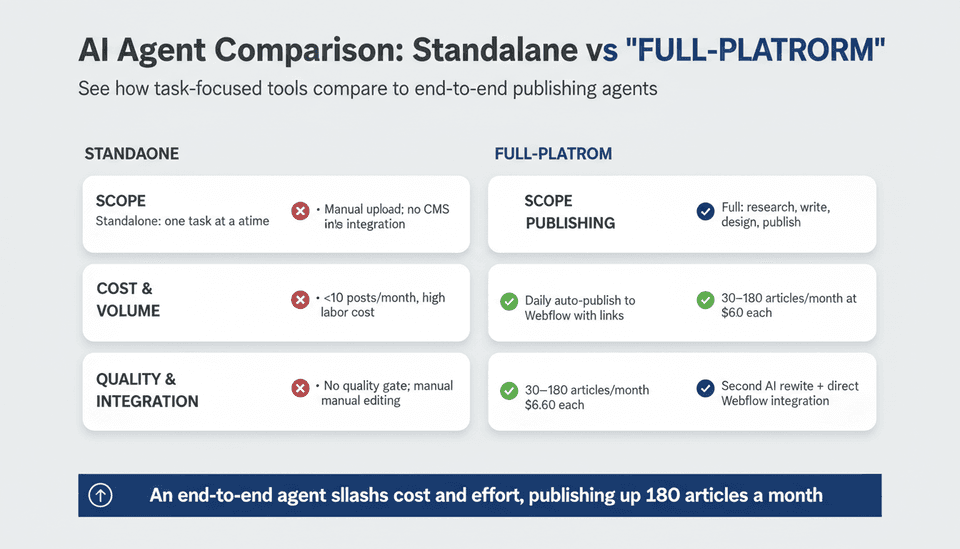
| Feature | Standalone Tools (e.g., Nightwatch, ChatGPT, Surfer) | Full-Platform Agent (e.g., Joyrise, SEO.ai) |
|---|---|---|
| Scope | Performs one task (keyword research, auditing, text generation) | Full pipeline: research, write, design, publish |
| Automated content publishing | No native CMS publishing; requires manual upload | Automatic daily publishing to Webflow (or similar) |
| Cost per article | Hard to quantify; often requires in-house labor on top of tool subscription | $6.60–$5.55/article (based on Joyrise plans) |
| Monthly volume | Limited by human speed; typically < 10 posts | 30-180 articles/month with no extra staff |
| Brand voice | Prompt-based, inconsistent unless heavily managed | Built-in brand voice modeling after site scan |
| Quality gate | None built-in; writer must edit | Second AI rewrite pass on Pro/Max tiers removes fluff and errors |
| Integration depth | API or manual export | Direct Webflow integration, internal linking, scheduled auto-publication |
| ** Risk free trial** | Freemium or demos | “Read first article before you pay” model on Joyrise |
Key Takeaways
- The best SEO AI agent is the one that automates your full content pipeline—research, writing, illustrations, and automated content publishing—not just a single task.
- An end-to-end platform like Joyrise can cut content production costs to roughly 1/10th of an agency while multiplying output, but strategic oversight must stay human.
- AI content is safe only if a quality check—whether a second AI rewrite or human review—is built into the workflow; raw, unedited drafts risk ranking drops.
- For Webflow users, a native integration that auto-publishes complete posts with branded images eliminates the manual labor that makes tool stacks inefficient.
- Test any candidate agent by seeing a fully published article on your own blog before committing—a trial without payment is the only reliable test.
Start your content automation with a risk‑free trial and see your first fully written, illustrated article published before you pay: get started with Joyrise.