 Joyrise
AI SEO Optimization: The Definitive Guide for 2026
 By Alexi · · Updated · 16 min read

On this page
- Executive Summary: What AI SEO Optimization Really Means
- The New Search Landscape: Where AI Fits in SEO
- Core Concepts: The Full Scope of AI SEO Optimization
- How an AI-Driven SEO Workflow Works: From Keyword to Published Article
- Options and Tradeoffs: AI SEO Tools, Agencies, and All-in-One Platforms
- A Practical Implementation Framework: Building Your AI SEO Engine
- Myths, Mistakes, and Limitations in AI SEO Optimization
- Frequently Asked Questions About AI SEO Optimization
- Key Takeaways
Executive Summary: What AI SEO Optimization Really Means
AI SEO optimization sounds like jargon, but for operators and finance leads it’s simple: using machine learning to do the repetitive, analytical parts of SEO—keyword research, content drafting, internal linking, meta tag generation, and performance monitoring—so your team can focus on strategy, brand voice, and decisions that actually grow revenue. It’s not a single tool or a magic autopilot; it’s a set of systems that, when wired together correctly, can produce publish-ready, SEO-native articles at a fraction of the cost and time of manual workflows.
Most current guides stop at high-level recommendations from Google or a bullet list of AI tools. This guide is different. It delivers a complete operational model for automating AI SEO optimization on Webflow—from site audit through automated publishing and measurement—so you can evaluate the concrete costs, quality controls, and ROI, not just theory.
A plain-language definition for operators and finance leads
AI SEO optimization means employing large language models (LLMs) and other machine learning systems to perform tasks that historically required an SEO specialist or content strategist: discovering keyword opportunities, grouping them into content clusters, drafting search-optimized articles, and then refining those pieces so they meet on-page standards. The output is not a final, humanless product, but a high-quality first draft that can be reviewed, adjusted, and published—often directly to your CMS.
If you run a Webflow site, the dream is a pipeline that goes from a competitive gap analysis to a published, illustrated article in hours, not days. That dream is now operational.
How this guide fills the gap left by existing resources
Existing resources often present AI SEO as a collection of Chrome extensions or they talk about eveything at once—content, technical SEO, backlinks—without showing how to string the pieces together for a specific content management system. This guide gives you that end-to-end view: the workflow, the economics, the quality checks that make AI content trustworthy, and a step-by-step implementation framework you can adapt for your Webflow blog. It also addresses the noisy debate about whether AI can replace human SEO expertise and whether automated backlinks are a safe shortcut, giving you a clear, reasoned stance.
The New Search Landscape: Where AI Fits in SEO
Search isn’’t just ten blue links anymore. Google’s AI Overviews, AI-generated answer boxes, and conversational follow-up questions are reshaping what it means to “rank.” AI SEO optimization adapts your content strategy to show up in those AI-powered features, not just in traditional organic results.
AI-generated search features and what they change about rankings
When a user asks a question and Google synthesizes an answer from multiple pages directly in the SERP, the click to a single source isn’t guaranteed—but being one of the cited sources is. Visibility shifts from “position1” to “be the source the AI trusts.” That means content must be exceptionally clear, factually airtight, and structured so AI models can parse it easily. Structured data, concise headings, FAQ sections, and entity-rich text all help.
Measuring visibility in AI search with Google Search Console
Google Search Console now reports impressions and clicks from AI Overviews and other generative features, separating them from traditional web results. Check the Search Console Performance report, filter by “AI Overview” appearance, to see whether your pages are being surfaced there. Without that data, you can’t know if your AI SEO optimization is reaching the new surfaces that matter.
Follow-up questions as an emerging SEO opportunity
As Search Engine Land highlighted in early November2026, every AI follow-up question is another SEO opportunity. Google’s conversational interface prompts users with next-step queries like “What are the costs?” or “How do I get started?” If your content answers those deeper, intent-driven questions, it can capture attention during a session that previously ended with a single click. This demands a content structure that anticipates the natural next questions—a pillar page supported by cluster articles that answer variations—so you can be the source for the whole journey, not just the first answer.
The market is reacting fast. On November6,2026, AI Search Engine Optimization announced a service combining proprietary rank intelligence with hands-on WordPress improvements, specifically mentioning visibility across AI-powered search (FinancialContent). While that announcement targets WordPress, the signal is clear: businesses are already seeking specialized AI SEO optimization services to capture traffic from generative AI interfaces, and the same principles apply to any CMS, including Webflow.
Core Concepts: The Full Scope of AI SEO Optimization
AI can intervene at almost every stage of a traditional SEO workflow, but understanding what’s real, what’s hype, and what’s risky is essential before building your stack.
AI for keyword research and intent clustering
Rather than pulling a flat list of keywords from a planner, AI can analyze thousands of search queries and group them by underlying intent—informational, commercial, transactional—and then suggest content clusters that build topical authority faster. Tools like Ahrefs, SEMrush, and dedicated AI-driven platforms now surface semantic clusters and show content gaps a competitor already covers. The result is a strategic keyword plan, not a spreadsheet of disconnected terms.
This shift is central to AI-driven keyword research: instead of spending hours sorting a CSV, you get a ready-to-execute content map. Combined with automated site scans, you can identify exactly which pages to create next to round out your topical authority.
AI for content creation and on-page optimization
AI content generation has moved well past generic “write an article about X.” Modern AI SEO tools produce researched, structured drafts with appropriate headings, internal links, meta descriptions, and even FAQ schema—all built in. However, the output varies: some tools are fine-tuned for factual accuracy and brand voice; others produce surface-level text that requires heavy editing. True AI content optimization means the system not only writes but also restructures the piece against SEO best practices: keyword placement, readability, entity density, and content depth.
For Webflow users, the gold standard is a pipeline where the AI generates content formulated for your site’s existing structure, matching your design patterns and CMS fields, so it publishes without reformatting.
AI for technical SEO and site audits
AI can crawl your site, flag broken links, generate canonical tags, and suggest schema markup at scale—tasks that would take a human days. Many automated SEO software tools now include AI-powered site auditors that prioritize fixes by impact. While technical SEO remains foundational, AI speeds the diagnostic phase dramatically.
The myth of the fully automated backlink
Some AI SEO vendors promote automatic backlink building as a core feature. Do not automate backlink creation at scale. Google’s guidelines explicitely warn that low-quality, machine-generated links can lead to manual penalties. AI can help identify relevant sites for outreach and even draft personalized pitches, but the actual relationship-building and link placement require human judgment. Any promise of “set and forget” backlinks should be treated as a risk, not a convenience.
There’s a broader debate here. Platforms like SEO.AI position their agents as a hands-off replacement for human SEO effort, while Google’s Search Essentials stress that human expertise and trustworthy content are non-negotiable, especially for YMYL (Your Money, Your Life) topics. In practice, the most effective approach combines AI’s scale with human strategic oversight. The machine drafts, the human decides direction, fact-checks critical claims, and ensures the brand voice isn’t lost. The goal is not to eliminate SEO strategists but to amplify them.
How an AI-Driven SEO Workflow Works: From Keyword to Published Article
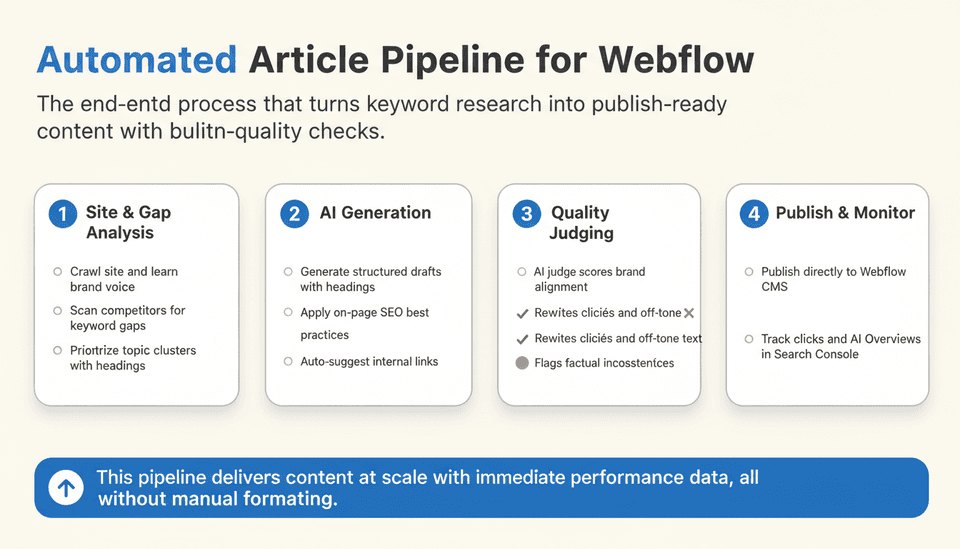
This is the operational core that existing guides miss—the actual, step-by-step pipeline that gets a researched, optimized, brand-aligned article live on your Webflow site with minimal manual intervention.
Automated site analysis and competitive gap discovery
The engine begins by crawling your existing Webflow site: it reads every page, learns your product language, brand tone, and the audience you already serve. In parallel, it scans competitor sites and identifies keyword clusters where you’re underperforming. The output is a prioritized list of article topics—not just keywords, but fully mapped articles with target primary and secondary terms, suggested headings, and internal link opportunities.
Tools like Joyrise (an SEO automation platform designed for Webflow) perform this deep scan automatically, but you can approximate it manually using a combination of Screaming Frog for crawling, Ahrefs for gap analysis, and a spreadsheet. The difference is time.
AI content generation with built-in on-page SEO
Once topics are queued, the AI generates a full article: H1, H2/H3 structure, body text, meta description, table of contents, and even branded header images. The generation is instructed to follow SEO best practices—keyword placement, natural internal links to related pages, and schema-ready formatting. Because the system knows your site structure, it can suggest which existing content to link to, building your internal link graph without human intervention.
For Webflow, the CMS fields (blog post title, author, featured image, summary, rich text body) map directly to the generated content, so publishing requires no additional formatting. The AI content optimization pass ensures the article meets on-page benchmarks before it ever reaches the CMS.
Quality judgment and brand-voice calibration at scale
This is the step most cheap AI workflows skip, and it’’s the reason much AI-generated content reads like a generic brochure. A second AI model—a quality judge—should automatically review the draft, flagging clichés, checking for factual consistency against your site’s existing knowledge, and rewriting sections that drift from your brand guidelines. This quality-control pass is what separates usable, publish-ready content from drafts that need a human to rewrite half the piece.
You set the parameters: preferred terminology, tone (casual, formal, technical), industries to avoid, and even the level of opinion allowed. The judge AI then scores the article and rewrites it until it meets your standard. Only after that pass should the article go to a human reviewer—saving substantial editorial time. Joyrise’s Pro and Max tiers incorporate this quality judge, but you can also build a similar safeguard with a chain of prompts across different LLMs if you have the technical resources.
Automated publishing to Webflow and Search Console monitoring
The final link: the platform pushes the approved (or human-reviewed) article directly to your Webflow CMS via API, publishing it live or saving as a draft depending on your workflow. All associated assets—images, alt text, internal links—are included. After publishing, the system can automatically add the URL to Google Search Console and begin monitoring clicks, impressions, and AI Overview appearances.
This closes the loop: you get not only content at scale but also immediate performance data tied to your SEO efforts, without manual dashboard assembly.
Options and Tradeoffs: AI SEO Tools, Agencies, and All-in-One Platforms
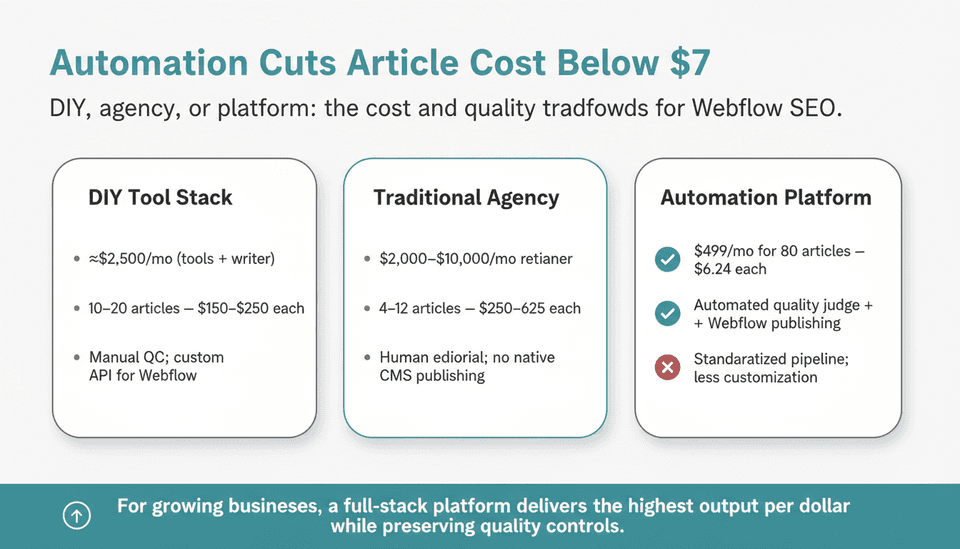
Businesses typically face three paths for AI SEO optimization, each with a different cost profile, level of control, and quality cadence.
DIY tool stacks vs. full automation: what you really need
A DIY stack might combine an AI writer (Jasper, Writesonic) with a content optimizer (Surfer SEO, Clearscope) and a publishing automation via Webflow’s API. You’ll need a developer to wire these together and a marketer to manage prompts and quality. The upside is full control; the downside is complexity and hidden labor costs.
A traditional SEO agency gives you strategy, human writers, and a managed service, but typically at a monthly retainer that covers far fewer articles. Then there are SEO automation platforms—purpose-built services that unify scanning, writing, optimization, quality control, and Webflow publishing. They replace the tool stack and the bulk of content production overhead.
Here’s how the three compare on key factors that matter for a Webflow content operation:
| Approach | Monthly Cost (US) | Articles per Month | Cost per Article | Quality Control | Webflow Integration |
|---|---|---|---|---|---|
| DIY Tool Stack | $300–$1,000 in tools + writer time (~$2,000+) | 10–20 (varies) | ~$150–$250 | Manual review, inconsistent | Requires custom API work; no guaranteed smooth publishing |
| Traditional SEO Agency | $2,000–$10,000 (typical) | 4–12 | $250–$625+ | Human editorial, brand oversight | None native; you handle CMS uploads |
| SEO Automation Platform (e.g., Joyrise) | $199–$999 | 30–180 | $6.24–$6.63 (Pro tier: $499/80) | Automated quality judge, style calibration | Built-in direct publishing to Webflow |
Costs for DIY and agency reflect market averages. Agency retainer ranges are consistent with data in SEO Company: What They Do, Cost, and AI Alternatives in2026.
The tradeoff is clear: a full-stack platform dramatically lowers cost per article while bundling quality-control mechanisms, but you trade some bespoke customization for a standardized pipeline. For most growing businesses, that tradeoff is easily worth it.
A cost model and ROI framework for AI SEO content operations
Understanding the cost of AI SEO versus the ROI of AI SEO demands more than a per-article dollar figure. You need to model the traffic lift against the fully loaded cost of each approach. Here’s a simple framework:
- Establish baseline content output: Say your manual operation produces4 articles/month at $500 all-in cost each ($2,000/month).2. Project AI-assisted output: With an automation platform at $499/month delivering80 articles, your effective cost per article drops to $6.24.3. Measure incremental traffic: Use Google Search Console to isolate traffic from the new AI-generated pages. Suppose those80 articles collectively attract500 additional monthly organic visits after6 months.4. Assign a value per visit: If your conversion rate from organic traffic is1% and average deal size $1,000, each visit is worth $10. Then incremental monthly value =500 x $10 = $5,000. Subtract the platform cost, and you’re looking at a net positive of $4,501/month—while your in-house team can focus on higher-order strategy.
This is a simplified model, but it forces a conversation about direct, measurable ROI of AI-generated content versus manual creation. The key is setting up Search Console tracking per URL batch so you can attribute performance, not guessing. Platforms like Joyrise that include integrated Search Console dashboards make this attribution straightforward; with a DIY stack, you’’ll need to build that reporting yourself.
A Practical Implementation Framework: Building Your AI SEO Engine
Switching to an AI-driven publishing pipeline isn’t just a tool purchase; it’s a process. Follow these steps, and you’’l have a repeatable engine in weeks, not months.
Step1: Audit your existing site and set SEO baselines
Run a comprehensive site crawl to identify technical issues (broken links, missing metadata, slow pages). In Google Search Console, note current click and impression levels, average position, and any AI Overview appearances. This is your pre-optimization baseline. If you’re using an SEO automation platform, the initial site scan will do much of this automatically; otherwise, tools like Sitebulb or ScreamingFrog plus GSC data will suffice.
Step2: Define target keywords, content cadence, and topical clusters
Use AI-driven keyword research to map out5–10 core topic clusters your site must own. For each cluster, list5–15 articles. Prioritize based on search volume and business relevance. Decide your publishing cadence: a moderate start is1–2 articles per day, scaling up as you validate quality. Tools like best AI SEO tools for small businesses can help with keyword discovery, but this step still needs human judgment to align with product positioning.
Step3: Configure AI generation parameters and brand guidelines
This is where you embed your voice. Define:
- Tone and grammatical style (e.g., “direct and authoritative, no buzzwords”)
- Terminology rules (product names, industry terms)
- Content structure preferences (always include a summary, always cite sources internally)
- AI quality judge thresholds (what score is “ready to publish” vs. “needs human review”)
Many AI SEO content generation tools let you save these as templates. Without this step, your output will sound generic, and the editorial load will remain high.
Step4: Automate publishing and create a measurement loop
Set up the integration to push approved content directly to Webflow. Then, each week, review the Search Console dashboard to see: new articles indexed, clicks, AI Overview impressions, and follow-up query patterns. Adjust your keyword clusters and article structures based on what’s gaining traction. This measurement loop is where the ROI becomes visible.
Integrating news-driven content for freshness and topical authority
Google values fresh, relevant content, especially for topics that change quickly. Add a news-driven layer: automatically monitor industry publications and use AI to draft short, timely articles that connect breaking news to your product’s perspective. For instance, if a new regulation affects your industry, a same-day article with your expert take can earn mentions and trust. Joyrise’s Pro and Max tiers include such a news-driven article feature, but you can also build a workflow with RSS feeds and a prompt chain if you have developer support.
Checklist for launch:
- Site crawl and baseline report saved.
- Topical clusters and article queue defined.
- Brand voice and quality judge parameters configured.
- Webflow CMS structure mapped (blog collection fields).
- API connection tested with one draft publish.
- Google Search Console daily monitoring set up.
- Weekly editorial spot-check of published articles (sample10%).
Myths, Mistakes, and Limitations in AI SEO Optimization
Myth: AI can fully replace human SEO strategists
AI cannot replace strategic thinking. It can execute and scale tasks, but it doesn’t understand your market shifts, customer pain points, or the nuance of brand positioning. A strategist still needs to set the direction, review the output, and intervene when the AI’s suggestions miss context. Treat AI as a senior copywriter that never sleeps, not as a replacement for editorial vision.
Mistake: Ignoring E-E-A-T signals in AI-generated content
Google’s emphasis on Experience, Expertise, Authoritativeness, and Trustworthiness doesn’t pause for AI. If you publish articles under a generic author name, lack citations, or never include real-world examples, you’ll struggle to rank for competitive terms. Always add human author bios, link to primary sources, and wherever possible, inject original data or experience to differentiate from templated AI text.
Limitation: Real-time news and fact-checking risks
AI models have cutoffs; they can’t independently verify breaking news. When you integrate news-driven content, you must have a human review step for sensitive or fast-moving information. A platform may draft a piece on a regulatory change within minutes, but publishing without verification risks misinformation that can damage your credibility and invite manual action.
Frequently Asked Questions About AI SEO Optimization
What is AI SEO optimization?
AI SEO optimization is the use of artificial intelligence—primarily large language models and machine learning algorithms—to automate or enhance the core tasks of search engine optimization, including keyword research, content creation, on-page tuning, technical auditing, and performance monitoring. It’s about making SEO processes faster, more scalable, and data-informed, while still relying on human oversight for strategy and quality. The goal is AI search visibility across both traditional rankings and AI-powered search features.
How can AI improve keyword research?
AI analyzes massive datasets of search queries and groups them by intent, uncovering patterns and content gaps that manual research might miss. It can generate thousands of long-tail keyword variations and cluster them into topical maps, saving hours. AI-driven keyword research also highlights emerging trends and competitor strengths, making your content strategy more proactive.
How can AI help with SEO content creation?
AI generates full-length, structured articles based on your keyword targets and style guidelines. It can produce first drafts in minutes, complete with headings, meta descriptions, internal links, and even original illustration suggestions. The real benefit is AI content optimization: the AI can compare its draft against top-ranking pages for a query and adjust depth, keyword usage, and readability, so the content is optimized before a human ever reads it.
How does AI help with on-page optimization?
AI tools can write optimized title tags and meta descriptions, suggest internal links, check heading hierarchy, and even evaluate content freshness—all automatically. Some deep on-page tools score your content against search engine signals and provide actionable recommendations to improve entity density, answer completeness, and featured snippet eligibility. They turn on-page optimization into a checklist that is executed by machines, leaving humans to handle only the creative exceptions.
How will AI influence SEO moving forward?
AI will continue to reshape the search results page itself, making generative AI search optimization a necessity. As Google and other platforms summarize answers directly, traditional click-through rates may shift, but visibility through citations will become a new currency. SEO strategies will evolve to prioritize content that AI engines can parse accurately, with more emphasis on structured, entity-rich, and authority-backed content. The follow-up question dynamic will force content to be more interconnected, anticipating the user’s next step.
Can AI replace human SEO specialists?
No. AI augments, it doesn’t replace. While it handles the heavy lifting of research, drafting, and technical checks, human specialists are still needed to set strategy, define brand voice, handle crisis moments, and ensure compliance with Google’’s quality guidelines. A fully automated system without human oversight risks low-quality content, brand damage, and potential penalties. The future is a partnership, not a replacement.
What are the best AI SEO content optimization tools right now?
The “best” depends on your stack and needs. For on-page content scoring, Clearscope and Surfer SEO are popular. Full-stack writing assistants include Jasper and Writesonic. For end-to-end publishing automation on Webflow, Joyrise is purpose-built to go from keyword to live article. For small teams, a mix of free and paid tools—like those covered in our Free AI Tools for SEO Optimization guide—can work, but require more manual stitching. Third-party tests, such as We Tested 15 Best AI SEO Tools, consistently rank tools that offer real-time on-page analysis as highly effective for content improvement.
How do AI SEO tools improve search engine rankings?
They improve rankings indirectly by enabling you to publish more high-quality, well-optimized content faster and at scale. AI SEO tools ensure each piece is built on solid keyword research, follows on-page best practices, and addresses user intent thoroughly. By automating technical checks and content scoring, they reduce the odds of publishing pages that underperform due to overlooked optimizations. The result is a broader, healthier content footprint that collectively earns more organic traffic.
Key Takeaways
- AI SEO optimization is a scalable content engine, not a human replacement; treat it as an amplifier for your strategy, with quality control baked in.
- The biggest operational gap in current guides is the end-to-end publishing pipeline for specific CMSs; a Webflow-focused workflow can cut cost per article below $10 while maintaining publish-ready standards.
- Comparing a DIY stack, agency retainer, and SEO automation platform reveals that automation platforms deliver the highest output per dollar while still supporting human oversight.
- Quality-control mechanisms like a second AI judge and human sampling are non-negotiable at scale; never skip them.
- Measure incremental ROI by tracking traffic from AI-generated pages in Google Search Console, including AI Overview appearances, not just traditional rankings.
For a complete, automated pipeline that plans, writes, quality-checks, and publishes daily SEO articles directly to your Webflow blog, sign up and read your first article before you pay.