 Joyrise
YouTube SEO AI: Optimize for AI Search & Retrieval
 By Alexi · · 16 min read

On this page
- Executive Summary
- What Is YouTube SEO AI?
- How AI Is Fundamentally Changing YouTube SEO
- Key Components of YouTube SEO AI
- AI Tools for YouTube SEO: Options and Tradeoffs
- Step-by-Step Implementation Framework
- YouTube SEO AI: Frequently Asked Questions
- Common Mistakes, Myths, and Limitations
- The Future of YouTube SEO AI
- Conclusion and Next Steps
- Key Takeaways
Executive Summary
YouTube SEO is no longer just about ranking in the platform’s own search bar. The same videos are now being surfaced by Google’s AI Overviews, ChatGPT, Perplexity, and other generative answer engines. Optimizing for these AI retrievals requires a fundamentally new approach — one that treats your metadata, transcripts, and even engagement signals as inputs for large language models, not just keyword-matching algorithms. This guide provides a strategic, data-backed workflow for YouTube SEO AI, moving beyond one-click generators to a continuous optimization cycle rooted in how AI systems actually find and cite video content. It covers how to optimize YouTube for AI search, how YouTube description optimization fuels YouTube AI retrieval, and how a 359% increase in daily AI retrievals was triggered by a simple description update — plus what ChatGPT needs from a YouTube video to cite it, and how to integrate AI-driven YouTube optimization with your broader analytics and content strategy.
| Area | What to do | Key detail from this article |
|---|---|---|
| YouTube description optimization | Rewrite each description as a standalone answer with a 2–3 sentence summary, 3–5 explicit entities, and descriptive timestamps | A single description update drove a 359% increase in daily AI retrievals (Peec AI via Search Engine Land) |
| Optimize YouTube for AI search | Treat metadata, transcripts, and engagement signals as inputs for retrieval models | AI retrieval depends on semantic relevance and entity clarity, not just keywords |
| YouTube AI retrieval | Make videos citable by ChatGPT, Google AI Overviews, and Perplexity | Transcripts and descriptions must be self-contained and entity-rich |
| Title and tags | Use titles that signal exact topic, scope, and question; reinforce entities with long-tail tags | Example: “Sourdough Bread for Beginners: Full Recipe and Starter Maintenance (2026)” |
| Audit and iterate | Run an AI audit; update descriptions, transcripts, and timestamps continuously | Descriptions under 200 words and missing timestamps are high-priority fixes |
| Tools | All-in-one platforms, specialized title generators (vidIQ, Hootsuite), or DIY GPT workflows | Human review remains essential |
| Measurement | Integrate YouTube Search Console and web analytics; track AI impressions over 30 days | No tool can guarantee rankings or AI citations |
What Is YouTube SEO AI?
Definition and Core Concepts
YouTube SEO AI is the practice of structuring, enriching, and linking your video content so that artificial intelligence systems — from YouTube’s own recommendation engine to external models like ChatGPT and Gemini — can accurately interpret, surface, and cite it. It combines traditional video SEO tactics (keyword-optimized titles, tags, descriptions) with techniques that make a video’s meaning explicit to a machine: transcripts that define entities, descriptions that answer specific queries, and metadata that signals authority and context.
An effective YouTube SEO AI strategy treats every video as a discoverable knowledge asset, not a static post. It feeds the algorithms that power search, recommendations, AI-generated answers, and even voice assistant responses. The goal is to appear wherever your audience is asking questions, whether that’s YouTube’s autocomplete, a Google AI Overview, or a ChatGPT thread.
Commonly Confused Terms
- YouTube SEO AI vs. AI video SEO: The former is the practice of optimizing content for AI discovery; the latter usually refers to using AI tools to perform SEO on videos. This guide covers both — the tools and the target.
- AI retrieval vs. traditional YouTube ranking: Traditional ranking depends on watch time, CTR, and keyword relevance. AI retrieval — the kind that powers ChatGPT citations and Google AI Overviews — depends more on semantic relevance, entity clarity, and the match between a video’s transcript and a question’s intent.
- Generative engine optimization (GEO): Extending SEO principles to generative AI outputs. YouTube SEO AI is a subset of GEO when you’re targeting citations in ChatGPT or Google’s AI Mode.
- AI YouTube title generator: A tool that uses a language model to produce video title suggestions. It’s a single component of the broader YouTube SEO AI workflow.
How AI Is Fundamentally Changing YouTube SEO
The Rise of AI Retrievals (359% Increase)
On November 7, 2026, Search Engine Land reported on an experiment by Peec AI that revealed a stunning metric: YouTube videos with updated descriptions experienced a 359% increase in daily AI retrievals. The study didn’t just highlight the lift; it proved that small, deliberate changes to how you structure a video’s description can dramatically alter its visibility inside AI-powered search experiences. Traditional SEO wisdom holds that descriptions help YouTube’s algorithm understand what a video is about. But this experiment showed that descriptions now serve a second, arguably more important role: they are direct prompts for retrieval-augmented generation systems.
The implication is clear. If your YouTube descriptions are thin, keyword-stuffed, or lifted from your website’s blog post, you’re leaving AI discovery on the table. The retrieval bump came from descriptions that summarized the video’s key points, defined the entities discussed, and directly addressed the kinds of questions a user might ask a chatbot.
ChatGPT and Generative AI Citations
A guide published on November 10, 2026, by Practical Ecommerce highlighted a parallel shift: optimizing YouTube videos for ChatGPT is now a practical necessity. YouTube videos already rank well in Google’s traditional search results, and that ranking strength carries into Google’s AI Mode and other generative experiences that pull from the same index. But ChatGPT doesn’t search the web in real time unless it browses, and when it does, it needs clean, structured information to produce a reliable citation.
For a YouTube video to be cited by ChatGPT, the system must be able to extract a self-contained answer from your content — typically via the transcript, a well-crafted description, or a timestamped segment. That means your video SEO strategy must now include creating descriptions that function as concise, factual summaries capable of standing alone as an AI-generated answer. The Practical Ecommerce piece underscores that the era of treating YouTube descriptions as afterthoughts is over.
Google’s AI Overviews and Brand Knowledge Panels
The impact extends beyond citations. Google’s AI Overviews — and increasingly, brand-specific AI-generated panels that replace traditional knowledge panels — draw heavily from video content, especially when that content is well-structured and authoritative. A video that clearly explains a product, defines a term, or demonstrates a process can become the de facto source block in a Google AI Overview. To capture that real estate, you need to apply the same retrieval optimization techniques that work for ChatGPT: clear entity mentions, descriptive timestamps, and aligned metadata across your video, your channel, and your website’s structured data.
Key Components of YouTube SEO AI
Title and YouTube Description Optimization
Titles are no longer just clickbait or keyword containers. For AI retrieval, a title should signal the exact topic, its scope, and, where possible, the question it answers. Instead of “How to Bake Bread,” an optimization-ready title might be “Sourdough Bread for Beginners: Full Recipe and Starter Maintenance (2026).” This gives an AI model immediate context about the content’s focus and level.
YouTube description optimization has become the highest-leverage activity. As the Peec AI data suggests, the description is where you supply the semantic richness that retrieval models need. A strong AI-optimized description includes:
- A 2–3 sentence summary that could double as a standalone answer.
- 3–5 key entities mentioned explicitly (people, products, concepts, locations).
- Timestamps with descriptive labels (not just “0:00 Introduction”) that break the video into answerable segments.
- A resources section linking to primary sources, because AI models weigh outgoing links as authority signals, similar to how they assess web pages.
- A call to action that reinforces the video’s purpose, but placed after the informational content, not before.
An AI YouTube title generator can help brainstorm variations, but human judgment is critical to avoid generic or misleading phrasing.
Tags, Hashtags, and Category Selection
Tags and hashtags still matter for YouTube’s internal discovery, but they now serve a secondary function: entity reinforcement. When you use tags that align with the entities you’ve named in your title and description, you’re strengthening the machine-readable signals about what the video is about. Category selection matters more than many creators think, because Google’s AI Overviews may use it to contextualize the video alongside other sources.
A YouTube keyword research tool can surface high-volume search terms that you should include in this metadata, but the real breakaway tactic is to also include low-volume, ultra-specific terms — the long-tail phrases that a retrieval model would use to match a nuanced query. For instance, tagging “sourdough discard recipes” and “high-hydration dough handling” in a bread video increases the likelihood of a citation when a user asks ChatGPT for “ways to use leftover sourdough starter.”
Transcripts, Closed Captions, and Entity Recognition
AI models consume text. If your video lacks a high-quality transcript or closed captions, it’s largely invisible to generative AI. An automated transcript provides the raw material that retrieval systems use to find the exact moment your video addresses a query. But even auto-generated transcripts need post-processing: adding correct spelling for names and technical terms, inserting chapter headings, and removing filler words can improve the accuracy of entity recognition.
Newer AI tools for video SEO can now automatically identify entities within a transcript and suggest how to link them to knowledge graphs, further boosting your content’s authority. If your video interviews a guest, for example, ensuring the transcript correctly spells their name, title, and company every time they’re mentioned can pay off when a model looks for an expert source on that topic.
Thumbnails and Engagement Metrics in AI Models
Thumbnails are not directly read by large language models, but engagement metrics — driven in large part by thumbnail click-through rates — are a signal that YouTube’s own recommendation system uses to judge video quality. High engagement increases a video’s internal ranking, which in turn improves its chances of being surfaced by Google’s index and, subsequently, by AI Overviews. So while a thumbnail isn’t a textual input, it’s an indirect lever for AI visibility: a video with a higher watch time and lower bounce rate is a stronger candidate for citation.
AI Tools for YouTube SEO: Options and Tradeoffs
All-in-One AI SEO Platforms
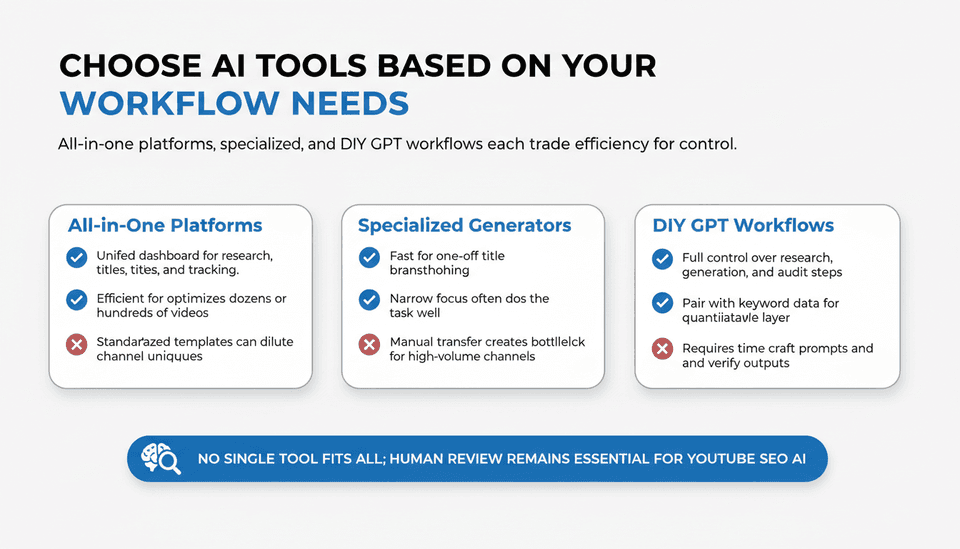
Platforms that bundle keyword research, title generation, tag suggestion, and performance tracking offer a unified dashboard for managing YouTube SEO AI at scale. They’re efficient for teams that need to optimize dozens or hundreds of videos monthly, but quality varies. The tradeoff is that these tools often rely on standardized templates that can produce same-sounding metadata across channels, diluting uniqueness. For a deeper look at the landscape, see our YouTube SEO Tools: A Strategic Guide for 2026, which breaks down the options by feature set and pricing.
Specialized YouTube AI Generators
A dedicated AI YouTube title generator — such as those from vidIQ or Hootsuite — focuses on a narrow task and often does it well. These tools are faster for one-off title brainstorming, but they typically don’t tie into a broader SEO workflow. You’ll end up manually transferring title suggestions into YouTube Studio, then doing description and tag work elsewhere. For a creator publishing infrequently, this is a reasonable tradeoff; for a business with a high-volume channel, the lack of integration becomes a bottleneck.
Do-It-Yourself AI Workflows with GPT Models
Many practitioners now build custom ChatGPT YouTube SEO workflows that combine research, generation, and audit steps. For example, you can prompt ChatGPT to analyze a competitor’s top five videos, extract their entity clusters, and then generate a description template that targets similar queries without copying. This approach gives you more control, but requires time to craft reliable prompts and verify outputs. As covered in our ChatGPT SEO Workflows: The Complete 2026 Guide, the key is to treat the model as a collaborative tool, not a final editor. Pairing GPT models with a specialized YouTube keyword research tool for search volume data adds the quantitative layer that pure AI generation lacks.
Step-by-Step Implementation Framework
1. Audit Your Existing Video Library with AI
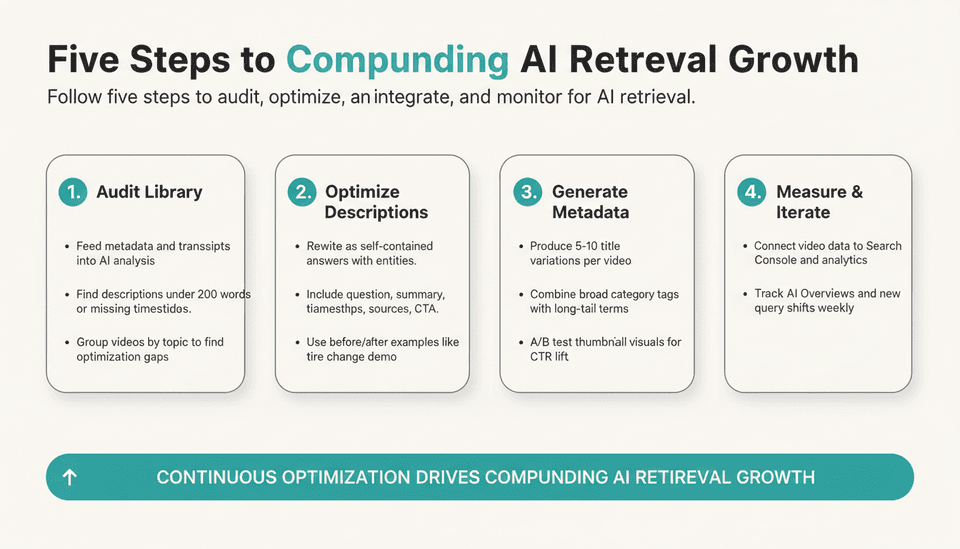
Begin by feeding your channel’s existing metadata and transcripts into an AI analysis, either through a platform or a custom script. Look for videos with:
- Descriptions under 200 words
- Missing timestamps
- Transcripts with garbled entity names
- Low click-through but high retention — a sign that the content is strong but the packaging is weak
- Videos that target the same query but cannibalize each other
Use AI to group videos by topic and identify gaps where you have content but no optimized metadata. This audit sets a baseline and reveals which videos are most likely to respond to description rewrites — the quickest way to replicate the 359% retrieval lift seen in the Peec AI study.
2. Optimize Descriptions for AI Retrieval
For each priority video, rewrite the description using the framework described earlier. Target a structure that an AI model can parse as a self-contained answer. Include the primary question the video addresses in the first line, followed by a summary, timestamps with descriptive labels, linked references, and a call to action.
A practical worked example:
Before:
In this video, we show you how to change a tire. Subscribe for more car tips!
After:
This video demonstrates how to safely change a flat tire on a passenger vehicle, covering tools needed, wheel removal, and spare installation.
0:00 – Required tools and safety precautions
1:10 – Loosening lug nuts and lifting the car
3:05 – Removing the flat tire and mounting the spare
5:20 – Tightening and final checks
Sources: National Highway Traffic Safety Administration guidelines, AAA driver education manual.
Subscribe for weekly vehicle maintenance tutorials.
This version immediately tells retrieval models that the video answers the query “how to change a flat tire” and provides the exact timestamps for each sub-task.
3. Generate Titles, Tags, and Thumbnails at Scale
Once descriptions are in place, use an AI YouTube title generator to produce 5-10 title variations for each video. Evaluate them manually based on clarity and specificity, not clickbait appeal. Apply the same discipline to tags: combine broad category tags with precise long-tail terms. For thumbnails, if your volume is high, consider using AI to analyze which visual elements (faces, text overlays, colors) correlate with high CTRs on similar channels, then A/B test variations.
4. Integrate with Web Analytics and Search Console
A YouTube video is rarely an isolated asset. It lives on your channel, is embedded in your blog posts, and often drives traffic to your website. To fully operationalize YouTube SEO AI, connect your video performance data to Google Search Console and your site analytics. Platforms like Joyrise, which automate blog content and SEO monitoring for Webflow-hosted sites, can serve as a data hub: you can track which videos are surfacing in AI Overviews for your target keywords and then produce supporting articles that reinforce those topics. While Joyrise is built for written content automation, the same AI-driven analytics approach applies to any business wanting to close the loop between video discovery and on-site conversion.
5. Monitor and Iterate Using AI-Driven Insights
Implement a weekly check using AI-powered trend alerts. Watch for:
- New queries appearing in YouTube Search Console that your description didn’t explicitly target
- Shifts in which timestamps are being surfaced in Google AI Overviews
- Changes in competitor video structure
Use these insights to update descriptions, timestamps, and tags continuously — not as a one-time project. This ongoing optimization cycle is what separates channels that see compounding AI retrieval growth from those that plateau.
YouTube SEO AI: Frequently Asked Questions
What is the primary function of a YouTube SEO AI tool?
A YouTube SEO AI tool automates the research, generation, and analysis of metadata — titles, descriptions, tags, transcripts — to improve a video’s discoverability in both traditional YouTube search and AI-driven retrieval systems. The primary function is to structure explicit, machine-readable information that answers user queries at scale, far faster than manual methods.
Who can benefit from using YouTube SEO AI?
Anyone who publishes video content with a goal of audience growth, brand visibility, or lead generation: YouTubers, marketing teams, educators, news outlets, and product companies. The greatest benefit comes to channels that have existing video libraries and are now seeing traffic from Google AI Overviews or ChatGPT, because they have the most to gain from retroactive optimization.
How does YouTube SEO AI save time for users?
Instead of manually researching keywords for every video, writing descriptions from scratch, and cross-checking timestamps, an AI-assisted workflow can generate multiple optimized versions in minutes. Automated YouTube SEO tools can also perform bulk audits and updates across an entire channel, tasks that would take weeks manually. The time saved shifts from execution to strategic oversight.
What kind of insights does YouTube SEO AI provide beyond basic generation?
Beyond generating metadata, YouTube SEO AI can reveal content gaps by comparing your video library to competitor topic clusters, identify which entities you’re failing to mention in your transcripts, and predict which videos are most likely to earn AI citations based on retrieval patterns. These insights inform not just metadata tweaks but future content decisions.
How do I implement YouTube SEO AI into my existing workflow?
Start with a small batch of high-potential videos — those that already have decent watch time but low AI visibility. Audit them with AI, rewrite descriptions for retrieval, update transcripts, and then track AI-driven impressions via Search Console over 30 days. Once you’ve validated the uplift, expand to your full library and integrate AI optimization into your publishing checklist, so every new video goes live with AI-ready metadata. Build a feedback loop that feeds performance data back into your content planning.
Will using YouTube SEO AI guarantee success for my videos?
No. AI optimizations improve the discoverability and citability of your content, but success still depends on video quality, audience engagement, and topic relevance. Over-optimizing without substance — for example, cramming a description with keywords but delivering a poor video — can actually hurt retention and rankings. AI is a force multiplier for good content, not a substitute for it.
Common Mistakes, Myths, and Limitations
The 'Set It and Forget It' Fallacy
The biggest mistake is treating YouTube SEO AI as a one-time setup. AI retrieval algorithms evolve, and your competitors are constantly updating their metadata. A description that was perfectly optimized six months ago may no longer target the specific phrasings that AI Overviews now prioritize. Continuous monitoring and iteration are non-negotiable.
Over-Reliance on AI Without Human Review
AI can hallucinate facts, misinterpret video context, and suggest titles that are technically accurate but tonally wrong for your audience. Every AI-generated element should pass through a human quality check. This is especially critical for descriptions that cite sources — the model may invent references. As a recent Search Engine Land piece on November 7, 2026, highlighted, LLMs can produce convincing but false explanations, making SEO verification a crucial step in any AI-driven optimization.
Guaranteed Rankings and Other Unrealistic Promises
No tool or technique can guarantee a top YouTube ranking, an AI Overview citation, or a ChatGPT mention. The algorithms are opaque and influenced by hundreds of signals. Treat claims of guaranteed results as red flags. The most reliable path is to methodically improve the clarity, structure, and factual accuracy of your metadata so that when retrieval models look for the best answer, your video is the most coherent candidate.
The Future of YouTube SEO AI
The next phase will see tighter integration between video content and large language models. Expect platforms to prioritize videos with structured markdown in descriptions, because it’s easier for models to parse lists and tables. YouTube’s own AI features — like automatic chaptering and AI-generated summaries — will become both opportunities and competition: they can surface your content, but they also risk summarizing it so well that a viewer never clicks. The channels that succeed will master the balance between being easily cited and remaining essential to watch.
We’ll also see more rigorous testing of AI retrievals, similar to the Peec AI experiment, making it easier to quantify the ROI of optimization efforts. As Google’s AI Overviews and ChatGPT both continue to expand their reliance on video citations, YouTube SEO AI will cease to be a niche practice and become a standard component of every serious content team’s strategy. For a broader look at how AI agents are reshaping search, see The Definitive Guide to SEO AI Agents (2026).
Conclusion and Next Steps
YouTube SEO AI isn’t about chasing a new tool or trick. It’s about updating your entire optimization workflow to meet AI systems on their terms. Start by auditing your library, rewriting descriptions for retrieval, cleaning up transcripts, and connecting your video performance data to your overall SEO analytics. The 359% retrieval increase from description updates isn’t an anomaly — it’s a signal that small, precise changes compound into significant AI visibility gains.
Key Takeaways
- A simple description rewrite can drive a 359% increase in daily AI retrievals, making it the single most impactful YouTube SEO AI action you can take today.
- Optimizing for AI retrieval requires more than keywords: your descriptions must function as standalone answers and your transcripts must be entity-rich and clean.
- Treat YouTube SEO AI as an ongoing cycle of audit, optimize, monitor, and iterate — not a one-time setup.
- Human review remains essential; AI-generated metadata can miss context, invent details, or dilute your brand voice.
- Integration with web analytics and Search Console turns AI-driven YouTube optimization into a measurable business lever, not a guessing game.
For brands ready to apply these same AI-driven principles to their written content, Joyrise automates your blog’s SEO, from research to publishing.